
SPH Consulting · 2025-11-02 · 28 min
Key moments - from our scoring
Substance score
52 / 100
Five dimensions, 20 points each
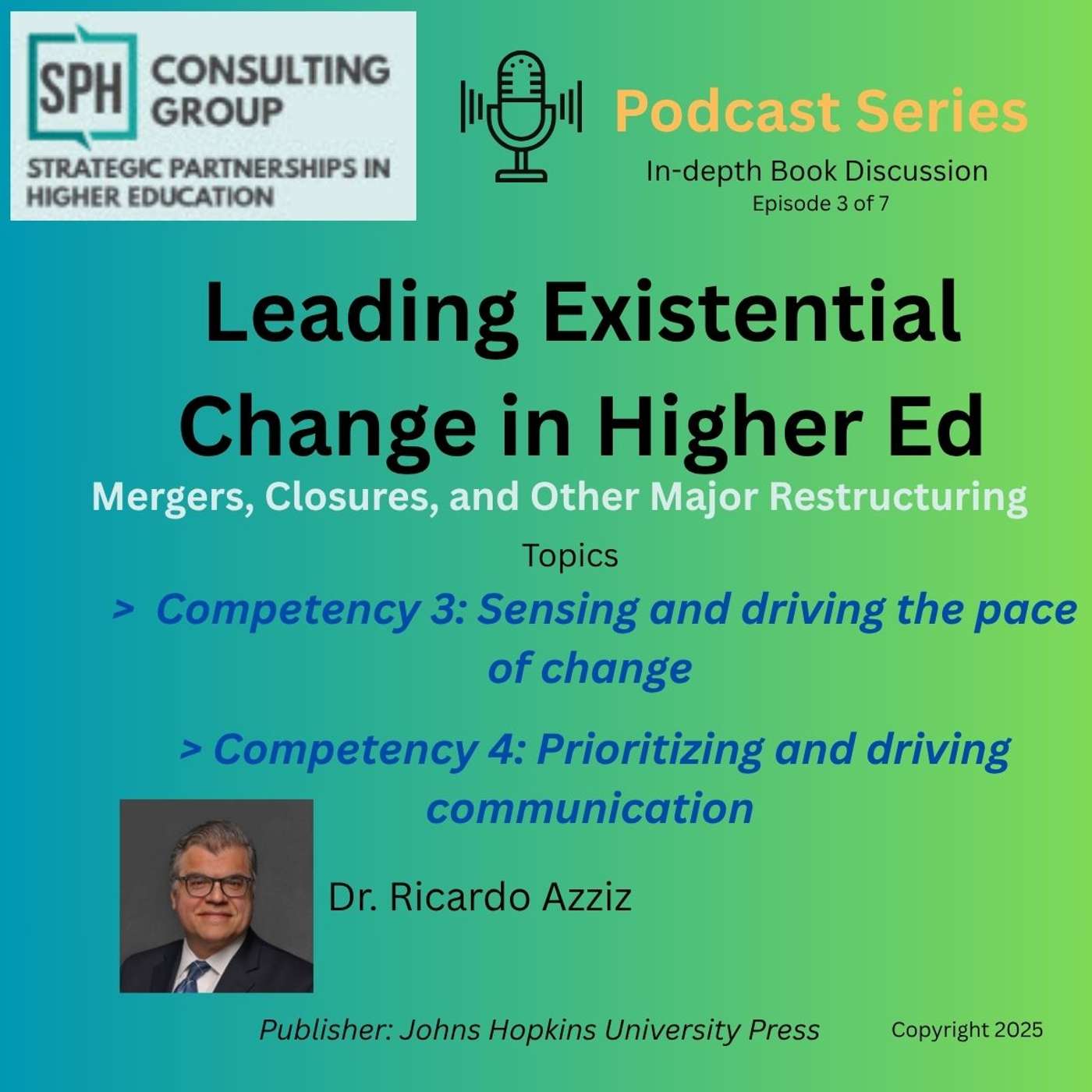
Dr. Ricardo Azziz and Gary Stocker examine how seven leadership competencies for managing existential change were derived through structured interviews with higher education leaders, manual thematic analysis, and AI review of merger case studies. The episode contrasts risk aversion in higher education - where traditions, alumni loyalty, and incremental change preferences create institutional inertia - against other industries where mergers are treated as natural business processes. The Connecticut State Colleges and Universities case demonstrates how significant opposition, accreditation rejection, and personal threats to leadership require extraordinary courage to persist. The Hope International University and Nebraska Christian College merger illustrates that successful consolidations demand multifaceted strategy addressing finances, enrollment, branding, mission alignment, and student welfare - not just geographic proximity or financial metrics. Azziz emphasizes that bigger institutions generally perform better financially, making mergers critical for smaller and faith-based institutions' survival, yet mergers alone cannot solve demographic decline without market analysis and strategic positioning.
The research combined structured interviews with higher education leaders (manually analyzed by theme and cross-checked with AI), analysis of multiple merger case studies, and firsthand experience of co-authors who had executed mergers themselves.
Higher education is tradition-bound, creates and preserves institutional heritage through alumni and athletics, employs leaders with long tenures in the sector, and has experienced prolonged success that discourages rapid change - unlike industries where M&A is a standard growth strategy.
The merger to consolidate multiple community colleges into one institution with multiple branches faced significant faculty opposition and initial accreditation rejection, but leadership persisted through new leadership transitions; it demonstrates the extraordinary courage required to navigate contentious institutional resistance.
No; while mergers may provide new brand positioning, programs, and marketing buzz, they cannot change the demographics of surrounding communities - institutions must combine merger strategy with market analysis and deliberate boutique or expansion positioning to address enrollment decline.
Operational envisioning goes beyond stating a vision to describing how it will actually be executed; Jefferson and the founding fathers didn't just envision democracy - they created constitutional operations to implement it, a model leaders must replicate when describing how merged institutions will actually function.
Our reviewer’s read on each dimension, with quotes from the episode.
The episode covers conceptual ground on risk aversion in higher ed, mergers, and operational envisioning, but much of it consists of restating the book's framework rather than drilling into novel mechanisms or surprising data. The discussion of why higher ed resists change more than other industries has merit, but lacks concrete examples beyond Connecticut. Significant portions are filler (technical difficulties, rereading passages, soft transitions).
leaders who have manage higher education institutions tend to have even a greater risk aversion than almost any other sector that we have studied
you actually have to think about the whole strategic process around a major restructuring event, whether it's a closure or an acquisition or a merger or consolidation
The core observation that higher ed is tradition-bound and risk-averse relative to other sectors is somewhat original, but the framing relies heavily on evolutionary psychology and generic change-management concepts. The 'seven competencies' framework appears formulaic. The Thomas Jefferson analogy for operational envisioning is a creative touch but feels tangential and underdeveloped. Most of the substance recycles concepts from the book itself.
higher education, you know, we are super tradition bound. In fact, we really build tradition
leaders who manage higher education institutions tend to have even a greater risk aversion than almost any other sector
Dr. Ricardo Azziz brings legitimate credentials as a former college president and book author with research methodology (interviews, case study analysis, co-author collaboration). He demonstrates operational experience with mergers. However, the episode format is a book promotion with a co-author (Gary Stocker), which reduces the guest caliber - this is not independent expert vetting but collaborative author discussion. His insights are credible but not from someone currently executing M&A at scale.
I was the lead author, but, know, we do have other co-authors of the book and other contributors, including yourself
we originally So the way we do our work, both in the first book as well as in second book, is that we perform a fair amount of interviews, right, of leaders
The Connecticut State Colleges and Universities case study is named and discussed, and the Hope International/Nebraska Christian merger is mentioned. However, details are thin: no enrollment figures, financial metrics, timelines, or outcome measures are provided. The Connecticut example mentions accreditor rejection but not specific costs or student impacts. Most claims remain at the principle level without supporting numbers or specific evidence.
There were a large number of faculty opposition to this
the accrediting agency rejected the initial application for this
The host (Stocker) reads passages from the book and asks open-ended follow-up questions, but rarely pushes back or challenge claims. Questions are mostly confirmatory ("Am I right?", "correct me if I'm wrong"). There are long passages where Azziz elaborates without interruption or probing for specifics. The technical difficulties derail momentum. No genuine disagreement or sharp follow-up sequences occur. The dynamic feels more like collaborative book review than probing interview.
Comment on what makes sense about that and what doesn't make sense about
And then you mentioned that think many will have to ponder seriously
Computed from the transcript - who did the talking, and the words that came up most.
Here are the questions Dr. Ricardo Azziz addressed during this podcast episode. 1. You list 7 critical competencies for BSC. Where did they come from? 2. We talked about how you used case studies throughout the book in our first podcast. Let’s talk about the one you use here: Connecticut State Colleges and Universities. I remember reading a lot about this and it was a contentious process. Step us through the highlights and lowlights. Lessons learned: “Extraordinary courage is required to face continued challenges”. Put that into context for us and share how you saw that at CSCU. 3. Following up on that, let's talk a little about uncertainty and risk aversion in higher education What about major change in higher education? Step us through the major differences of M&A in higher education and other industries. 4. P. 81: “The degree of risk aversion in higher education is so high that it borders on the impossible.” If we accept that statement, I contend that some serious financial set of catastrophes are needed to move higher education toward consolidation in the form of M&A. Am I right or wrong? 5.
Transcribed and scored by The B2B Podcast Index.
Gary Stocker (00:01.586) Welcome back to the multi podcast discussion of the new higher education book, Leading Existential Change in Higher Ed, Mergers, Closures and Other Major Institutional Restructuring. Hi everybody, I'm Gary Stocker, back again, founder of College Viability. Author and physician and former college president Dr.
Ricardo Aziz wrote the book and he and I are doing a series of seven podcasts that we'll use to review the book in more detail. And if you have questions about either today's podcast or future podcasts on this book, send them to gary at college viability. That's one word, gary at college viability.com.
Today we're looking at two of the competencies that Dr. Aziz created for mergers and acquisitions. The first is comfort managing significant change, uncertainty and risk. And the competency number two in chapter five in the book is all inclusive, operational, envisioning and Dr.
Aziz. You list seven competencies for big scary change. We talked about that last week. Big scary change, where did those competencies come from?
Ricardo Azziz (01:09.506) That's a good question. Just to clarify, thank you for having me on this podcast. But, you know, I was the lead author, but, know, we do have other co-authors of the book and other contributors, including yourself.
So I have to recognize everybody's effort on this book. was a labor of love, right? It was a book in probably took us about five years from conception to production. So what's interesting is that we originally So the way we do our work, both in the first book as well as in second book, is that we perform a fair amount of interviews, right, of leaders, you know, and it's a structured interview, it has structured questions, and then we manually assess those responses, right, the responses that were given to us.
Sometimes we take notes while the interview is ongoing, but sometimes... Leaders don't feel comfortable being recorded. In other cases, we do record them and transcribe them that way. And then we analyze them manually, right?
By theme, thematically analyze them, and also using AI. So we do both, right? Just to see if AI identifies anything particular in large language model AI, to see if they identify other themes. In general, it's interesting.
Not really. They've not... The AI is very similar to what we do manually. And so that's how we begin to identify major themes of our discussion.
We ask questions like, what are the major issues, et cetera, from doing it? We also analyze many mergers. We have some of the case studies in the book. But again, there many other case studies that we have actually looked at that we are familiar with.
And also from that data, we also extract some elements that will inform us around what we think is essential, right? And then finally, we use our own experience. We sort of use our own experience. All the co-authors of the book had actually done the mergers, carried them forward, understood them.
And so that also helped provide some perspective on the responses that we were getting and so on. Ricardo Azziz (03:29.623) So that's sort of the general method, if you would, for us extracting, in this case, seven essential elements of leadership, right? But again, in our first book, it was seven essential elements for the success of a merger.
And, you know, I can't tell you why it turned out to be seven. We didn't force that. We started out with eight or nine and realized that actually, you know, one or two of those were actually sub-parts of others, right? They were not really...
separate and so on and so forth. So we ended up with this magical number of seven. We didn't intend to at all, but it's the way the data, you know, laid out. Gary Stocker (04:13.
286) Interesting. Seven two times, that's got to be a lucky number of some sort. Ricardo Azziz (04:17.912) You know, I think it has to do with, you know, there's lots of sevens, right?
Threes and sevens and so on. So it almost seems like, you know, even numbers don't always come out in these things just because for some karmic rule of some sort. Gary Stocker (04:39.87) So Dr.
Zs, we talked in the first episode about how you used case studies throughout the book. And let's talk about the one you used in this chapter four. You used Connecticut state colleges and universities. And I'll share, I remember reading a lot about this as it was happening over the last couple of years.
And it was, to be nice, a contentious process. So if you would just from your experience and observation, step us through the highlights and no lights of that particular merger. Ricardo Azziz (05:09.336) So I think that you're right.
mean, I think the merger itself was contentious. Again, the objective was to try to create one college, one community college with multiple branches rather than multiple community colleges. Connecticut was dealing with both financial and other issues around access of students and so on. And I think that the idea of merging all community colleges into one with different branches certainly would streamline the uniformity of student access, right?
It would also decrease administrative burden, would create a uniform platform. There were a number of reasons that were expressed why this would be an improvement. And so it was, it took a lot of work. There was a large number of faculty opposition to this.
Not necessarily surprising, but it was certainly contentious. And then of course the accrediting agency rejected the initial application for this and that was also a major blow to leadership. and it sort of seemed to justify a lot of the negativity around this. to be fair, leadership persisted moving forward and even under new leadership and then eventually the plan was approved.
There's still a lot of discussion and contention as to whether this has improved things. Unfortunately, mergers really don't prove themselves for about a decade, right? I mean, it's not... I think that people who are looking for instant gratification, instant results, don't understand the complexity of a merger and don't understand the complexity of merging different cultures.
In this case, the cultures would remain somewhat distant because the campuses would remain separate. But again, the administration, the policies and so on would become much more uniform from that point of view. Ricardo Azziz (07:25.87) So we felt that it was a good case study.
It's a case study of dealing in opposition, right? Significant opposition and sort of spoke to leadership in this setting. Gary Stocker (07:41.311) And one of the conventions that you use in the book is lessons learned.
And on page 75, box 4.1, I want to pick one of those for the merger lesson learned with Connecticut State Colleges and Universities. And you mentioned that extraordinary courage is required to face continued challenges. And that was a theme that came up in our first podcast episode as Ricardo Azziz (08:03.
118) Yeah, I must say that for leaders who are actually undertaking these mergers, particularly as they get more contentious, you know, it takes a lot of courage. mean, there are threats of physical violence. There are threats to your family around this. There are unhinged communications coming in, anonymous threatening letters.
So it actually gets very personal. And it gets very personal because, you know, in the end, whether the decision was made by the person actually executing the merger or by others, you know, there is one person that is at the tip of the spear, right? And it usually is the chief executive of the institutions in question, right? And that's the president or chancellor, however you want to call them.
And those people are at the tip of the spear and opposition sees them as the target, right? If we can topple the president or the chancellor, we can then stop this process. That's sort of the general outline. In fact, it's the general outline for opposition to almost everything that we see, right?
I mean, it becomes very personal very quickly and it takes a lot of courage to stay in the bus. to understand the vision, to try to continue to sell the vision despite a lot of challenges and opposition. Gary Stocker (09:36.831) I'm going to talk about uncertainty and risk aversion.
And of course, that is universal. That's not just in higher education. That's in many places. I'm going to read from the book.
I'm going to read a paragraph on page 77 in the book, Leading Existential Change in Higher Education. And you write, Dr. Aziz, few of us like change, not even those who claim to be change agents. We prefer a life that is predictable, to come to the same home, to the same partner.
to the same pleasures and even to the same food. In other words, we prefer to know what the challenges will be and to be prepared for these. And even we want our surprises and unexpected events to be well, you say, expected. This risk aversion is, in my mind, and correct me if I'm wrong, is particularly acute and chronic in higher education.
If you would step us through the differences you see in risk aversion, in higher education and maybe that with other industries. Ricardo Azziz (10:43.496) I'm sorry, Gary, you actually faded into there, so, for a minute. So you may want to repeat that question.
Gary Stocker (10:53.704) When did I start fading? Ricardo Azziz (10:57.093) some point where you said, and you're, don't know if it's my bandwidth or yours, because you're sort of, hmm.
having difficulty. And I'm in it out as well, so let's see something. I'm going turn off my camera. Gary Stocker (11:08.
926) Yeah, you internet too. Gary Stocker (11:14.622) I'm gonna turn my camera off. I'm gonna turn my camera off.
Ricardo Azziz (11:20.32) And so I think you faded off as you were going to ask me the question. So you may want to just repeat the question. Gary Stocker (11:26.
404) Did the paragraph come out though? Ricardo Azziz (11:28.162) I think the paragraph came through, yeah. Gary Stocker (11:30.
952) So uncertainty and risk aversion is everywhere. And if you would step us through the major differences between mergers and acquisitions in higher education and other industries, specifically in the context of that risk aversion and uncertainty. Ricardo Azziz (11:47.375) So I think we have to understand that root conversion is a natural human process, right?
I mean, we have grown and evolved, right, from our origins some a million years ago or so in our own species, the homo species, and of course, before that, in whatever ancestors we had, really to fear the environment, to be careful of the environment, to actually... you know, have this fight or flight kind of reaction, right? And so we generally would rather flight, right? We'd rather run away than actually fight if we have that opportunity, right?
And so risk aversion is a natural thing. But I do think that we have to be rational about our evolutionary instincts, right? We have to actually understand where they come from and then control them. Now, if we look, for example, at other industries, know, other industries very often, they are actually designing their company to be acquired.
They actually wanted to be acquired. I'm on the board of several companies and objective is really to be acquired by somebody. So we want that to happen, right? Merging and acquisition is a natural process that occurs.
Not everybody in other industries wants to be acquired. You can see this from the various fights that are occurring, whether it's theater, theater chains or cinema or, you know, or AI, et cetera. mean, you know, everybody, know, depending on who it is, would some people would like to remain independent. But but having said that, &A is much more natural a process in other industries other than higher education.
Now higher education, you know, we are super tradition bound. In fact, we really build tradition. We actually generate tradition, you know, whether it's alumni or athletics or a history or heritage. We are in the business of creating traditions, right?
And creating these kind of events that will last for a long time. And that's why I think it becomes very difficult for the mergers and acquisitions to occur. Ricardo Azziz (14:09.578) in higher education because everybody's fighting to preserve their own traditions and their own heritage despite perhaps the rationality of what needs to be done.
The other thing is that to be fair, you know, we study different kinds of leaders, leaders that manage research institutions, leaders who manage healthcare institutions, leaders who manage higher education institutions, and it's very clear that leaders who have manage higher education institutions tend to have even a greater risk aversion than almost any other sector that we have studied. Part of that is that things have been going so well for long time, why actually rock the boat?
Two, we are accustomed from our employment to be very predictable, right? We spend maybe perhaps our entire career at a university or a college within the sector. So we actually have a lot to say about, you know, the permanency of what we do and the lack of change what we do. And we do think that if change is to occur, should occur incrementally, collaboratively, slowly, and thoughtfully, right?
All these are good, except that as the environment is changing very rapidly, we're not really in a great position to respond, okay? So I do think that risk aversion is one of those features of higher education, particularly higher education. governing boards and executive leadership that is actually creating major risk for institutions and their students because we are not able to react with sufficient speed to changes in the environment. Gary Stocker (15:51.
455) I want to stick with this risk aversion theme because it's critical, it is in my mind pervasive. And I want to read from page 81 in the book. And you write, and your co-authors write as well, the degree of risk aversion when higher education is so high that it borders on the impossible. Ricardo, if we accept that statement, I'm going to make an observation.
I contend that what it would take is some serious financial set of catastrophes to move higher education toward more consolidation in the form of mergers and acquisitions. Am I right or am I wrong on that contention? Ricardo Azziz (16:34.926) Well, I think you are partially right, but hopefully not all correct.
So I've spoken to a number of boards and executive leaderships over the past few years, and some of them really are clear that they are unwilling to accept even the smallest degree of risk. For them, risk tolerance is zero risk. There is no such thing as zero risk. There's no such thing, you know, you cross the street, you're taking a risk, you you go to dinner, you're taking a risk, you sit down on your sofa too much, you're taking a risk, right?
Life is about taking risks and measuring them. But in this situation, I think that, you know, stating that you're trying to aim for a zero risk is really unreasonable, right? And this is where I'm speaking about the impossible, okay? So I do think that boards and executive leaders need to begin to understand the concept of risk and the concept of risk versus gain, right?
I mean, I think that as we all know, no pain, no gain. We use that for our athletics, but we don't seem to be willing to use it for our management styles. So I think that's important to keep in mind. Gary Stocker (17:56.
159) And Dr. Aziz, Competency 2 in Chapter 5 is entitled All-Inclusive Operation Envisioning. And you cite on page 91 where Thomas Jefferson, I lost my track here. me start that again.
Let me change my edit, 1815. Dr. Rizzi's competency two is in chapter five, all-inclusive operation envisioning. Your case study in this one is Hope International University and Nebraska Christian College.
And this was not approximate merger, close colleges, but one more closely of mission alignment. And on page 91, you talk about four lessons learned. I briefly step through each one of those. and I'll read each one in order just for your comment.
So lessons learned from the merger of Hope International and Nebraska Christian Colleges. Big scary change, BSC, requires a structured, multi-faceted strategy. Ricardo Azziz (19:01.762) and would like me to comment on that.
Sorry. Gary Stocker (19:03.556) If you would please. Ricardo Azziz (19:05.
39) So it does. mean, there is no one single strategy that is going to say a merger or acquisition is the right thing. You actually have to think about the whole strategic process around a major restructuring event, whether it's a closure or an acquisition or a merger or consolidation, even some significant partnerships. You know, in terms of the many areas that it's impacting strategically, it isn't just financial, around students and heritage and branding and marketing and a large number of things.
So it has to be multifactorial. I think that individuals who try to look at things and simplify them and say, is this going to make me more money or not? Or is this going to make me more, bring me more enrollment or not? Actually are missing the boat and don't understand the complexity of these events.
Gary Stocker (19:57.279) And then you mentioned something that think many will have to ponder seriously. You note that geographic distance can be overcome by highlighting a shared purpose, such as a similar mission or concern for student welfare, as was the case in this merger. Ricardo Azziz (20:14.
126) And that is correct. mean, I think that we do know that one of the predictors of a successful merger is geographic proximity. We reported on that and discussed that in our first book, Strategic Mergers in Higher Education. But the reality is that many of the acquisitions and mergers that are occurring are occurring really in distant sites.
And often it's because you intend to grow that particular market. Maybe you are a rural school and want to have an urban setting, or maybe you're an East Coast school and want to have a West Coast presence or a Midwest presence, and so on and so forth. So there's a lot of strategy, right, that will dictate and suggest that perhaps a distant merger or acquisition is in order. But again, it has to be a multi-factorial process of analyzing this.
It isn't just one thing. It isn't just saying, want to market in the West Coast if I'm on the East Coast, right? It's more than that, but nevertheless there are lots of reasons why a distant merger would be in order. Gary Stocker (21:22.
366) And then you mentioned that in particular the survival of smaller and faith-based institutions may rely on mergers and acquisitions. What's your thought process behind that? Ricardo Azziz (21:34.223) So I think that one has to understand that in general when you look at finances, you look at sustainability, you look at enrollment, larger is better, bigger is better generally.
And not always, I mean there are some very small schools that seem to be doing quite well, but they tend to be the exception. We speak about them in terms of awe rather than terms of generality. So the reality is that bigger is better generally. And so if an organization, an institution can be part of a larger organization, a larger institution, I think that will be better and bode better for everybody involved.
Gary Stocker (22:14.398) And then something that I worry is not as well recognized as it should be, you note finally in this box 5.1, note, mergers in and of themselves do not necessarily correct the pervasive demographic challenges that an institution may be facing. Ricardo Azziz (22:33.
356) And that's absolutely correct. I do think that again, It requires a multi-factorial analysis with some in-depth market analysis. You can't just simply say, we're going to merge and somehow all the students are going to come to us just because we merge, right? I mean, certainly a new brand name may be very helpful, you know, a new buzz, if you would, and marketing around the merger process itself, perhaps new programs that you're able to bring in to your place by association to the other.
institution, etc. So there's a number of reasons why, you know, the merger would be positive, right, for the community and for the students and the prospective students of a place. Otherwise you wouldn't be doing the merger right. But having said that, you know, to expect the merger to all of a sudden address a declining population around you, etc.
It's probably not not reasonable at all. I mean, I think that you need to decide then at that point, are you going to become much more focused and are you going to become much more boutique around your offerings or not, but you can't change the demographics around you by merging. Gary Stocker (23:49.023) And then finally, the question about Thomas Jefferson.
And you made the case that Thomas Jefferson exhibited this operational envisioning as he looked ahead toward what a democracy would look like for the country that you and I, and I'm guessing most of the listeners live in. And I want to engage in some operational envisioning as well and get your comments. And Ricardo, you and I have talked about this before. I have a vision that when we, as we work our way through this consolidation period, that The end game will be that we see mergers of not just one or two colleges, but 10 or 15 or more colleges, just to get the scale that we see in other industries.
Comment on what makes sense about that and what doesn't make sense about Ricardo Azziz (24:34.766) So let me just speak about operational envisioning first, you know? You know, clearly leaders need to provide a vision, right? This is what we talk about envisioning or providing a vision, right?
You you can't lead people if you can't tell them where you're taking them, right? I mean, if you're not, you know, if they can't see that, you know, we're going to become bigger or better or joined or more sustainable or whatever it is that you're trying to envision, right? The vision is we will be the premier providers of, you know, whatever it is, healthcare professions in the Midwest or whatever it is that you're trying. That's a vision, okay?
And the vision is critical in order to lead others to that vision. So hopefully the vision is attractive enough and it is positive enough, et cetera, et cetera. But operational envisioning is a little bit different. Operational envisioning really requires you to also describe how that's going to happen.
The reason I use Jefferson as an example of operational envisioning, our founding fathers, Jefferson to a great degree, was able to envision a country based on democracy to the extent that they could understand democracy. which had never actually existed on the planet at that point, perhaps in ancient Greece at the most, right? But to be fair, they were able to create the operations, right, the bones of... Ricardo Azziz (26:10.
862) of a country that was democratic, that valued individuals and so on, you know, that is reflected in our Constitution. And no, notwithstanding, of course, the Constitution has been amended over time. Nevertheless, it has remained important. But really, secret sauce to that whole discussion was to say, this is how it's going to work.
Not just simply say, you know, we value every man and every man to himself and that kind of thing. And then how do you really do that anyway, you know? So I think that's what needs to happen when you're talking about a merger and acquisition. You need to describe more than just we're going to be the bigger, the better, the this, the that.
But tell us a little bit about how that's going to happen. Gary Stocker (26:45.534) I'm Ricardo Azziz (26:59.982) And that's why I talk about operational envisioning, right, from that point of view.
Gary Stocker (27:08.078) And let's call that a wrap for this second episode. The book is Leading Existential Change in Higher Ed Mergers, Closures and Other Major Institutional Restructuring. It's from John Hopkins University Press.
Doctors Lloyd Jacobs, Bonita Jacobs, Richard Katzman, and me, Gary Stocker, are all contributing authors. The book is available at Amazon and other online retailers. Dr. Aziz, always a pleasure.
We'll do it again next week. Ricardo Azziz (27:31.939) Thank you very much, as always.
 Podcast 7 of 7 Leading Existential Change in Higher Ed55 / 100
 Leading Existential Change in Higher Ed: mergers, closures and other major institutional restructuring Podcast 6 of 762 / 100
 Leading Existential Change in Higher Ed: mergers, closures and other major institutional restructuring Episode 5 of 762 / 100
 Leading Existential Change in Higher Ed Episode 4 of 774 / 100
 Leading Existential Change in Higher Ed, Mergers, Closures and other Major Restructuring Ep 3 of 774 / 100