
SMB Tech & Cyber Newsletter · 2026-08-07 · 11 min
Key moments - from our scoring
Substance score
46 / 100
Five dimensions, 20 points each
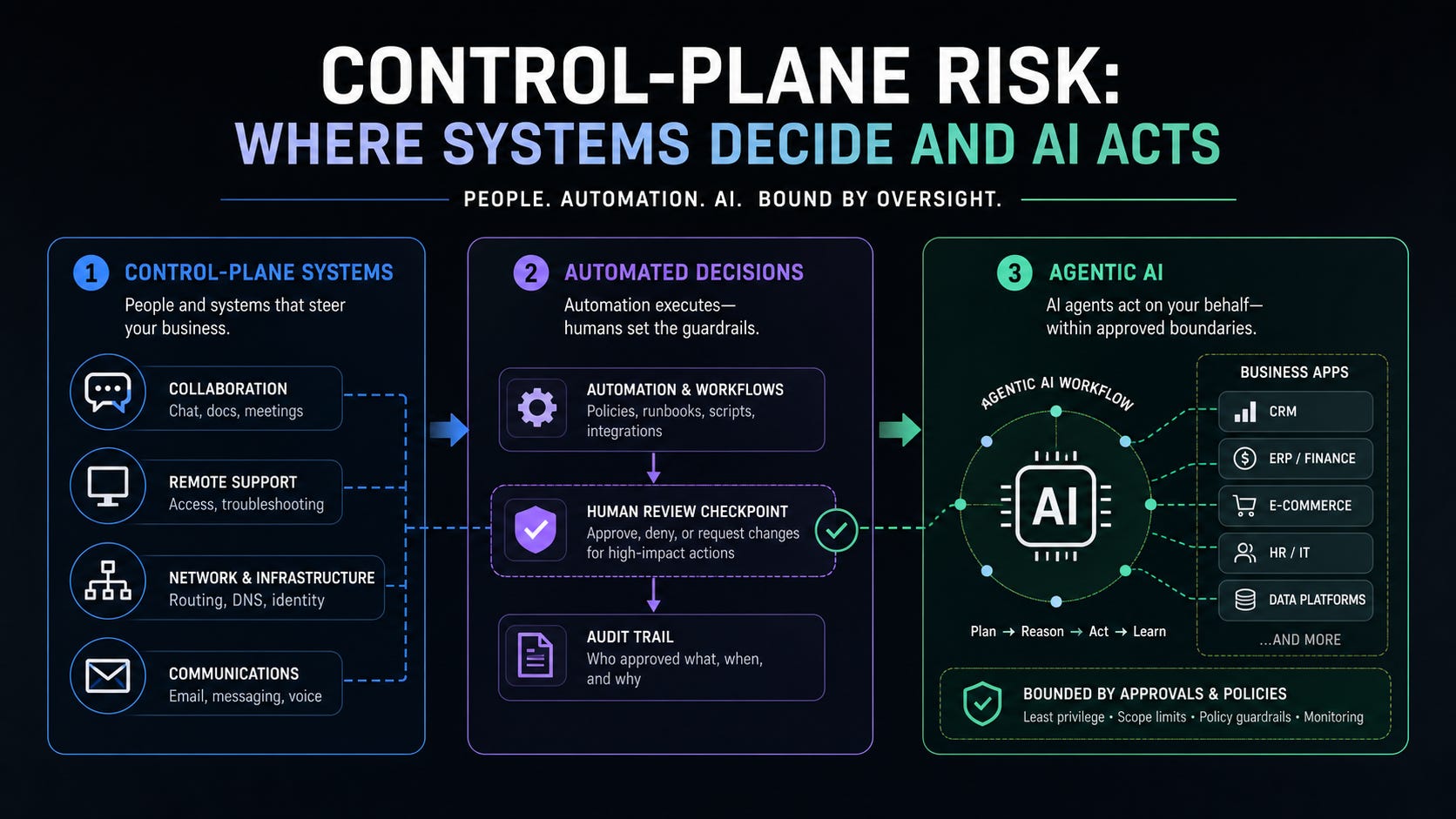
The newsletter addresses three interconnected risks sitting at the periphery of most SMB operations but carrying significant authority. Enable's August 2 hotfix for N Central 2026.3 patches an authentication bypass (CVE2026-18577, CVSS 8.2) that could enable account takeover across managed endpoints - a critical issue because remote management platforms sit in the administrative bloodstream of any business relying on MSPs or internal IT infrastructure. The impact extends beyond patching: if the control plane is compromised, the same automation channels trusted for legitimate administration become vectors for malicious scale. Simultaneously, California's DROP (delete request and opt-out platform) entered its live deletion phase on August 1, requiring registered data brokers to process deletion requests from over 225,000 registered users. Any SMB acquiring enrichment data, audience segments, or broker-sourced records now faces deletion suppression and proof obligations that can cascade through vendor chains - a problem compounded if data provenance is unclear or inherited from past CRM migrations. Finally, OpenAI's August 4 Enterprise and EDU update signals a shift from experimental AI usage to governed capacity: long pastes above 10,000 characters now become attachments, and weekly role-based spend limits move to monthly budgets on August 15. Together, these updates reflect a pattern: control surfaces - remote management, third-party data pipelines, and shared AI workflows - require named ownership before they escape governance.
CVE2026-18577 is an authentication bypass that can lead to account takeover in N Central instances up through version 26-3-3, with a CVSS base score of 8.2; Enable issued guidance to upgrade immediately to 2026.3 with Hotfix 1 and investigate for suspicious SVC host exe, cloudflare exe, psexec activity, and inbound connections from listed IPs.
California's delete request and opt-out platform requires registered data brokers to delete personal information when valid requests arrive; one consumer request can fan out to hundreds of brokers at once, creating deletion suppression and proof obligations that cascade through the vendor chain if an SMB relies on broker-sourced data.
Pastes longer than 10,000 characters now become attachments instead of inline text, and weekly role-based spend limits automatically move to monthly limits on August 15, signaling a shift from experimental AI usage to governed, budgeted shared resources that require named ownership.
Remote management platforms like N Central sit in the administrative bloodstream and can touch downstream customer and employee devices at scale; if compromised, the same automation channels used for legitimate administration become vectors for malicious spread, so patches should be applied faster than normal server cadence with proof of review.
The business is still depending on a blind spot; list every current data source in CRM, marketing automation, and outbound tooling that didn't come directly from a customer action, mark which came from broker enrichment or scraping, and assign one owner for deletion proof and one for vendor contract review.
Our reviewer’s read on each dimension, with quotes from the episode.
The episode delivers concrete, operationally-focused insights about three specific unmanaged risk vectors (N Central CVE, California data broker deletion rules, and AI usage governance) with actionable leadership moves. However, the density is somewhat undermined by repetitive framing - each section follows the same structure (what happened, why concern, strategic action, leadership move), which creates padding and reduces the insight-per-minute ratio despite substantive core content.
Remote management layers, third party data pipelines and shared pool AI workflows...sit just outside day to day frontline work but still carry real authority
Your MSP control plane can become the fastest route into every managed endpoint
The framing of 'control surfaces' and the specific linkage between three contemporaneous policy/product changes is useful, but the core advice - patch faster, inventory data sources, assign owners - follows standard governance playbooks. The California deletion rule and N Central CVE are real events being communicated, not novel analyses, and the AI governance framing is familiar risk-management thinking.
Treat every remote management server as a privileged identity and execution system
Stop managing AI usage like a loose perk. Treat it like any other shared business platform
This is a monologue newsletter read-aloud with no guest; there is no practitioner, operator, or expert voice beyond the speaker delivering risk bulletins. The content is curated product updates and regulatory guidance, not original insight from someone who has lived through these scenarios at scale.
This is the SMBTech and Cybersecurity Leadership Newsletter
Strong use of named technical details: CVE-2026-18577 with CVSS 8.2 base score, specific N Central version numbers (26-3-3), Enable hotfix dates, California's August 1 drop milestone with 225,000 sign-ups in six weeks, OpenAI character thresholds (10,000), and named tools (Bitdefender, Optory). The concrete indicators (SVC host exe, cloudflare exe, psexec activity) and process steps are specific enough to be actionable, though some sections lack dollar impact or quantified failure scenarios.
CVE2026-18577 describes an authentication bypass path that can lead to account takeover in N Central up through 26-3-3 with a CVSL 8.2 base score
Californians can submit one deletion request that reaches more than 500 registered data brokers, and his office said more than 225,000 Californians signed up in less than six weeks
No conversational craft is present - this is a scripted newsletter monologue with no host-guest dialogue, follow-up questions, or productive disagreement. The structure is prescriptive and didactic, not exploratory or challenging. There is no opportunity to see ideas tested, nuanced, or pushed back on.
This is the SMBTech and Cybersecurity Leadership Newsletter
Here is why you should be concerned
Computed from the transcript - who did the talking, and the words that came up most.
Discover this week's top SMB risk signals. Learn why leaders must immediately secure MSP control planes, manage data broker deletion rules, and govern AI workflows. This is a public episode. If you'd like to discuss this with other subscribers or get access to bonus episodes, visit substack.cpf-coaching.com/subscribe
Transcribed and scored by The B2B Podcast Index.
Speaker A: This week's SMB risk signals patch the control plane, delete the broker trail and budget AI work, remote admin, resale data and metered AI workflows now need named owners before they outrun your business controls. This is the SMBTech and Cybersecurity Leadership Newsletter. On August 2, 2026, Enable published Hotfix 1 for N Central 2026.3 and and warned that all N Central instances not running 3-3-26 should upgrade immediately because of a security issue tied to CVE2026 18577. One day earlier, California's delete request and opt out platform or drop moved into its live deletion phase, which means registered data brokers must start deleting Californian's personal information when valid requests arrive on August 4, 2026. OpenAI's Enterprise and EDU release notes said long pastes above 10,000 characters now become attachments and remaining weekly role based spend limits will automatically move to monthly limits on August 15. These are not isolated product updates. They all describe systems that sit just outside day to day frontline work but still carry real authority, remote management layers, third party data pipelines and shared pool AI workflows. If you are running a lean SMB team, the immediate leadership question is simple. Who owns those control surfaces before they fail under pressure? Your MSP control plane can become the fastest route into every managed endpoint. N Central matters because it is not just another internal server. It is a remote monitoring and management platform that can touch downstream customer and employee devices at scale. Enable's Aug. 2 note said all N Central instances that are not already on 2026 3.1 should apply hotfix1 as soon as possible and its investigation guidance specifically called out suspicious SVC host exe, cloudflare, exe, psexec activity, and inbound connections from listed IP addresses. Here is why you should be concerned. First, the blast radius is wider than one box. The NVD entry for CVE202618577 describes an authentication bypass path that can lead to account takeover in N Central up through 26-3-3 with a CVSL 8.2 base score. Second, the vendor warning is operational, not theoretical. Enable said every instance not already on 26-3-3 should upgrade immediately and supplied concrete triage indicators for administrators to investigate. Third, managed service trust can flip into managed compromise. If your team or MSP uses a privileged control plane to push tools, scripts or remote sessions, that platform effectively sits in your business's administrative bloodstream. The strategic action is to treat every remote management server as a privileged uh, identity and execution system. Your patch process for those tools should be faster than your normal server cadence, and your response plan should assume that compromise could spread through the same automation you usually trust. This week's leadership move has three parts. First, confirm whether your internal team or MSP runs N Central anywhere in your environment and whether the instance is already on 26-3-3 with hotfix one. Second, ask for proof of the review, not just verbal reassurance, patch evidence, admin session review remote access logs and any findings tied to the enable indicators. Third, freeze non essential remote automation until the control plane owner confirms both patch state and downstream endpoint review. A brief sponsor note fits here for SMBs that need stronger endpoint containment when a remote management layer goes sideways. Bitdefender is a practical fit for tightening device level detection, isolation and response while you verify whether administrative tooling has been misused Section 2 California's Broker Deletion Rule turned data resale into a live operating obligation California's August 1 drop milestone matters because it converts consumer privacy rights into an active business process. Attorney General Rob Bonta said Californians can submit one deletion request that reaches more than 500 registered data brokers, and his office said more than 225,000 Californians signed up in less than six weeks after launch. If your business buys enrichment data lists, audience segments or broker sourced records, that is no longer just a marketing input. It is a workflow that can now generate deletion pressure at scale. Here is why you should be concerned. First, the volume trigger is real. One validated request can fan out to hundreds of brokers at once, which means deletion suppression and proof duties can show up quickly across the vendor chain. Second, your vendor choices can become your privacy problem. Even if you are not a registered broker yourself, you can still be exposed if you rely on broker Fed lists or cannot explain how third party data entered your stack. Third, the rule rewards proof, not intent. When customers, regulators or enterprise buyers ask where data came from and whether it was deleted, a good faith answer without evidence is not enough. The strategic action is to inventory every place your business acquires personal data that did not come directly from the customer. Then decide who owns deletion, routing suppression lists, contract language, and the evidence trail when a vendor must prove a request was honored. I recognize that many SMB operators inherited these data feeds from old demand generation experiments, partner deals, or CRM M migrations that still run quietly in the background. That inherited sprawl is exactly what turns a privacy rule into an executive issue. If no one can name the owner of the broker trail, the business is still depending on a blind spot. This week's leadership move has three parts. First, list every current data source in your CRM, marketing automation and outbound tooling that did not come directly from a first party customer action. Second, mark which sources came from a broker enrichment, vendor lead marketplace or or scraped data workflow. Third, assign one owner for deletion proof and one owner for vendor contract review. Then make them compare the same source list. This week, another sponsor note belongs here. Optory is a strong fit when you need to reduce personal data exposure, remove records from broker ecosystems and cut down the amount of discoverable information already circulating about executives and staff. Section 3 AI work is moving into usage governed operating lanes, not side experiments the August 4th open AI enterprise and. EDU update matters because it changes how heavy AI work behaves and how it is budgeted. Pastes longer than 10,000 characters now become attachments instead of inline prompt text, which is a signal that larger working sets are being handled more deliberately. The same note said remaining weekly role based spend limits in the admin console will automatically move to monthly limits on August 15th. Here is why you should be concerned. First, large working context is becoming normal once long inputs become structured attachments. Teams are more likely to treat AI work as a place to move real operational material, not just quick prompts. Second, the cost model is settling into governed capacity. A weekly limit culture feels experimental. A monthly limit model feels like a budgeted shared resource that someone must own. Third, shared usage can drift without a responsible operator if no one owns limits, allowed use cases and data ingestion rules. The business can overspend, overshare or normalize workflows it never explicitly approved. The strategic action is is to stop managing AI usage like a loose perk. Treat it like any other shared business platform. Name the owner of limits, define what kinds of content can be pasted or attached, and decide which high cost or high risk workflows need approval before they become habitual. This week's leadership move has three parts. First, identify which team owns your shared AI budget, role limits and admin console settings today. Second, decide whether any workflow involving contracts, regulated data, pricing, payroll or customer exports should be blocked from long paste or attachment heavy use without review. Third, set one monthly review cadence for usage spikes, new workflow requests and documented exceptions before August 15th arrives. Final thoughts for leaders this week's signals all point to the same leadership lesson. Your risk is increasingly concentrated in the systems around the main workflow, not just inside it. Remote management layers can become privileged execution paths. Broker fed data can become a deletion and sourcing problem overnight. Shared AI work can turn into an unowned budget and data governance issue if you let convenience define the rules. Put one item on your next leadership agenda. List the control surfaces in your business that can administer devices, source outside personal data, or consume shared AI capacity. Then assign the named owner for each one. Before next week closes, subscribe to access the Premium implementation Pack the owner register, the checklist, the exercise, and the full strategy.
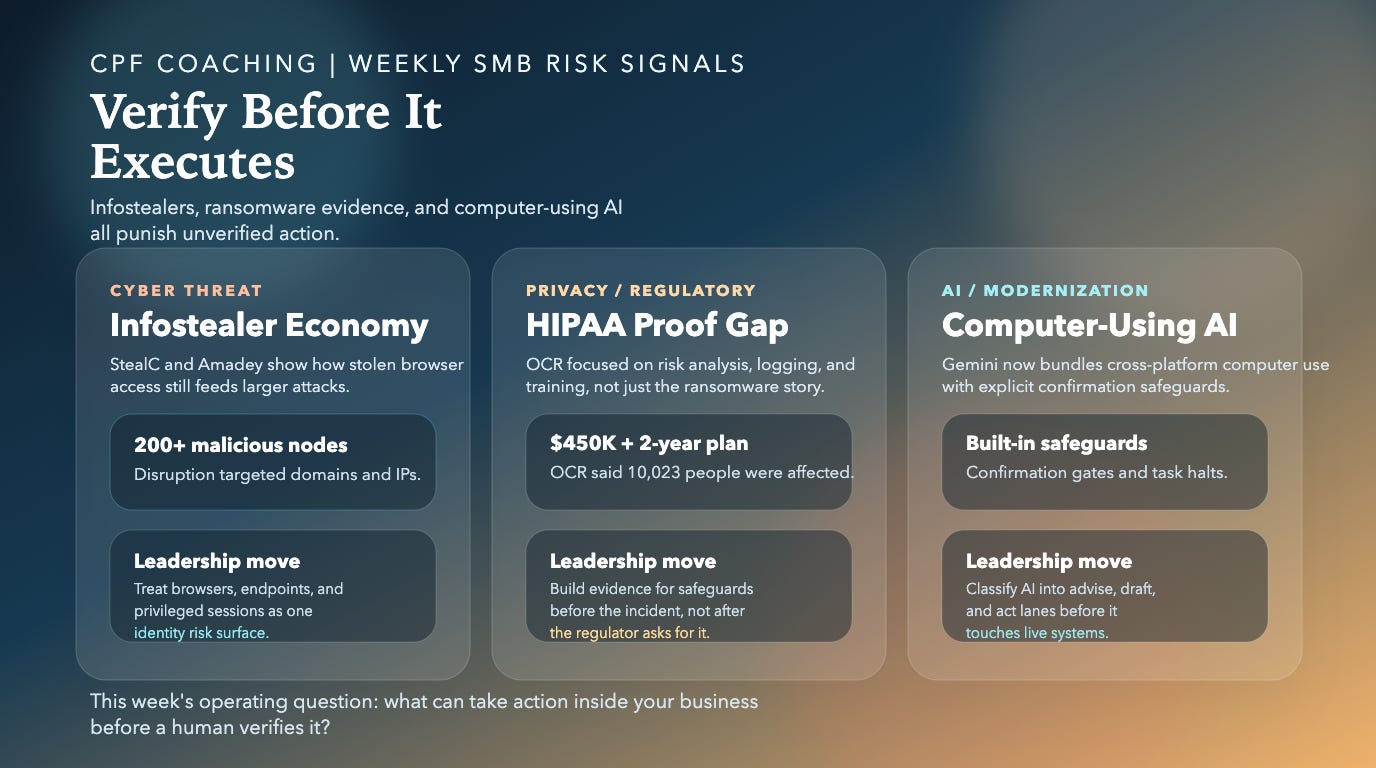 Stolen Logins, AI Agents, and $450K Regulatory Fines56 / 100
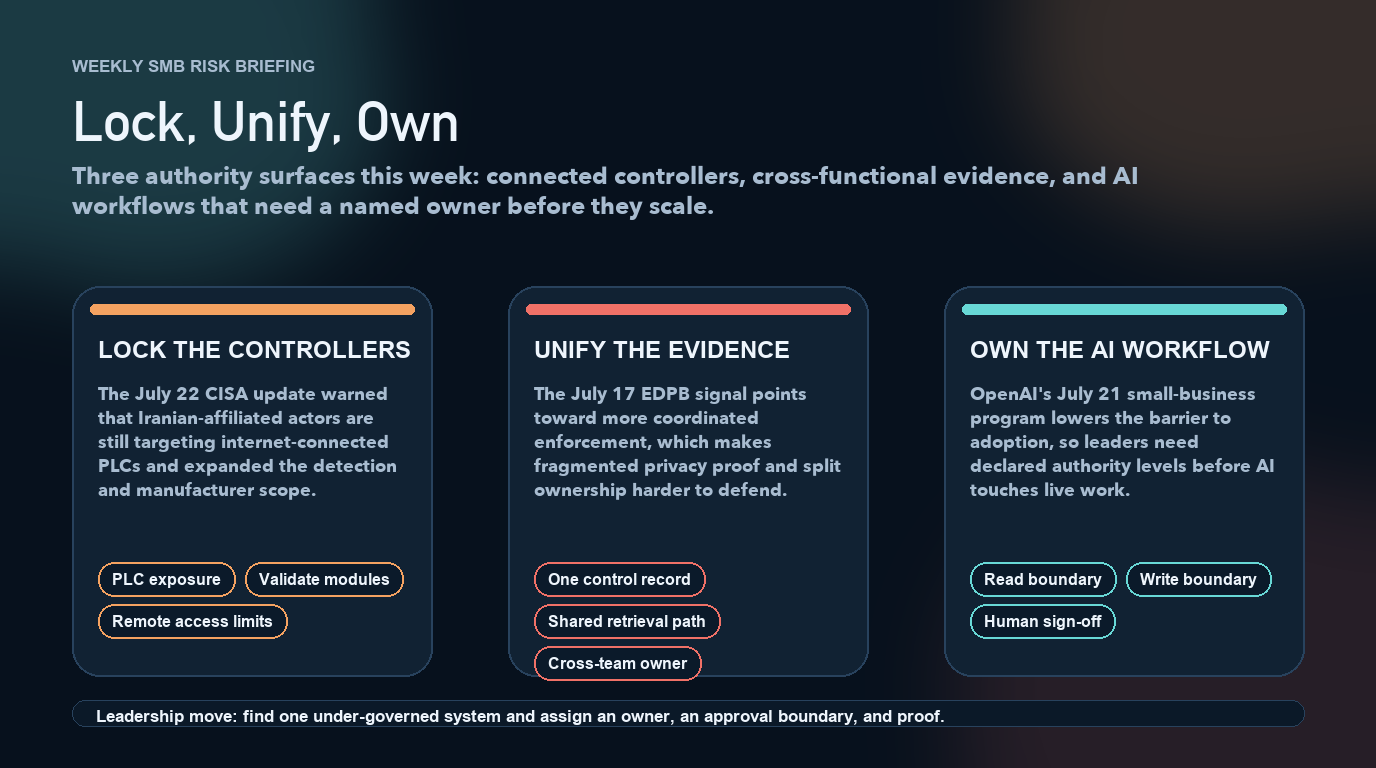 SMB Risk Briefing: Lock the Controllers, Unify the Evidence, and Modernize AI with Real Ownership
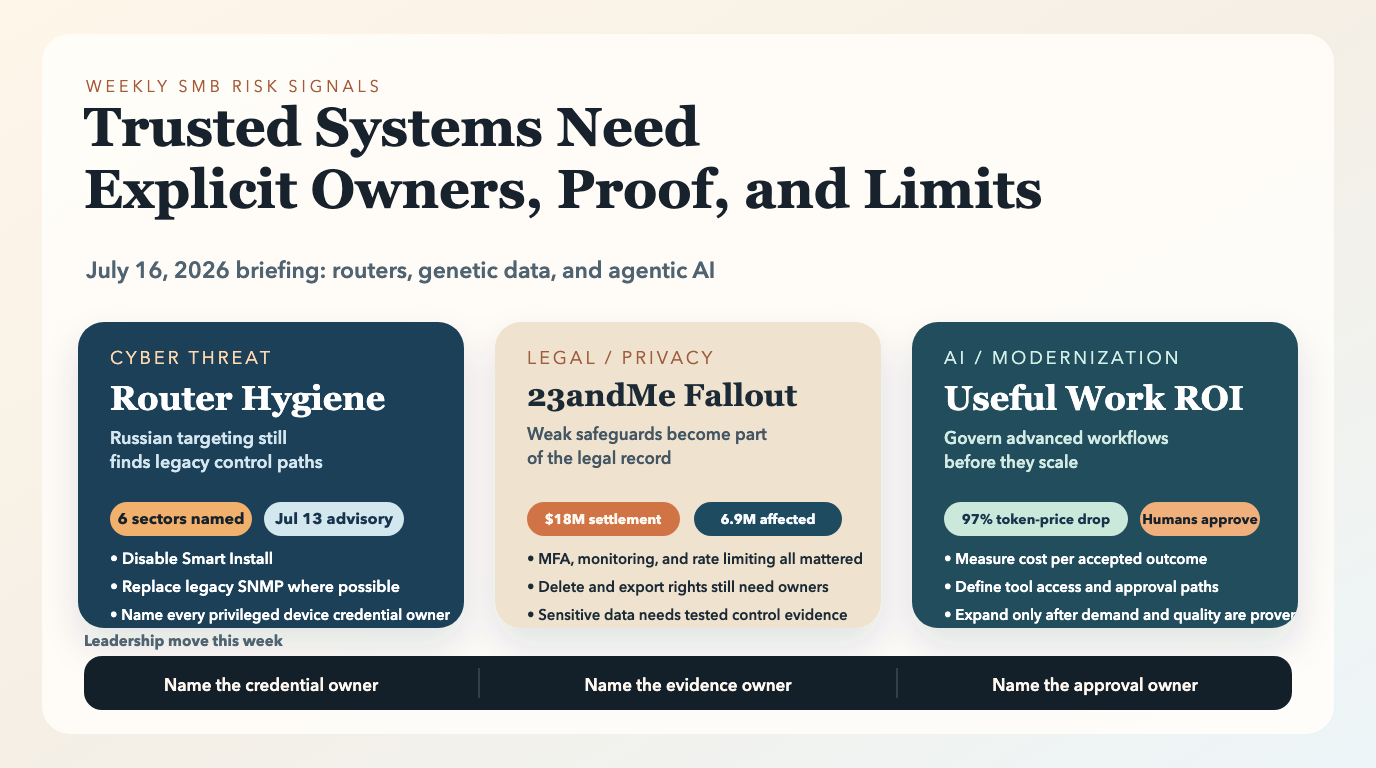 This Week's SMB Risk Signals: Router Hygiene, Genetic Data, and Agentic AI
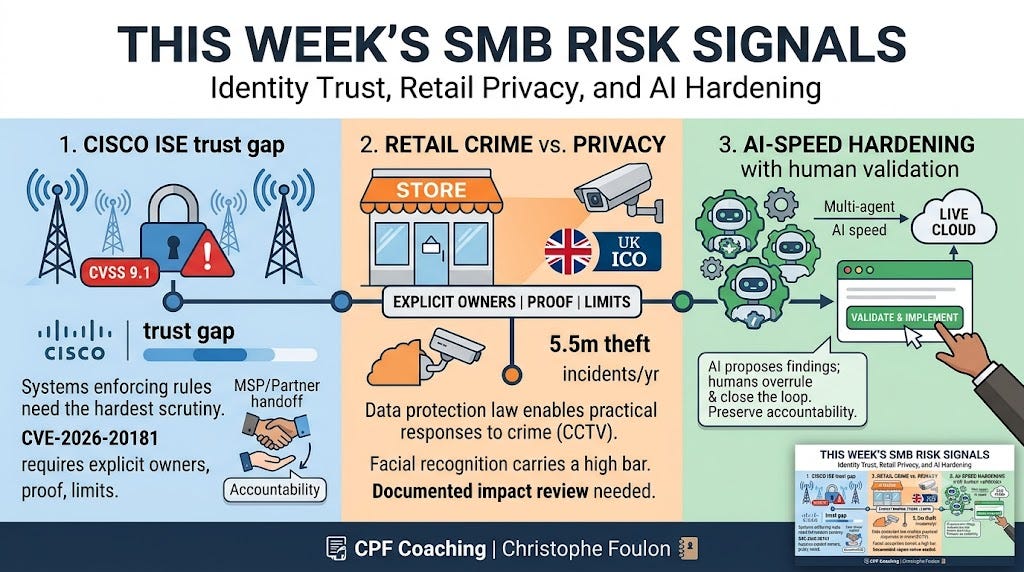 Can Your Security Tools, Cameras, and Agents Prove Their Work?
 SMB Cyber Risk: Securing the Control Plane and Agentic AI