
SMB Tech & Cyber Newsletter · 2026-06-26 · 5 min
Key moments - from our scoring
Substance score
36 / 100
Five dimensions, 20 points each
Three concurrent security developments in late June 2026 converge on a single operational risk: execution without human verification. Microsoft's disruption of over 200 SteelC and Amaday command-and-control domains, an HHS OCR $450,000 fine against a health plan following ransomware affecting 10,023 people, and Google's integration of computer-use capabilities into Gemini 3.5 Flash reveal how stolen credentials, regulatory enforcement gaps, and autonomous AI agents can each bypass organizational approval gates. For SMB leaders managing lean teams and sprawling tool inventories, the episode argues that browser-stored credentials, weakly verified admin sessions, and AI pilots designed for convenience create a unified threat surface. The leadership agenda covers three immediate actions: treating endpoint credential hygiene as a shared control surface (revoking privileged sessions on unmanaged devices, enforcing managed endpoint protection); documenting risk analyses and audit controls post-incident (logging, authentication, encryption, and training ownership); and defining approval boundaries for AI - separating advisory, draft, and execution-only-with-confirmation workflows. The episode is built as a briefing for operators deciding whether to strengthen controls before regulators or attackers expose gaps.
Microsoft disrupted more than 200 malicious SteelC and Amaday command-and-control domains and IP addresses working with Europol. SteelC collects sensitive data from browsers, cryptocurrency wallets, messaging applications, email clients, and gaming platforms, while Amaday helps deliver SteelC and other malware.
HHS OCR fined the health plan $450,000 after a ransomware incident affecting 10,023 people, citing failure to conduct a thorough risk analysis beforehand. OCR emphasized audit controls, information system activity review, authentication, encryption, lessons learned, and workforce training as required corrective actions.
Google built computer use directly into Gemini 3.5 Flash, enabling AI to see, reason, and take action across browser, mobile, and desktop environments. Teams can require explicit user confirmation for sensitive or irreversible actions and can automatically stop tasks when indirect prompt injection is detected.
Revoke or rotate privileged sessions on lightly managed endpoints and confirm managed endpoint protection; map sensitive data flows and document risk analyses with named ownership of logging, authentication, and encryption; and define AI approval boundaries by selecting a low-risk pilot workflow, requiring confirmation for spending and external changes, and logging all systems touched and rollback paths.
Our reviewer’s read on each dimension, with quotes from the episode.
The episode synthesises three real news events into a single operational frame ('execution without verification'), which is genuinely useful for an SMB operator. However, the individual recommendations (rotate credentials, document risk analysis, define AI approval tiers) are standard hygiene advice that most security-aware operators will have heard before, and the 5-minute runtime leaves no room for depth.
The software you trust can steal the workflows you postpone can become regulatory evidence and the AI you pilot for convenience can cross the line from draft help to real execution faster than your approval model catches up
The strategic move is to treat browser-stored access, local endpoints, and admin sessions as one control surface
The 'execution without verification' thread linking InfoStealers, OCR enforcement, and computer-using AI is a clean editorial observation that rises above simple news summary. But the weekly action items (revoke sessions, map data flows, require confirmation for AI) are conventional cybersecurity playbook items with no contrarian or first-principles angle.
These are not separate stories. They are one operating lesson told from three angles.
Info-stealers exploit it, regulators punish its absence, and computer-using AI makes it easy to scale.
There is no guest - this is a scripted solo narration reading synthesised news items. No practitioner, operator, or domain expert appears, and the host's own expertise is not demonstrated beyond the ability to summarise press releases and regulatory announcements.
Subscribe to access the premium implementation guidance, templates, exercises, and full strategy behind this week's SMB risk briefing.
The episode cites real dates, a precise dollar fine ($450,000), an exact affected-population figure (10,023), named malware families (SteelC, Amadey), and a named AI model (Gemini 3.5 Flash) - all drawn from primary sources. However, none of this is original research and the operational advice sections revert to abstraction without any case studies or client-level data.
HHS Office for Civil Rights announced a $450,000 high-pay settlement after a ransomware incident at a health plan that potentially affected 10,023 people
Microsoft said SteelC collects sensitive data from browsers, cryptocurrency wallets, messaging applications, email clients, and gaming platforms
This is a scripted newsletter read aloud - there is no conversation, no host-guest dynamic, no questions, and no opportunity for pushback or follow-up. The format structurally prevents any conversational craft from being demonstrated.
Put endpoint credential hygiene, risk analysis evidence, and AI approval rules on your next leadership agenda before this week ends.
Computed from the transcript - who did the talking, and the words that came up most.
What inside your business can act before a human verifies it? This week, we dive into the convergence of three major tech shifts: the modular infostealer economy, costly regulatory enforcement after ransomware, and the mainstream arrival of computer-using AI agents like Gemini 3.5 Flash. If you lead tech or cybersecurity for an SMB, this episode provides a localized execution plan to bridge the gap between risk awareness and actual protection. We cover: Cyber Threats: Why treating browsers, endpoints, and admin sessions as a single identity risk surface is critical to stopping credential theft. Compliance: How to build an evidence trail that satisfies regulators (like HHS OCR) before a ransomware incident occurs. AI Governance: Setting up "advise, draft, and act" lanes for AI to prevent unverified execution. Listen in for the 3 steps you need to take this week to secure your unverified workflows. This is a public episode. If you'd like to discuss this with other subscribers or get access to bonus episodes, visit substack.cpf-coaching.com/subscribe
Transcribed and scored by The B2B Podcast Index.
On June 24, 2026, Microsoft said its Digital Crimes Unit, working with Europol and industry partners, moved to disrupt more than 200 malicious Steel C and Amaday command and control domains and IP addresses. Six days earlier, on June 18, 2026, HHS Office for Civil Rights announced a $450,000 high-pay settlement after a ransomware incident at a health plan that potentially affected 10,023 people. Then on June 24, 2026, Google said computer use is now built directly into Gemini 3.
5 Flash, giving teams a mainstream path to AI that can see, reason, and take action across browser, mobile, and desktop environments. These are not separate stories. They are one operating lesson told from three angles. The software you trust can steal the workflows you postpone can become regulatory evidence and the AI you pilot for convenience can cross the line from draft help to real execution faster than your approval model catches up If you lead an SMB with limited staff and a long tool list the real question this week is simple What inside your business can act before a human verifies it?
First, InfoSteelers are still feeding bigger attacks. Microsoft said SteelC collects sensitive data from browsers, cryptocurrency wallets, messaging applications, email clients, and gaming platforms, while Amaday helps deliver SteelC and other malware. Microsoft also said defenders may only notice the breach after valid credentials are already being abused. The strategic move is to treat browser-stored access, local endpoints, and admin sessions as one control surface.
This week, revoke or rotate privileged sessions used on lightly managed endpoints, confirm that leaders and administrators are using managed endpoint protection with stronger credential workflows, and review which SaaS admin accounts still allow broad access without step verification Second regulators still expect you to show your work after ransomware HHS OCR said the health plan paid agreed to a two corrective action plan and potentially failed to conduct a thorough risk analysis before the incident.
OCR also emphasized audit controls, information system activity review, authentication, encryption, lessons learned, and workforce training. The leadership move is to stop assuming controls are real because they are familiar. This week, map where your most sensitive data enters and leaves your systems, document one current risk analysis for a high sensitivity workflow, and verify that logging, authentication, encryption, and training are named, owned, and reviewable. Third, computer using AI is becoming a real operations design choice.
Google said computer use is now a built-in tool in Gemini 3.5 Flash and positioned it for long horizon tasks across browser mobile and desktop environments Google also said teams can require explicit user confirmation for sensitive or irreversible actions and can automatically stop tasks when indirect prompt injection is detected The leadership move is to define where AI may advise, where it may draft, and where it may act only with approval. This week, pick one low-risk workflow with a clear stop condition, require confirmation for spending and external changes, and log every pilot with the systems touched, data involved, owner, and rollback path.
The common thread this week is execution without verification. Info-stealers exploit it, regulators punish its absence, and computer-using AI makes it easy to scale. Put endpoint credential hygiene, risk analysis evidence, and AI approval rules on your next leadership agenda before this week ends. Subscribe to access the premium implementation guidance, templates, exercises, and full strategy behind this week's SMB risk briefing.
Other episodes covering the same guests and topics, from across The B2B Podcast Index.
 How AI Is Rewriting the Rules of Cybersecurity | Truffle Security & SocketAI + a16z · on credential theft95 / 100
 How Zalando Deployed GenAI Without Handing Attackers the Keys with Florence MottayCyber Leaders · on Ransomware87 / 100
 Building a Cybersecurity Culture in Your Company (Encore)The Backup Wrap-Up · on Ransomware86 / 100
 Reframing Cyber Risk with Jane Frankland MBEBCG on Compliance · on Ransomware84 / 100
 Practice Makes Progress in Cyber Resilience with Jim Bowie, VP and CISO at Tampa General HospitalHybrid Identity Protection Podcast · on Ransomware80 / 100
 Ep 31. Autonomous Marketing Is Coming - But Brand Still Wins, with Jamie Domenici, KlaviyoThe AI Edge Podcast · on Gemini 3.5 Flash74 / 100
 The Top 3 Unmanaged Risks Threatening Your SMB Right Now66 / 100
 SMB Risk Briefing: Lock the Controllers, Unify the Evidence, and Modernize AI with Real Ownership
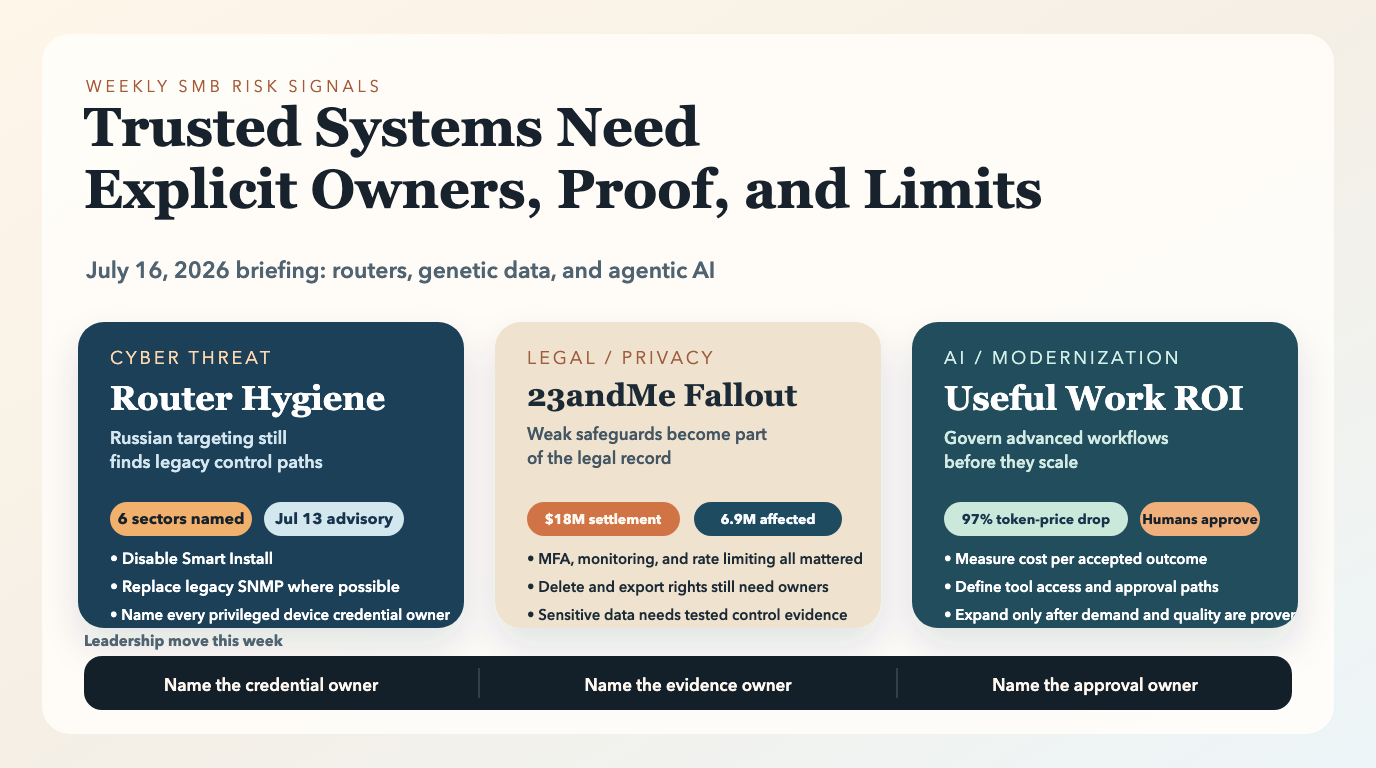 This Week's SMB Risk Signals: Router Hygiene, Genetic Data, and Agentic AI
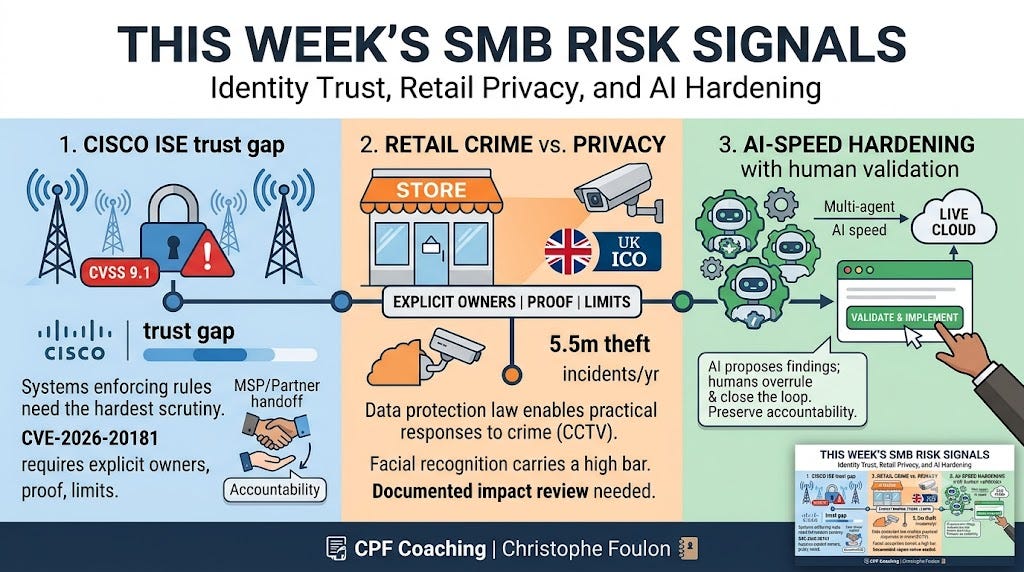 Can Your Security Tools, Cameras, and Agents Prove Their Work?
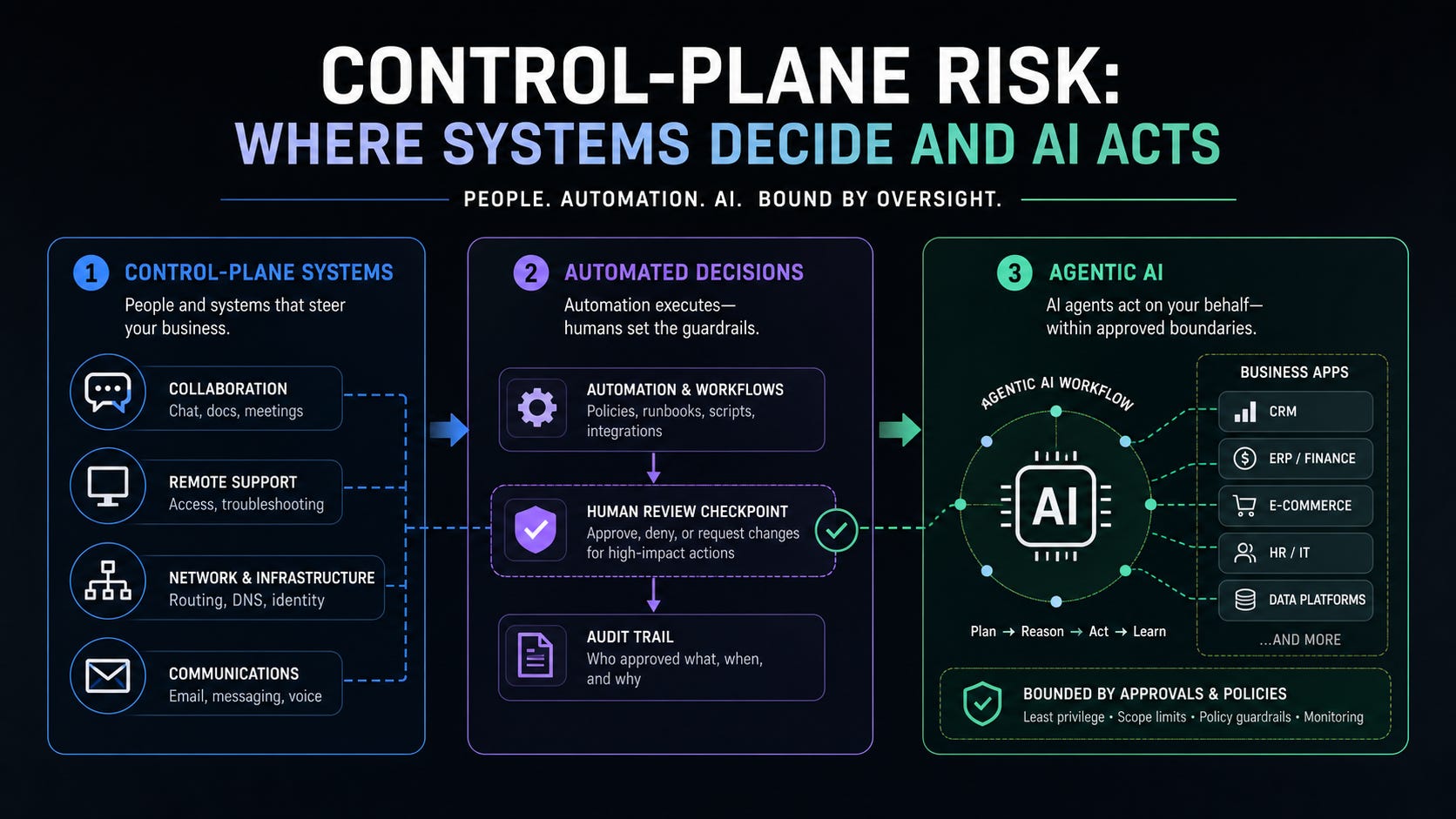 SMB Cyber Risk: Securing the Control Plane and Agentic AI