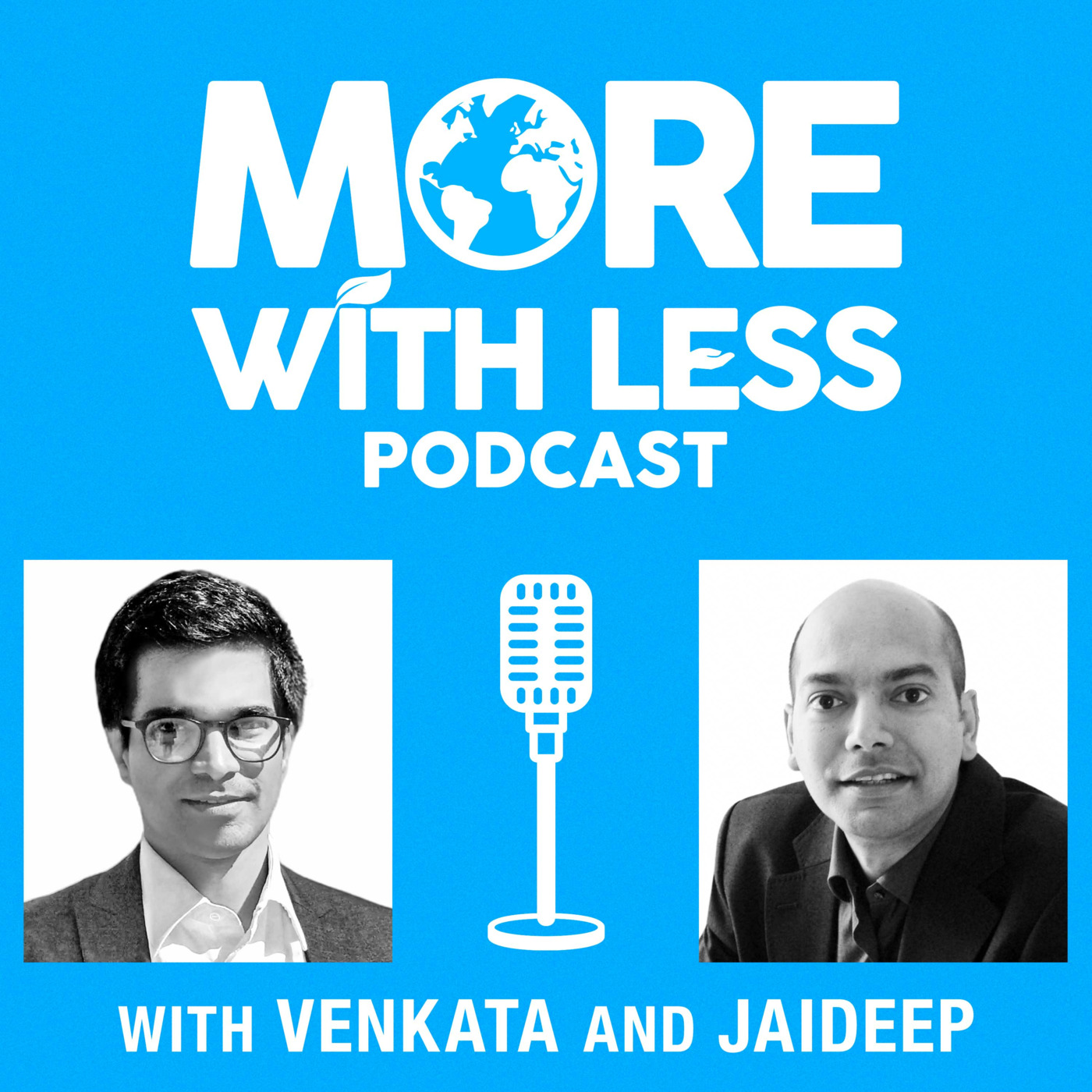
Hosted by Venkata Gandikota and Jaideep Prabhu
How do businesses balance financial growth with sustainability and impact? Join hosts Venkata Gandikota - a frugal innovation and impact investing evangelist - and Prof Jaideep Prabhu - Professor of Marketing at Cambridge University’s Judge Business School and co-author of an award-winning book on frugal innovation -…
10 episodes · publishes weekly · latest 2022-09-07 · ~25 min/episode
Rank
#1047
Substance
72.0
/ 100
Breakdown
Scored 2026-07
Updated monthly
General rank
#64 of 271
Across the index
#1047 of 6181
Substance
Top 17%
outscores 83% of the index
More With Less Podcast with Venkata and Jaideep ranks #1047 on The B2B Podcast Index with a substance score of 72.0 out of 100, scored across 1 recent episode. It scores highest on guest caliber and specificity & evidence. Winston is more than a pure thought-leader: he co-authored with a sitting-era Fortune-50 CEO, conducted original off-record research with 3G Capital, and has 20 years of direct company advisory work. However, he is fundamentally a writer and consultant rather than an operator who has personally built or run a business through these sustainability challenges at scale.
Averaged across 1 recently scored episode, with cited evidence.
The episode contains pockets of genuine insight - particularly the argument that ROI is broken because investment is measured precisely while returns are vague, and the palm oil coordination problem - but large stretches are high-level sustainability advocacy and thesis restatement that anyone familiar with ESG discourse will have heard before.
“return on investment or ROI is fundamentally broken as a tool... We measure the investment, the I part really specifically... We're not good at measuring the return at all”
“companies going to electric fleets for trucks. They've waited till, in some sense, till the upfront cost of buying that electric truck is the same or better than the diesel one, which is really silly”
The dominant framing - stakeholder capitalism vs. short-term shareholder primacy - is well-worn territory, and the episode leans on references to other books (Built to Last, Jim Collins) and borrowed quotes (Gandhi). The 'elephants in the room' chapter, where Winston argues CEOs are not blind to the problems but are pretending, is a fresher rhetorical move, but it doesn't develop into a truly novel framework.
“CEOs know what they are. They're pretending they don't know. Like they actually, they're not blind. They know what this thing is. They're just ignoring it”
“the rich must live simply so the poor can simply live”
Winston is more than a pure thought-leader: he co-authored with a sitting-era Fortune-50 CEO, conducted original off-record research with 3G Capital, and has 20 years of direct company advisory work. However, he is fundamentally a writer and consultant rather than an operator who has personally built or run a business through these sustainability challenges at scale.
“as part of the book research, I've talked off the record with 3G folks, and I basically asked them, like, the valuation you put on the company... did you really value the sustainability stuff? And in essence, the answer was no”
“I ended up going back to school. I had an mba, but I went and got a degree in environmental management. I worked with a co author at Yale and we wrote Green to Gold”
There are genuine data points scattered through the episode - GlobeScan's 11-year consecutive ranking, the $150B Kraft Heinz bid resolved in nine days, Unilever's 3% share of global palm oil, the Lifebuoy reformulation killing 99.9% of germs in 10 vs. 30 seconds - but many broader claims about business trends and impact are asserted without sourcing or quantification and go unchallenged.
“GlobeScan does this annual ranking, they've been ranked number one for 11 years”
“it was 150 billion, something like that... it all happened very quickly. It was like a nine day kind of battle”
The hosts show genuine ambition with the Danone question - using a real counterexample to probe whether sustainability leadership survives governance pressure - and the growth/consumption contradiction question is substantive. However, when Winston hedges or deflects (notably on Danone: 'I don't know... I just have a hard time believing that'), the hosts consistently move on rather than follow up, and most questions are topic prompts rather than precision probes.
“their CEO, Emmanuel Farber, was recently ousted by activist shareholders. What's your take on what happened there? Was that old school shareholder capitalism fighting back”
“Is there a contradiction in terms between growth and consumption and being environmentally conscious?”
First period on the Index - history builds from here.
1 scored on substance · 10 tracked in total.
Add this badge to your site - it links back here and updates automatically as you rank.

<a href="https://index.fame.so/show/more-with-less-podcast-with-venkata-and-jaideep" target="_blank" rel="noopener">
  <img src="https://index.fame.so/badge/more-with-less-podcast-with-venkata-and-jaideep/badge.svg" alt="Ranked #64 on The B2B Podcast Index" width="360" height="136" />
</a>Track More With Less Podcast with Venkata and Jaideep's rank
Get an email whenever this show moves up or down the Index. Monthly at most, no spam.
The themes that come up most across this show's episodes.

CareTalk: Healthcare. Unfiltered.
CareTalk: Healthcare. Unfiltered.
Money Code
Stablecon

Reshaping Workflows with Dell Pro Precision and NVIDIA RTX PRO GPUs
Dell Technologies AI Factory with NVIDIA

The RAG Podcast
Sean Anderson

Outthinkers
Outthinker
Business Scholarship Podcast
Andrew Jennings
Podcasts that dig into the same topics.



