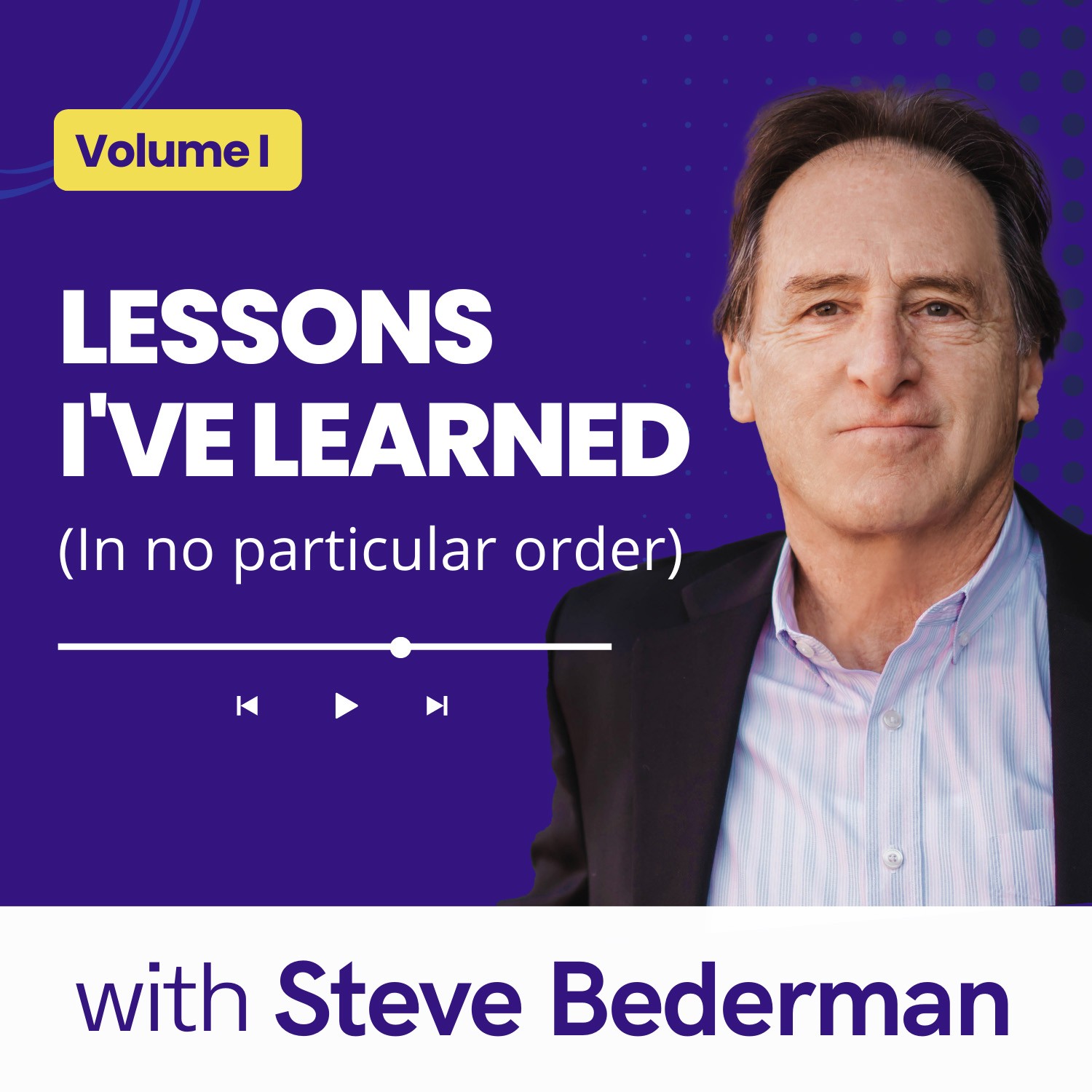
Lessons I’ve Learned (in no particular order), with Steve Bederman · 2024-06-10 · 23 min
Key moments - from our scoring
Substance score
28 / 100
Five dimensions, 20 points each
Bederman reflects on how learning business fundamentals in large corporations taught him conventions exist for good reasons, but his survival as a bootstrapped CEO forced him to innovate through nonconformity. Entering a mature tech industry with no capital, he couldn't compete on marketing spend or trade show presence, so he invented guerrilla tactics - upgrading hotel rooms at industry conferences and inviting prospects for meals and conversations. This "gap marketing" approach identified what competitors weren't delivering: genuine customer relationships and promise-keeping. He built his entire company culture around customer-defined support and product design rather than industry standard practices, despite pushback from engineers trained at larger competitors. Bederman also shares unconventional survival decisions, including convincing a major Denver law firm to defend him pro bono during litigation, and developing acquisition models using notes payable and earn-outs instead of cash, which eventually became industry practice. His core lesson: maintain mastery of business fundamentals and conventions, but when facing existential challenges, identify gaps your competitors have left and execute affordable, repeatable alternatives that align with your core values and ethics.
He booked nice hotel rooms at the conferences where his industry gathered, printed unconventional invitations, and invited prospects to meet him there for meals and product demonstrations - a guerrilla marketing tactic that let him have meaningful conversations with 4-5 qualified prospects at each event.
Customers weren't getting genuine relationships or fulfilled promises from larger vendors; they wanted accountability and transparent communication. Bederman built his entire company culture and marketing around promise-keeping and customer-defined support and product design.
He developed a creative model using notes payable and earn-outs rather than cash up front, which eventually exceeded what those companies would have received through traditional sales, and later became a recognized acquisition method.
Instead of conceding, he approached a major Denver law firm, promised the attorney he would become a successful company and eventually pay him, and convinced them to defend him pro bono based on his credibility and vision alone.
Identifying what competitors do or don't do that upsets customers, then building your entire go-to-market, company structure, and product around solving that gap - making it your unique, repeatable, affordable competitive advantage.
Our reviewer’s read on each dimension, with quotes from the episode.
A handful of genuinely tactical anecdotes (hotel-room guerrilla marketing, customer-designed product specs, zero-cash acquisitions) are buried under heavy narrative padding and generic entrepreneurship exhortations. The ideas surface occasionally but are not unpacked with enough depth to be immediately actionable.
I had money though for my hotel room. I upgraded my hotel room so it was a nice hotel room within the hotel where the convention was. I printed out on, um, a printer, an invitation to my hotel room.
I came up with a model of how to buy a business with no cash up front, with notes payable and earn outs that inevitably exceeded what those companies would ever get.
The hotel-room tactic and the zero-cash acquisition model are relatively fresh personal stories, but the overarching thesis - 'break conventions, know your gaps, stay true to your values' - is well-worn entrepreneurship canon repeated without a genuinely novel analytical frame.
I began to do what I call gap marketing and gap, uh, business building, um, gap structure, which was what other companies didn't do that or did do that upset the general customer.
I'm going to listen to convention when it suits and I'm going to break convention in spite of all of the advice around me after listening to it if I have no other choices
This is a solo monologue with no guest at all; the host appears to be a legitimate operator who built and acquired companies, but the format forecloses any external practitioner perspective, and the host's own credentials are asserted rather than demonstrated with verifiable detail.
I'm your host, and as a CEO myself, I'm excited to share with you a behind the scenes look at the lessons I have learned in pursuit of true purpose, courageous leadership.
I had not been one. And I was left in this situation, uh, where I needed to survive because I needed to eat, to tell you the truth
The stories are almost entirely unanchored: no company names, no revenue or deal figures, no timelines, no named competitors or customers. The one geographic detail ('largest law firm here in Denver, Colorado') and the mention of 'notes payable and earn outs' are the only concrete specifics in the entire episode.
I went to the largest law firm here in Denver, Colorado and I found some lawyer and I talked to them and I told him I needed his help and I couldn't pay him
with notes payable and earn outs that inevitably exceeded what those companies would ever get
There is no conversation - this is an uninterrupted solo monologue with no interviewer, no questions, no follow-ups, and no pushback. The format structurally eliminates any possibility of conversational craft, and even as a prepared talk it lacks structured argument or deliberate rhetorical progression.
I only have about four or five minutes left. And here's what I want to tell you.
I wish I could solve it on this one call, but I can't
Computed from the transcript - who did the talking, and the words that came up most.
Are we daring to weave the vibrant threads of nonconformity into our leadership, all while nurturing the heart and soul that embody transformative guidance? Join me in this episode for a journey that transcends the boundaries of conventional thinking and ventures into leading with heart in a world that often walks a well-trodden path. This isn't just a conversation for the mavericks and the visionaries; it's a beacon for those curious about how the boldness of nonconformity and the warmth of human connection can coalesce to redefine leadership. Together, let's navigate this fascinating terrain, where embracing our uniqueness becomes our strength. #DareToBeDifferent #NonconformityInLeadership Follow Steve on:
Transcribed and scored by The B2B Podcast Index.
Speaker A: Hey, everybody. Welcome to Lessons I've Learned business series. I'm your host, and as a CEO myself, I'm excited to share with you a behind the scenes look at the lessons I have learned in pursuit of true purpose, courageous leadership. Throughout my career, I faced countless challenges and obstacles. Each experience has taught me invaluable lessons that have shaped me into the leader I am today. I'm passionate about sharing my journey with others. I. I hope that by doing this, I can inspire, guide others in their own path to be a leader, the same leader that I am today. This is season three, Leadership Through Failure. Hey, how's it going, Steve Biederman? It is. I can't believe it. It's March already. It's March 2024. It feels, feels as if it was just Thanksgiving, uh, and Christmas. Well, look, I really always look forward to this time with you where I can talk to you about lessons I've learned. And, and as I always say, they, these lessons come in no particular order. We learn in no particular order. Um, you know, as I was sitting here waiting for this to begin, I was looking at, ah, this is volume three, so our third season. And this is labeled Leadership Through Failure. And I think that's kind of an interesting tag because so many of the things that happen to us in business, uh, we learn because of the hard days. Right? We don't look forward to the hard days, uh, but we learn some of the formulas that are necessary to be successful if we're resilient. And in this case, frankly, I learned today's discussion that based on moments of real challenge, um, this is about innovation through non conformity. You know, when I grew up in business, I was, uh, trained in large organizations. And in those corporations there was a lot of basic training. And basic training really taught me the conventions, the fundamentals, uh, what really were considered that you have to do things in a certain way. And I stand by learning that you do need to learn the conventions, and you really need to understand that they're there because generally they've worked over decades and decades, if not even centuries. Uh, so there are certain, uh, organizational approaches that just are beneficial and really you shouldn't look at them arrogantly or that's in the past, and we don't think like that anymore. Just recognize that, uh, there are certain rules of behavior that keep things moving and that are beneficial. Now, that being said, when I moved out of organizational large, uh, organizations training me, and I became a consultant in business. This was before I was a CEO. I began to see smaller businesses. And I began to see the differences from one business to the next and what was working and what wasn't working. And I got to see a lot of hard headed thinking people were either hard headed about, I'm sticking to convention, this is just the way it is. This is, there's only one right way to do something. And then of course I was in their business as a consultant to help them turn that around. So it had only gotten them so far. Or it was, I am unique, I am different, we do everything my way. I'm the smartest person in the room. And in that regard I can do anything I feel like doing. And look how far that got me. But again, remember I was still in that room being called in and to resolve some issues that that behavior, uh, was faced with. Then I became a CEO and I was the CEO of my own company. And suddenly there was nobody telling me one way or the other or a middle way to do anything. And I began to feel uncomfortable. I really felt like, uh, how do I do this? Uh, am I capable of doing this? Or should I go back to my fundamentals in making decisions? But sometimes those fundamentals don't seem right. I really wish I could just take a leap and do something different. So I'm going to relate to you a few of my experiences that may give you some perspective and um, help you in how you're facing things. Um, in my business I entered into a very mature industry and it was, uh, a tech industry. And it had been around for quite a while. There were major players in the industry and people who were buying the technology had their entire business dependent upon it. And in that it meant that a new guy on the block was not going to be easily accepted. In addition, I didn't have any money and I had no experience being a CEO. I had worked in companies, solved problems, stepped in, worked with CEOs, but I had not been one. And I was left in this situation, uh, where I needed to survive because I needed to eat, to tell you the truth, and among other reasons that I can give you. But uh, very basically I needed to eat, needed to keep my house, I needed to uh, support my family. And so, uh, there was a lot of conflict going on inside of me. Uh, but every day the one thing that, that seemed to drive me the most was I needed to make a sale. Because the only way I could get money was to make a sale. And then I figured out once I had a sale, I, I'll figure out how to produce it. But right now I Just need to get a sale. Now that, that's very short sighted and it's not perfect thinking. And it may be unconventional to not have been completely prepared, but I didn't have the time to be completely prepared. So I had to sort of, uh, invent as I went. And that meant that I was faced with making decisions that I absolutely knew that if someone were looking over my shoulder, I'd be uncomfortable making. But I made them because first of all, I recognized nobody was looking over my shoulder and I was the only judge. And I had to find the fastest way to the thing I needed the most, which was I needed the sale. Okay, I needed the money. Wish I could tell you it was deeper than that, but frankly, sometimes, as we all know, it isn't. So I, I had a problem. And the problem was I had no money and I couldn't buy business, meaning I couldn't market the way, uh, people market. I couldn't afford a trade show. I, I couldn't afford a printer. Uh, I, to hand things, you know, to, to make things to hand out. Uh, and I, what, what did I do? So I began to do the next right thing and that was what can I do today? Kind of thinking. So I started to call people. Now that's a pretty standard thing people do when they're prospecting and they're hunting. They call people. I found out really quickly that this industry I was in was not necessarily a hunting industry. And that meant that me calling people didn't get me money. It didn't solve my problem. And so it was something I could do, but it didn't work. So I thought, you know, I need to go where people are that are going to buy from me that I can talk to in a legitimate environment where they're going there willing to talk. And obviously we know trade shows are one of those areas. The problem was I couldn't afford a trade show. I could afford a hotel room. So uh, here's what I did. First time to meet people within that industry, I went to a trade show. I didn't have money to go into the trade show. I had money though for my hotel room. I upgraded my hotel room so it was a nice hotel room within the hotel where the convention was. I printed out on, um, a printer, an invitation to my hotel room. And in that invitation I wrote it in a way that didn't look like how other people wrote things. I found a gap in communication that was non conformist. And that said, if you come to my hotel room, um, I'll talk to you about this. And before you leave, this will happen, I promise you. But you have to make the walk to my room. Come on. I'll be there. And. And I had times to be there. A couple people came, and when I ran into people, I said, hey, I hope you come up to the room. It's really a good situation. I can show you this. And I showed them. When they came up, I showed them. I did two things. One is I showed them what was, uh, you know, what, what I had to offer them. And, and I was honest with them and I said, look, I want you to know the reason I got you here was because I can't afford to be there. But I think what I have is valuable enough to you that it's so worth it that you're here that if you'll take the time to do this. Let me order you some room service. I can order room service. I didn't know how I'd pay it later, but my credit card covered me, uh, for the credit to order it. And I, in a very, you know, kludgy way, I brought people to the room. And within that context, I began to develop my network. It was completely, uh, you know, guerrilla marketing per se. So as things progressed in my life began to improve. And I got a customer, and then I got another customer. I also began to realize that I have to differentiate myself from what I'm learning that everybody is getting. And I don't know what it is that they want that they today don't have. So I began those conversations. I would go to other shows, same routine, and I'd say, these are forums to talk to me about what you need within the context of what I'm doing that nobody else is doing, that I may be able to do for you. And if you come, you'll have something to eat and you can choose from a menu and it won't hurt, you know. And I, I was, uh, pleasant about it, and it worked. And I didn't get a lot of people, but at every show I got four or five people in my room directly that I could talk to. And I began then asking them questions about things they needed that they weren't getting time and time again outside of feature sets that they needed. What they needed was a different relationship with the company they were using. Because most companies, customer support was the same. You called in, there were steps to it. You talked to different people, different people, uh, knew different things. Oftentimes you were passed along. Many times phone calls weren't returned. And at the Bottom of it, people don't understand me because I'm calling them, I'm not looking at them and talking to them. So I began to realize that, uh, to do something different really was about the one thing that people weren't getting from other. Other companies. They had a perception that the promises that people were making them when they got sold weren't being kept. And so everything I talked about was about keeping a promise. And at that time, although it's common talk, people talk the talk, they don't prove the talk. And so I began to do what I call gap marketing and gap, uh, business building, um, gap structure, which was what other companies didn't do that or did do that upset the general customer. And I assumed that those customers would become my target market. I did it and I talked about it and I did every, uh. I made everything audacious. I made everything big. I will do it. I will assure you this is going to happen. And then within the company, I would say to my staff and m. My people, as we began to grow, we have to do this. We are not going to decide how customer support works. The customer is going to decide it. We are not going to decide how to build this product. The customer is going to design it. And time and again, my developers, my engineers and my support people told me I was wrong. I am telling you, they told me I was wrong. And they told me I was wrong because they had come from, uh, competitors, bigger competitors, that they didn't learn that and they didn't do it that way. And so they told me, but this is the way to do it. But every time, what kept coming back to me was, but that doesn't seem to work for a group of the customers that are using this type of product. And so that's my market, and my market is the one that cares about the promise more than the product. And, uh, that's what I pushed because it was a gap within the discussion out there. And at the same time it was something I could to some degree control. I also began to know that you can't always meet a promise and that people have different definitions of promises. And that, uh, if you say I'm just going to do whatever we promised, it's too naive. It's too naive and too superficial. So what I did was I said, how am I going to meet your promise? And what I would do is create a document for our customers that said, when I say I'm going to meet a promise, let me show you inside my company how we do it exactly how we do it, not generically, but exactly when we fail you, here is how it will work. Inside, uh, I want you to look inside of us as if there's a video camera on us. Completely unconventional to the way people run a business. I was told that that's showing I'm just a small business, but I kept doing it. I was told that if I'm sharing what I'm doing as I got bigger, other people are going to do it and it's sharing my intellectual property per se. I didn't care. I did it. I did what I believed and no one else looking over my shoulder could say not to do. That worked and that met the key pieces that I believe in that should never vary, which are your values, your core values, your ethics and your rules around them. And I built everything, everything, everything off of that. Now that's something to remember because many of us, uh, as we are building business, we see what our competition does and we market the best we can with what we can afford, similarly to the way they market. And I believe when you do that, all it does is it does show you as less capable because you're doing what they're doing less rather than doing that, do something different that they're not doing that you can afford to do over and over and over. And usually those are the things that are non conforming and those are the gaps that you have to fight within and those are affordable, repeatable, sustainable. Now there's a whole other part of uh, innovation through non conformity in business when it surrounds survival and when it, as an entrepreneur, if you're trying to survive, it's one day to the next, how do I live to fight another day? And in that you'll often make decisions for today that might damage the future, but it gets you to the next day. And it's a very difficult moment to make those decisions that say, even if living to fight another day gets me till tomorrow, if it uh, absolutely with my honesty destroys me in the future, I'm not going to do it because it's better to just at least push your problem to the next day sometimes. So it's a discussion you have to have with yourself about where and how do you make those choices. I wish I could solve it on this one call, but I can't because I only have about four or five minutes left. And here's what I want to tell you. When it comes to survival, there are things you can do that are uh, non conforming and different. And I've told this story before. And I'll tell it again, I was sued. Somebody wanted to take my company, they wanted my software, they felt they could and they told me they could because they had the money and they knew I didn't have it. Many people would, in a conforming world will die in that situation or concede. So I just thought, what can I control? Well, what I could control was I went to the largest law firm here in Denver, Colorado and I found some lawyer and I talked to them and I told him I needed his help and I couldn't pay him, but I would pay him. And I promised that I will become a great company. And the only proof of that was because I'm the guy sitting here asking him. And nobody had ever done that in his case before. And I convinced him against all odds to defend me for no money that eventually I had to pay, but no money in that moment. Now in that case I bet on, um, that if I lived through that moment, my long term plan would be effective enough for me to pay him and for me to become a great company. And that worked and I solved that problem. I've had many situations where my attorneys, my friends, my, my compatriots, um, and partners have said that it can't be done, you cannot do that. But I did that. And the last thing is this. When I began to buy companies, there's a standard of how companies were bought. And I talked to an investment banker and I said, and he happened to be visiting me and I hap. I said I want to buy companies. I don't want to be talking to you about you buying my company or you selling my company. I want to buy companies. He said, do you have the money? And I said no, I don't have the money. I said, but I want to buy companies. He said, well, you can't buy companies if you don't have the money. And I said, I can buy companies. There are a lot of companies out there that need things that I can do for them. And it isn't all about the money. Eventually it's about the money. And I came up with a model of how to buy a business with no cash up front, with notes payable and earn outs that inevitably exceeded what those companies would ever get. And I began to prove the model against the advice of the investment banker and found that those acquisitions boldly changed me, were completely non conforming. Today they do conform to certain methods, but at the time they were inventive and innovative and necessary if I was going to compete. So I made the decision. I'M going to survive and I'm going to compete and I'm going to listen to convention when it suits and I'm going to break convention in spite of all of the advice around me after listening to it if I have no other choices and I'm going to find the gaps and those gaps are going to lead me to success. So innovation, um, through non conformity it comes from challenges, some failures and the moment in time where you finally get to make the decisions. But remember, always maintain yourself in terms of being a student of business because knowing the basis foundation and conventions can always be be necessary for your your most the highest level of success. So with that look, I'm m going to talk to you in three weeks. I think you're going to like what we're talking about next time and I hope this helped you at least gave you something to with that. You take care. Enjoy the weekend. Bye bye. Thanks for tuning in to Lessons I've Learned business series. I hope you enjoyed today's episode. Stay updated with our latest episodes and follow us on Spotify, Apple, Google Podcasts and SoundCloud. Thanks for your support. Until next time. Take care. Keep learning.
Other episodes covering the same guests and topics, from across The B2B Podcast Index.
 Pitch Anything's Oren Klaff: From Spreadsheet to Deal TableFinancial Modeler's Corner · on earn-out structures88 / 100
 Event ROI for Early-Stage Startups: Lessons Learned the Hard WayA Go-To-Market Perspective · on Guerrilla marketing88 / 100
 From Founder to Exit. What Really Changes After Selling an AgencyThe Fractional CFO Show with Adam Cooper · on earn-out structures84 / 100
 Exit-Readiness Starts with Cash FlowThe New F*Word · on earn-out structures71 / 100
 Why Private Equity Is Buying Up Wedding VenuesThe Buyout Show with Fexingo · on earn-out structures67 / 100
 Stop Pretending "Sell and Stay" Is the Safe PlayWeeks Weekly with Ed Weeks Jr. MBA · on earn-out structures66 / 100Call Center Chronicles Podcast: Tech For The People with Juanita Coley and Steve BedermanE36: AI and Leadership Intelligence: How to maintain a strong human-centric approachE35: Lessons from the Trenches: Leadership Through FailureE34: The Zero Hour Strategy Making Decisive Moves When It CountsE33: From Trenches to Triumphs Entrepreneurial Lessons from the Retail World, with Rudy Waldner