Helping Sells Radio · 2022-03-11 · 28 min
Michael Blaisdell brings decades of customer success expertise to explain why organizational structure matters for onboarding. He traces the evolution of customer success from a support-adjacent function (circa 2009) to a strategic discipline, arguing that onboarding must belong to a unified organization that also includes training, documentation, and ideally sales engineering - all reporting to one executive. His core thesis: when success is "everyone's job," it becomes nobody's responsibility, leaving no single owner accountable for metrics or customer outcomes. Blaisdell contrasts this with Catherine Blackmore's model at Badgeville, where customer success had veto power over deals that didn't fit the ideal customer profile, enabling her team to turn down poor-fit prospects. He emphasizes that successful onboarding requires a "glide path" starting at contract signature, tracking feature adoption and usage patterns to identify at-risk customers before renewal conversations. Blaisdell also critiques the Snowflake CEO's decision to eliminate the customer success department entirely, arguing this eliminates accountability despite the appealing rhetoric of collective ownership. His Fireside Chat at Propel 22 with consultant Kristen will ground these organizational principles in real-world case studies.
Onboarding should be part of a unified customer success organization that also includes training, documentation, and ideally sales engineering, all reporting to a single leader (chief customer officer, VP of customer success, or similar). This consolidation ensures accountability, prevents skill-set duplication, and enables dynamic resource allocation to customer needs.
When success is declared everyone's job, it becomes nobody's responsibility - there's no single owner accountable for metrics, no centralized customer data management, and siloed information across sales, support, marketing, and onboarding that never gets unified for organization-wide insight.
By embedding success people in sales qualification and deal review meetings with the VP of sales (like Catherine Blackmore did at Badgeville), they can use customer data to veto deals that won't achieve tier-one retention, educating salespeople on ideal prospect signals while explaining why certain deal characteristics predict customer failure.
Track feature adoption and usage patterns from contract signature through training and beyond; if customers plateau or decline in their use of feature sets they should be expanding into, that signals a red flag for potential churn well before renewal conversations happen.
Not necessarily, but yes in some organizations (chief revenue officer or chief customer officer model); the critical requirement is that sales, success, onboarding, and training report to a single leader so everyone's metrics align and documentation is unified, regardless of title.
Computed from the transcript - who did the talking, and the words that came up most.
We are doing a special series of episodes leading up to Rocketlane's Propel22 , the world's first customer onboarding conference, in which we will talk to many of the Propel22 conference speakers to preview their talks and see what we can do to further the customer onboarding category. We all know that the best thing we can do the help customers be successful is set them up for success right from the start. In this episode we talk to Mikael Blaisdell, executive director of the Customer Success Association about his Rocketlane Propel22 talk. Register for Propel22: More about ServiceRocket: * Visit ServiceRocket.com : * On Linkedin: * On Twitter: * On Facebook: * On Instagram: This is a public episode. If you would like to discuss this with other subscribers or get access to bonus episodes, visit helpingsells.substack.com
Transcribed and scored by The B2B Podcast Index.
Speaker A: Selling doesn't help, but Helping Sells. You're listening to Helping Sells Radio brought to you by Service Rocket Media.
Speaker B: Helping Sells Radio is sponsored by Service Rocket. Since 2001, Service Rocket has helped users of of some of the world's top software companies configure, learn and use their products with services that Geoffrey Moore of Crossing the Chasm fame calls whole product solutions. You probably didn't realize it at the time, but you may have used one or more of these products in your work and engaged in some of these whole product solutions like learning, professional services and technical support. You may have even used Service Rocket apps that connect or enhance products like Salesforce, Jira, Confluence, Workplace, from Meta, and many more. Service Rocket wants to bring its whole product solutions capabilities to software companies like yours, so you can focus on what you do best, building and selling your core product. Check them out@servicerocket.com that's servicerocket.com and when you get there, tell him Bill from Helping Sells Radio sent you. My guest today is Michael Blaisdell. He is the executive director of the Customer Success association and he is here to talk about his Rocket Lane Propel Fireside Chat. We are doing a special series of episodes leading up to Rocket Lane's Propel 22, the world's first customer onboarding conference, in which we will talk to as many of the Propel 22 conference speakers as we can to preview their talks and do what we can to further the customer onboarding category. And as we all know, Michael, that best thing we could do with customers is probably help them become successful right from the start. That's why we're here. Michael, welcome to the show.
Speaker A: Thank you. Thank you very much for having me. And of course, one of my favorite subjects.
Speaker B: You mean onboarding within customer success is one of your favorite subjects?
Speaker A: Yes. Yes. Okay. And exactly as you alluded to. You need to do it right from the start. And of course, one of the things we get into with customer success is where should it begin? Yes, I've been, I've. I ran into software as a service in 2006.
Speaker B: Right.
Speaker A: And I immediately realized, hey, wait a minute, um, there's a couple of very important changes with this.
Speaker B: Yes.
Speaker A: And the first important change is of course, the change in profits realization that you're not making the bulk of your money up front anymore at the point of sale. You're taking it incrementally over time. So that very definitely means you can't play take the money and run if you anymore. And it took the industry a few years to realize that essential truth. But once it finally sunk in, then the, um, you know, that was the beginning of customer success, of knowing that if you're going to keep a customer, the very best way to do so is to make sure, of course, that the customer gets continuing value out of the relationship. So I've scared more than a few VCs in my time by telling them, particularly those who invest in technology companies, that, um, um, guys, do you realize that you are not selling features and functions anymore? It's not about the technology. That's just the table stakes to get into the game. And of course they look at you and go, what?
Speaker B: That's crazy. No, no, can't, ah, be right.
Speaker A: Yes, absolutely. He said, no. What you are selling is a relationship, a profitability relationship over time. And we need to learn how to do that. But the most important thing about that is starting it off right from the very beginning so that you set properly set expectations for the relationship when you're actually making the sale. But certainly when you start to onboard that customer, you want to make sure that everything is smooth and they know how to get maximum value out of it. And that was why when rocketlane came along and said, what would you like to talk about? I said, well, let's discuss the role where the onboarding group should sit within the overall corporate organizational chart.
Speaker B: Right, let's talk about that. Because I assume different companies do it differently. And is the answer it depends or is there a right answer?
Speaker A: Well, it's been, you know, we've been changing the, um. You know, for example, I started the Customer Success forum on LinkedIn in 2009. I had 350 members. We'll be at 50,000 before the middle of June.
Speaker B: Congrats. That's incredible.
Speaker A: But one of the benefits of doing that was because it's LinkedIn, every time somebody joined, they had to tell me who they were, what company they worked for, what group they worked for in their title and where they were. So I watched the expansion of customer success, um, far beyond the technology industry, but within that. And I was doing yearly surveys. Of course, at the beginning it was not at all uncommon to find customer success and customer support to be part of the same organization. Now, sometimes that happened because the CEO foolishly walked into the customer support group and said, hi, guys, did I tell you you're now called Customer Success? Yeah, I mean, it happened. Dumb, but it happened. But the other one was, as I began to notice in titles, people would come into the forum and we're talking many years Ago, of course, people would come into the forum being the vice president of support and customer success. So they um, owned both pieces of that puzzle. And then over time it turned into vice president of customer success and support, and then the support dropped off.
Speaker B: Okay.
Speaker A: So I was seeing this trend and the next thing that happened was training began to be a part of the success organization.
Speaker B: Okay.
Speaker A: So. And you often had documentation in there as well, which, you know, when you look at it, you know, one of the things that, you know, I did many years as a consultant in customer support operations and one of the big things was headcount. You've got to get maximum use because these people are expensive.
Speaker B: Right.
Speaker A: So you want to put them where, so you don't duplicate skill sets. And that logic is I followed ever since because the skills that make a good customer success person, you know, your product, um, most importantly, you have domain expertise in that business so that you can talk with the voice of a trusted advisor to the customer. Well, knowledge of the customer's business and knowledge of the product just happen to be key attributes of onboarding people as well.
Speaker B: Yeah.
Speaker A: So that was sort of my feeling of we need, you know, it works better to have those part of the same organization so that at need you can dynamically flow people to where the, the, you know, the utilization need is the hottest.
Speaker B: So go.
Speaker A: Sure.
Speaker B: Michael. I'm going to go back to the sort of the it happened thing where the CEO comes in and says, now you're all called customer success. And I want you to react to this because I just finished reading the book amp it up and it's written by the snowflake CEO and there was a chapter on customer success in that book. And he said the first, like the third thing he did, uh, when he joined was get rid of the customer success title and department. He did the opposite. He says now you're no longer customers because he, it was his idea of saying, wait a minute, isn't that everyone's job? That's not a silo over there. And so I wonder how you react to the almost the opposite reaction to your now call versus now it's no longer because it's everybody's job.
Speaker A: I have a very strong reaction to that and I will attempt to hold on to my manner as best if I can.
Speaker B: Yes.
Speaker A: You know, the kindest thing, because I read that and my first thought was he's an idiot.
Speaker B: Okay. Yeah.
Speaker A: And the reason he's an idiot is because, yes, it's wonderful to say everybody's in sales, everybody's in customer success and all of that. But when you do that in an organization, nobody's really responsible for anything.
Speaker B: That's a good point.
Speaker A: And what you want is, yes, you want that attitude. And everybody should be in the role of customer success, especially in a SaaS organization where again, your income stream depends on keeping customers for as long as possible. But there needs to be a central part of that organization that assembles and manages all of the data about a customer and explores it further and then makes it available across the organization.
Speaker B: Ah.
Speaker A: So that you have insight from any direction into what's going on with that customer. Now, technically speaking, okay, sales has their records, Onboarding has their records.
Speaker B: Yes.
Speaker A: Support has their records, marketing has their records. But they don't talk to each other. So there's not one place I can go. And most importantly, there's not one group of people. You know, I came out of the old days of customer CRM systems and the failure rate was horrendous. Like of all major installations in CRM, 50% of them could be counted on to fail. And I had an answer for that. Customer CRM systems did what they were supposed to do, but there were no customer relationship managers. There were sales.
Speaker B: Nobody. Uh, I see there were salespeople.
Speaker A: So you got, I mean, Salesforce started out is basically Salesforce Automation.
Speaker B: Right.
Speaker A: And it did, I mean, it did its design function, but Salesforce Automation is all about closing the sale. It's not about managing the relationship over time. And that takes technology and that takes somebody dedicated to do whose job it is to gather that information and make sure it's disseminated throughout the organization and make sure everybody's playing on the same page. And this is why those who said, get rid of customer success, we don't need it. Customer success is everybody's job.
Speaker B: You know, I bring that up because I find it. It's related to your chat. I think your topic of where does it fit? Because the bromide of it's everyone's job, um, it's easy to say that and we all believe it and maybe it's true. On the other hand, you said it best. You said, well, that means it's nobody's job in some sense because now no one really is. The nectus, uh, to whatever you. The nectar squeeze or whatever it is, or the responsible party, the one throat to choke. That's exactly right. Right.
Speaker A: And I would say that to say if you say success is everyone's job, what you're also saying is it's no one's responsibility.
Speaker B: Yeah. That's right.
Speaker A: Because the metrics aren't there. Right. And you can't manage this unless you've got metrics. Unless you can, you can answer questions about it. Now if you get in tight with CSMs and listen to them, as I've done many times, I'm sure you have too, at ah, conferences and all that, you just sit off the back and they're all talking and you just poke in and go, what really bugs you about your job? And one of the first ones you're going to get and it's going to be big is those damned salespeople never tell me what they promised the customer. They didn't document the handoff didn't happen to which my response to that is to encourage and Krista and I disagree on this one a bit is um, I think not only should onboarding be part of the customer success or. But also sales engineering. And I'm going to be intrigued because when we talked she already said, well I've run into one where that didn't work out very well.
Speaker B: So that'll be a good debate. That'll be a good debate, right?
Speaker A: Oh absolutely, absolutely. And I will try to avoid taking up most of our time, you know, with Kristen, my times with getting into that one because those are more fun anyway. But handoffs have been a complaint all along and you know, there's several ways you can approach it. You can try to train people to document things, you can get the systems there. You can, you know, you could say to sales, you can't turn over this customer until you've done the paperwork.
Speaker B: Uh, sales guys hate, ah, required fields required.
Speaker A: Just hate. Yes. So my response to that is get the success people in there from the, from when you're qualifying the prospect. And this is what I saw as you know, since 2009 that initial external point of engagement has moved earlier and earlier and earlier in the process. Okay. So that when once upon a time success was introduced at the same time support was and usually just about as clumsily because of course the sales guys would say to when they're introducing support, they're talking to the customer. They'd say, okay, if you ever have a technical problem, just call support and they'll take care of you. Can you imagine a bigger blank check? Right. Just you know, dump it all on the support folks, you know, we've got our money, we're done.
Speaker B: Or just wait to the problem. Like wait until the. Well, when there's a problem that's just going to happen, then yeah, yeah, bang
Speaker A: Then, you know, then, then it's playing catch up ball.
Speaker B: Yes, exactly.
Speaker A: Same with, with, with Success. And then it shifted. So that success was getting introduced about the same time the training people were. And then it got moved so they were getting introduced somewhere in the onboarding process. And then finally, you know, it moved beyond that to when the contract was signed. Success was there to be introduced. And then even earlier, because you were using the success people to do your sales engineering, which had a couple of great advantages because that meant the success people could have a very good look at that prospective customer and could answer the question, is this a fit for us? Is this one likely to become a tier one customer for us? And if not, how can we improve the deal so that it could be? Catherine Blackmore, when she was at Badgeville, you know, blew away an audience, uh, at Customer Success People one night when she says, oh, yeah, every week I sit down with the vice president of sales and we review the deals in the pipeline to see which ones we're going to continue. And it got dead silent. And everybody said, she said, did I say something wrong? Catherine, are you telling me you have veto authority over the sales pipeline? And she says, of course. You couldn't do this job without it.
Speaker B: I love that phrase. Michael, I have to interrupt that. She said to see which ones were going to continue.
Speaker A: Yes.
Speaker B: Now, so even if it was the genius that, uh, she was doing that with the VP of sales together and she had that, what if the sales team even had that attitude in the first place, it would be better. But what sales team can even have or company can even have that we decide who we're going to turn down by, by name or whatever. That's incredible.
Speaker A: It is incredible. But, uh, and Catherine made the point. You can't, you can't just walk in and say, no, you can't sell to that customer.
Speaker B: Okay.
Speaker A: You have to be able to show why. Okay, that takes us back to the data so that you can say to the sales team, as you should be the perfect prospective tier one customer for us, where we're going to make the, have, uh, the longest relationship and make the most money. Those people talk like this, they say these things, they ask these questions, and here's how you respond to them. So whenever they're saying things like this, smile because you've got a real good one. And let's make sure they don't get away.
Speaker B: Right.
Speaker A: But on the other hand, if they're coming in and saying this and they're asking about that, well, our data says that Customers who started out that way don't tend to either finish the first year or don't renew. So uh, they become a dead loss.
Speaker B: So back to um, Catherine's story where the VP of sales and the VP of customer success have a weekly meeting and they go it over and they okay, um, if we go back to the org chart question or this, the org cultural structural question, um, does that become one team on the org chart? Does it remain two with just a better working relationship? Like how do you see that the
Speaker A: org chart part of it, it's one organization that has, has some subgroups within it, but it reports to the same person so that you have alignment throughout that organization. Everybody's playing off the same page. Most importantly, everybody's metrics are tied to produce the same things. And all the documentation is being gathered for it so that you can analyze so you can have a perfect, a perfect glide path that starts at the moment the contract is signed, goes through onboarding, goes through training, smooth path. And you're watching what they do with your features and your function set so that you know which features are likely to be used. And then if you have that kind of data, first of all, it tells you, tells you the ideal customer prospect, customer you're looking for. Second of all, you also get to notice when something is not quite going, according to Hoyle, with the customer.
Speaker B: Yes.
Speaker A: Like they're supposed to be moving from this part of the feature set up to the next part of the feature set and beyond and increasing their uses only oops, they plateaued or even they started to recede in their use of the specific features. And that just ought to send red alarm bells throughout the organization. Yes. Because now we know we got, you know, we got a prospective at risk customer. Why aren't they following the glide path? What's up? Maybe either it's something, you know, that is okay. Something specific to that business, in which case that's a learning opportunity.
Speaker B: Yeah.
Speaker A: Or something's wrong and we need to move in there long before the customer calls up and says, um, or in the renewal conversation. Well, no, sorry, um, not so much. We're not going to go here. It's been nice knowing you, but no, it's too late.
Speaker B: You, uh, can't save me now. Um, I noticed you, you didn't give a name. Like you said, these multiple functions all reported to one team, right? Or one role. I noticed you didn't say it has to be a this role or that role. And so my question is, is that true? Could it be any could you call it anything? Um, or did you leave it out on purpose? Just not to cloud the issue of it has to be a chief customer officer or it has to be a chief operating officer or it has to be a. I don't know. Right.
Speaker A: Well, part of, you know, part of my organizational studies over the years was watching, you know, titles change.
Speaker B: Okay.
Speaker A: And you, you know, so you've got, you know, manage, you know, customer success managers is a different animal than managers of customer success.
Speaker B: Yes.
Speaker A: One of them is a team leader. The other is a practitioner. Manager of customer success, Director of customer success, head of, uh, you know, I'm never quite sure where to put head of in there. I don't like the title, but it's, it's widespread use. So I loosely group them somewhere in, around directors and then there's a vice president. Now that for a long time was the pattern in customer success. And then you began getting a chief customer officer that actually owned both the customer success organization and the sales organization.
Speaker B: Okay.
Speaker A: And then that morphed into, in some companies it was referred to as a chief revenue officer.
Speaker B: Yep, yep.
Speaker A: And Kathleen Lord, who was with, um, uh, an accounting software company years ago, I had her at a session and she was vice president of sales and customer success. And I said, um, Kathy, which hat do you wear when it gets towards the end of the quarter and you've got a deal that you know, is going to m. Meet the quota for the team but is not really a good prospect for long term retention? Which hat do you wear in that situation? And it's, you know, ooh, uh, well that's a difficult issue.
Speaker B: Yes.
Speaker A: Which I fully, you know, appreciate.
Speaker B: But Catherine, Catherine would have said, I wear the customer hat maybe the way she.
Speaker A: Well, Catherine Blackmore, of course.
Speaker B: Yeah.
Speaker A: Because she's looking at and had the data to prove it that the real benefit, the real economic benefit was not to a flash in the pan customer because they turn into dead losses and they do terrible damage to you, to your accounting setup. The long term tier one customer is where the money comes from. For years, Oracle had the largest customer success organization. They didn't call them customer success, but their um, their CFO went to the president and said, um, Larry, oh, buddy, we make far more from our established base of customers than we ever do from new sales. Yeah. About time we ran the company that way.
Speaker B: Mhm. Okay, so I wonder what the marketing and salespeople react to that. Wait a minute, what about our parties and our events and our, you know, Facebook ads, you know.
Speaker A: Well, I Mean, hey, salespeople are the fighter pilots of the business world.
Speaker B: That's good.
Speaker A: Uh, they live for the moment of closing the sale. That's what it's all about for them. And of course, you, uh, know they keep score by money. Right. But the profits realization has changed. It's not about coming in with. In the old CRM days where you could sell a multi million dollar deal and after it was sold, who cares if it's shelfware? We already have the money, right? Yeah, yeah, yeah, we, we lose the 15 to 20% maintenance fees, but we have the money, right? You can't win doing that anymore.
Speaker B: All right, uh, Michael, we're almost out of time. I want, uh, a last question. I guess my question is this. Are you and Kristen in this talk going to debate? Um, it's called a Fireside Chat. Right. And the org chart and customer success. So, um, give us a sense of the format you intend to run on this so people can get excited about coming.
Speaker A: Okay. Um, Kristen and I are generally in agreement. And the reason I wanted Kristin there is because, I mean, as a consultant working with organizations now, she can pull up examples. Okay. I work with this kind of a corporation.
Speaker B: Here's what we get.
Speaker A: This is the thing. And that's what I want because she lives here. You know, I'm coming more from. You know, my focus for many years has been studying the development of the profession worldwide.
Speaker B: Right.
Speaker A: But to really bring it home to folks, you need the stories from the trenches. And of course, Christian, being one of the leading consultants in the space, has got plenty of stories from the trenches.
Speaker B: Yeah, I'll bet. And you have all of the industry data, uh, to question, pose the right questions and get her to say, well, that works sometimes, not others. I don't know.
Speaker A: That's exactly it. That's uh, exactly what I'm after to get. Because I mean, our goal, of course for the session is, Is to equip our audience to give. Give them a list of things to think about, questions to ask about their own organization that they can use to become better. I'm not trying to give them. Well, here's the cookie cutter. Do it this way. I'm, uh, trying to say these are the forces. These are the ones that I think are most important. Kristen will have her. Her view of them. Yep. Some approaches consider. And you know, in case of Kristen, let her know if you need, you know, some direct assistance.
Speaker B: Very good, Michael. Thanks for coming. Your session is called onboarding. And the company organizational chart, it's a Fireside Chat for people who want to go to your session. I'll be there. I want to attend. I intend to attend. It's Rocketlane.com Propel registration is free. I mean Michael, people should sign up come to your session.
Speaker A: They should. It's going to be fun.
Speaker B: I think it is very good. Michael, thanks for being on the show.
Speaker A: You're very welcome.
Speaker B: Thanks for tuning in to the show. Don't Forget to visit helpingsells.substack.com and subscribe with your email so you never miss an episode. We won't give your email to anyone else. We will just use it to communicate with you directly and share things with you that we think are helpful and that you might think are helpful too. Subscribe@handingsells.substack.com and I have to give a few shout outs to friends of the podcast to our friends at Customer Success Leadership Network if you believe Customer Success is a team sport and that it should be part of everyone's job that you should join your new friends@customersuccessnetwork.com to my good friends at Business of Software who have built an incredible and welcoming community. They welcome me and welcoming community of SaaS leaders to help you build a better software company with carefully curated online conferences and master classes. The content is just excellent. Best in the business. Go check them out@businessofsoftware.org that's businessofsoftware.org to my friends at Strategizer who have helped me innovate my business model more than one time. Actually uh, also designed my value propositions that actually help customers and set me on the path to build an incredible and ah, invincible company. Check out strategizer.com that's s t R A T E G y z e r.com that's strategizer.com and learn how they can help you do the same. Okay, that's it. Thanks for being part of helping sells radio. Your support means a lot and it keeps us going and until we are together again, go help a customer.
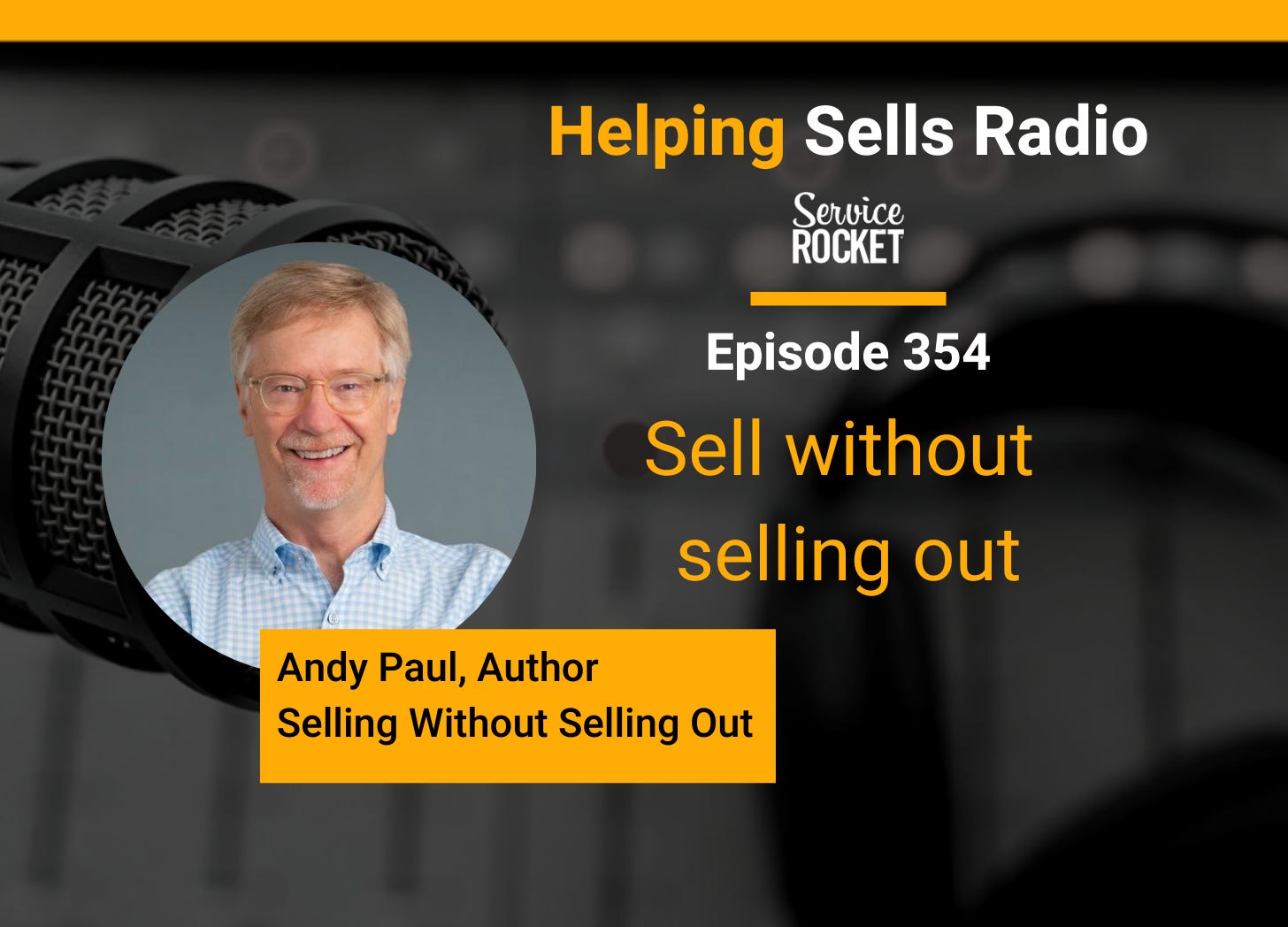 354 Andy Paul Sell without selling out82 / 100
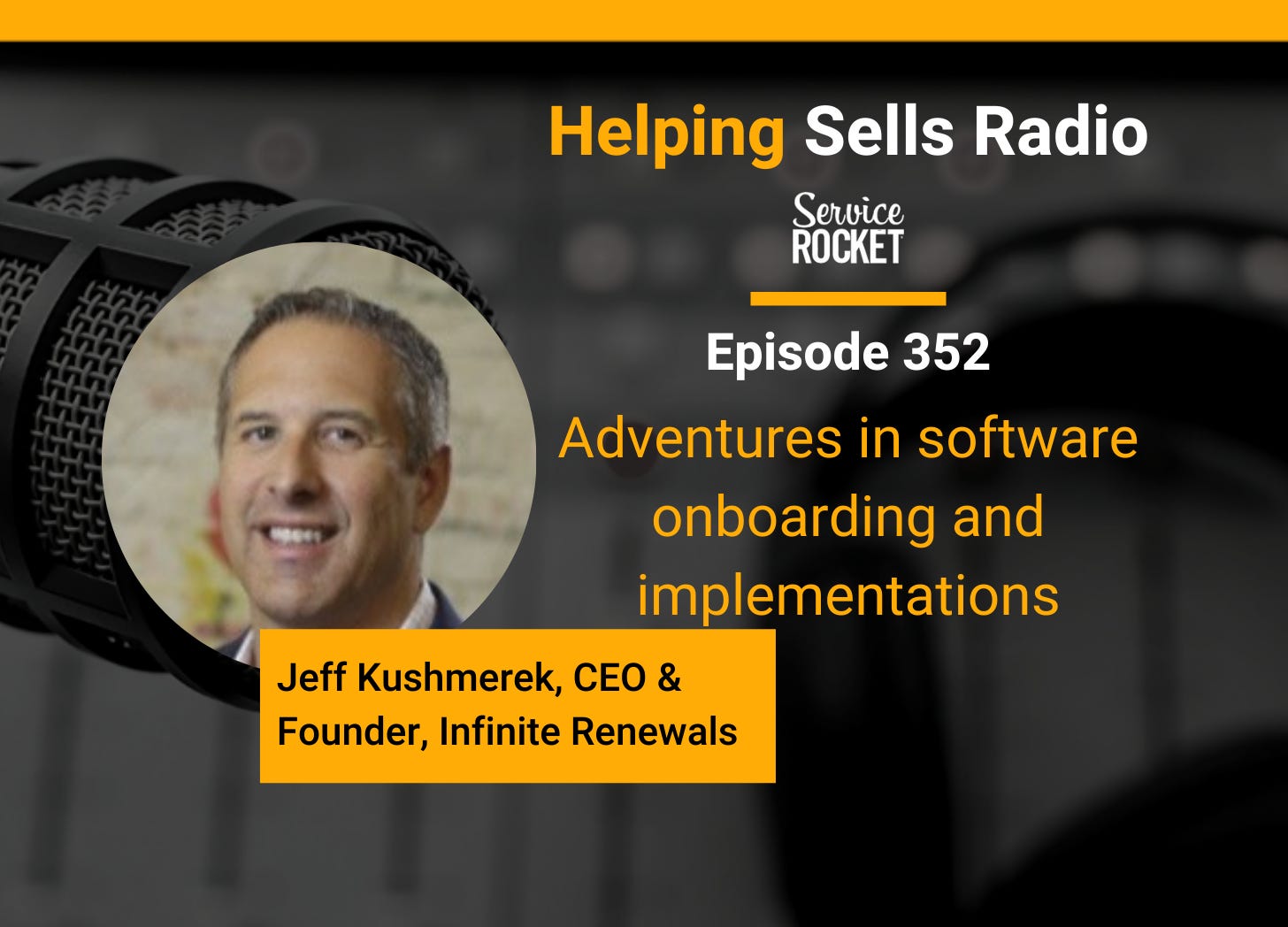 352 Jeff Kushmerek Adventures in software onboarding and implementations
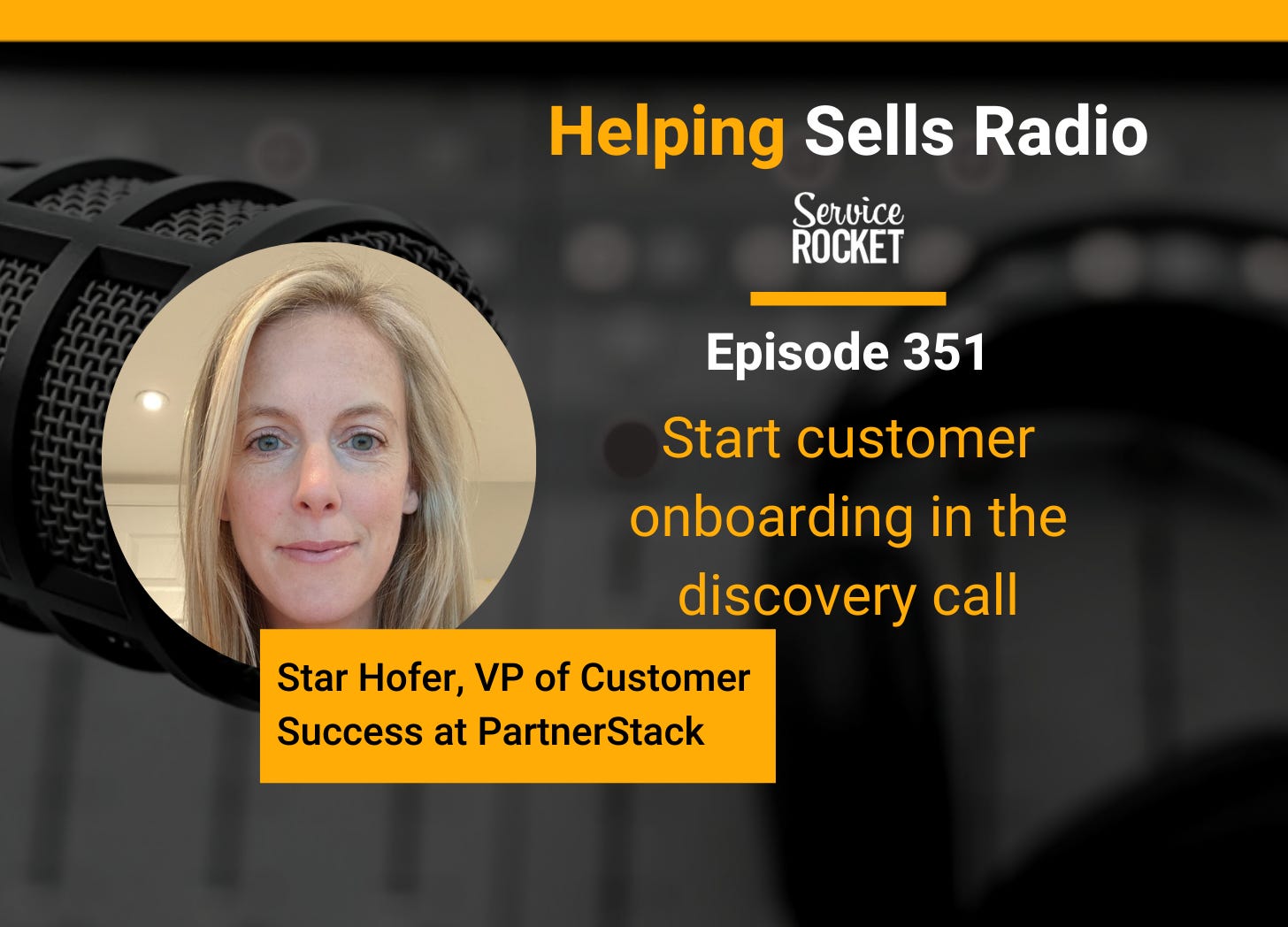 351 Star Hofer Says customer onboarding could start as early as the discovery call
 350 Peter Armaly Building a better strategy for effective go live
  349 Rod Cherkas Packaging your services offerings to support fast growth