Hardware to Save a Planet · 2026-04-02 · 41 min
Key moments - from our scoring
Substance score
57 / 100
Five dimensions, 20 points each
Deise Yumi Asami discusses how labor bottlenecks and construction speed have become climate-critical constraints on solar deployment. As solar panels grow heavier (70-80 pounds each) and demand from hyperscalers accelerates, the industry faces mounting labor shortages that threaten to slow the energy transition. Her company Maximo - an AI-enabled field robotics system developed inside AES - automates the mechanical installation of solar modules on tracker systems, addressing what she identifies as 50% of construction time. The robot uses vision-based AI to handle outdoor conditions (dust, glare, variable light) and works across multiple module and tracker types without retraining for each variant. Asami shares deployment experiences across US projects including the 1-gigawatt Belfield installation in California's Mojave Desert, explaining how digital twins via the Nvidia Omniverse accelerated development cycles and how working alongside skilled operators enables end-to-end automation on some projects. For solar developers, EPCs, and hyperscaler infrastructure teams, this reveals why deployment speed - not just panel costs - is now the binding constraint on reaching decarbonization timelines.
Maximo automates 50% of total solar construction time, which is dedicated entirely to the repetitive task of mechanical module installation. On some tracker systems, it performs end-to-end installation automatically with only an operator supervising and holding a safety switch.
Unlike controlled factory environments, Maximo operates outdoors with dust, glare, and varying light conditions throughout the day and year. Its AI-based vision system trains to recognize modules and tracker components despite these uncontrolled variables, and can now recognize new module variants without retraining after learning across diverse conditions and manufacturers.
Depending on tracker type, Maximo can operate in fully automatic mode where operators only supervise and hold a safety switch, or in hybrid modes where human crews perform specific tasks alongside the robot. The goal is to make existing crews more efficient rather than replace workers.
Maximo has been deployed across projects in New York, Ohio, Louisiana, Virginia, and California. Most recently, it completed 10% of the mechanical installation for the Belfield project - a 1-gigawatt solar and 1-gigawatt energy storage installation in California's Mojave Desert.
Using Nvidia's Omniverse, the team created physics-based digital replicas to test upgrades, fix technical debt, and stress-test new features remotely before deploying them across the fleet, enabling faster iteration cycles than hardware-only testing.
Our reviewer’s read on each dimension, with quotes from the episode.
The episode contains a handful of genuinely useful operational facts - the 70%/50% time-allocation stat, the outdoor AI vision challenges, and the Omniverse simulation approach - but much of the runtime is absorbed by scene-setting, meandering answers, and generic closing questions that produce no actionable insight for a B2B operator.
70% of the time is focused on highly repetitive activities and 50% of the whole time it is solely dedicated for the repetitive installation of solar modules
20 robots at today's performance could deliver roughly a gigawatt
The core thesis - robots address solar labor shortages - is real and grounded but not contrarian; the most interesting original thread (outdoor glare and uncontrolled conditions making field robotics fundamentally different from factory robotics) is raised but not explored deeply, and the closing questions produce entirely recycled answers.
when we look into a module that has glass in front of it...everything when the robot is looking, it's seeing glare everywhere
Is there a potential for the design of solar panels to change, to be more suited for robotic installation than human installation
Asami is a genuine practitioner who conceived, built, and is operating a deployed fleet of construction robots at commercial scale across multiple US states - she has real skin in the game and engineering credentials, not a thought-leadership background, though her seniority and public track record are limited.
Maximo was responsible for delivering 10% of that
for the past few projects we've been to, I would say three, and we have variances of five modules. We haven't really needed to make any have any training of the system
The episode delivers concrete figures - 70 - 80 lb modules, 400 - 500 module runs, 1 GW Belfield project with 10% Maximo contribution, 20 robots per GW capacity - that give real texture, though the future roadmap and expansion plans are explicitly kept vague and the competitive landscape is completely unquantified.
Belfield project. It's a 1 gigawatt solar, 1 gigawatt energy storage. Maximo was responsible for delivering 10% of that
400, 500 modules for one single run of the robot versus when you were Virginia
The host asks several genuinely useful follow-up questions - probing the business model, customer value proposition, and whether AI generalizes across module variants - but never challenges a claim, accepts vague answers about the future roadmap without pressing, and closes with three generic boilerplate questions that waste several minutes.
Does that certainty mostly come from speed, essentially, that it gives them more buffer in their schedule, or is there something about Maximo's approach that makes it more reliable
Sorry to interrupt. So you haven't had to train it on every permutation of tracker and the model of various panels
Computed from the transcript - who did the talking, and the words that came up most.
Utility-scale solar is racing to meet surging power demand, yet installation bottlenecks, including labour shortages, heavier panels, and inconsistent daily output, are slowing progress. Deise Yumi Asami and the team at AES Corporation are tackling this with Maximo, an AI-powered field robot that automates panel installation, thereby cutting build times while improving safety and deployment certainty. In this episode of Hardware to Save a Planet , host Dylan Garrett speaks with Deise about engineering autonomous robotics for unpredictable outdoor environments. She explains how computer vision replaces fixed programming, how simulation and digital twins accelerated development, and why EPCs value certainty over simple cost savings. The conversation explores scaling hardware inside a Fortune 500 company and reflects on how aligning technical skill with climate impact can accelerate clean energy adoption.
Transcribed and scored by The B2B Podcast Index.
So we're talking about solar modules that are 70 to 80 pounds roughly. We're talking about probably three stacks of the 24 pack of bottles of water that you're trying to lift over your head hundreds of times a day. And as they are getting heavier, you are needing more people to be involved. And as the demand continues to grow, obviously you would need a lot more people involved.
So finding ways to be more efficient, it's key. So if today we already face labor shortages, I do think that demand continues to grow. The labor shortage will only continue to have more effect. Hardware to Save a Planet explores the technical innovations that are giving us hope in the fight against climate change.
Each episode focuses on a specific climate challenge and explores an emerging physical technology solution with the person bringing it into reality. I'm your host, Dylan Garrett. Hardware to Save a Planet is brought to you by synapse. Make sure to click subscribe so you don't miss any future episodes.
Thanks for listening. Hello and welcome to Hardware to Save a Planet. I am very excited to be joined today by Daisy Yumi Asami, the creator of Maximo, a robot designed to accelerate the deployment of solar panels. Daisy created Maximo within AES, one of the world's leading power companies based in Virginia.
Accelerating construction of new solar installations is really important because climate change is caused by cumulative emissions. It matters how much CO2 we emit between now and mid century, not just whether we eventually decarbonize. Daisy has an electrical engineering undergrad degree and developed her career within AES for over the last decade and she founded Maximo in 2023. Daisy, it's an honor to have you on the show.
Thanks for joining us today. Hi Dylan, thanks for having me here today. I really appreciate the opportunity to share with you what we're building. Talking a little bit more about Maximo and deep dive on Tilde Robotics.
All right, let's do it. So I actually wanted to start by understanding a little more about where you're coming from. You founded this innovative robotics company or initiative inside AES, which is this big Fortune 500 energy company. I'm curious, what path did you take through AES to get to this point?
So starting a little bit, I think before AES, I had the exposure of working with special machines inside of factories. So I think that was the first time I got this kind of like connection to automation and robotics. When I joined AES, I joined through our business in Brazil. That's where I started.
And 80 years ago is when I had an opportunity to join the headquarters. Join AES next, which is an incubation investment arm of the S Corporation that is focused on new growth businesses. And Maximo came out of that program. So, so from day one when I joined the headquarters, I had this opportunity of starting a program that was called Solar Transformational Designs.
And the goal of that program was really looking into ways in which we could improve the financials of our solar projects and all the ways in which we could do so. But it would take a little bit more of a medium to longer term. So that's where AES NEXT would come in. And that's when I came into looking into the low hanging fruits of things that were right for automation.
And that's when I combined the both worlds that I'm passionate about energy and robotics. Nice. What, what were you, were you part of the kind of original concept for Maximo? Like identifying the need and understanding where various opportunities were to improve costs and what was that process like?
Yeah, it was from the very beginning, literally the genesis of Maximo. Obviously I wasn't alone. There's always many people across AES that support in any new initiative. I worked very close with the M and A team way back then to really understand what value could we bring by automating some certain repetitive tasks that happens at a solar construction site.
So if you look into a Solar construction site, 70% of the time is focused on highly repetitive activities and 50% of the whole time it is solely dedicated for the repetitive installation of solar modules. So we looked into the opportunity and the value that this would create by automating such tasks and accelerating the installation of solar modules. So through that I took it and ran with it and then conceived a few concepts out of which one of them that we decided to pursue was Maximil.
And then once we decided to pursue Maximo, we started from the basics, doing a design thinking process, understanding what value really creates, what opportunity we have, what are the things we want to prove first and the things we want to learn early on to then keep growing the initiative, if that makes sense. And I want to understand, I want to kind of dig into like the significance of this to climate change. So you're. And then in a little bit we'll get into sort of Maximo itself and what the robot's doing.
But at a high level, as I understand it, you're essentially speeding up the construction process of these solar installations. I said in the intro that, you know, climate change is really about cumulative emissions. So the faster we can get solar deployed, the better. We have more renewables on the grid and the lower our emissions are.
I'm curious what's actually happening though, when solar deployment is slowed down, what is the problem we're addressing there? If solar is slower, are there more fossil fuels being deployed on the grid? Do fossil plants run longer than they would otherwise? Or is it.
Can you. Can you help us kind of characterize the problem you're solving? I think maybe it's a couple of things I can share here. So one is solar over the past decade got so standardized and it is so cheap as a source of energy, then it makes a lot of sense for especially hyperscalers that are looking for faster time to power to deploy technologies such as solar to power their data centers.
And when we looking into other alternatives, I do think that there's a mix that will always exist. But being solar being one of the cheapest source of energies out there, I think makes a lot of sense for, for solar to continue to grow. I think for many reasons. There's, I would say a steady growth as of now, but we still see that continue to grow, especially because of the hyperscalers demand.
But then connecting that to maximo, when we look into that faster time to power, we can only meet that faster time to power if we do accelerate how things are done today and we challenge the status quo. And when we talk about accelerating schedules, there's only so much that can be done, given that everything is just so optimized and standardized in industry for solar specifically. So really looking into those opportunities of deploying a technology that can help accelerate certain tasks, it is going to be super valuable not only for the end user, which are the hyperscalers, but also for project owners who are able to build faster and have more certainty of delivery, as well as ultimately also EPCs, the engineering, procurement, construction companies that are involved in the process to have the ability to have the tools to have the equipment to be able to build faster.
Yeah, yeah, you mentioned the hyperscalers. I was going to ask about this because the projections for kind of our increase in energy demand are kind of crazy. There's all this new demand coming online. Um, what are the bottlenecks we're going to run into as that happens with solar?
And it sounds like one of them is just, you know, construction time itself is, is labor an issue? Are we, or should we also be thinking about, you know, land available for these things or raw materials or what? What are the kinds of challenges are we going to run into to meet that demand? I think a couple there you mentioned, definitely, as solar continue to scale and the other thing I didn't mention is the fact that the solar panels are getting bigger and heavier as well.
So them getting bigger and heavier, you also require more people to be involved in the installation process. So we're talking about solar modules that are 70 to 80 pounds roughly. We're talking about like it's probably three stacks of the 24 pack of bottles of water that you're trying to, you know, lift over your head hundreds of times a day. And as they're getting heavier, you are needing more people to be involved.
And as the demand continues to grow, obviously you would need a lot more people involved. So finding ways to be more efficient, I think it's key. So, you know, if today we already face labor shortages, I do think that if any more demand continues to grow, then the labor shortages will only continue to have more effect. I think for solar in particular, there's always other things that have a play in terms of the speed.
Everything is interconnected. Interconnection availability is another component. Land is something that we had also under my. The solar Transformation designs program is also another thing that I had envisioned.
And that through that we also made an investment in a startup company that was really making the most efficient use of land. So it's the east west type of design of solar where you can be a lot, you can have a lot more density. For the land that you have available, especially for behind the meter, those starts looking very attractive. It's interesting.
You talk about kind of the, the limit, you know, how as it gets heavier, it's harder for humans to install these. It makes me wonder with robotics as an option now for installation with Maximo and maybe others, is there a potential for the design of solar panels to change, to be more suited for robotic installation than human installation? And do you see that kind of feedback loop happening in the future? I definitely see see happening in the future.
What we do. Like, you know, this was more of a principle that we used when we designed Maximo, was to really make it work with what exists today without making changes to the supply chain, because the supply chain is just so established that trying to make that change while trying to introduce a new technology is just harder to make it happen. And plus also meeting the whole backlog that AES has. Right.
Like, I think this is something that we were very intentional. But nonetheless, as technology is starting getting more and more mature, we do see an opportunity for what we call like more automation friendly parts to be designed and also for solar panels to getting to get even bigger. One thing though, I would say is the future is not too far. There are some actually solar modules that are, they have hail protection and they are actually in the hundreds of pounds.
So we actually heard this from a colleague when we were talking about this type of modules and we're like, but how many people would you need to install modules if you're already using three to four? And they said, well, I'm sure Maximo can handle it. And it wasn't even anyone from Maximo team in that call, but it was so interesting to hear that the industry is already thinking about Maximo too. So support with installation of those modules, those heavier, bigger modules.
Yeah, awesome. I'm going to put some links in the show notes to you have some great videos of Maximo. So everyone can kind of visualize it, but can you say a little bit about what it looks like and what it's actually doing in the field? Yeah.
Well, Maximo, the way to think about this, for those who are seeing the video, it's great. So you have a visual. But if you're trying to imagine how Maximo looks like, it's essentially what we call our solar AI enabled solar panel robot. It is a system that it's almost of a size of a Ford F250.
It is taller, it's probably double of the height. Um, and the system is essentially what it's doing. It is truly detecting the solar modules. It knows where to pick, it knows what to pick, where to pick and where to place.
So one thing that it's unique about, you know, when we talk about field robotics and Maxima in particular, is the fact that, you know, robotics, inside of a factory, everything is controlled, temperature is controlled, the light is typically controlled. Often with traditional robotic systems, you are always like with a coordinate, you always know where to go and what you need to pick. And it's always the same position, or often it is the same position. When you are in a outdoors environment, you then start getting exposure to so many different components.
You have a lot of dust, you have a lot of glare. The light conditions varies not only throughout the day, but also throughout the year. And those things are things that we got exposure to as we've been operating for more than a year. Of course.
And with those conditions, it is important for us to have a way to have an AI based vision to really be able to handle those kind of uncontrolled things and aspects. So when we look into the, you know, to a module that has glass in front of it, when we look into the torque tube, which is like the tracker is typically the ground mounting system. It's the structure that holds the module into the ground. So we call those trackers.
And the torque tube is one component of it. And the piles, they are metal and they have reflection. So everything when the robot is looking, it's seeing glare everywhere. It's seeing parts of what it's supposed to see.
It's no different from us outside, outdoors and having kind of exposure to glare. So training our system was key to be able to handle those kind of aspects of being outdoors, but also to be able to handle all these variances that we have in the industry from a supply chain perspective. There are so many players out there, tracker manufacturers, module manufacturers, there are so many models within the same manufacturer, especially in our industry. The attachments, they can change every 6, 6 months.
Modules also changing very specific characteristics, probably faster than that. So for us it was really key to be able to have a system that would be robust, resilient and flexible to all those changes. So again, using an AI based vision system was very important for us. Sorry to interrupt.
So you haven't had to train it on every permutation of tracker and the model of various panels and everything. It's resilient to kind of permutations it hasn't seen before. Is that accurate nowadays? It is more resilient depending on the variants.
We do have to go through some training, but one thing that is very different is when I started this many years ago, literally when we had to change from one module manufacturer to another, it would take like six months at best because we would have to go through the whole training with all the different light exposures. We did get really good at synthetic images at some point, but then this is definitely not scalable. So we definitely improved all the AI frameworks that we're using and how we trained our models.
And then it got to a point, point that for the past few projects we've been to, I would say three, and we have variances of five modules. We haven't really needed to make any have any training of the system. He really just recognized and knows what a solar module is in different conditions. So it's essentially, and we'll see it in the videos, but the operation that it is automating is picking panels up and placing them on the kind of support structure, is that right?
That's correct. And then you talk about it kind of working alongside humans. I'm curious because often that in and of itself is a big challenge, getting humans and robots to work together. Is that a place where the sort of AI comes in, or how does that work, that humans and Maximo can work together?
For us, it was really everything that has been kind of the anchor of our existence is purely driven by the acceleration of the installation. So making the crews more efficient, it's really more about that. So having our operators working alongside Maximo is very important, especially because we have different modes of operation to this day, you know, depending on the tracker system. Today, we might already be able to do the whole mechanical installation.
So we call it the end to end mechanical installation of solar modules, where essentially all that the operator is doing, supervising and holding the safety switch and just holding a switch, you know, a button. And then Maximo does the whole thing completely automatically. And there are some other modes of operations that we would then have some hybrid support team to do certain tasks of the installation. So being able to operate, I would say, at the.
In California, we were there at least, you know, last year as we were ramping up our fleet, it was really key for us to be able to have a whole procedure from a safety perspective, from an operations perspective, to ensure efficiency of production, that we got the whole exposure to operating that fleet on site. So then we really know what the operator has to do, how they can do it safely, how the hybrid supporting crew, what they need to do and how they need to perform. So then we get the best out of that whole crew, which is comprised of Maximo and the people involved in the process, if needed.
I just have to say, okay, you founded in 2023, so three years ago, at least that's what I saw. Is that right? The business started to take shape around that time frame. Before then, it was really an initiative within AES.
Okay. Okay. Well, what I was going to say is it feels like you've made pretty remarkable progress in that amount of time. And I want to hear about the projects you're mentioning.
But to have a robot of this complexity kind of up and running and operational in a commercial environment in a few years, three or four years, whatever it is, feels. Feels. Feels like quite the feat. So well done on that.
And I'm kind of curious to hear about that process. And if there were things that Strategies you took throughout to kind of accelerate development or that enabled you to follow that path. Yeah, many things had to be in place so we could evolve from developing a single robot that you have in a real world. I mean, that's the benefit of being incubated by a corporation like AES.
We have many projects to go to. But then at the end of the day, the very first few prototypes and versions of our system that we built, we would end up having engineers having to be with the robot and pretty much operating the robot and debugging the system. But definitely that's not scalable, right? So I think taking a step, like a firm step into making a true kind of working product, working robot that is meant to be operated by very skilled labor, not very skilled labor.
I think that was very important. And having a way in which the robot can recover itself was also key. So that journey took some time, but we are definitely there today. And that's what gave us confidence to start scaling our fleet.
But I think the other component that was really important for us that helped us tons in terms of having a more accelerated deployment and accelerated upgrades and accelerated development. It is really taking benefit from the omniverse and things that can be done virtually. It's like you have a true replica of everything from the real world into physics, into a digital world where you can quickly test things out and develop things and understanding some scenarios and doing all of that kind of remote from the actual operating robot.
That was one of the most beneficial things I think we put in place that we definitely don't regret. So I'm talking about literally fixing some legacy technical debt that we had, or creating some upgrades and rolling out that across the fleet and understanding really stress testing that upgrade and make sure that everything is not only done properly, but it will work and it can be then deployed across the fleet. I think that was also key. And then obviously testing out the new things.
I think that sort of. It's always good to have the hardware with us. Definitely nothing replaces that. But having kind of like these fast paced things that can happen in the digital world that can be then quickly translated into the hardware, I think was super helpful to our development team.
So doing a lot of kind of test and iteration in a simulated environment allowed you to iterate faster. But then it also sounds like because of your connection with AES, you had access to these project sites where you could actually go do kind of supervised testing in a way that maybe a startup totally unconnected from a company like AES might struggle to be able to do. Yeah, we definitely benefited from first, from a program perspective, having our own kind of test facility and testing zone.
Everything was rather fast for us to be able to be out there. That was sort of another principle that we had very early on is really kind of like just not staying in the lab, but really testing everything outdoors as soon as we could. So I think that was from our perspective. But then the other one is once we get to a certain level of confidence of the technology, then being able to get the exposure to the real site.
Because once you are at a real site, it's completely different from just having some transactions, torque tubes and some, you know, some. Some small sections in your backyard versus really going to the site. What it takes from a logistics perspective, you know, things that are already in place that might affect the logistics of the robot or not, things that have to happen shortly after you installed solar modules that you need to ensure that, you know, it's all completed in time.
So I think it's getting that exposure early on was tremendously beneficial. And I do think we benefit from that from. From being with as. Can you.
Can you talk about some of the projects that Maximo has worked on or is working on? For sure. We've been across the U.S.
we've been in New York, Ohio, Louisiana, Virginia and California. Most recently we've been in California. We've been part of the Belfield project. It's a 1 gigawatt solar, 1 gigawatt energy storage.
Maximo was responsible for delivering 10% of that. We are very close to finishing the project and then heading to our next project with our fleet. But I think California was a phenomenal opportunity for us to really stress test the system at a fleet level and also make sure that we could reach the peak performance that we could. Because we're talking about the Mojave Desert, the runs that the rows are super long.
We're talking about 400, 500 modules for one single run of the robot versus when you were Virginia. The projects are like little pockets of. It's almost like a bunch of little po. It's a big project.
Like it was a 500 megawatt project, but it was like little pockets of solar sections. So we would then have a run, but then quickly have to turn and quickly have to turn. It was also wetlands. So we got a different type of terrain exposure.
So yes, we've been across all over the US and we got all sorts of different types of systems and different types of conditions that helped us to really understand what it takes to install solar model with a robotic fleet. And you talk about scaling, what kind of scale are we talking about? I think. Are you going to build a lot of have, you know, a lot more maximos, a lot of different robots that can do multiple projects in parallel?
Is that the idea? Oh, for sure. This year we are starting with parallel project, so it's more of a multi Site operations. We are, you know, continue to expand our fleet.
And the goal is really obviously what we want, want to continue to do is to develop the technology to get better and better. So the better the performance of the robot, the less robots you actually need to build. As a matter of fact, that happened last year. We had envisioned for a certain size of a fleet and as we challenge ourselves to actually boost the performance, we were able to actually just have four to deliver the same amount of megawatts that we had planned for the year.
So that was pretty incredible. And that's exactly what we're trying to do right now. It's not about having a huge fleet, is actually to have a high performing fleet. That's what we're focusing on.
Focused on. Okay, and what's how, how big is the fleet that you're planning? Like roughly how many robots are we talking? It's tens of robots for a couple of years.
The way you think about this is 20 robots at today's performance could deliver roughly a gigawatt. So we would say like has a capacity of delivering 1 gigawatt per year, which is a lot already. But again, as the performance of the robot increases, probably less is needed. But we are talking about, for Maximo, the business, we're talking about gigawatt scale.
Yeah. And then how does it relate to the AES business? Is Maximo about serving project development for AES specifically, is it something that you'll sell as a service to other, other product developers or EPCs? How does it work?
I think the benefit of being with AS is that we can follow its pipeline and follow also its footprint. But the commercial model for Maximo, it's really providing solar module installation services to EPCs. So the junior procurement construction companies are the ones who are effectively the customers for Maxmo and then the EPCs are the ones who are then often delivering those projects to project owners to companies such as AES and others. Okay, okay.
And what can you say anything about how the, like, what's, what's motivating them as Maximo really building its own, forming its own business and servicing EPCs. I think the key value proposition and the key thing that they are looking for is certainty of delivery, more so than anything else. Of course, the speed will come with the amount of robots that you're deploying and how efficient they are. But then at the end of the day, it is a lot about having that certainty of Delivery because the EPCs, they have to deliver those projects at a certain date.
And module installation being such a big Component of the whole time that they are at the site has a huge impact. And having that sort of certainty and being able to handle all the other things that might be delayed in between, that then put puts pressure into one of the last steps there of the module installation. It is super beneficial to them. And then the second component is also making their resources that are available more efficient.
So for the same amount of person in the project being able to install more modules on a per person basis, it's also super, super helpful to the EPCs. Does that certainty mostly come from speed, essentially, that it gives them more buffer in their schedule, or is there something about Maximo's approach that makes it more reliable or more reliably installed correctly? And this kind of thing, it is more about the certainty of delivery. For Maximo, it's really like guaranteeing that the modules, a certain amount of modules are going to be installed every single day, despite of variances you might have with the crew.
So when you have manual installation, you might have a lot of variances first on the training and then the second on people coming in and out and having different types of performance. As you can imagine, we were Talking about the 70-80lbs of modules being lifted hundreds times of times of days by those crews. With Maximo, you're just holding a button and you're having the same performance every single time. You're having the modules being installed with the same pace because that's what the equipment is doing for the people.
It's not getting tired. It doesn't get tired. It can support extended shifts as well. This is something we've proven actually in a few of our sites to extend the fleet, not only because depending on the wind, of course, there's a certain limit to it, but depending on the wind that you have at the site, because the robot is the one who is doing the lift of that big panel.
It has a little bit more security to it, so there's a little bit more extension compared to when you're actually doing with people. And that thing might fly off. It's not a robot holding the system. So extending those kind of times of operations, even though it's a little bit.
Until it's actually shut down, it's very, very, very helpful. As you're working more with your customers with the EPCs, are you finding other opportunities to automate other aspects of the process or to do, you know, increase the scope of Maximo or future iterations of Maximo or other robots? Yeah, when we have a lot of things in our roadmap that we obviously don't stay just within the maximum scope of solar module installation. We do expand to other scopes, but those are more on the confidential side.
But I think just ultimately, the way that we're building our business, we see a huge potential for us to expand to other verticals. That goes even beyond just solar. We are starting with solar because that's who we are and what we do. But the underlying technology and the platform that we're building can go really beyond that.
Looking into the future, what's your vision for Maximo and what kind of impact do you hope to have? I think looking to the future, what I see, I mean, emerging competitors are growing, which is really reinforcing, and it's great to see underscores. Right. Like the need for things in technologies like Maximo.
But I see the future being full of robotic systems, and that's going to be the norm. That's going to be the standard. And I think the idea of Maximo is to continue to grow the fleet and grow the team so we can continue to do wonderful things. And again, not only for solar, I think it goes beyond that.
All right, we'll be watching. I have three questions that I close every episode with. But before I do that, is there anything you wanted to hit that we haven't talked about yet, trying to land us on time here? No.
Nothing else. Right. Okay. I have three last questions for you.
The first is, how optimistic or pessimistic are you about the future of the planet and why? I am very optimistic, but that is because I believe that there are so many things. I do have a huge bias to technology in general, but I do think it would just continue to improve and get better. I think it's just having the world focusing on the things that really needs to be paid attention to so, you know, we don't destroy ourselves in the future.
So I do have a very optimistic view of the future. All right, who is another company or individual doing something to address climate change that's inspiring you? I think there's. I do.
You know, when I started at AES, I started with the new growth businesses and it was like looking into the technology, radar, and what really inspires me, quite frankly, it's like those things that are. You don't see them coming and they're so small today, but they might be a big thing in the future. But it's really finding those things, those opportunities early on, not only from the business, but, like, for really having an impact. To me, it's more generic.
It's not like a specific company or specific technology, but it is those early on technologies that you see as having a potential impact and if they really drive value to the world, to the planet, I think those are the things that I want to see coming to fruition. Yeah, totally. And I think that's a really good, really good way to characterize a lot of the kind of entrepreneurial spirit that's getting after climate change right now. Like seeing those little seeds and the potential they could have and really kind of pursuing and developing it.
What advice do you have for someone not working in climate today who wants to do something to help? Something to help the world? Yeah, help with climate, fight climate change, save the planet. Would you mind repeating the question?
Last question. Yeah, no problem. What advice do you have for someone not working in climate today who wants to do something to help? I think my, my biggest advice, I would say that it's important, maybe it's a twofold.
One is what's really important is for you to looking into where you add value and where you're bringing to the table and what are the things like that you do that really drives energy, focus on that so then everything will come kind of like unfolding really well. The second, I think the other element is to then truly understand the value that you are creating and what impact it has so to the world and to the planet. So then if you understand that it's not about you just having a cool idea or wanting to help, but you don't know where to start.
But if you understand that there is a hard problem to solve and if you understand the value that that's driving to the world, then you will for sure have an impact. But you have to have those two things. One is the internal drive and the second is more of the true impact that you can have to not only a company, but to the planet. Yeah, yeah, think about the impact.
I love it. Daisy, thanks for everything you're doing. It's really important work. Maximo is super cool.
I'll put links to some videos and stuff in the show notes and everybody should go check it out. Really appreciate your time. Thank you so much Dylan. And thank you for the conversation.
Hardware to Save a Planet is brought to you by synapse. To find out more about us and how we develop hardware solutions for the world's most ambitious companies. Head to synapse.com and then make sure to search for hardware to save a planet in Apple podcasts, Spotify or anywhere you like to listen.
Make sure to click subscribe so you don't miss any future episodes. On behalf of the team here at synapse, thanks for listening.
Other episodes covering the same guests and topics, from across The B2B Podcast Index.
 Franz Tschimben (ALLSIDES) & Michael Brehm & Ben Scheidt (Redstone): Why physical AI needs 3D dataEUVC · on Robotics85 / 100
 Bending Gravity To Build Houses FasterWhat The Tech? · on Robotics84 / 100
 Is encryption enough to protect our data?Technology Now · on Hardware acceleration81 / 100
 SpaceX Starfall And Apple Price Hikes | The Brainstorm 138FYI - For Your Innovation · on Hyperscalers80 / 100
 Steroid Era With Spencer Jakab, the F***’s Going on With Strategy?, Margin DebtThe Compound and Friends · on Hyperscalers80 / 100
 The Robot Is Waiting on Your Data.AI Proving Ground Podcast · on Robotics78 / 100
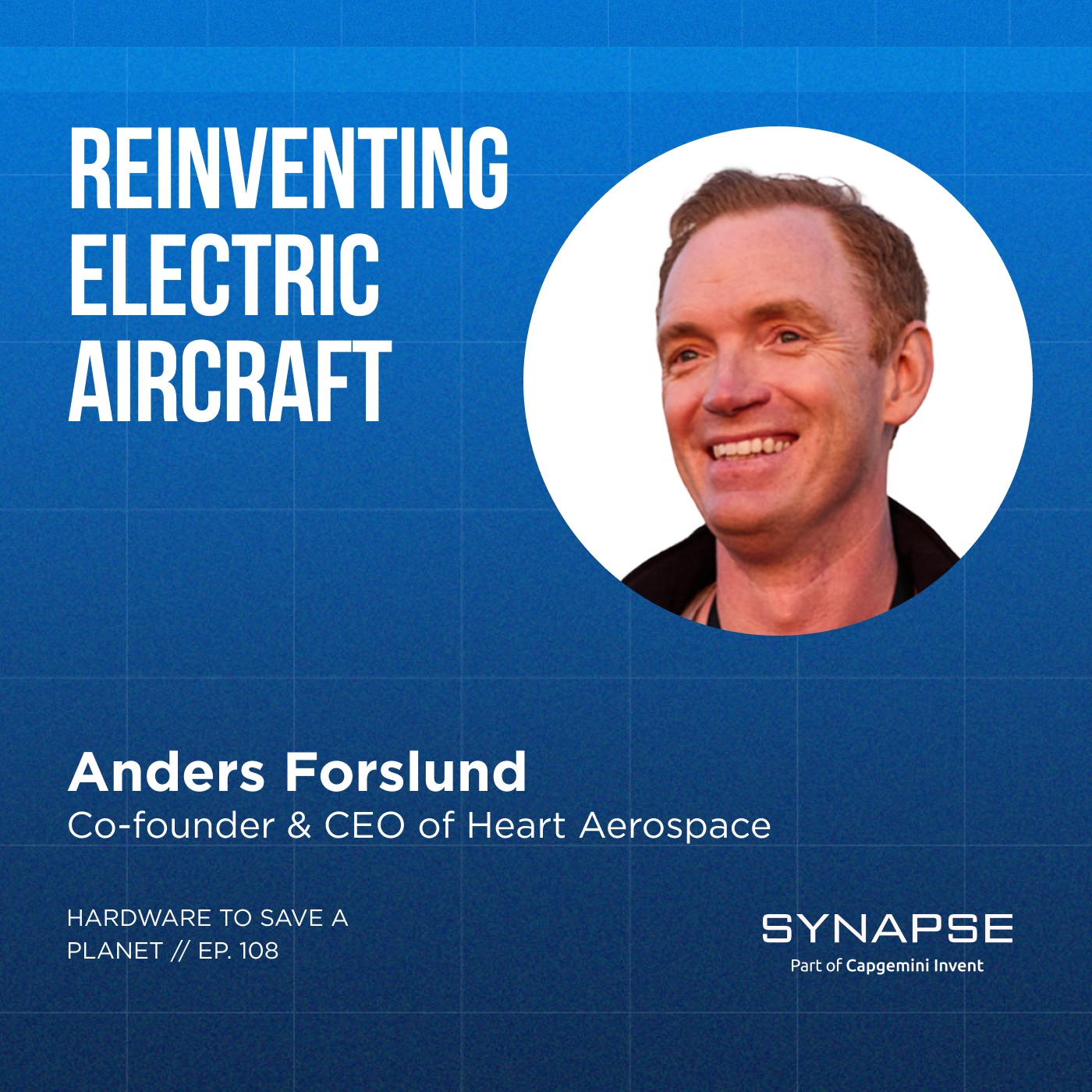 Why Electric Aviation Is Finally Becoming Possible | Anders Forslund97 / 100
 Turning Cow Burps into Clean Energy with Griffin Cherry85 / 100
 The Race to Replace Plastic: 2026 SF Climate Week81 / 100
 Climate-Driven Wildfires: Building Faster Fire Response Systems with Andrea Santy65 / 100
 30% More Power, 20% Lower Costs: Scott Graybeal on Solar’s Step-Change Moment86 / 100