
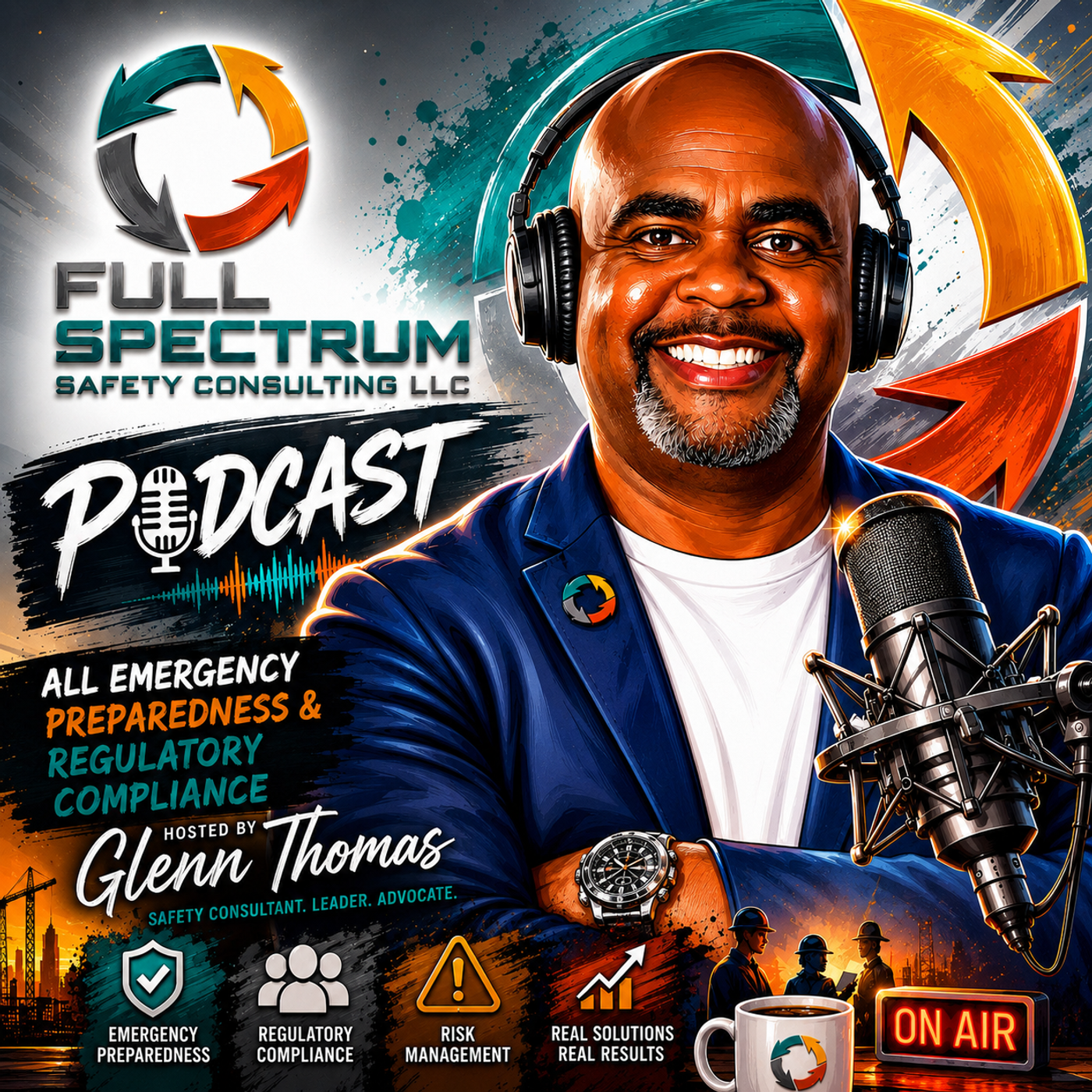
Full Spectrum Safety Consulting Podcast · 2025-09-20 · 29 min
Key moments - from our scoring
Substance score
46 / 100
Five dimensions, 20 points each
This inaugural episode of the Full Spectrum Safety Podcast features Glenn Thomas (Full Spectrum Safety Consulting) and Stan, a 25-year consulting veteran in fire and life safety, unpacking practical personal preparedness strategies. The hosts stress that home preparedness isn't about doomsday prepping - it's about creating baseline capacity to support your family, your workplace, and your community when emergencies strike. They walk through concrete essentials: water storage (challenging the one-gallon-per-day FEMA standard with risk assessments tailored to regional hazards), dehydrated food, lighting (prioritizing headlamps), power solutions (solar and lithium battery systems), and non-electric tools like manual can openers. Storage degradation in extreme climates - plastics failing in 130-degree Arizona garages - gets practical attention, as does battery safety. The conversation extends to vehicles as preparedness extensions, covering fire extinguishers, go-bags with clothes and toiletries, emergency shutoff tools, and cash reserves. Ready.gov and similar resources are positioned as practical starting points. Pet preparedness, vital records, medications, and functional-needs planning round out the framework. This episode targets safety professionals, facility managers in long-term care, and B2B operators seeking to build organizational resilience by anchoring it in personal and family preparedness first.
The FEMA standard of one gallon per person per day for three days is a baseline, but Stan recommends conducting a hazard vulnerability assessment specific to your region - Arizona and hot climates require significantly more due to heat stress and power failure risks, so store what you actually need based on your climate and access to municipal water.
A manual can opener, emergency shutoff multipurpose tool (with gas and water shutoff capability, prying, and window punch features), and a reliable saw are critical - these enable you to access food, shut off utilities, and clear debris when power is unavailable.
No - don't store fuel in the generator because it degrades over time and reduces reliability when you need it; keep the generator fueled separately, maintain it periodically, and test it regularly to ensure it operates when called upon.
During emergencies, power outages disable card readers and digital payment systems; Hurricane Katrina demonstrated that cash is the only reliable payment method for supplies, services, and critical resources like portable sanitation units when infrastructure fails.
Include a change of clothes (shoes, shirts, pants, socks, undergarments), toiletries (toothbrush, toothpaste), and medications or vital medical records; Glenn keeps one at his desk and one in his vehicle since he supports multiple long-term care communities during wildfires and emergencies.
Our reviewer’s read on each dimension, with quotes from the episode.
The episode covers standard preparedness advice (water storage, food, flashlights, generators, cash) that is widely available from FEMA and Ready.gov. While the guest's point about hazard vulnerability assessment and regional variation (Arizona heat vs. Midwest moisture) adds modest depth, most claims are introductory and predictable. The hosts acknowledge they won't cover 'every single point' and frequently defer to external resources rather than deriving novel insights.
one gallon of water per day per person for three days is a general rule. But you've also got to consider the hazard vulnerability assessment
It's really all about readiness, having the stuff that you need at, ah, fingertip accessibility, making sure that it's properly charged, maintained
The episode recycles conventional preparedness frameworks without fresh perspective or counterintuitive thinking. The hosts repeatedly direct listeners to Ready.gov rather than offering original analysis. The single original anecdote - Stan's realization about not having a fire extinguisher in his car - is presented as personal oversight, not as a derived principle. No contrarian arguments or first-principles rethinking is evident.
Ready.gov is filled with checklists for older Americans for kids, for people who are responsible for vulnerable populations
Don't recreate the wheel. We want, uh, to do the heavy lift for you
Stan brings legitimate practitioner credibility: 20+ years as a firefighter/deputy fire chief, 25 years running a consulting firm, retained consultant for multiple state healthcare associations. Glenn also has 18 years in long-term care. Both are operational practitioners, not career podcast guests. However, neither demonstrates deep expertise outside their vertical (senior living/long-term care emergency prep), limiting relevance to a broader B2B audience on general preparedness.
I retired as deputy fire chief and fire marshal
I've been engaged with for almost 25 years
The episode lacks concrete data, metrics, and named case studies. References are vague: 'Hurricane Katrina' is mentioned once without specifics; the wildfire evacuation anecdote involves only a first name and no timeline or outcome. The '130 degrees' Arizona garage temperature is a single data point. Most advice is generic (keep water, maintain batteries, use cash) without quantities, costs, or comparative evidence. Show notes are promised but not provided.
sometimes my garage gets as high as 130 degrees so plastics and other things start to degrade
I know of numerous examples, particularly during Hurricane Katrina, where there were people that served vulnerable populations
The hosts trade friendly questions and anecdotes but rarely push each other or challenge claims. When Glenn mentions not fueling his truck regularly, Stan jokes about mentorship rather than exploring why preparedness practices fail. Follow-ups are mostly confirmatory ('Absolutely,' 'That's a great point') rather than probing. The conversation flows naturally but lacks the sharpness needed to extract deeper insights or test assumptions.
Well, if it didn't cost me $175 to fill thing up, maybe I'll be a little bit more prone to keep it fueled up
I'm surprised because I am. Um, I thought if I'm your mentor, you better listen and keep those fuels above three quarter
Computed from the transcript - who did the talking, and the words that came up most.
In this episode, we dive into the fundamentals of personal preparedness and explore how this sets the foundation for developing a mindset of preparedness.
Transcribed and scored by The B2B Podcast Index.
Speaker A: If we're not prepared, we as individuals are not prepared in our home life, how are we going to be prepared to respond, to be able to serve our communities that we may be supporting in our day to day roles or anybody be prepared to take care of their business when an emergency strikes. So I know in my home life I focus a lot on preparedness and ensuring that my family is well equipped to be able to deal with whatever emergency we're faced with. And that will give me the ability to focus on getting back to work and to assist our communities. Hello and welcome to the Full Spectrum Safety Podcast. Really excited. This is our uh, inaugural podcast. We're kicking it off. It just so happens that it's National Preparedness Month and we thought it would be a great idea to have a conversation regarding preparedness as a whole. I'm your host Glenn Thomas, owner of Full Spectrum Safety Consulting and we uh, have a really special guest with us uh, today. Kind of break my career up into three sections and I truly feel I have mentors uh, in my career. I uh, had a really strong mentor with my former fire service career who got me into the fire service. I have a ongoing mentor with my current role with continuing life now as well. That's gotten me into a long term care space and then someone I also consider a mentor, Stan. And I'll let Stan introduce himself who's um, who's helping uh, me get immersed into the, the uh, consulting realm as well. So really fortunate to have Stan with us today. And with that being said, I'll turn it over to you Stan for an intro of yourself.
Speaker B: Well Glenn, I am so thrilled to be your first guest on this inaugural podcast and uh, for you to consider me as a mentor, I really appreciate that. But you know, similar to you, I've got a consulting practice that uh, I've been engaged with for almost 25 years. I parlayed my career in the fire service which started a lot longer before yours did. But I got into the fire service as a kid back when I was in high school. The year was 1977. Community that I lived in, had a cadet program with a small paid on call fire department. Fast forward a few years. I became one of the communities first of uh, six full time firefighter paramedics. And in a blink of an eye 20 years kind of came and went as a career firefighter. I retired as deputy fire chief and fire marshal. But on the side like a lot of brother and sister firefighters do, I had a little bit of a side gig and I was Consulting with vulnerable populations. First assisted living and then nursing homes helping facilities prepare for disaster. Starting a consulting business in the Chicago area where I was based. But ultimately when I retired I did what all good Chicago area firefighters do. I moved to Sunny Mesa, Arizona. But I didn't really retire Glenn at all. I just kind of shifted gears. Focused on my passion. Helping people in vulnerable populations which include the senior living and long term care space and help them, um, focus on compliance when it comes to things like life safety, but also being prepared for emergencies. Uh, in addition to my own company, Fire and Life Safety Incorporated, I'm the retained consultant for the Arizona Healthcare association, the California association of Health Facilities and the Utah Healthcare association, along with the American Assisted Living Nurses Association. So I've got a lot of great friends like you and clients where I help that vulnerable population be prepared for emergency and disaster.
Speaker A: Thanks for that intro, Stan. You know we share a lot of commonalities in what we do, but we both spend a lot of time in the long term care space. Obviously we just heard parts of your resume and times you spend consulting with different long term care providers of all different types of and for the last 18 years that's been my bread and butter helping to support large scale continuing care retirement communities throughout the state of California. Uh, with all levels of care from we're going to talk about from a preparedness standpoint will be dovetailing into future episodes as well to talk more in depth in the long term care space regarding preparedness and regulations and how to be compliant with But I thought today would be a great conversation and a great starting point to talk about general preparedness and the general preparedness will dovetail into all aspects of our life but also into other industries as well. This is not only a uh, long term care specific podcast, this truly is a general industry podcast where we can gleam ideas and takeaways on how to keep all of our uh, workplaces more secure and resilient through preparedness.
Speaker B: Yep. Love it.
Speaker A: So with that being said, what I like to do is go ahead and get started with home preparedness. Some home preparedness efforts. As we were preparing for this we were talking about the need if we're not prepared, we as individuals are not prepared in our home life. How are we going to be prepared to respond to be able to serve our communities that we may be supporting in our day to day roles or anybody be prepared to take care of their their business when an emergency strikes. So I know in my home life I focus a lot on preparedness and ensuring that my family is, is well equipped to be able to deal with whatever emergency we're faced with. And that will give me the ability to focus on getting back to work and to assist our communities, keep our residents safe, keep our employees safe. So I know that uh, one of the things that I focus on a lot is uh, just ensuring that my home is well equipped. When it comes to the essential supplies, uh, what I consider essential supplies. If we were to go into my garage, those things are going to be food, um, and the food will come in the form of dehydrated food. Uh, it's not going to be, you know, a, ah, five star gourmet meal. This is going to be something we're going to rehydrate to get some calories in, to be able to get, give ourselves energy. Water is really important. You know, water being more important personally I believe than, than food. You know, we, we can go much longer without food than we can water. So what water do we have in our water provisions do we have in our homes to be able to make sure we can make it a number of days? Speaking of days, you know, I always. The gold standard, you know, one gallon per person per day. From a water standpoint, it's kind of the gold standard. What do you think about that number? Is that the right number? Might it be a little bit higher depending on where we live? Maybe you're in Arizona. What are your thoughts on that?
Speaker B: Yeah, great point. Water is essential clearly in Arizona and anywhere for that matter, as you point out, even more than the food or other levels of subsistence. But you know, that whole FEMA standard of one gallon of water per day per person for three days is a general rule. But you've also got to consider the hazard vulnerability assessment. Uh, if you're in a rural area and you don't have access to water, or you're in an area like Arizona where it is significantly hotter, longer during the year, power failure is a real threat. You've got to determine as an individual person or as a family unit what's going to be the right amount for you. When we get later on in our discussion about regulations such as CMS regulation, they no longer use for, let's say a skilled nursing facility, the formula of uh, one gallon of water per day per person for three days. They actually say that you need to do a risk assessment to determine actually how much water you need for a specific amount of time based on your own needs. So I recommend the same thing for family units or even individuals if you're Going to need more than three days. You should make that determination and have the amount of water that you think is necessary for your own subsistence. So if you were to go in my garage, you'd probably see a lot more water than you think might be required. But again, Arizona supply chain, excessive heat. In this case, having more rather than less is something that I made a determination for. So we're stuck, filled with water.
Speaker A: Those are great points regarding just the uh, how to go through that assessment to determine how much water or other supplies you may need. One of the things that we'll do in the show notes of this podcast are drop some links in there for our viewers to be able to, if they're watching this and they don't know where the starting point is, to be able to look at those show notes and, and, and um, access some resources to help them build, uh, build their plan. So we talked about food, we talked a little bit about water. Other provisions that I'm concerned about are going to be. Lighting is important to me. I'm a big proponent of headlights. Flashlights are great, but I like to be able to keep my hands, keep my hands free to be able to do whatever I need to do in the moment. So I find a good reliable headlamp is always a really solid thing to have. And then you know, it just provides a means to provide general lighting within your home, um, as well other supplies such as battery powered generators or solar power generators to be able to keep cell phones charged. You know, one of the things that we know is that during emergencies, even if our uh, backbone infrastructure is damaged, meaning cell towers and those types of things, we may still be able to text. So we want to be able to keep our devices charged as much as possible. And then more importantly, there could be medical devices, right? Medical devices or other ancillary devices that may need to be charged. Having some type of, whether it's gas powered generator that you can use outside, propane powered generator that you can use outside, or more of the lithium type larger battery packs that you can run different appliances off of for shorter periods of time, keep things charged up. Uh, and those type of things I think are really important because considerations. What else do you have?
Speaker B: Well, let's get, let's talk about batteries for a second because you know, anytime that we're utilizing batteries, storing batteries, we need to do it safely. And one of the biggest risks with uh, lithium batteries is overcharging them, especially if they are not really formidable batteries. And what I mean by that are some people think that they're getting a great deal with a, uh, lithium knockoff battery that they purchased from someplace else in the world. Sometimes those cells aren't very reliable and when they're overcharged, they break down and you've got a fire risk. Same thing with your gas powered generator. I've got a small generator in the garage ready to go. I do not keep fuel in it because I don't want that fuel to break down. I need it to be reliable. I test it on a periodic basis. But it's really all about readiness, having the stuff that you need at, ah, fingertip accessibility, making sure that it's properly charged, maintained, not overcharged, that you're not creating a hazard from something that you've got in place for preparedness. That would be quite the irony that, you know, your lithium batteries start your garage on fire or something like that.
Speaker A: Those are absolutely good points. And aside from that, you know, you started talking about it a little bit, but just making sure on an ongoing basis that your essential supplies are maintained, are properly maintained. Whether it's charging batteries, whether, uh, it's making sure your food's not expired, whether it's making sure that you didn't develop a rodent issue nearby or in your food, whatever it is, uh, periodically check, you know, checking those supplies from a workplace standard. Definitely recommend that minimum of monthly to check all of your emergency supplies. And it's not a bad best practice for home as well. When you're in the garage and you're getting ready to roll out the lawnmower or getting your vehicle to go out or whatever it may be. Just kind of have a checklist easily accessible, just to be able to lay eyes on those, uh, on those essential supplies quickly and to make sure that all those supplies are accessible, that they're still there. Nothing grew legs. And with that being said, I'm a big proponent of having dedicated supplies for emergency preparedness. I try not to use my home tools. If we're talking tools for emergency preparedness and supplies for emergency preparedness for daily use. Really it's a dedicated ration of supplies, tools, food, water, whatever it is to use just for that purpose. I just find, you know, and don't
Speaker B: forget about, um, degradation. What I mean by that is when I was in the Midwest, everybody had a basement and we would keep things in basements, sometimes finished or partially finished. We had a storeroom where we kept our supplies. But in a basement in the Midwest you got to worry about moisture and potential for water intrusion. You move out to Arizona and I'M assuming a lot of parts of California as well. We don't have those basements, but we've got the garage. And in Arizona, I mean sometimes my garage gets as high as 130 degrees so plastics and other things start to degrade in there. So you've got to be on alert for how you're storing things. Don't just keep stuff in a box and then think five years from now it's going to be fine. You might open it up and it's completely degraded. So the things like that, you know, and other things. When we talk about food and water supply, make sure that you've got the tools, the non electric tools. One thing that everybody should have in their house that they might not have is the old fashioned mechanical can opener. You know, you get the convenience of an electric can opener, but if you don't have the power and you don't have an electric can opener, those non perishables that might be in a tuna can, you're going to have a hard time getting access to.
Speaker A: Absolutely. A really good, a really good point to bring up. How are you going to get into that food? If you're using like you said, a can type food and rations, how are you going to get into that food? Because power probably won't be around. So really good point. So we've talked a little bit about tools. Um, you know I don't think we're going to get into every single tool we have, but just some, like you said, some general tools to be able to get by. An emergency shutoff tool, I think those are really important tool, some type of emergency shutoff multipurpose tool. There's uh, a lot of really nice ones out there that are relatively lightweight, that have multiple capabilities. Gas shut off, water shut off, a prying tool, a hammering tool, everything kind of built into one. Many of them have window punches on them as well. So kind of to have a multi um, purpose, reliable tool that you can use to address any utility related issues around your home is probably a really good consideration as well.
Speaker B: Yeah, or your threat assessment. If you're out in the country and you've got a driveway with trees or bushes and the storm, or in our case in Arizona, the haboob comes through and knocks, you know, landscape items over. You might not think about it even if you have a landscaper or someone that services your property, but having at least a basic saw to cut branches or even a chainsaw. Or today, you know, with these tools that are powered by lithium batteries which can include saws and vacuums and other devices that would be helpful in an emergency, kind of assess what your own needs are and have the capabilities available to meet those needs in times of crisis.
Speaker A: Absolutely needs to be specific to your region, to the emergencies that are most likely to happen based upon your threat assessment you mentioned. And again, in the show notes, we'll drop an, uh, example of a threat assessment in there for folks to be able to look at and to further develop their home preparedness plans. I think a lot of these things that we're talking about also transfer into your vehicle. I try to look at my home and my vehicle very similar. I probably spend more time in my vehicle, unfortunately, than many times I do at home. So what equipment do I have, what tools do I have in my truck to be able to, A, get me home or B, if I'm somewhere else and I need to now, you know, be able to, you know, clear a smaller tree from across the road to, uh, be able to get through or again, address the utility issue with gas or water, whatever it may be, what do I have to be able to do that? So for us to have those same type of tools and resources, not to the same degree we would in our home, not to, you know, I'm not a doomsday prepper. I don't say, oh, I need to have a bunch of water and a bunch of food and I carry around a chainsaw on my truck. I don't do that. But just some general things to be able to get us around, to get us from point A to point B and to, you know, if we're at work, uh, because we're talking some about how this blends into our work preparedness as well. We have some other things to be able to keep us up and operational as well.
Speaker B: And, you know, this was as basic as basic could be. And it amazed me that I just didn't consider this. And as focused as I am on preparedness, you think I would. But it was only just a few years ago. And I'm not a truck guy like you. I know you've got a big old rig. I'm a sedan guy. And I just realized after seeing all these videos that you see on different reels and stuff of vehicles that, uh, catch on fire and all the traveling I do in state, down, uh, to Tucson with clients or up to Flag, occasionally I'll drive out to California. And if I'm on that freeway or that interstate, I realized I didn't have a fire extinguisher. Extinguisher, uh, with me. So I saw the sale sign at the Costco. I picked up a fire extinguisher for each car. And, you know, it's as basic as that. Those basic tools, the wrench, the screwdriver, the pliers, the hammer, whatever it might be, having a little bit of, uh, an emergency kit in your car, along with the flares, the extinguisher. It's really about a mindset of readiness and having the capabilities to be able to succeed.
Speaker A: Absolutely. You know, one thing that I think about from the vehicle standpoint as well, I've unfortunately had the opportunity to spend multiple days at different communities, uh, during emergencies. Most commonly that I'm faced with here, uh, in California are wildfires. So we're up, we're operational, our emergency operations center is open and within our communities. And we're monitoring, we're actively monitoring. And sometimes that goes on for days. Um, just to have a little bit of a go bag in my vehicle, just with some clothes that I. That I've just kind of maybe a little bit older, a little bit more ratty, if you will, that, that I just don't wear on an ongoing basis. A pair of tennis shoes, a sweater, a couple T shirts, couple pairs of pants, some socks, some gar. Undergarments, and then, uh, you know, some, uh, general. Just, uh, go bag with toothbrush and toothpaste and things like that. It's just good to have. I leave it at my desk. And I also actually keep 1m in my vehicle as well, because I help support multiple communities. I never know where I'm going to be. So if I'm in a vehicle, need to go help support a client side or whatever it may be, we're ready. And then if I'm at a stationary location, we're ready as well, to, uh, be able to. To ride out the storm, if you will, for a couple of days, you
Speaker B: know, and it doesn't have to be a heavy lift. I know that you're talking about resources and a resource that you and I both promote to our clients and to our folks in our employment situations. Ready.govReady.gov is filled with checklists for older Americans for kids, for people who are responsible for vulnerable populations. I'm pretty sure that they've got a checklist of the things that you should have in your car. A go bag. So talk about that a little bit, Glenn, how ready.gov and some of the other resources that are out there factor into this whole discussion.
Speaker A: Yeah, that's a really good point. You know that that resource and Others that will again drop into the show notes. You can just easily. You don't have to be overwhelmed by, by a starting point. If we're trying to figure out where to start.
Speaker B: Don't recreate the wheel. We want, uh, to do the heavy lift for you.
Speaker A: That's it. That's it. We'll do the heavy lift for you. Utilize your resources, drill down into what's specific for you. Uh, you know, ready.gov and other resources will drill down into if you have someone in your home with access or functional needs or any other type of special needs or older folks in your home or your pet. How about pet preparedness? Like everybody loves little Fido, right? No one's going to leave little Fido behind during the emergency. How do we make a little go bag for Fido? Uh, with some essential and vital records or if Fido takes medications or if you have medications. All these things are relevant, right? All these things are relevant when it comes to vital records. Having copies of things easily accessible. Cash money. You know, cash is king during emergencies. I know. I've been through a couple emergencies and I'm sure you have as well. Especially spending, um, uh, a big part of your career in other regions that were prone to, you know, other types of hazards and emergencies. If the grid goes down, there's only one thing that's going to get you supplies and that's cash. Credit card machines don't work, you know, and if you've ever come across a 20 year old kid in the Lowe's, they have no idea what the old school carbon copy swipe, credit card imprint machine is. No idea. I don't even think they exist anymore. So cash is king. And having those in your, in your uh, in your go bag is really important.
Speaker B: Yeah, I know of numerous examples, particularly during Hurricane Katrina, where there were people that served vulnerable populations. And as they made their way out of town in advance of the storm, that's exactly what they encountered. They needed cash and they. Fortunately, some of the clients that I work with understood this premise, but others didn't have an understanding of that. And I get it. Especially for individuals in cashless societies, the way that we've evolved, or organizations that really rely on not using cash. It's uh, sometimes a controversial issue, but take our advice. Having that petty cash available. And what would be a great example, let's say that there was a cyber attack that took down public utilities and you had uh, an environmental emergency where you couldn't flush a toilet and you needed uh, a bank of Porta Potties on your campus to deal with sanitation in times of crisis. The only way that you might get something like that if you can pay for them with cash. Whatever example you pick, it's applicable. But to me that's one that's kind of practical for meeting some immediate needs.
Speaker A: Yeah, all really good, all really good points. And the other thing that comes to mind directly related to cash is fuel. You know, I will say I am not the best at always ensuring my vehicle is fueled up. I'm not. So don't, don't follow.
Speaker B: I'm surprised because I am. Um, I thought if I'm your mentor, you better listen and keep those fuels above three quarter.
Speaker A: Well, if it didn't cost me $175 to fill thing up, maybe I'll be a little bit more prone to keep it fueled up.
Speaker B: I don't know why I drive a sedan.
Speaker A: Yeah, absolutely. Uh, you know, uh, uh, I have to drive a truck to make sure I can pull my emergency trailers around. And that's a whole nother conversation we'll get into in a future episode when it comes to business preparedness, uh, regarding, you know, how we have supplies and more supplies, uh, to be able to help us out in the workplace but keeping vehicles uh, filled up, um, so you, you know that you can get from point A to point B. You know, I had a situation about three months ago. Uh, there was a fire, a wildfire in a local area near one of the communities I helped support. And our director of operations called me because his house was being evacuated. Uh, he could not get home timely. But his kids were home. His kids and his mother in law were actually at the house. And I said hey, I'm headed over now. I'll figure out how to get there. I'm headed over now. Don't worry about it. I'll make sure your family uh, is, is okay. Well, when I jumped to my truck, as soon as I jumped to my truck, the gas light came on and I still had a, you know, I still had a little bit of a distance to go. So I wasted, I shouldn't say wasted. I was slowed down by about 15 minutes to stop and get fuel to fuel up, to be able to get to where I needed to go to, to help, uh, to help a counterpart out. So that was uh, a reminder, yet another reminder for the need just to, to stay fueled up. Take the extra few minutes before the emergency is happening. Be build it into your normal routine. Make sure you're always above that. You know that, that three quarter mark and uh, and, and everybody will be happy.
Speaker B: You know, it really is a mindset of preparedness. I think I've shared this story with you before. When I was on the job, I was on shift for my 24 hour shift. And being in the Chicagoland area, every once in a while we would experience severe weather. I get that call from dispatch that conditions are favorable, a tornado watch was issued, and of course I had the privilege of living and working in the same jurisdiction. And then uh, the next thing I know, dispatch calls up and says, we're going to sound the sirens, we've got a tornado warning. And trust me, personally, I felt that impulse to want to go home and leave the station, check on my family, make sure that they were in the basement and doing what they needed to do. But I couldn't be derelict in my duties. Instead I prepared my family. They knew exactly what to do when the siren sounds or the alert tones were issued. They knew where to go in the basement, they knew what part of the basement to be in. And because I had that level of comfort that we were prepared at home, I was able to stay on mission and discharge my duties because I knew that I had a level of confidence that my wife was prepared, my kids were prepared, and that's what preparedness is all about. It's not a list, it's not a kit, it's a mindset of being prepared continuously. Situational awareness I think is what we call it.
Speaker A: Absolutely. I couldn't agree more. This is exactly why we're doing this series. And um, we call it a series because truly we're going to be using this as the launch point for other topics related to emergency preparedness. So we're in mid September now. This is the first episode we're doing just to kind of get people primed and hopefully excited about, about future conversations to be had. You know, by no means did we cover every single point, every single consideration, but really just to get people thinking about the need to be prepared on a personal home basis and how that will then dovetail in the future into overall work preparedness as we get into more of the specific things related to industry specific things, as you mentioned, the regulatory side of things which we'll be diving into. And then also, you know, just uh, it, I can just speak to it. So stay tuned for this in future episodes. Also working with other partners and having discussions regarding business continuity, planning, restoration services for companies because having those relationships in place as well, ahead of time, all these things, the key here is to do these things ahead of time. So we're not scrambling to figure out how to be prepared. We're just in a constant state of preparedness. Uh, and that's what really is most important here.
Speaker B: You know, I'm hoping that you're going to tackle workplace violence. Armed intruder, active shooter, how technology can embrace safety and preparedness in the workplace. And Glenn, what I really appreciate about your full spectrum approach is that, uh, we're not just going to focus on long term care, senior living, um, this is general industry stuff that we'll probably expand into. And I just want to end by saying I'm really honored to be your first guest. So thanks for that Stan.
Speaker A: I appreciate the sentiment. Is the same. Back to you. You know, I love being able to have a conversation with a peer, with someone that, that I respect and the fact that we can just talk shop and bounce ideas off of each other and hopefully at the end of the day empower people to be more prepared as they're going throughout this journey, uh, of preparedness. So Stan, thank you so much for the conversation. Look forward to you. Will be back on soon as you know, as we continue this conversation. So I look forward to continuing the conversation. I look forward to everybody joining us in the future. Please make sure, uh, you subscribe for future episodes. You can find us on Spotify, you can find us on, uh, Apple podcasts and with video on, uh, YouTube. So with that being said, stay safe my friends and we look forward to talking to you next time.
 Dying to Live Part 258 / 100Fundamentals of Hazard Vulnerability Assessments 58 / 100Dying to Live Part 167 / 100FSSC Podcast Launch