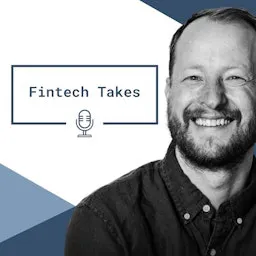
Hosted by Alex Johnson
★3.0on Apple Podcasts · 2 recent reviews
Fintech moves fast. But here at Fintech Takes, Alex Johnson and his rotating panel of guests move faster so that you can stay on top of the latest and greatest news in the industry without breaking a sweat.
234 episodes · publishes weekly · latest 2026-07-01 · ~60 min/episode
Rank
#1047
Substance
72.0
/ 100
Breakdown
Scored 2026-07
Updated monthly
Across the index
#1047 of 6181
Substance
Top 17%
outscores 83% of the index
Fintech Takes ranks #1047 on The B2B Podcast Index with a substance score of 72.0 out of 100, scored across 1 recent episode. It scores highest on specificity & evidence and insight density. The Parker Card section is notably specific: named parties (SVB, Varde Partners, Patriot, Piermont), exact dollar figures ($21M receivables, $465K balance vs $6.4M owed, ~$5M swept, $600K reserve vs prior 6-8M), precise dates, and specific contractual terms (1.25% fee, 45/60/90 day rolling terms). The prediction market section also names real figures (1,105 videos, $166K losses, $2-3K creator payments). Debanking is more discursive and light on hard data.
Averaged across 1 recently scored episode, with cited evidence.
The Parker Card failure breakdown is genuinely dense with operational detail about BaaS infrastructure risks, and the debanking section offers a usable conceptual split. However, a significant chunk of runtime is consumed by weather talk, World Cup banter, and mutual agreement riffing that produces no informational value for a B2B operator.
“we have constructed a system in which it's vastly more modular, where you have different parties that are all kind of stacked on top of each other playing different roles. Each party's role is like, somewhat cooperative but also adversarial”
“it's almost like a tragedy of the commons thing, right? Where it's like everyone acting in their own individual when something goes wrong manifests a problem”
The capital-D vs lowercase-d debanking framing is a useful and somewhat fresh analytical split, and the murder-vs-conviction prediction market thought experiment is a clever specific illustration of a regulatory loophole. Most other frameworks deployed (prisoner's dilemma, tragedy of the commons, musical chairs) are standard and recycled; no truly contrarian or first-principles claims are advanced.
“I've sort of in my own head split the conversation into two things...One is like debanking with a capital D...The other version of it that you also described is like the lowercase D version of debanking”
“would a contract on whether Elon Musk will be convicted of murder in 2027 be allowed? Oh, yeah. That, that feels legit. That feels like a pretty big loophole”
Both participants are credible fintech journalists and newsletter writers with real domain knowledge - Jason has Goldman and startup marketing background, Alex has FICO-era practitioner experience - but neither is a current operator who has built or run fintech infrastructure at scale. This is a peer commentary format, not a practitioner interview.
“I came from a consumer marketing background...certainly during um, my time at Goldman, I was like, oh, this is how real banks implement compliance and legal controls specifically around things like marketing claims”
“I don't think I'd actually heard of it before it abruptly shut down”
The Parker Card section is notably specific: named parties (SVB, Varde Partners, Patriot, Piermont), exact dollar figures ($21M receivables, $465K balance vs $6.4M owed, ~$5M swept, $600K reserve vs prior 6-8M), precise dates, and specific contractual terms (1.25% fee, 45/60/90 day rolling terms). The prediction market section also names real figures (1,105 videos, $166K losses, $2-3K creator payments). Debanking is more discursive and light on hard data.
“there's $21 million in receivables that were originated after that date and before the program shut down on May 4th”
“Parker asked Patriot to reduce the amount of its reserve account held at the bank...Parker agreed to reduce that account to a flat $600,000”
The two hosts probe the Parker Card mechanics with reasonable follow-up and the murder/conviction prediction market exchange shows genuine analytical back-and-forth. However, the format defaults heavily to mutual agreement and reinforcement rather than challenge; open-ended questions like 'what jumps out to you' are the norm, and almost no claim goes meaningfully contested.
“Are you following along? I think so. I think so. This is uh, weirdly complicated though”
“would a contract that, uh, asked will Elon Musk murder someone in 2027, would that be allowed and would that be deemed in the public interest?”
First period on the Index - history builds from here.
1 scored on substance · 60 tracked in total.
These guys are witty and bring new concepts and ideas to my attention. Subscribed.
- Run34dahill
Add this badge to your site - it links back here and updates automatically as you rank.

<a href="https://index.fame.so/show/fintech-takes" target="_blank" rel="noopener">
  <img src="https://index.fame.so/badge/fintech-takes/badge.svg" alt="Ranked #151 on The B2B Podcast Index" width="360" height="136" />
</a>Track Fintech Takes's rank
Get an email whenever this show moves up or down the Index. Monthly at most, no spam.
The themes that come up most across this show's episodes.
Podcasts that dig into the same topics.