
Financial Modeler's Corner · 2026-06-16 · 19 min
Key moments - from our scoring
Substance score
50 / 100
Five dimensions, 20 points each
Financial modeling faces a critical language problem that's holding back both human efficiency and AI integration. John Yeldham, who has spent 20 years building modeling methodologies at BDO UK, AH Forvis Mazars, and Lodeum, argues that financial modeling lacks standardized terminology between finance professionals and modelers - creating silos where expertise gets trapped with individuals rather than distributed through reusable frameworks. The issue manifests in examples like labeling IRR calculations as "XIRR" (an Excel function, not a finance concept), which confuses stakeholders and makes procurement of modeling services difficult. Yeldham explains that standardizing this interface language - separating finance terminology from Excel jargon - enables three major breakthroughs: AI can understand models from a finance perspective rather than a modeling perspective, modular libraries and reusable code become viable, and buyers can meaningfully compare modeling service providers. His advice to current modelers: stop thinking linearly about calculations and instead decompose models into distinct business blocks (like "senior debt module") with clear inputs and outputs, making complex models manageable and future-proof as AI adoption accelerates.
XIRR is an Excel function name, not a finance concept, so it creates confusion for non-modelers and makes models harder to understand. Financial modelers learned finance from Excel rather than finance principles, so they use Excel terminology as their primary language instead of the finance language their clients actually speak.
AI currently reviews models from a financial modeling perspective rather than a finance perspective. Standardized language with modular, reusable code libraries would allow AI to understand models from a finance viewpoint, apply finance knowledge, and communicate directly with finance professionals about model design and outputs.
Different banks and finance organizations use their own slang and terminology, and they view knowing their specific language as proof you understand their business. Additionally, financial modeling standards exist but focus on modeling terms rather than standardizing the interface between modeling and finance languages.
Modelers should decompose the entire model into business blocks (like a senior debt module) and understand the inputs and outputs of each block as a unit, rather than focusing on individual calculations step-by-step. This breaks an overwhelming task into manageable chunks instead of requiring you to hold the entire model in your head at once.
Instead of assembling financial models themselves, modelers will focus on creating reusable, modular patterns and designs that AI can use - shifting value from high-volume output to designing the best example of particular functionality that others can leverage.
Our reviewer’s read on each dimension, with quotes from the episode.
A handful of genuinely non-obvious ideas appear - AI reviewing models from a 'financial modeling hat' rather than a 'finance hat', and the Hotelling's Law analogy for semantic procurement - but roughly a third of the episode is eaten by a horror story, promotional content, and the host's own XIRR tangent, leaving the actual insight rate modest for the runtime.
AI looks very much from a financial modeling viewpoint. If you ask it to review a financial model, it kind of puts its financial model a hat on. It doesn't put its finance hat on.
if we standardize the language, we could create these modules and libraries that an AI can understand from a finance perspective
The XIRR-as-label critique is a sharp, concrete observation most practitioners overlook, and applying Hotelling's Law to financial modeling procurement is a creative framing; however, the modularization advice is standard and the language-standardization argument is sensible but not contrarian or first-principles in a surprising way.
when people do an IRR calculation in Excel, they often use the XIRR formula and they will write in their spreadsheet xirr as the row label... xirr is just an Excel function. It's not a real thing.
if the financial modelers can go into a space, a kind of semantic space and share a common place, then people will find it
John Yeldham is a genuine long-tenure practitioner who built methodologies at BDO UK and Forvis Mazars and contributes to ICAEW thought leadership - legitimately credentialled, not a career podcast guest - but the episode doubles partly as a soft launch promo for his own platform and he is not widely known at scale.
John created the BDO UK modeling methodology, renewed the methodology at AH Forvis Mazars, and recently created the methodology for the Lotum modeling trading platform
He is a regular contributor to the ICAEW Excel thought leadership, such as the 20 principles for good Spreadsheet Practice
The XIRR label example and the IDC acronym example are concrete and well-chosen, but the episode is largely abstract: the 'more than half of all models' claim is unsubstantiated, no client names, dollar figures, timelines, or measured outcomes appear, and the horror story is deliberately vague.
more than half of all the models out there that have irr. Uh, it's very often labeled xirr
idc, meaning interest during construction. You have to know it
The host asks reasonable second-level questions ('Why do you think the language hasn't become standardized?') but never challenges an unsubstantiated claim, digresses into his own IRR confusion for a full paragraph, and wraps up before any of the more provocative ideas - such as AI fully replacing model assembly - are meaningfully stress-tested.
Why do you think the language hasn't become standardized? I mean, obviously we had a lot of financial modeling training.
I can never remember always like now which one's IRR and which one's X irr. But that's not the point here.
Computed from the transcript - who did the talking, and the words that came up most.
In this episode of Financial Modelers Corner, Paul Barnhurst talks with John Yeldham, founder of Lodeum, about building trust in Excel models, standardizing modeling language, and creating modular, scalable models. John shares his experience leading financial modelers and using advanced Excel features like Lambda functions and dynamic arrays. Expect to Learn: Standardize language to improve clarity and collaboration Use modular blocks to make models understandable and trusted Leverage advanced Excel functions carefully for scalable, auditable models Online training through Lodeum allows flexible global learning Here are a few quotes from the episode: "If standards could be introduced for language, it allows financial modeling knowledge to be shared and scaled beyond individual experts." - John Yeldham "The role of a modeler is evolving from just churning out numbers to creating reusable, understandable modules." - John Yeldham John provides actionable strategies for financial modelers to improve clarity, scalability, and trust in their work while leveraging advanced Excel techniques and modular design principles.
Transcribed and scored by The B2B Podcast Index.
Paul Barnhurst: Welcome to another episode of Financial Modelers Corner. I'm your host, Paul Barnhurst. This is a podcast where we talk all about the art and science of, uh, financial modeling with distinguished modelers from around the globe. The Financial Modelers Corner podcast is brought to you by the Financial Modeling Institute. FMI offers the most respected accreditations in financial modeling, and that is why I completed the Advanced Financial Modeler this week. I'm thrilled to welcome our guest on the show, John Yeldom. John, welcome to the show.
John Yeldham: Hello. Good to be here.
Paul Barnhurst: Yeah, we're excited to have you. So let me give a little bit about John's background and then we'll get to the questions. So John has 20 years experience in leading and training teams of financial modelers in both project and corporate finance, supporting gills and finance for global funds and developers in energy and infrastructure, as well as working capital valuations and deal models for smaller businesses. John created the BDO UK modeling methodology, renewed the methodology at AH Forvis Mazars, and recently created the methodology for the Lotum modeling trading platform, which I know we'll get to talk a little bit about today. He specializes in utilizing the latest Excel functionality, including dynamic arrays and lambda functions, which are particularly helpful in creating functional models for large global asset portfolio models. He is a regular contributor to the ICAEW Excel thought leadership, such as the 20 principles for good Spreadsheet Practice. I've read that one before. Great one. And the Excel Spreadsheet Competency Framework. He is a founder of Loadum, a global online financial modeling training platform which will launch later this year. In fact, when you listen to this, it may have already launched, but it's launching this year. So John, love the background. I have to start every episode. Tell me your horror story. Worst modeling experience, worst model you inherited, you built, whatever it might be. Tell us that horror story.
John Yeldham: While I have had clients who have hated models, not so much recently, but a long time in the past when I was getting started, actually, the horror stories are really where it's most stressful, I think. And I did have one model. Uh, the model was complicated. It's gone through these changes and when you have models where they decide to change the periodicity or things don't match, the timelines don't match in various parts of the model, it gets complicated really quickly. And this was a difficult model to work with and, and they were in the process of an, uh, early part of their project and were just running out of money and they needed to get the covenants passed. And it was perhaps a real Education to me about how much leeway there is in bank contracts around covenant testing, that we could tweak this and that and that and say, well, if you move that from that company and that from that company and move that there and there without doing anything in terms of their operations, we can get that fixed. And the reason I recognize it as a horror story is that, you know, I had the FD sat there almost having a nervous breakdown, and at the end we got that number and he gave me a hug. He's the only client to ever hugged me at the end of a modeling session. So that is my story. I mean, I can't say if I'm just talking about the badness of the model. The worst feedback I ever got was from a model that just didn't look very good. But actually it was perfectly correct. They said, this is the worst model we've ever seen. It's not doing what we want. I went back, I changed some formatting, I reordered some cells, no changes, and they go, well done. You've just, you managed to fix everything so quickly.
Paul Barnhurst: It's amazing. So I would love to know, when we chatted about modeling, you talk about how a big part of it is a, uh, is, you know, communication and a language problem often. Look, modeling, there's a communication and language problem. I'd love for you to elaborate a little bit on that, why you think that is the case. Maybe give us an example of what you mean there.
John Yeldham: I think I'm always conscious of this. I've always been conscious of maybe my language being slightly different from other people's. And I think in the world of financial modeling and the world of finance as well, but separately and in the world of accounting, there are certain sets of languages that have arisen. There are words that are used, and those words, they're not necessarily consistent, they're slangy, and they, they really do a few things, some positive and some negative. Sometimes they provide a, a quick way to describe something so that people inside that bubble can communicate quickly and get things done. Um, I know in financial modeling, people say idc, meaning interest during construction. You have to know it. But it's obviously quicker than saying interest during construction. Um, at the same time, it creates a barrier for people coming into, into that business. It also creates a barrier for procurement because coming at it from the outside, I'm talking to people now that don't speak my language. Finance, uh, is a bit of a weird case because who's really the customer there? But for finance modeling, it's quite clear. You know, I'm the um, provider and someone's my customer if they, if they, if I can't talk their language and I'm just talking in financial modeling, go, go gobbledygook. It's getting in way of procurement. So there's these bubbles. And in terms of what happens in a financial modeling model, rather these cause problems because financial modelers don't know quite what finance people want, what words they want to use, and they end up having a mishmash of stuff in their own model, which includes some of the financial modeling slang as well. And you end up with this dissatisfaction with the end product. It's not clear, it doesn't communicate very well. And uh, this is something that I've thought about deeply recently. It inhibits the ability for financial modeling to break out from a, uh, set of individual experts. You and me, we're experts at financial modeling, um, and Excel. And obviously we may not want to break it out, democratize the process of financial modeling. But if standards could be introduced for language, it allows it to break out that you can now start carving up the information in understandable nuggets. And you don't need these kind of little units of financial modeling expertise as we are, to kind of absorb everything from everywhere because you've got a clear communication channel. It's all about inputs and outputs and interfaces between different groups of people and the way that works in a model. It's between different parts of the model just to speak the same language. So it's really important and it's a big impediment in the whole process financial modeling. And I'm really coming at it from the point of view of a uh, professional financial modeler who provides financial modeling services. But it's the same problems are going to occur within businesses as well. Very often the financial modeler is, you know, the geek in the attic kind of thing. They have one person, they go, oh yeah, he's the guy or the girl that can do that stuff. And they do that stuff. But you know, that weight of that expertise is sat with them because it can't be disseminated very well. The language hasn't been standardized, um, and it just, it just becomes a silo.
Paul Barnhurst: Why do you think the language hasn't become standardized? I mean, obviously we had a lot of financial modeling training. We spent a lot of time focusing on functions, model building in Excel. So why do you think the language is so, so fractured?
John Yeldham: I think part of it is that in the world of finance, different banks may have different slang they use. And so certain terms are um, ambiguous. And actually part of your badge to know that you can talk to a particular bank is, you know, the language they speak. And they, and very often there's an attitude that they, that you don't understand their business if you don't say the same words, even though you've said the same words to someone just like them and that they understood that. But can, um, yeah, could get, get in the way that way. And, and that's coming in the world of finance, we don't, as financial models, don't control that world. Within financial modeling there are lots of terms and lots of standards being written. So they exist, but they talk about things in financial modeling terms, not in terms of, um, the outside world. And what's really missing is that standardization of the interface between the two. Um, and I'm going to take an example of how it's easy to not use the right standard. So this isn't a standard. It should be, um, and it certainly would be advised by certain methodologies. But when people write, or when people do an IRR calculation in Excel, they often use the XIRR formula and they will write in their spreadsheet xirr as the row label, as the label for that item. But xirr is just an Excel function. It's not a real thing. And yet you see more than half of all the models out there that have irr. Uh, it's very often labeled xirr. I mean that's clearly financial modeling slang. Uh, maybe, you know, it's derived from Microsoft, so it has a reason why where it came from. But it's meaningless in terms of that interface with the finance people. They don't use the word xirr. Uh, you're making a model for them. So that's just a digital example. But that's the sort of thing that I think has arisen. And because the financial models are not necessarily ex finance people, some of them are. They start from the Excel, they've almost learned finance from the Excel. Right. And so they talk in that language. And really they need to talk in the finance language.
Paul Barnhurst: Xirr is a great example, right? No, there's no concept. If you Google search Xirr, you're only going to find the Excel function. You're not going to find a concept of irr. Yes, it has to do with how it's calculated, how it handles the period, whether it's beginning or end. Or try to always try to remember because I don't do a lot of IRR in my calculations. Right. I was in stna. And usually you're just building a forecasting model for the P and L, not not calculating irr. So I can never remember always like now which one's IRR and which one's X irr. But that's not the point here. I think the point is it's confusing, right? For the average person. I think that's a great example. So I mean, what do you think it's going to take? I mean, how do you think about this as far as standardizing language? Because obviously you have companies that have their own slang they want to use and may not want to give it up. And then you have non finance people that are seeing things where certain slings being used. So you know, we've done a pretty good job of putting standards out there for models. You know, whether it's fast or smart, not saying everybody's adopted. It's still quite a bit depends on the industry and what you're doing and your level of modeling, how much you adopt. But what do you think it will take to, uh, do a better job standardizing, maybe adopting something on the language front?
John Yeldham: I think what it'll take is an investment by someone to make a modeling process that works really efficiently and really fast. Because the end game from all the standardization isn't so much the small improvements that just come from tweaking language here and there. It's the big improvements that come m from once you've standardized it. You can create libraries, you can create modules, you can create reusable code. You can create reusable code that's well documented and understood, and those modules can be understood by an AI. And therefore the AI has Lego pieces it could work with well and communicate well with people who want to buy your services. Those people who want to buy your service are speaking a particular language. And uh, I'm actually writing a paper at the moment about the way that AI examines models. And what's clear is that AI looks very much from a financial modeling viewpoint. If you ask it to review a financial model, it's. It kind of puts its financial model a hat on. It doesn't put its finance hat on. So if we standardize the language, we could create these modules and libraries that an AI can understand from a finance perspective, utilize all its finance knowledge, talk to finance people, and it completely changes the way we think about building a financial model. Because now a financial modeler's job isn't actually the assembly of the financial model because the AI can do that. It's probably to some degree understanding the client needs, but the AI can do quite a lot of that. But what a financial modeler can do is create these modules and design. So as a modeler you're creating a reusable pattern that other people can use. So your, your, your value moves from being churning from the sausage factory, churning out lots and lots of stuff, to creating the best example you can of a particular set of functionality. Um, and the people who can do that can do the best financial modeling in certain modular elements will, I think will succeed and the ones that just turn the handle there may not be so much of a place for them in the future.
Paul Barnhurst: So a lot of this, not all, but there's a big. And that makes sense. I hadn't thought about the AI side of it, but standardizing this makes it much easier to go quicker that speed as you have a common language for AI to work off versus today every model it's trying to understand what does this mean?
John Yeldham: And um, it's about the. I'm going to use the word memosphere. I'm not sure it's the right word, but the sense of ideas in the globe. One of the things that standard language also does is provide a marketplace for people who want to buy from natural modelling service or need them to understand what's going on because you have a front which has a common sense of language. And if they can understand that, they can then compare all the various people who are trying to provide financial modeling services to them at the moment. If they look at different financial modelers, they're all saying slightly different things. It doesn't make sense, it's difficult to compare. So it really helps in the procurement aspect as well. I don't know if you've heard of hotelers, uh, law or it might be hoteliers or I think it's hotelers law about the proximity of things. The famous example was on a beach, a uh, long beach. The two ice cream vendors would sit themselves next to each other in the middle of the beach because everyone from one side would go to one and everyone would go from the other side would go to the other. There isn't actually any benefit for them moving apart even though they're competing against each other. And similarly, if the financial modelers can go into a space, uh, a kind of semantic space and share a common place, then um, people will find it. And let's face it, AI is going to be finding them. Right. So we can talk specific, sensible standard language. The AI is going to find that marketplace much more easily than someone who does. Talks completely different words over here. While the AI will just stick around the group of people who speak the same language. Right. And that's where you'll get your procurement from.
Paul Barnhurst: Last question here before we just kind of wrap up and I let people know where they can connect with you. If you can offer any final advice to somebody listening to be a better model or something they should be doing, what would it be?
John Yeldham: I think other than obviously signing up for Loadium when it launches, I think they could do a lot by taking a step back, zoom out. I think a lot of modelers focus in on the individual calculations step by step and actually return to this idea of modularization. They should take a step back. What does a senior debt module do? What are the inputs and outputs of it? Just take some time to think about it in those terms because I think people aren't abstracting it in that way enough. And when you do that, you turn a business into a series of units and each unit is a little bit more manageable. Otherwise, the only way to really be a good modeler is to have a perfect stream of thought. And you start from the beginning of the model. You've basically picture the entire model in your head in one go. And. And that's actually really, really difficult. So decompose, turn into blocks. Understand those blocks. And I'm not talking about the little blocks like you get in fast methodology, for instance, which is one calculation. I'm talking about the whole of senior debt, for instance, as a block. Think about it in those terms and that will give you a grounding for everything you do going forward and make the work manageable in chunks instead of what looks like an impossibility. And let's face it, a financial model as a whole is an impossibility, right?
Paul Barnhurst: Yeah. It can feel impossible if you look at the task in totality versus breaking apart. It can feel overwhelming. Totally agreed. So if our audience wants to get in touch with you, let's learn more about you. What's the best way for them to do that?
John Yeldham: Get in contact with me on LinkedIn. It's John Yeldom. John with an H and Yeldom with an H as well. I'm not quite sure how to say my own name really, so I say it's Yeldam, like Beckham. Y E L D H A M. Anyway, you can find me on LinkedIn. I think I'm the. There may be one or two Johnny Eldoms in the entire world, but only one of them has a mustache, so I can be found. And then to take a look at. We have a page for Lodium. It's L O D E U, um, M dot com, where you can find out about what will be happening in the future. In a few months, hopefully, I'll have another announcement and we'll have the full site up and running. And then please take a bigger look and hopefully some of you might sign up.
Paul Barnhurst: Good luck with that. I hope you get lots of signups. Again, congratulations on the, uh, business, and thanks for joining me today. I've enjoyed chatting with you, John.
John Yeldham: Yeah, it's been great. Thank you very much.
Other episodes covering the same guests and topics, from across The B2B Podcast Index.
 Pitch Anything's Oren Klaff: From Spreadsheet to Deal Table88 / 100
 Can Competition Make You Better at Finance? with Eric Kelley72 / 100
 AI Financial Modeling Test for Finance Pros to Understand the Limitations Using Real Tool Comparison75 / 100
 AI in Financial Modeling: Better Than Ever, Still Not There, and the Fatigue Factor63 / 100
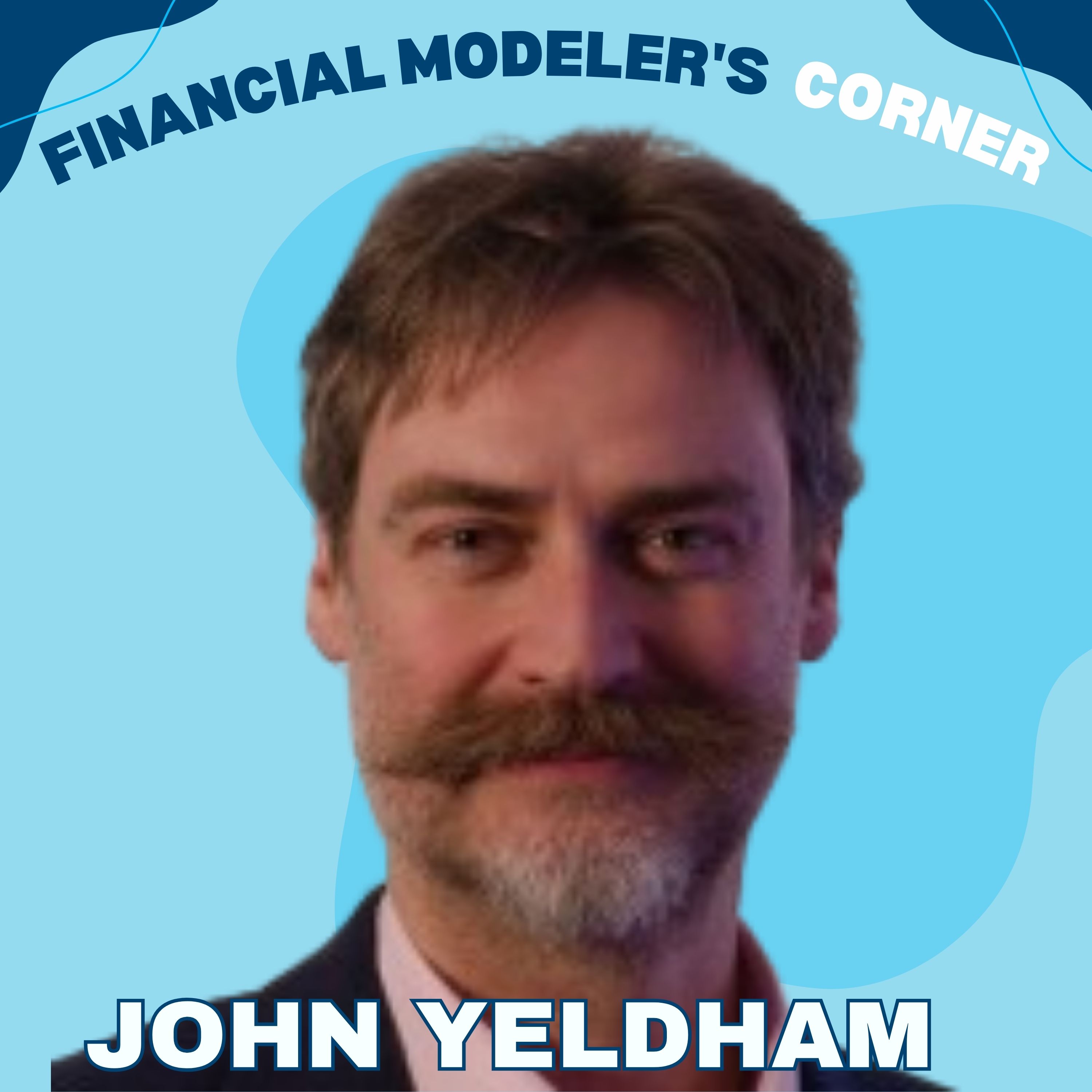 The Critical Role of Communication and Standard Definitions in Financial Modeling with John Yeldham72 / 100