
Disruptors · 2026-06-30 · 28 min
Key moments - from our scoring
Substance score
47 / 100
Five dimensions, 20 points each
Global Relay operates one of Canada's 300 data centers - a fraction compared to the US's 5,000 - and stores communications data for 22 of the world's 25 largest banks. The episode tours the facility's physical design, including its free-cooling system using Burrard Inlet's marine air, redundant backup systems with robotic LTO tape management, and dedicated AI infrastructure. Warren Roy, founder and CEO, explains how the company deliberately built its entire technology stack in-house since 2012 to maintain control and sovereignty, contrasting this with organizations dependent on hyperscalers like AWS or Azure. He details the three layers of data sovereignty: privacy laws (varying by employee location), regulatory frameworks (non-standardized globally), and law enforcement approaches. Global Relay has achieved what it calls "data visas" - regulatory permissions to hold country-specific data in Canada - across nearly every nation. Roy emphasizes that Canada risks exporting its digital upside through founder exits and acquisitions, and argues Ottawa must strategically support proven Canadian tech companies rather than defaulting to foreign vendors. He sees AI as transformative for organizations with structured, high-quality data, positioning record-keeping as foundational to competitive advantage.
The facility uses free-cooling technology, drawing cool marine air from Burrard Inlet through three-story intake louver systems and circulating it via giant fans throughout the data halls, eliminating the need for energy-intensive air conditioning units.
Data visas are regulatory permissions granted by a country's authorities allowing businesses to hold that country's data in a non-domestic data center; Global Relay has achieved these approvals in nearly every nation, enabling it to serve multinational customers while maintaining compliance.
Data location (physical jurisdiction) is just one layer; true sovereignty requires understanding privacy laws (by employee country), regulatory frameworks (non-standardized globally), and law enforcement approaches in each jurisdiction where an organization operates.
After a catastrophic data center failure early in the company's history, Global Relay chose to build its own infrastructure to ensure it could resolve issues independently without depending on third-party cloud vendors, giving it complete control over its service.
AI can vectorize structured, quality-assured data and use LLMs to interpret natural language prompts, enabling organizations to have near-real-time conversations with their data (asking about performance, risks, top performers), making data quality and completeness critical competitive advantages.
Our reviewer’s read on each dimension, with quotes from the episode.
A handful of genuinely useful concepts emerge - the three-layer sovereignty framework (privacy, regulatory, law enforcement) and the 'data visas' construct - but they are buried under extended tour narration, light banter, and generic policy commentary that pads the runtime without adding substance.
we've been able to achieve what we just internally call data visas. So the permissions of a regulator in any given country to hold that country's data in Canada
The three areas that we speak about most commonly with global companies is privacy...Underneath that layer you have the regulatory framework...And then a layer underneath that is law enforcement
The 'data visas' framing and the critique of PE-driven exits are modestly fresh, but the episode leans heavily on well-worn ideas - 'data is the DNA of your organization,' standard AI LLM discourse, and generic Canadian conservatism observations - that circulate everywhere in tech-policy media.
when we use the phrase data is the DNA of your organization, what we're trying to say is that everything that you are is in that data
if you can vectorize all of that data, which is what AI reads, and if you can have an LLM interpret your natural language inputs
Warren Roy is a credible practitioner who bootstrapped a 25-year-old B2B compliance infrastructure company serving 22 of the world's 25 largest banks across 90 countries - genuinely done the thing at scale; Sahar Kahani adds operational grounding, though her segment is limited to facility tour commentary.
it materialized initially after about four years in the financial sector as a result of Enron, Arthur Andersen, WorldCom, all going bust. And the SEC...coming down with a rule called 17A4
in 2012, we went down a road of developing our entire technology stack. In other words, we have no dependency on cloud vendors
The episode delivers solid concrete anchors - SEC Rule 17A4, the UK Data Protection Act naming Canada, 22-of-25 largest banks, 300 vs. 5,000 vs. 11,000 data center counts - but Warren frequently retreats to abstraction when making strategic or policy arguments, leaving the most important claims unsubstantiated.
The United Kingdom names Canada in their Data Protection act, and it says any business residing in the UK can hold its data in Canada
the SEC, the Securities and Exchange Commission in the United States coming down with a rule called 17A4, which was a record keeping rule
The host's questions are leading and descriptive rather than probing; there is no pushback on any claim, and the episode closes with explicit praise ('it's so impressive what you've built'), signaling a PR-friendly format that consistently leaves the most interesting threads - why Canada lags, what specific government decisions failed - unexplored.
Warren, it's so impressive what you've built at uh, Global Relay. Congratulations on that
walk us through a bit more of how AI is changing the relationship with data
Computed from the transcript - who did the talking, and the words that came up most.
There are roughly 11,000 data centres in the world. Canada has about 300. The United States has 5,000 and that number is growing fast. Canada is putting real money behind sovereign AI compute. But what does data sovereignty look like on the ground In this episode of Disruptors, John Stackhouse visits Global Relay’s data centre in North Vancouver to see the physical side of the cloud: cooling systems, backup power, biometric access, data halls, and AI racks. Global Relay Chief Product Officer Sahar Kayhani explains how the company manages communications data for highly regulated industries and why the infrastructure behind that data is becoming as important as the data itself. Warren Roy, Global Relay’s founder and CEO, joins the conversation to discuss why the company chose to build its own cloud, and share his thoughts on what Canada needs to do to develop more technology companies rooted here. For more RBC Thought Leadership on AI, healthcare, productivity and Canada’s innovation economy, visit rbc.com/thoughtleadership . Hosted by Simplecast, an AdsWizz company. See pcm.adswizz.com for information about our collection and use of personal data for advertising.
Transcribed and scored by The B2B Podcast Index.
Speaker A: M. Hi, it's John here, and welcome to a special episode of Disruptors. I'm in North Vancouver, standing outside the nondescript building on the north shore of Burrard Inlet. It's a data center. Those are two words that you may not have used a lot a few years ago.
Speaker B: And.
Speaker A: And now it's hard to pass a day without hearing a lot, and some of it controversial. Data centers are front and center in every economic conversation and a lot of political conversations because they are so important to what's going on in our society. The new AI strategy from the federal government speaks directly to that. Canada needs to develop more capacity and, and more sovereignty around all sorts of things, but data is one of them, and we may need more data centers to ensure that. Right now, There are roughly 300 data centers in Canada, including this one, owned, operated, and built by Global Relay, a Canadian company. 300 may seem like a lot, but that doesn't stack up to much next to the United States, where there are 5000 data centers and, and that number is growing rapidly globally. The world has about 11,000 data centers right now. And there's a real arms race underway to build more data centers, as well as the infrastructure, including energy and water required to power, cool, and operate them. This Global Relay center was designed to minimize the carbon footprint not just of the building, but of the processing of all the data, which, frankly, is more than any of us could ever count. I'm being greeted now by Sahar Kahani. She's the chief Product officer at, uh, Global Relay, a facility that stores communications data for 22 of the world's 25 largest banks. And while I've got a lot of questions, we'll be sure to delve into one very big one when it comes to digital sovereignty. What can Canada learn from a company that has spent years making it operational? Sahar, welcome to Disruptors.
Speaker B: Thank you, John. It's great to be here.
Speaker A: Well, it's especially great to be here on a gorgeous day in Vancouver. The sun is shining, the gentle wind is blowing. Before we get going, Sahar, tell us a bit about your own journey and how you got to Global Relay.
Speaker B: I graduated in computer science, uh, a while ago. When I joined the company in 2014, I think we had about, uh, a little shy of 300 employees or around that number. And since then, we grew to 1800 or a little over 1800 now. And as a woman in technology, it was a very welcoming, uh, journey in Global A. Uh, we have many senior leadership of the company that are women here. So it's been a fantastic journey so far.
Speaker A: Sahar. We're still outside the building, and it's fascinating to see the design and the architecture, which, as I understand it, is designed for security to keep the data center from outside attacks, if I can put it that way.
Speaker B: Yeah, there are some, uh, elevated, um, walls that basically are designed to make sure that the data center is physically secure from outside of vehicles. Uh, as well as. As we, obviously, when we go inside, there is various other elements of physical security that is built into this data center.
Speaker A: So we're inside the compound now, Saher. And one of the aspects of your location here in Vancouver, and specifically North Van, that I hadn't appreciated was the free flow of cooler marine air coming off Burrard Inlet. We're staring now at three stories of intake devices for that air. They look kind of like louver blinds.
Speaker B: Yeah, the cool air goes into the facility and makes the cooling very efficient, basically from power perspective.
Speaker A: And I guess another advantage there is it doesn't look like you have air conditioners around here. And that's one of the functions of the bigger data centers, especially in hotter places like the southern United States. They need massive air conditioning, which takes up space, also takes up a lot of energy.
Speaker B: Yes. This allows us to not, uh, use any traditional air conditioning and just rely on the air from the. To basically control the temperature of, uh, the facility.
Speaker A: And that's one of the reasons you call this a green data center.
Speaker B: Yep.
Speaker A: Let's go further inside. We're now inside the electrical room. M. It's loud. Around me are six UPSs. That stands for Uninterruptible Power Supply, and that is the engine, quite literally, of any data center. Inside each of these six big boxes. It's really interesting to seen one opened up. And underneath are these giant wheels that spin at 7,000 RPMs. So there's a lot of power that goes into making more power for the data center. Sahar. Huh. We've moved to the second floor and are now inside a data hall. You can get in here only with biometric access. And once in here, it feels to me a bit like the data economy equivalent of an old bank vault. We used to store gold bars underground. Now we store data in these giant racks on the second floor of a data center.
Speaker B: So there is a few aspects related to storing data and the security of it. Um, the first one is obviously redundancy does matter, and the second one, from various different regulatory perspective or generally data management, the aspect that no one can tamper with. The copy also matters. So this hall that we see here, we saw all these tapes as backups.
Speaker A: I'm holding an LTO. Now this is like a big old disk that has 10 terabytes of data on it. And we're staring at racks with hundreds of these disks on. And it's all operated by robots. And the purpose of this room is essentially a backup for all the data that is out there on servers.
Speaker B: The robots help manage the whole system of which data is stored in which tape and moving them around for efficiency purposes. The servers that we're going to see next are where basically the live data and the live product and application runs. But this stores the non tamperable, non deletable copy of the data. It's basically the last copy of the data.
Speaker A: Lets go. We're now inside the main data hall. It's frankly a little cool in here. I think it's 13 or 14 degrees Celsius. All that cool air that we described earlier being sucked into the building is being cranked through this room by giant fans to cool the data racks and servers. And we're looking at rows and rows of them. Zahar in front of us. Each is built on top of these fascinating little devices to create some resistance in case there's an earthquake. Because we're here on the west coast and there are earthquakes and tremors. And if you're operating a data center, you have to be very mindful that every little shift or bend beneath the surface can affect your data. Sahar, tell us a bit about what's going on inside these racks and servers.
Speaker B: We have a few of these data halls within the data center. We manage, uh, tens of petabytes of data for our customers and financial services and other highly regulated industries. So what these server racks, do they store all this data, um, with the aspects of security and encryption. They also run the services on top of this data that our customers need. Basically what we do with this data or what our customers do with this data, they keep it as business records. So as you can imagine over the last few years of social media AI, the data is only growing. And that's why we have the efficiency in the data center to be able to grow with the customers and their data needs.
Speaker A: I'm standing next to an incredibly loud rack that is designed entirely for AI. I'll step into the next room to learn a bit more about why AI is so loud.
Speaker B: It does go back to the energy. So those GPUs, ah, consume a lot more energy than the other server room and the data hall. We were at then. That's why the noise, in addition to the air, uh, cooling noise, you hear a lot more noise from the GPUs than the other rooms.
Speaker A: So the next time I have a question for Claude, I'll ask it to respond a little more softly.
Speaker B: The concept of peace and quiet doesn't match a data center because I think quiet translates to something that's not peaceful
Speaker A: at all, something going down. That was a fascinating tour into the engine room, quite literally of uh, the data economy and what Global Relay is doing to make more advances. We're now going to hear from Warren Roy. He's the CEO and founder of Global Relay. Warren, welcome to Disruptors.
Speaker C: It's a pleasure to be here. John. Thanks for making the time for me today.
Speaker A: I want to pause here and go back in time, uh, to the origins of Global Relay and then we'll get into some of the here and now. But you founded the company way back in 1999. There was an Internet back then, but it was a very different digital world. What inspired you to create Global Relay?
Speaker C: Well the inspiration came from a very simple concept which was really founded around people and companies transitioning from paper based communications to electronic communications, being email. And the principle of the business was never lose email again. We sat down and we designed the fundamentals of the business to achieve that objective.
Speaker A: Here we are more than a quarter century later, you're in 90 countries. I think it is what accelerated the Global Relay story to get you to where you are today.
Speaker C: We really strove to have a niche focus and uh, the focus itself was record keeping. But it materialized initially after about four years in the financial sector as a result of Enron, Arthur Andersen, WorldCom, all going bust. And the SEC, the Securities and Exchange Commission in the United States coming down with a rule called 17A4, which was a record keeping rule. And we had developed record keeping technology. So there's an element of luck, as every entrepreneur will tell you, in that a market presented itself based on a technology that we had developed. And the interesting part about that is that that rule from the SEC obviously spawned many other companies getting into uh, the same business. But we had a significant head start on them. The other aspect of the rule is that virtually every western country adopted a, uh, derivative of it, record keeping for the financial sector. And we were able to really aggressively get after those countries by getting in planes and flying around the world over and over and over again until we built up, um, you know, reasonable amount of momentum, literally knocking on doors.
Speaker A: Here we are in a very different environment. How are you seeing tech sovereignty and what do you think is really driving it as a preeminent, uh, concern right now?
Speaker C: Well, tech sovereignty and the whole sovereignty discussion is really quite new. It started to appear about two years ago. And if you boil it down, it's two things. It's about control and security. Every business wants to be in control of its destiny. Every government wants to be in control of the data that it uses, that that's largely private in nature to conduct its day to day operations. So sovereignty is incredibly important. And the way the technology world is unfolded, there is an enormous amount of power in very few hands. And it's recently made a lot of countries uncomfortable and resulted in them taking a look at what levers they can pull to have better control over their data. Maybe not absolute control, but better control.
Speaker A: It's interesting that you say, uh, tech sovereignty has been around for only a couple of years. I suspect you're right. I certainly don't remember people talking about tech sovereignty a decade ago. But you were onto the issue a decade or more ago in terms of building infrastructure that would allow your customers and clients to develop optionality and therefore sovereignty. What did you see back then when the world was rushing to the, what are now known as hyperscalers, but the big, uh, cloud companies, what did you see back then that perhaps others missed?
Speaker C: We built the company from the standpoint of having top to bottom control over all aspects of the service. And that comes from lessons learned. John. We had, you know, a data center early on that we occupied on the west coast that had a catastrophic failure and we lost a lot of systems. We did fully recover, but the lesson we learned from it is that we didn't want to depend on anybody going forward. And it really changed our strategy at the time. And in 2012, we went down a road of developing our entire technology stack. In other words, we have no dependency on cloud vendors. If you think about it objectively, we are our own cloud. We have always been our own cloud. And that capability that governments and large organizations are looking for today, it's really control over your ability to resolve issues when they occur, specifically not having dependencies where you cannot resolve issues.
Speaker A: Data location is an important part of sovereignty. And I wonder if you can walk us through some of the nuances there, because a lot of us might assume that, hey, if a data center is in a jurisdiction in Canada, the data is safe. Not that simple. Walk us through how we should be understanding location versus data sovereignty.
Speaker C: Yeah, the three areas that we speak about most commonly with global companies is privacy. And privacy is really about the country that your employees reside in. And when you're dealing with a multinational, you have to resolve the privacy issues or meet the privacy issues of every one of those countries. Underneath that layer you have the regulatory framework that's, that's in place. And not all industries are regulated, but all significant industries are regulated. And the regulatory framework, there's no global standards for it. So it's different in every country that you operate in. And then a layer underneath that is law enforcement. And different countries have different level, I would just call it of, uh, aggression when it comes to their law enforcement. You need to understand privacy, regulatory environments and law enforcement to be able to put any solution in place. And historically, if you. I'll just give you an example. The United Kingdom names Canada in their Data Protection act, and it says any business residing in the UK can hold its data in Canada. And most countries have similar laws. That's just, uh, uh, an example. So you really want to understand, you know, what countries you can do business with given where the corporation resides or cloud service resides. From a global relay perspective, we've been able to achieve what we just internally call data visas. So the permissions of a regulator in any given country to hold that country's data in Canada. And we operate data centers in Canada and in the US and they're used for different purposes by different customers. But to date we've been able to achieve data visas in almost every country in the world. So there's been, yes, a benefit to having an operation in Canada, but it's more about setting the business up strategically to capitalize on whatever your objective is. And ours was to manage data. So we became subject matter experts in privacy, regulatory laws, and, and obviously deal with law enforcement on a routine basis.
Speaker A: Walk us through a bit more of how AI is changing the relationship with data. I think you've said that data is the DNA of an organization, but that DNA is evolving with AI. How should we be thinking about that?
Speaker C: In a regulated organization? Your record keeping applies generally to your voice data, to your social media data, and to all your electronic communications. And when we use, uh, the phrase data is the DNA of your organization, what we're trying to say is that everything that you are is in that data. It has your strategy, it has your customer communications, it has your contracts, it has your marketing, it has, most importantly, your relationships. And the relationships in business are what drive business forward in terms of winning prospects and so forth. So organizations, they want AI to be able to capitalize on that data. A, uh, record keeping company, as we are, has very structured data. And structured data equals quality, accurate and complete data. And those three words I use commonly because they're the three words that you see in every subpoena that gets delivered. And our whole organization has been based on preserving quality, accurate and complete data sets. And I don't want to dive into the technology, John, but if you can vectorize all of that data, which is what AI reads, and if you can have an LLM interpret your natural language inputs, you know, commonly called a prompt, and have a feedback loop of a couple of seconds, you can get to the point where you can have a natural language conversation, literally, verbally with your company. Tell me how we did today. Who are the top performers? Are there any risks that I should be concerned about? And when you start to understand these pieces and how they go together, you can see how, one, it's a very exciting business, and two, that there's a huge upside for the companies that capitalize on AI sooner than later.
Speaker A: So we've got a number of forces swirling together in the world, but probably two of the most powerful are AI, as you mentioned, and also the longer reach of the most powerful nations in the world. As we become even more borderless in digital realms accelerated by AI. How should we be thinking about borders? Uh, here in Canada, but elsewhere, when it comes to data and digital sovereignty?
Speaker C: When I look at the world, you certainly have, you know, the two major powers putting everything they have into AI. It's still done privately through private corporations, but the investments and the efforts are superhuman. You can choose to compete against that. It's very tough. But to me, when I think about what's going on, you need to be in the AI game. You want, as a country to be in control of your data. And you could boil it down to one thing. One of the key things with any government is to put a framework in place to allow businesses to be successful and at the same time boost the standard of living. And, uh, those two things encompass many different controls, but that's really how you have to think about it. And I think there's huge opportunities in Canada for AI and just generally cloud services, where we can have the autonomy we want and at the same time achieve the control and privacy that we need.
Speaker A: You've deliberately stayed in Canada, but you've also said that Canada is at risk of exporting our upside. Tell us what you mean by that.
Speaker C: People think far too narrowly. It seems to me that success today in business is based on selling your company and measuring your win based on the value of the sale. And I think it's unfortunate that people think that way. I really feel that, John, and for us as an organization, I've always been focused on just trying to build the best business I could. Our largest customers are in the UK and France. So we're well positioned globally to serve customers. And I think it's also important to realize what is a global company. And really the definition of that is that you can serve companies well around the world, which means 24 hours a day. So you really have to think through a, uh, strategy defining success in your own mind and taking on partners which usually come in the form of outside capital that are aligned with your long term vision. And one of the really tough things that I see every day in the tech sector in most countries is they're just all sold out to the top, you know, private equity firms. Typically where they are then taken and capitalized on that is not a winning formula. And whether you address that through taxes or through other mechanisms, people need to think differently. The government needs to think differently. We need to support businesses that grew up in our country. I think that spells success for a far broader group of people than you could ever define. By selling a business where simply a few capitalize,
Speaker A: you've had more success arguably outside of Canada than within. And, uh, maybe that's good. That's why you're a global company. You've put the global into global relay. But you said that the UK and France are your two top markets now. Uh, they're bigger than Canada, so there's some simple math there at play. But why have you done better in those European markets than in Canada?
Speaker C: Well, when I look back over the past 25 years, it was only after we became quite successful outside of Canada that we did any significant business inside of Canada. And I think Canadians are just, you know, gun shy. They're very, they're very conservative. But I also think at the same time, we have had a massive wake up call in the past 12 months where we need to start looking within and capitalizing on our capabilities. Because I will tell you on the world stage, Canadians are very capable in almost any area in business. And running a global company has a huge benefit to the country that, that um, is its origin. And I, you know, really would like to see more Canadians going abroad to drive their revenues. The global markets are just simply huge. But today we have had some really good support from Canadian business, especially the Canadian banks. And that's, that's great to see. It is Hard as a startup to walk into government or a major bank and say, hey, could you buy my product? Because there's a big gap between your ability and their expectations. But in reality, when companies do start to become successful, you do need to support them.
Speaker A: What does Ottawa need to really come to grips with, both as a customer, as a regulator, and through industrial strategy?
Speaker C: Well, they, they have some tough decisions to make. You have our provinces and our federal government that are hardwired into, um, U.S. and other foreign technologies. There are successful Canadian companies, but there's very little, uh, implemented. When you look at the percentage of expenses that is pushed out into the technology sector, the vast majority of all, all of it is provided by foreign nations. Tech is complicated. It's a big bet. And from a, uh, Canadian government perspective, you need to be able to reason your way through the right bets. And that doesn't mean betting on everybody and that doesn't mean throwing money at everything. It means choosing smartly, reducing the risk of your mistakes, and partnering with some key critical companies that can really change the game. You know, have proven that they can change the game on the world stage. I have spent a fair bit of time in Ottawa in the last year. Um, we've really put forward our case that we can deal with the scale of the federal government because we manage the data for some of the largest organizations in the world. But I'm sure there are a hundred plus companies like Global Relay in Canada that should be considered by the federal and provincial governments that currently aren't. And part of it is you need to find champions within the government. It is full of people that are interested in doing the right thing, that have the ability to do the right thing. But the bureaucracy itself is a challenge for everybody, whether you're working within it or you're trying to provide, uh, a service to it.
Speaker A: If we tackle those challenges, if we get it right 10 years from now, what do you think Canada looks like in the digital world?
Speaker C: It is all about automation and efficiency. Canadians want a better standard of living and you can only achieve that if you can boost productivity. So from my perspective, I think the government and corporations can do far better at providing more efficient services if they can focus on automation. And automation is really driven solely by AI. And with that automation, you should be able to downsize the government itself, reduce its overall expenses, and ultimately provide far better service to Canadians.
Speaker A: Warren, it's so impressive what you've built at uh, Global Relay. Congratulations on that and uh, thank you for being on disruptors.
Speaker C: Oh, it's been a pleasure, Jon.
Speaker A: Data is quite literally the most valuable intangible in any organization and right across the economy. But when you go through a data center, you certainly see the tangible side of what's at stake. It's not only the incredible machinery and all the power generation and cooling that's required to make it run sustainably. It's the growing requirements for security and redundancy in an increasingly complex and volatile world. If you want to know more about these issues or hear more of these conversations, go to rbc.com or follow us on social media. And if you like this episode of Disruptors, please be sure to subscribe wherever you get your podcasts and give us a rating or a review that will help others find this conversation and share it. This is Disruptors, an RBC podcast. I'm John Stackhouse. Thanks for listening.
Other episodes covering the same guests and topics, from across The B2B Podcast Index.
 Ship It Conversations: Jake Warner on Cycle.io, Bare Metal’s Comeback, and Why Private Cloud Is Getting Interesting AgainShip It Weekly · on Data sovereignty91 / 100
 Less about Models; More about ArchitecturePractical AI · on Data sovereignty85 / 100
 SpaceX Starfall And Apple Price Hikes | The Brainstorm 138FYI - For Your Innovation · on Hyperscalers80 / 100
 Steroid Era With Spencer Jakab, the F***’s Going on With Strategy?, Margin DebtThe Compound and Friends · on Hyperscalers80 / 100
 From Billable Hours to Business Outcomes: How AI Is Rewriting the Rules of IT ConsultingEvolving the Enterprise · on Data sovereignty78 / 100
 VC10X - The AI Bottleneck Keeps Moving - Ashmeet Sidana, Founder & Managing Partner, Engineering CapitalVC10X · on Data sovereignty77 / 100
 REBOOT: The Trust Advantage: How OpenText is Securing Canada’s Information Layer82 / 100
 REBOOT: Beyond the Battery: Inside Quebec’s Mine-to-Refine Transformation
 REBOOT: Port to Prosperity: How Roberts Bank Terminal 2 Is Rebuilding Canada’s Pacific Gateway
 From Ottawa to Orbit: Two Views on Canada’s Big Day
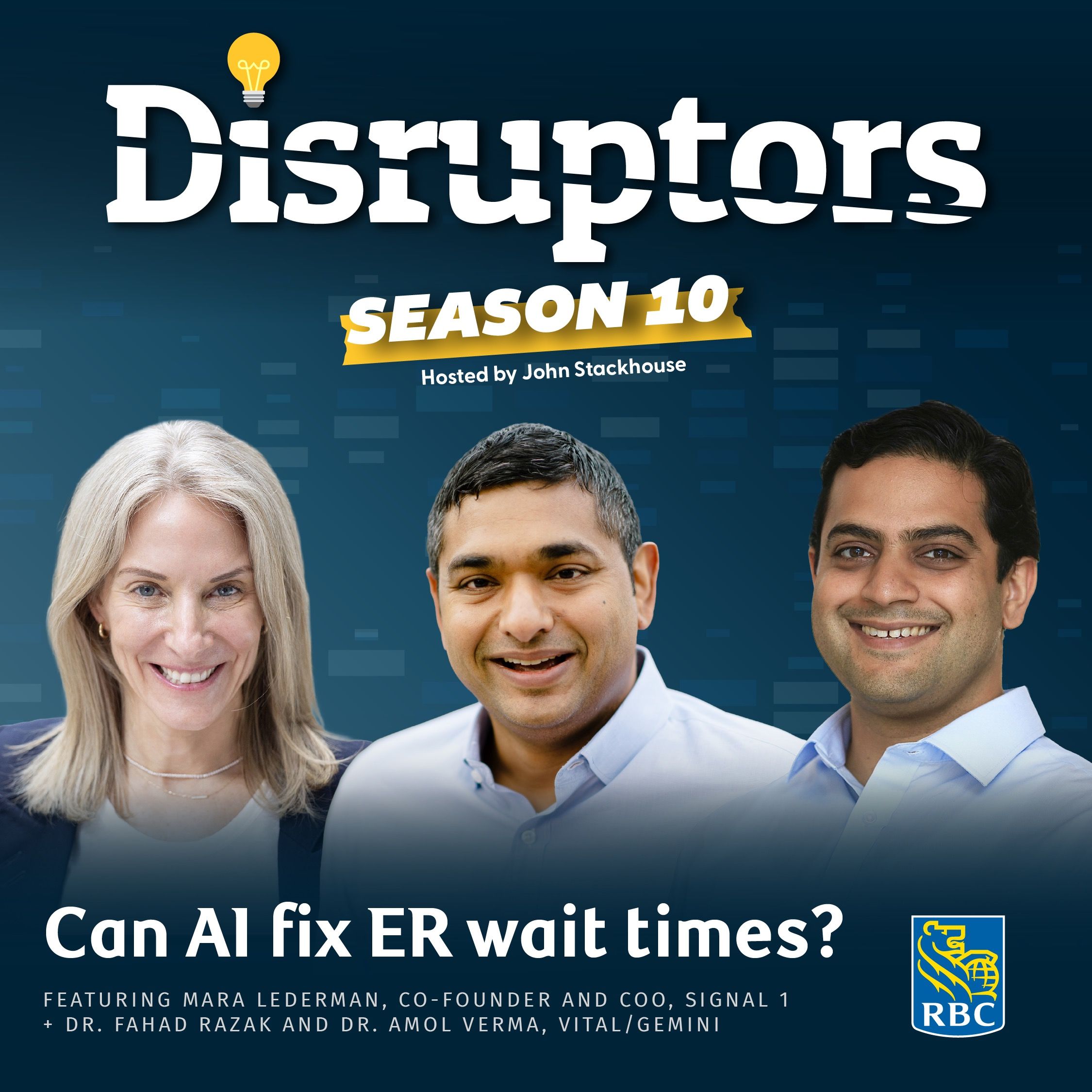 Can AI Fix ER Wait Times?