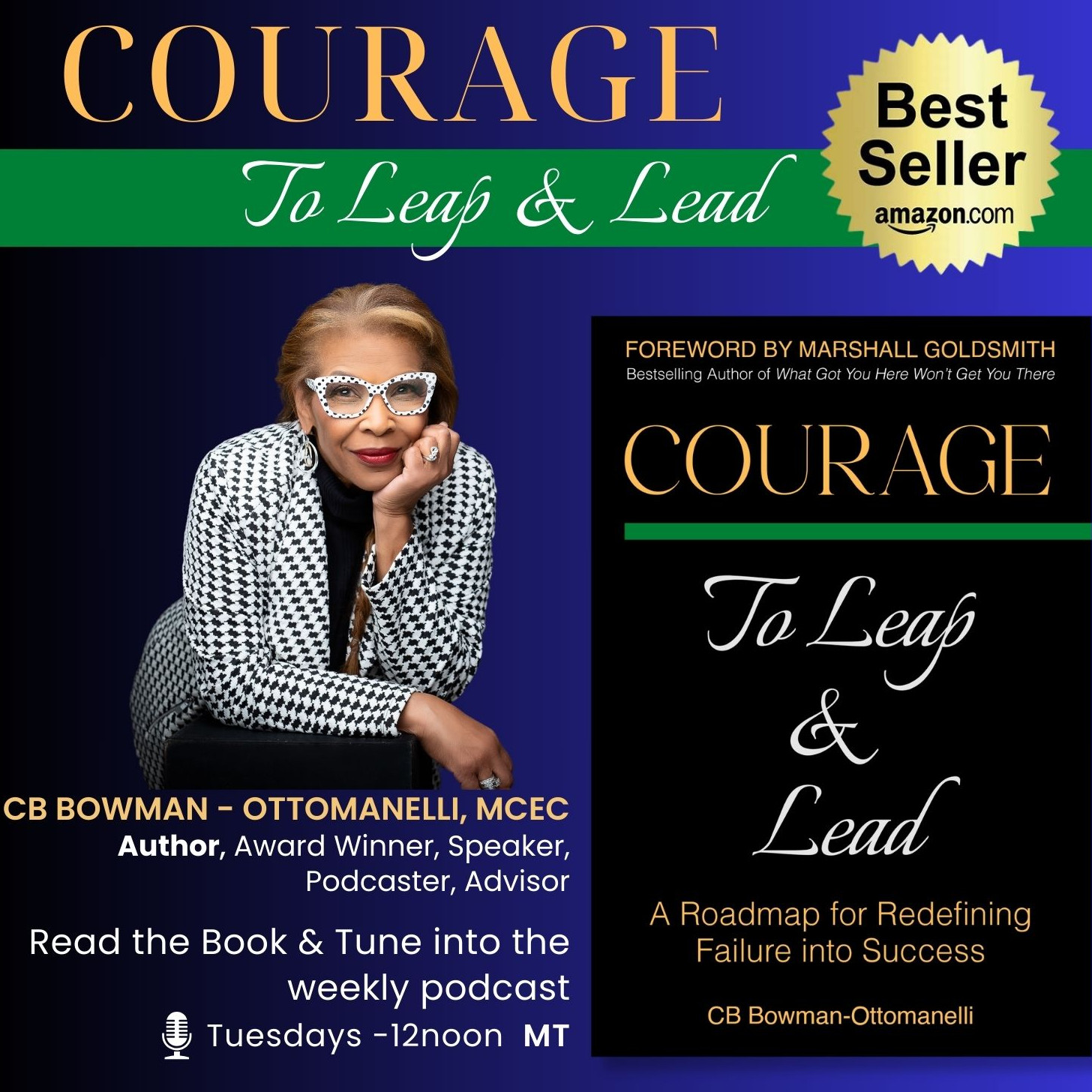
Courage To Leap & Lead · 2025-04-08 · 23 min
Key moments - from our scoring
Substance score
29 / 100
Five dimensions, 20 points each
Louise Story returns to discuss her book examining the $0.15-to-$1 racial wealth gap between Black and white American families. Rather than focusing solely on income, the conversation explores how wealth compounds through generations via mechanisms like the GI Bill (which only 3% of Black WWII veterans could access compared to nearly all white veterans), bankruptcy relief (which Story shows white Americans access more successfully), and family financial decision-making. Story shares how her co-author Ebony discovered her own fourth-generation homeownership traced directly to her grandfather's GI Bill benefits, while host CB Bowman reflects on personal experience - her father's decision to reject GI Bill homeownership benefits, limiting generational wealth transfer. The discussion emphasizes that wealth is not simply about earning power but about historical access to asset-building tools, family financial literacy, and what you own minus what you owe. The book features over 400 interviews and aims to make visible the often-invisible structural factors perpetuating wealth inequality across racial lines.
Black families hold approximately $0.15 in wealth for every $1 held by white families, a figure that holds across income distributions, not just among wealthy outliers.
The GI Bill was designed to help all WWII veterans start businesses, buy homes, and attend college, but only 3% of Black veterans could access it compared to nearly all white veterans, creating lasting generational wealth differences.
Yes - bankruptcy can increase net wealth by eliminating debt, since wealth equals what you own minus what you owe; however, white Americans are more likely to have their debts discharged compared to Black Americans filing for bankruptcy.
The book features over 400 interviews, profiles of seven main subjects (including rapper Killer Mike), chapters on bankruptcy and the GI Bill, historical analysis by Black writers, and personal stories showing how history shapes current wealth.
The book is available in print and on Audible, narrated by Toba Otto; profits are donated as part of a public impact project, and more information is available at 0.15info.
Our reviewer’s read on each dimension, with quotes from the episode.
The episode offers a handful of data-backed claims about racial wealth disparities and the bankruptcy mechanism, but the bulk of runtime is consumed by the host's personal anecdotes, book promotion, and emotional back-and-forth. There is almost nothing a B2B operator would find actionable or novel.
bankruptcy creates wealth...You successfully go through bankruptcy, you can get rid of what you owe. So what does that mean? Now you have higher wealth.
black people are less likely to get that Relief than white people
The framing of bankruptcy as a wealth-creation mechanism via debt elimination is a mildly counterintuitive reframe, and the GI Bill disparity data adds some historical texture, but virtually none of this is original to the podcast conversation - it is all drawn directly from the guest's book. No contrarian or first-principles B2B thinking is present.
wealth is where history shows up in your wallet
bankruptcy creates wealth
Louise Story is a credible investigative journalist who conducted 400 interviews and produced a rigorously researched book, earning mainstream press attention including The New Yorker. She has genuine practitioner depth in her subject, but she is not a B2B operator, founder, or executive, making her largely irrelevant to a B2B operator audience.
we did over 400 interviews for this book
It's been all over the press and the New Yorker and all over tv
The episode does cite concrete figures - the 15-cents-on-the-dollar statistic, the 3% GI Bill usage rate, 400 interviews, 7 main subjects, Killer Mike named by name with Grammy count - which is more specificity than most episodes in this genre. However, all evidence is sociological or historical rather than business-operational.
15 cents on the dollar is the amount of wealth that a typical black family has compared to $1 in wealth from a typical white family
Only 3% of black Americans who served in World War II were able to use it
The host repeatedly redirects to lengthy personal anecdotes (her financial mentor, her lawsuit, her clothing debt), asks surface-level questions, and closes with overt self-promotion. There is no substantive pushback, probing follow-up, or intellectual challenge to the guest at any point.
Oh, I've not read that. Tell us, tell me more about it.
I was just so broke and I was very, very fortunate to run into a financial mentor
Computed from the transcript - who did the talking, and the words that came up most.
"15¢ 𝗼𝗻 𝘁𝗵𝗲 𝗱𝗼𝗹𝗹𝗮𝗿. 𝘁𝗵𝗶𝘀 𝗶𝘀 𝘄𝗵𝗮𝘁 𝗽𝗲𝗼𝗽𝗹𝗲 𝗼𝗳 𝗰𝗼𝗹𝗼𝗿 𝗲𝗮𝗿𝗻 𝘃𝗲𝗿𝘀𝗲𝘀 𝘄𝗵𝗶𝘁𝗲 𝗽𝗲𝗼𝗽𝗹𝗲! 𝗝𝗼𝗶𝗻 𝗺𝗲 𝘄𝗶𝘁𝗵 𝗿𝗲𝘀𝗲𝗮𝗿𝗰𝗵𝗲𝗿 𝗟𝗼𝘂𝗶𝘀𝗲 𝗦𝘁𝗼𝗿𝘆 𝘁𝗼 𝗹𝗲𝗮𝗿𝗻 𝗵𝗼𝘄 𝘁𝗵𝗶𝘀 𝗵𝗮𝘀 𝗲𝗳𝗳𝗲𝗰𝘁𝗲𝗱 𝗴𝗲𝗻𝗲𝗿𝗮𝘁𝗶𝗼𝗻𝗮𝗹 𝗪𝗲𝗮𝗹𝘁𝗵 𝗶𝗻 𝗔𝗺𝗲𝗿𝗶𝗰𝗮. 𝗜𝘁 𝗶𝘀 𝗮 𝗰𝗮𝗹𝗹 𝘁𝗼 𝗮𝗰𝘁𝗶𝗼𝗻 𝗶𝗻𝘁𝗲𝗿𝘃𝗶𝗲𝘄!" Best-Selling Economics Author. Content, Data & Technology Consultant. Recent Chief Product and Technology Officer of The Wall Street Journal and Top WSJ Masthead Editor. 12 Year Alum of The New York Times (The Museum for Black Girls in Denver is holding a free gathering for the book I co-wrote about the Black-white wealth gap. It's a free event on June 25.) 𝗗𝗲𝘃𝗲𝗹𝗼𝗽 𝗮 𝗰𝗼𝘂𝗿𝗮𝗴𝗲𝗼𝘂𝘀 𝗺𝗶𝗻𝗱𝘀𝗲𝘁 and unleash your inner strength. Your courage roadmap starts here: Don't forget to follow CB, comment, rate, review, and
Transcribed and scored by The B2B Podcast Index.
Speaker A: You've got courage to lead. Courage to lead. Be brave and be bold. Wow. Let it roar. Welcome to the Courage to Leap and Lead podcast, where each of our guests share the stories of courage that help them become powerful leaders. Before we start today's show, please remember to visit courage consulting.com where you can find all the episodes and other excellent resources, all@courage consulting.com now here's your host, Leadership Courage Coach, CB Bowman.
Speaker B: Reading the book is like peeling back an onion. There's just so many layers, there's so many aspects. It's not one thing. It's baked into a lot of areas. We also have a chapter we write where we write about bankruptcy. And this is very interesting because, um, a lot of times when you talk about wealth building, you talk about ways to make money. When you think about bankruptcy, you're not thinking about making money, but actually, you know, bankruptcy creates wealth.
Speaker C: You know that because that one time, and it's, it's not clicking in my dyslexic brain.
Speaker B: Let me, let me say it. Why? Because it's very interesting. And wealth is what you own, minus what you owe.
Speaker C: Okay?
Speaker B: You successfully go through bankruptcy, you can get rid of what you owe. So what does that mean? Now you have higher wealth. You used to have, before bankruptcy, you had negative wealth, right? Because you owed more than you owned. Now you can go to through bankruptcy and you can get to zero. And zero is higher than negative 200,000, right?
Speaker C: Yes, but then, but then if you go to get money for something else, you have this credit rating that handicaps you.
Speaker B: Okay, okay. But let's put that aside and just, um, say that bankruptcy does take, does eliminate what you owe it or structure it. So what we examine in this chapter is the success rates of getting debt discharged by white Americans or black Americans. Because again, bankruptcy is a relief program. And if you have it, if it's the case that one group of people is able to take more advantage of a relief program than another group, again, that affects overall Data points like $0.15 on the dollar. And it turns out when you just look at the data, um, black people do not file for bankruptcy more than white people. They file in proportion to their percentage of the population. But of the people who file, white and black, white people are more likely to, to have their debts discharged or reorganized, meaning they get more relief. So that has an effect on the aggregate. I agree with. You can debate whether or not it's smart to go into bankruptcy, but if you choose to do it,
Speaker C: black people
Speaker B: are less likely to get that Relief than white people. So we really go in depth in that chapter. It's fascinating to understand why. And we have some, uh, people in the book who are very inspirational, who readers will never have heard of, but we also have some famous people in the book. Um, all these lives end up connecting in the book. One of the famous people we have in the book is Killer Mike the rapper. Killer Mike, um, his real name is Michael Render. You know, he's a three time Grammy award winning rapper. And we tell the bankruptcy chapter through him and it had never been covered before that he'd been through bankruptcy. He, he did not get his debts dismissed. And um, we explore why and it's really interesting.
Speaker C: Yeah, I mean we have as people of color a lot of stigma that's attached to things that white people don't in relationship to wealth. And um, you know, a lot of it has to do with a lack of uh, academic exposure as to what can happen, what can't help and what's the truth and what's not the truth. One of the greatest books that I ever read in my life and I wish I had read it when I was in my teens, was called the Millionaire Next Door.
Speaker B: Oh, I've not read that. Tell us, tell me more about it.
Speaker C: Fabulous. It's just fabulous. You know, we as people of color tend to be very status minded. Mhm. Right. So what happens is, and I know, uh, I'll say for myself, when I got my first corporate job, I was so excited and I thought I don't have a wardrobe to wear. So I went out, went in debt, buying clothes from designers to look good, to look corporate. Instead of taking that money and spending it on more education that would help me. And so this book is about, um, people who do those kinds of things. Uh, not looking at, for example, you want to buy a house. This cracked me up. Buy a house in a very expensive neighborhood, but by the smallest house m so that the equity in your house is up, but you're going into less debt on a mortgage. So those kinds of things. Um, they talked about buying cars. Don't buy a new car. You've got to be crazy. Buy a used car. Right. People with money. Wealth, sorry. People with wealth tend to buy used cars because they know the value of the car and is going to drop 50% the minute you walk out of the car dealership. Never occurred to me. To me it was always, oh, you don't want to buy a used car. It's something that somebody else had and you know that's going to show that you don't have the money to buy. Well, what the heck, right? Which is more important?
Speaker B: Well, what you're speaking to, by the way, is like I said, the focus on assets, not liabilities. So, uh, what you're speaking to, and this is something anyone of any race can mix up feeling like if they have a lot of assets to show off, nice clothes, nice jewelry are that. That is success and wealth and that. But anyone of any race can forget also. Well, you should factor in how much debt you had to put on the car. And for the close, even people will go into credit card debt. So it's just that forgetting of the debt piece, which is a common thing across our society.
Speaker C: Yeah. I was surprised one year when I. I was just so broke and I was very, very fortunate to run into a financial mentor. And he said to me, he sat me down, he said, what do you want? What do you want in terms of money that you don't have now? First thing out of my mouth was a house. And he said, you're never going to get it doing what you're doing. It was a, you know, it was a call to Jesus kind of meeting, right? And I, I was in tears because I wanted to be the first person in my family to buy a house, in my family's history to buy a house. And he said, I'll help you, but you got to help yourself. He said, the first thing I want you to do is I want you to go back and I want you to look at your credit cards and I want you to tell me how much money you spent on clothing in one year. Luis. It was enough to buy a house, clothing and jewelry. I was stunned. I had no concept. And, um, I told him, and he said, so this is good news. And I said, why is it good news? And he said, because now you know what not to spend on. And he said, and I'm going to take over your debt and I'm going to give you an allowance. So he gave me allowance. And I said, I can't possibly insist on this. He said, okay, we'll make it higher, and then each year we're going to lower it. So you can get accustomed to this. To this day, he's still my accountant.
Speaker B: Wow. Well, I mean, you know, he's my
Speaker C: financial planner to this day. And, uh, I just. When those lessons learned were hard and truism and so many people don't have the opportunity to learn them.
Speaker B: Yeah, there's, there's, as I said, it's an onion. There's so much there, you know. And, um, we just think that, um, people should think about how connected we are, not only to our own actions, but to history around us. One of the things Heather McGee, you know, who wrote the Sum of Us, um, read our book and wrote an endorsement for it on the COVID And she said about our book that it shows that wealth is where history shows up in your wallet. So it's theory of what you've done. It's also the history of what's happened to you. It's the history of your ancestors. Our book cover, we chose to put this photo on the COVID of a father holding his daughter on his shoulders because, you know, we all stand on the shoulders of where we came from. And, um, you know, sometimes people, sometimes people forget that. And sometimes people forget, you know, even if they worked really hard, that, you know, they were on someone's shoulders. And so I think, you know, by reading our book, you go on that journey of understanding what was it happening with my family and the 1920s and what was happening in the 1980s, and how is that different from what I'm m seeing here? How is it similar? And you know, white, black, Latino, Asian, people of all races will find some similarities and some differences to people in the book. There is no one experience. We tried to write a really nuanced book. You know, Ebony, my co author, um, she, um, didn't grow up super wealthy, but, uh, she is a fourth generation homeowner, and that would be rare for someone today. And she's, um. And she didn't quite know why she was. But in the course of our book, we have a whole section here. We reported out about the GI Bill and how black and white people fought in the war. And then the GI Bill was supposed to give benefits to, to all veterans to help start a business, to help buy a home, to help go to college. It very much created the white middle class of America. It was a big benefit program. But only 3% of black Americans who served in World War II were able to use it, whereas almost all white Americans who served in it were able to use it. And we kept interviewing family after family. We did over 400 interviews for this book. We interviewed so many black families where they were telling us about their World War II veteran grandfathers or great grandfathers who were not able to use it. And one day Ebony called me up and she says, I've got to tell you something. It's a little awkward. I'm like, what? And she says, I was just talking to my aunt and I found out my grandfather, who is Black, used the GI bill. He was one of the 3%. At first she felt a little awkward because as she explained to me, she felt a little awkward that she had had something that people in our book, some of these families had not had. But then she said, you know, it all makes sense now. It makes sense. I'm, um, a fourth generation homeowner. That one change in her family's trajectory was a big thing. And then her father and aunt went to college, and her aunt's college was paid for in part with some equity from that house bought with a GI Bill. So Ebony is black, I'm white. That's part of our partnership. But even for her as a black American writing the book, she found surprises and things that were similar to the most common story and things that were different. And everyone will find similarities and differences to the most common things.
Speaker C: You know, it's, um, synchronistic that you mentioned that. Because my father chose. Chose not to take advantage of that.
Speaker B: And what were his reasons?
Speaker C: He said to me, they lived in an apartment. And he said, your mother and I don't want to take care of a house. And I found out, well, but he could transfer that to me as his daughter. He was a lieutenant colonel.
Speaker B: Right. Okay.
Speaker C: And I think in his mind he felt, well, we don't want a house and they don't deserve his children, don't deserve to be able to benefit from this opportunity that he paid for as a soldier.
Speaker B: I see.
Speaker C: So there is a whole.
Speaker B: That's interesting.
Speaker C: Yeah, there's a whole nother side of, of that picture that's.
Speaker B: Yeah.
Speaker C: Not pleasant when you think about it. It's this, um, well, I didn't have it or I didn't want it. And so you can't have it either picture.
Speaker B: It's all complicated.
Speaker C: Yeah, complicated.
Speaker B: And a lot of times people don't talk openly, even with their families, about wealth. A lot of people don't know the financial picture of their own brother or sister or even their parents sometimes. And that's part of the problem. When no one can talk about it, um, it's hard to talk about if things are happening in an equitable way.
Speaker C: Exactly. And I grew up as a middle class black person and it just, it angered me. I had such anger that my father made this decision and I kept trying and trying and trying, and then finally I just said to myself, screw it. I'm going to buy my first house myself. M And that's when I went to my financial planner. Mhm. That anger, very interesting. Served me well. And here I am three houses later.
Speaker B: Yeah.
Speaker C: You know.
Speaker B: Yeah. And you did it and.
Speaker C: Yeah. And was it a struggle? Oh, hell yes. Was an incredible struggle.
Speaker B: Mhm.
Speaker C: But I felt like, you know what, I did it.
Speaker B: Mhm.
Speaker C: Take time to say congratulations.
Speaker B: That was a common thing. We also have throughout the book is the satisfaction that people get. We all know it, no matter our backgrounds and having things that are yours, you know, financial things, but also even our own stories and the value in our stories and our history. And um, we were very cognizant in the book to also, um, lift up, uh, um, his historical writings by black Americans, which are often ignored in historical works. We were a book with a lot of footnotes and we're able to lift that up. It's often ignored. But um, the people in our book who are future, we have seven main people, you know, it was a big driving force for them throughout to have something that was theirs. And in fact, at the very end of our book, before those personal recommendations, I won't spoil all the details, but I'll just tell you, someone in our book went through something really difficult, really sad story, um, a moving story. It's an important story. And at the end of the book,
Speaker C: after
Speaker B: all these trials and tribulations and ultimately losing something, we asked, ah, him was it worth it? And he said yes, because for that time period he said it was mine. And so it was worth it just to have had that period of it was his.
Speaker C: You know, I do know. I know exactly what he's saying. M. When I had to sue two Fortune 500 companies for race discrimination and work at the company while I was doing it.
Speaker B: Mhm.
Speaker C: And after I left, I said to myself, was it worth it? M. And I said, yeah, it was my fight. It was my fight. And what will happen generations later is that people who don't know that I walk that walk will be able to benefit. They'll be hired, they'll get the raises. Um, but now that it's so many years later and I won't reveal how much I realized how much of a health toll it took on me. Didn't M realize it at the time because my, you know, my energy was towards the fight.
Speaker B: Right, right.
Speaker C: I would say now I still feel like it's worth it, even given my health, because I did not, I didn't take it laying down, stood up, I shouted it out and fought.
Speaker B: Mhm.
Speaker C: And that's a remarkable strength that it gives you this kind of peace, this kind of strength. That you're able to say, not only for me, but for others who followed.
Speaker B: Right?
Speaker C: Yeah, Right.
Speaker B: Courage.
Speaker C: Courage, yes. Ergo, the book. Courage to leap and lead. Um, you know, Louise, this has been an amazing interview. I'm so excited about your work. What. What will be your next step?
Speaker B: Well, you know, EBONY and I both have been catching our breath since the book came out, and we've been. It's been all over the press and the New Yorker and all over tv. And, um, we've been hearing from a lot of readers. A lot of book clubs are, you know, taking the book on, which I think is a great way for people to have meaningful conversations. And, you know, we did organize ourselves these huge regional symposiums. Some of them had over 300 people. So it was a lot of work, but I think also, um, a lot of impact in reaching these people around the country. Um, but, you know, that's kind of where we are. We're just, um, hoping more people will read it, we'll talk about it, and that in particular, even someone who doesn't read it, who hears this podcast, we'll start spreading the statistic. 15 cents on the dollar is the amount of wealth that a typical black family has compared to $1 in wealth from a typical white family. This is not a figure driven just by white billionaires. It's a figure. It goes through the distribution. So when you compare the median people right in the middle of the distribution, that's what the figure is. And more people need to know it, need to think about it, need to care about it. And so, um, we are doing what we can. I'm so grateful to you to come on this, um, to spread this information. And so thank you.
Speaker C: Well, I'd love to put you, um, in my next LinkedIn newsletter, which will be November.
Speaker B: Okay.
Speaker C: Put your book in there. It goes out to over 3,000 people on LinkedIn.
Speaker B: Thank you.
Speaker C: Um, anything else I can do to support you all, ah, in this really important topic on racism that we don't. We don't have enough information on.
Speaker B: Well, we'll keep in touch. Thank you.
Speaker C: You know, it is a, um. Uh, it's a flame. It's a flame that's burnt a lot of us, and we didn't even know we were being burnt.
Speaker B: That's a powerful analogy.
Speaker C: Yeah. So thank you. Audience, please, please get a copy of Louise's book. Louise, show it again. Fifteen cents.
Speaker B: And I should say that, um, to the audience, you'll see when you open it on the first, um, page that, um, we're donating profits. So we. This is a public impact project, and your support of this is something we're donating when we make profits. So, um, thank you for just reading and spreading the word.
Speaker C: Absolutely. Is it also out on audio?
Speaker B: It is. There's a great version on Audible. A woman, um, named Toba Otto reads it, and she's a black American who lives in Northern California. We featured her in our newsletter. If people want to learn more about her, they can see that on, um, our website, which is $0.15 info. $0.15 info www. $0.15 info. Um, and it's a great listen. So it's about 15 hours long, but it's the kind of thing, if you walk a lot or you drive a lot, you. You can listen. So I, um, frankly, actually listen to most my books, so I recommend that, too, if people are book listeners.
Speaker C: I am. I would love to read, but, um, I can listen to it faster being dyslexic, so. You got it. You got it. Thank you again. Please keep in touch. I want to know more about how I can help the cause.
Speaker B: Thank you, audience.
Speaker C: I am so appreciative to your listening to this and, um, having an opportunity to learn more about the flame that's burning us. Thank you. This is CB on, um, Courage to leap and Lead. See you next week.
Other episodes covering the same guests and topics, from across The B2B Podcast Index.
 Investing From Birth: How Families Can Build Wealth Together with Niall DennehyDigital Irish Podcast · on Financial literacy70 / 100
 Reimagining Career Transitions with Bridie SearleReimagined Workforce · on Financial literacy63 / 100
 How to Take Over a Family Business Without Destroying RelationshipsChats with Jason · on Generational wealth transfer60 / 100
 A FinTech Startup Educating the Latino Community on Investments and Financial Literacy: Israel Hernandez CEO & Co-Founder, Aaron Chavez CFO of DinerazoGo Entrepreneur Yourself · on Financial literacy58 / 100
 Bridging the Gap: Earned Wage Access, Financial Wellness, and the Future of QSR WorkThe Shift Change · on Financial literacy50 / 100
 Democratizing Finance: How AI and Stablecoins Could Transform Financial AccessBanking on Information · on Financial literacy50 / 100211- Courage to Leap & Lead with Louise Story part 1210- Courage to Leap & Lead with Elizabeth Lotardo part 2209- Courage to Leap & Lead with Elizabeth Lotardo part 1208- Courage to Leap & Lead with Richard Boyatzis, part 2207- Courage to Leap & Lead with Richard Boyatzis, part 1