
Big Careers, Small Children · 2025-12-04 · 46 min
Key moments - from our scoring
Substance score
59 / 100
Five dimensions, 20 points each
Ori Carmel brings a background in decision science, game theory, behavioral economics and analytics to his work at Sowen, a consulting firm serving philanthropic and nonprofit organizations. He describes how fatherhood - arriving at age 40 when his first child was born - prompted a deliberate career pivot away from corporate roles at Twitter and American Express toward work with clearer social impact. The conversation explores the structural challenges of American work culture versus European patterns, where long hours and availability expectations create different pressures for working parents. Carmel shares tactical approaches he and his wife employ: daily emotional bandwidth check-ins where they rate their capacity (on a percentage scale) to handle family chaos, aggressive phone boundaries during family time, and planning individual self-care like his wife's Friday tennis sessions. He reflects on missing his daughter's first smile while in Florida for a client meeting, which crystallized his thinking about intentional presence. The episode addresses the deeper American cultural emphasis on transactions and money over health and wellbeing, contrasting US working norms with UK and European approaches, and discusses the long-term costs of self-sacrifice in high-impact professions like healthcare.
He limits weekend work, avoids checking emails after 5pm, puts his phone away during family time, does nightly story time together as a couple with both children, and regularly checks in with his wife about their emotional bandwidth to handle parenting stress that day.
Having children prompted him to shift from corporate roles at Twitter and American Express toward social impact work at Sowen, a consulting firm serving nonprofits and foundations, because he wanted his work to have intrinsic purpose and impact beyond transactions.
Each evening around 5-5:30pm when they're reunited, they tell each other what percentage of emotional and intellectual capacity they have left to handle family chaos that evening (ranging from 20% to 80%), which helps them balance support and adjust expectations accordingly.
The US emphasizes long hours, constant availability, and equates flexibility or part-time work with lack of commitment, whereas countries like Spain view work as a means to fund life outside work; the UK falls somewhere in between, creating tension around health and family versus career.
They offer complete flexible workplace hours with core availability windows, rarely mark things as urgent, and have a firm boundary against calls or texts after 5pm, creating cultural guardrails that everyone respects.
Our reviewer’s read on each dimension, with quotes from the episode.
The episode contains thoughtful reflection on work-life balance and parenting, with some useful tactical approaches (bandwidth percentage checks, calendar blocking for family events, guardrails against after-hours work). However, much of the conversation revisits well-trodden ground (missing milestones, long US work hours, gender inequity in parenting) without novel frameworks or surprising data. The substantive insights are somewhat diluted by extensive preamble, promotional content, and philosophical asides that don't yield actionable knowledge.
I'll be like, I had a really, really rough day. I'm at 20%. What are you at? And she'll be like, all right, I'm at 60%
I put the kids like extracurricular activities on my calendar. So I know that I need to finish a call at 4:45 because at 5:15 I gotta take oh into Code Ninjas
The episode treads familiar terrain for this podcast's target audience: the tension between senior roles and parenting, systemic barriers for women, US work culture excess, and the importance of intentionality. The 'bandwidth percentage' check-in is a moderately fresh tactic, but the broader framing (structures, guardrails, making choices aligned with values) reflects widely-circulated thinking in parent-career literature. The discussion of teaching children to value money over health is interesting but underdeveloped and not connected to actionable business insights.
Everything is a choice. Almost everything is a choice
There are systematic components that work against us, and I think it's really, really important to recognize those and how powerful those are
Ori Carmel is a thoughtful practitioner with genuine operational experience (Twitter, American Express, consulting) and has made real career pivots. However, his current role at a small consulting firm does not position him as a large-scale operator or recognized authority. He is reflective and self-aware but not a household name or person known for breaking new ground in work-life integration. His value lies in reasoned personal experimentation rather than proven, repeatable systems at scale.
I work for a small consulting firm called Sowen
My background is kind of strange. It's decision science and game theory and analytics
The episode includes some concrete details (Sophie is 10, Owen is 7; maternity leave was 6 months; the first smile moment; Code Ninjas activities) but relies heavily on generalizations about US vs. UK vs. European work culture without hard data. Claims about maternity leave length, innovation rates, mental health, and gender participation at school events are made without citations or statistics. The discussion of how children are taught math via money examples is illustrative but anecdotal. Lacks named case studies, metrics, or research backing.
Sophie are now 10 year old. Our oldest was a couple of months and I was still working, I was still at Twitter at the time
in the U.S. women are back to work, sometimes as short as, you know, eight weeks, if not even shorter
Verena asks solid, open-ended questions and shows genuine curiosity about Ori's decision-making processes and internal habits. She follows up thoughtfully on his 'deep thinker' characterization and probes the gap between belief and action. However, she rarely pushes back or challenge his claims - for instance, when he says things are 'rarely as significant as they seem,' or claims about teaching children to value money, she doesn't dig deeper. The conversation is warm and collaborative rather than adversarial, which limits its analytical edge. Some airtime is devoted to promotional content and the host's own background rather than extracting maximum insight from the guest.
How did you turn that thought of I do want to be present into action, or did you turn it into action in any shape or form?
Can you share a bit more about those structures you mentioned? People, processes that help you have those guardrails in place?
Computed from the transcript - who did the talking, and the words that came up most.
In this reflective and deeply thoughtful episode of Big Careers, Small Children, Verena Hefti MBE speaks with Ori Carmel , Founder and CEO at Sowen. Drawing on his lived experience as a father of two, Ori shares how working parents can make better decisions about work and family, build guardrails that protect what matters most, and avoid the regret that often comes from overwhelm or overcommitment. Ori reflects on the moment he missed his daughter’s first smile while travelling for work, the subtle choices that shape daily family life, and the simple frameworks he now uses to stay aligned with his values.
Transcribed and scored by The B2B Podcast Index.
Welcome to the Big Careers Small Children Podcast. My name is Verena Hefti. I believe that no one should have to choose between becoming a CEO and enjoying their young children for much too long. Amazing people like I'm sure you listening right now have found themselves stuck on the career ladder when they have children and that leads to gender inequality in senior leadership because those people don't progress to senior leadership and the same stale, often male middle class people leading our organizations.
We must change this together and I hope that many of you listening right now will progress to the most senior leadership roles that you like where you can make the decisions that make our world a better place. Outside of the podcast. I am the CEO and founder of the social enterprise Leaders Plus. We exist to help working parents progress their careers to senior leadership in a way that works for you and for your families.
We have free events and resources on leadersplus.org where you can download helpful toolkits such as on returning from maternity leave, share parental leave, securing a promotion, dealing with workload challenges, or managing as a dual career couple. We also have an award winning fellowship community which is global for working parents who have big dreams for their careers but don't want to sacrifice their family. You'll join an absolutely wonderful group of people, a very tight knit, supportive group of parents who have your back together.
You'll explore what your career aspirations are and you'll get advice from senior leaders who are also working parents about how to achieve those aspirations. You'll get new ideas to combine your hopes for your careers with your hope for your family. And you are supported by people who are experiencing what you're experiencing yourself. I'm really delighted that a larger majority of our fellows have made tangible changes following the program.
Be that becoming more senior in their roles, working short term hours, having better flexible working arrangement. They always impress me so much with the courage that they instill in each other to do what is right for them without apologizing for having a family or apologizing for wanting that top job. Details are on leadersplus.org/Fellowship in today's episode I'm chatting to Ori Carmel about his approach to work life balance, about what safeguards and guardrails he puts in place to ensure that he does have this presence.
And we also discuss about how to live work life balance in a culture that isn't designed for it. And we chat about all things in between Linked to Philosophy and Cambridge Theory and so on. Enjoy the conversation. A very warm welcome.
Why don't we start with you Introducing who you are, what you do for work and who's in your family. Who's in my family? Oh, can we start with that, the important stuff? Sure.
All right. So it's myself and my wife. Well, my wife and myself actually. Her name is Fiona.
She is born in Ireland and we met actually on a trip in Southeast Asia on a boat in Laos, out of all places. And we live in Fairfield, Connecticut with our two children, Sophie, who is 10, and Owen, who is 7. Lovely. And what do you do for work?
So I work for a small consulting firm called Sowen. Sowen works with large philanthropic, nonprofit, government and corporate philanthropy organizations and it helps them identify and integrate better data and technology solutions processes into what they do. So we basically help them what they are already trying to do, but help them do it better, more effectively, faster with better data technology solutions. Makes sense a little bit.
I don't quite understand the detail, but basically help them do what they were meant to do anyways, but to do it really well and efficiently with better data. Exactly. Okay. Exactly.
And help them measure the impact of what they do, which is a hard part nowadays, but an important one. Absolutely. That's the bit that matters in the end. Can you share a bit about your journey as a working parent and how it shaped your professional life?
Yeah, absolutely. My background is kind of strange. It's decision science and game theory and analytics on kind of that's one part of the brain and then it's behavioral economics and marketing on the other part of the brain. So my career has taken me across multiple sectors.
I worked for the government for a little while and then got into corporate, worked for large organizations, most recently Twitter and then American Express where I had Adapt products and then also had a couple of smaller organizations, startups even in between, and really started getting into social impact work about seven or eight years ago. And I don't know if it is related to absolute certainty, but I think that there's a high correlation between the fact that we had our first child two years beforehand and had our second child a year after that drew me into working or diverting my career away from corporate and into something that I feel and think has a little bit more of a intrinsic purpose to it and hopefully helps impact the lives and well being of people and communities around me.
So yeah, I'm sure that there are other factors that went into kind of that shift career change, but I would like to think that having children, as cliche as it may sound, it was a component of making that career decision at the ripe old age of 40. I think you just can't waste your time on stuff that isn't impact. When you. A lot of people tell me that they feel they have to spend their time wisely, one, because their children will hear about what they're doing at some point, and two, if you spend time away from the family, you wanted to count and you wanted to make a difference.
I think for me, that's also a reason why I do what I do. Yeah, I think that's right. No good. I.
I recognize not everybody thinks in that way and that's fine. Different people value different things in different points in their lives and place emphasis on the things that matter to them at that point in time. And it's okay to change that over time. I know that for me, once we had children, all the questions that I was already asking myself but was able to kind of suppress or put aside, what am I doing?
What am I spending my time on? Why am I doing this? How is this contributing? All these types of things rose to the surface in a much more visceral way once I face them at a completely different point in my life with different stakes.
Right. That is not a judgment call on anybody who hasn't or doesn't or chooses a different path or just finds themselves in completely different circumstances. That's just been my experience. And for me, yeah, I think having children and thinking about the things that I'm doing, the time that I'm spending, what am I spending it on and what am I leaving, hopefully one day leave behind, was a component, a serious component of making that decision you come.
Across, just chatting to you before coming on there as someone who is, you know, a really deep thinker and tell me if I'm mischaracterizing you there, but I think the challenge with children, especially when they're younger, is that it is just hectic and messy and your schedule falls apart. And I'm interested for you. Can you remember the most challenging moments of combining demanding, high stakes work with equally demanding children and what you learned from those moments? I think that the challenging moments happen every single day.
They don't have to be monumental to count and they don't have to be monumental to impact you or help you shift or reflect or make a decision. One moment that comes to mind. I don't know if it's a monumental moment, but Sophie are now 10 year old. Our oldest was a couple of months and I was still working, I was still at Twitter at the time and I was in a meeting down in Florida somewhere, meeting A client and I get a text from my wife and it's a picture of her smiling.
And I remember being very happy. It was like the first time that it was like an actual smile, you know, when a baby, like a couple months old, like they make faces and stuff, but that was an actual smile. My wife was still on maternity leave at the time. I was like, crap, damn it.
I missed that. Like, I missed that moment. And in reality, I could have missed it either way, even if I weren't in Florida. Right.
I like, I was, I wasn't doing anything wrong. I went to the office and, you know, my wife is on paternity leave. Clearly the chances that she will be there for the baby's first smile is significantly higher than mine. Because in the US we barely get any paternity leave, which is insane.
Don't get me started on paternity and maternity leave so we can dive into that. But it was a moment where I was like, okay, how many moments am I going to miss? I'm going to miss some, but how do I make sure that I don't miss as many of the important ones as I possibly can? So that was like a moment of I felt a little guilty for a second, consciously knowing that there wasn't much that I could do about it and it could have happened, it would have happened anyways, or a moment like it would have happened anyways.
But it did make me think, how many moments am I going to miss? What can I do to miss as few of them as possible? It also made me think about what moments did my parents miss? Because my dad worked insane amounts of hours.
So it kind of also made me reflect on that, like, what do I want to do differently? I don't know if that answers your question at all. No, I think that's really self provoking because also the we're chatting across continents on this and I think that whole how do you not miss stuff that matters is possibly harder in the US because the expectations just in terms of hours of work seem to be really high compared to Europe, even the uk, which has quite long working hours compared to the rest of the oecd.
How did you turn that thought of I do want to be present into action, or did you turn it into action in any shape or form? So first of all, just to recognize your comment about working patterns. Absolutely. I mean, the working patterns here on this side of the Atlantic are nonsensical, unhealthy.
I mean, you see it in everything, everywhere. You see rates of innovation, you see mental Health in the modern workplace, you know, issues with that. But we can touch on that later if you want. How do you manage that?
First of all, you fail every day, right? It just happens, right? I catch myself picking up the phone when I shouldn't or not paying attention when I should. So I think the first step is to recognize that what it's going to happen and recognize when it's happening and course correcting quickly.
I try to get myself into better habits. So for example, I used to spend a lot of time working on the weekend. I really like working. I like what I do.
We solve really interesting and complicated problems at work. So I really, really like what I do. But I try not to do that on the weekend now. You know, I'm try to spend or be very, very present in things that aren't necessarily related to work, that are around the kids and the family and friends and those types of things or things for myself, like reading or watching a good movie or something like that.
So I think catching yourself when it happens and then recognizing patterns like working over the weekend. I try not to work late and I think the danger for me. You said deep thinker. I don't know if I'm a deep thinker, but I.
I certainly tend to take myself way more seriously than I actually should is to recognize that, you know, hey, things are rarely as significant or as, you know, weighty as they seem at that moment and nothing's gonna happen if that email goes out tomorrow and I can just disconnect and go see the kids or those types of things. Take work a little bit less seriously. Despite the fact that we do serious work and that matters. Create those balances.
I think balances are important and I think that a lot of us nowadays feel off kilter because our senses of balance have been really thrown off over the past five years. That's true. I think there's something about flexible working, which again in the UK is a very. I think it's well embedded.
I would say not as well as I would like it to be, but it is definitely there and it's here to stay. But that also means that I can bleed into absolutely everything. So I have been absolutely guilty of checking my emails while supervising the children in the bath and make sure nobody drowns. Nobody did drown, but wasn't the most relaxing experience or anyone involved.
I think to me there's something about that feeling of I'm a high performer and it's somehow connected with working intensely. It doesn't have to be long hours, but that intense you know, getting absorbed into something, that's when I feel I'm excelling. And I had to learn the hard way of how to actually switch off. You know, I'm sure everyone listening is going to applaud your whole, let's not work too much on the weekend and all that.
Sorry, this came out a bit more negative than I meant to, but everybody's going to agree with that, that that's a nice thing. However, how have you endeavored to change your own internal habits, as you've called them? I think you do need to think about these things pragmatically and prioritize. And each family, each environment, each parental unit, whatever you want to call it, is going to have its own reality.
One thing that my wife and I have started applying that has worked well for us is we'll let each other know what percentage do we have in our emotional intellectual bandwidth on that day, at that moment to deal with the hectic nature of life? So, like, we finish work, we get the kids, or, you know, Sophie comes home from school, she walks home, we get we ghetto, and he's still too young to walk home, you know, and it's 5, 5:30, we're all together, and we'll have a check with each other, and I'll be like, I had a really, really rough day.
I'm at 20%. What are you at? And she'll be like, all right, I'm at 60%. Then we know that she's got a little bit more fuel in the tank than I do for that evening.
And that helps. That helps because we can balance each other off. And some nights she'll be at 80 and I'll be at 20. And some nights I'll be at 80 and she'll be at 20.
Or some nights we'll both be at 60. And that's great. Little things like that have really, really helped us, I think whenever we manage to put away the phone. The phone is an incredibly intrusive component in our lives.
And it is a device that is literally designed to detract you. Detract your attention from everything else. So I think putting away the phone and letting it charge at least for that time between five, which I don't do every day, I fail at all the time. But when I do that, when I manage to do that, that's been really, really helpful.
Yeah, those are two things that come to mind that are a little bit more tactical than, like, okay, we won't work on the weekend. We also try to employ a very, very healthy approach. To some really negative and destructive work patterns that you mentioned earlier that are specifically prevalent in the U.S.
so for example, we have complete flexible workplace. We have hours where we need to be available. But overall nobody tracks how many hours when you're on the phone. There are very few things in our work that we deem urgent.
There are very few times when there's a call or a text after 5 o', clock, for example. And we're really careful about those things as a working culture. So that creates guardrails, barriers that everybody respects and can work around. And that helps.
That helps everybody kind of maintain that balance or barrier between work overtaking other areas of your life that should still be there. Absolutely. And I think there's something about the balance between your work and the children. But then there's something about time for yourself.
Have you found anything that works or is it just out of the window and you're giving up on time for yourself for the next 10 years? It's not. That's something that we're really, really again careful and thoughtful and we plan for it, right. So my wife really loves tennis.
She was a tennis player. She has her tennis Friday afternoons, Friday morning sometimes, sometimes Saturday morning. So we plan for that. Right.
So if it's Saturday morning, I got the kids from 8 o' clock in the morning when she goes off to tennis until 11. And it's not like we have shifts but you know, it's not like shift parenting but we plan for it, right? So I know that she's going to be gone for three hours and that's great. That's her time for herself.
She knows that if I want to get a workout in sometimes that's going to happen at 7 o' clock in the evening. And sometimes she's going to read stories to the kids by herself, which we usually do together as a family. And that's okay. Like we give each other grace and space to do these types of things.
So I think, you know, as horny as it sounds, being forgiving with yourself is also a component here. You can't be perfect all the time. That is very true. Although I have to say the fact that a 10 year old still wants to listen to your stories.
Oh yeah, it's definitely in my book that goes to in towards perfect parenting territory. Yeah, we do story time every night and we're starting to see the 10 year old starting to read her own books. But she still sits like and we do it in bed all together in our grownups bed. Like my wife and I's bed and the kids both come in.
And that's a nice thing that we all still do. I recognize that, you know, maybe she won't want to do that with us at 13. So we're very much cherishing those moments. Enjoying it while it lasts.
I have one at a similar age and she will sometimes say, mommy? Yes. You're allowed to tell me a story. I.
Yes, I know how much you love it. I'll let you do it. But actually, I just want to read Malora Towers on my own. Can I ask you a question?
Sure. So you highlighted something really interesting, which is, you know, the different working patterns and there's a geographical component to it. There's also a cultural component to it. What do things look like from your side of the Atlantic?
Like, what is the perception of the North? I wouldn't even call it American because Canada kind of gets bunched up into this. What is your perception of the American working culture? Positive, negative, and everything in between.
I mean, obviously I'm just one person. My perception is that the hours are very long, that you're expected to show that work is a key priority at all times and that things like flexibility or part time are assigned of lack of commitment. I think that's a bit the case. I mean, the UK is far from perfect.
Those elements are there as well. But just from my American friends, which is not a huge sample. That's my impression. Yeah.
Is that what you think? Does that tally with what you're thinking. Or not so much mass generalizations, but yeah, but on the whole, yeah. I mean, UK is somewhere in the middle, but yeah, I think the American sense of manifest destiny and all those concepts that are very ingrained into American culture lend themselves very easily to finding themselves on overdrive.
I had a friend who presented a really, really interesting thought to me on a project. We were actually talking about issues with the healthcare industry of which, again, there are many differences and many gaps between the approach that Europe and the UK have to that of the American system. And. And she touched on this topic of parenthood.
We were thinking about the concepts of this podcast and she noticed something interesting that I haven't thought about from early education. We teach our kids here. I don't know if it's in the UK because I didn't raise my kids. I raised them a little bit in the uk, but not wholly.
We teach our kids to value money over health every time. And it was really interesting observation. She asked me, how does my 7 year old learn math? And I said, well, I don't know, like Johnny has 10 apples, he has to give five apples to Judy and five apples to Hannah.
You know how many apples is he left with? Like it's all transactional. And then something else. I went and looked at his notebook.
They teach them through money. They teach division. He's learning division right now. So a dollar distributed to 10 cents, you know how many 10 cents increments or.
I don't know if it's symbolic, I'm sure it just caught me at that moment, but it made me think of how much our curriculum and education is structured in overvaluing transactions, finance, business, money versus health, well being, family, community. Again, I'm not an educationalist, but I think I could absolutely concur with that. What your point just made me think of as. Well, we work.
About a third of our work here is with the nhs. So with the uk, the parents who work as doctors, midwives, nurses and so on. And I think there's something interesting going on about this whole self sacrifice which is, you know, if I'm looked after by a wonderful midwife who is going above and beyond, this is a wonderful experience for me. It's, in fact it's an experience that is going to likely make me feel safer and probably also make increases chances of me and the baby surviving.
But that's, I think it just us valuing that as a society and people being recruited into those professions which they often don't do because of the money, they do because they want to make a difference. I think that's the flip side of it. Through that self sacrifice, that's where exploitation can happen and long term damage to health. And I just wondered what.
I know you know the UK health system really well. You may or may not want to publicly say what your opinion is on this, but I'm interested, we can cut it out here. But I'm interested in your, you know, that tension between actually having a high impact career in health and at the same time being here as a whole person for your family. Yeah.
Again, I think the UK is kind of in an in between place. If I take, again, this is a mass generalization, but if we take the US and what you described earlier in terms of the working hours and the expectations and how people value themselves and how people value others. Right. At one extreme.
And then you take, I don't know, countries where, let's take Spain for example. Right. The working culture is different. The value of the role of the workplace in your life is different.
Right. Work is a means the end is to have enough Money to spend time with, have enough money to survive and have a good life. Again, mass generalization, not for everybody, but to spend time with family, spend time with community, spend time on your interest, spend time with your friends, you know, have dinner at ungodly hours in the evening. And the UK is kind of in that in between phase, either unsure of which path to go or finding a balance between the two, which I think is great.
I think it can get incredibly challenging and destructive here. I think it can get really, really destructive here. I see a lot of loneliness here. I see a lot of loneliness, you know, for the kids themselves.
I see a lot of loneliness for the parents in those moments of realization where they understand that their kids are grown up and they're not as much of an active part of their lives. I see a real moment of kind of reflection and whatever you want to call it, realization of consequences that kids leave the house for a lot of people, you know, when they leave the house and all of a sudden it's quiet. And now all those opportunities that you had to spend time are gone, right? They went off to college, they went off whatever they're doing.
And that can be a very, very challenging difficulty moment for a lot of parents, I think. I haven't gone through that phase myself, but I. I see it with some people around me, and it's. It's challenging, it's hard.
I think that's true. And. And hindsight is always. It's an easy way to look at it, but I'm quite encouraged as well.
I. Look, I'm obviously able to interview a lot of wonderful people like yourself on this podcast, and some of them are towards the end of their careers and then look back and they say they're usually people who have spent a lot of time with their children while holding down very senior jobs. But what is interesting is that actually most of them say their children didn't suffer from their senior jobs, or they say their relationships didn't suffer and so on, which I think is quite encouraging.
But, you know, you use the word culture a lot, and I think that's interesting because people are choosing, we are all choosing to try to live our lives more or less by our values. But then if those values aren't once in society, what is your reflection about living a big career, small children combination in a way that works for you, but which may not be in line with the mainstream rhetoric in society? Look, I think everything is a choice. Almost everything is a choice.
And if you're smart and thoughtful and lucky and have A good life partner or smart mentors or friends or people around you who will help you think about these things when you're not thinking about them and point them out, then you will come to a moment of choice. And for some people, choosing to become a high power executive at a corporate organization will mean that they will spend less time with their children. I'm not saying if that's a good choice or a bad choice, but I'm just saying that it's a choice, right?
There are times when that choice is really, really difficult. But for me, I think the important thing was to create a balance. I knew that I can't be in a job, I can't do a job that I truly a job, I can't, you know, invest that much time into something that I am not deeply involved, emotionally and intellectually involved in. At the same time, Ihavetochooseeverydaywhat'smoreimportant.
Icanworksevenor eighthoursandIcanwork12hours,butifI work12hours,I'mnot goingtospendthethreeorfourhoursin theeveningbetweenfivetoeight,you MostchoicetowardsthethingsthatIknowmattermoreinthebigpicture.That'sreallyhardtodoin the moment,butput asmuchasmanyof thoseguardrailsandrecognizethosemomentswhentheycomeandslowmythinkingdownandthink,allright,like,isthisactuallythatimportant thatI'mgoing tospend threemorehoursonthis?OrshouldIpause,spendtimewithmychildren,maybecomebacktoitlater,maybecomebacktoittomorrow?
Youknow,nomagicbulletsolution.There'snolike formula.ButItrytokeepitataround80%.Whenthechoicecomes,Itrytomakesurethat80%ofthetimeIPut allthestructuresaroundmethatallowme to pickthefamily,thekids,theself,youknow,youknow,thetimeformyself,thetimeformywife.
Don'talwayssucceed.I failallthetime. We all do. Well, exactly.
I don't know if that's. If that answers. I think that's really fascinating. I'm interested in that word structures.
Yeah. Can you share a bit more about those structures you mentioned? People, processes that help you have those guardrails in place? Yeah.
I mean, that's where my background kind of kicks in. Right. Game theory and analytics and, you know, different people operate on different things and have different methodologies or ways in which they are motivated. For me, it's really important to think about these things schematically because that's how I know that I will make decisions that I can stick to for a long period of time and that make both emotional and intellectual sense to me.
Right. My wife, who as I said, is better than me at everything, including these things, she's intuitively very, very good at recognizing when to find those balances. I need more structure. I need mechanisms around me.
So for example, I put the kids like extracurricular activities on my calendar. So I know that I need to finish a call at 4:45 because at 5:15 I gotta take oh into Code Ninjas where he's learning how to code, you know, those types of things. I structure it into my behavioral patterns. And I find that that helps me a ton because it allows me to think of these things in a way that fits into how I structure my day, you know, so every single kids activity is on my work and personal calendars.
Even if you don't take them. Yeah. So even if I can't go, if there's like a parent teacher conference and it happens to be at the middle of the day and I'm like, hey, Fiona, you got this one? She says, yeah, I got this one.
It's still on my calendar. So I see it. So I'm conscious of the fact that I'm missing it. There may be a perfectly good reason.
And again, there's a choice. It may be the right choice to make at that moment in time, but that choice has a downside. Better remember that I missed that. And if I miss two in a row, then it starts to become a pattern.
And if I miss three in a row, then it's a problem. Right. So to keep those things in mind and to have them is really important for me. It works for me because that's the way that my brain works it works on like patterns, structures, schematics, and that helps me.
Yeah, and I couldn't agree more. So I'm the same. Not quite every. I think my diary looks a bit messier than yours by the sound of it.
And I do forget which day, which lesson is up. Luckily my partner is very organized. So you said you're a game expert, do you? I'm imagining game theory.
I have no idea about game theory, but imagining you get rewards for doing certain things and you make it all quite fun. And I just, if that understanding is right, how do you do that with the whole balancing big career, young children. Right. So in principle your understanding is right.
Game theory basically tries to understand how people and organizations behave. What are their motivations, pros, cons for those behaviors and how can you influence. So it's not necessarily just about games meaning like Monopoly or things like that. It's about how do people, structures, organizations operate in different dynamics.
So how does that weigh in? I think it weighs in, in understanding the pros and cons of every situation. That's where it comes in. If I am missing a parent teacher conference, I'm not going to hear firsthand from the teacher, from Sophie's teacher, how she's doing.
I'm going to hear from Sophie and I'm going to hear from my wife who you know, might be there. But I'm not going to get a chance to ask the questions that I want to ask. I'm not going to get a chance to get a first hand account. I'm not going to get a chance to interact with our teacher, which I think is super, super important, those types of things.
So understanding the pros and cons of every situation and what those mean in the short term, medium term and long term for me, for my family, for in this case my daughter, for us as a family unit really helps me kind of get smarter and make better decisions in the moment, especially when it's under high pressure, right? When it's like, oh my God, I really shouldn't miss this meeting and oh my God, I really shouldn't miss this PTA meeting. All right, now things are real, right?
Like because decisions in day to day are already hard, decisions under pressure or with high stakes are significantly harder now it becomes a real battle. And I want to make sure that 80% of the time I land on a place or a decision that I will be comfortable with or as comfortable as I can be a day later and a week later and a month later and a year later that I won't Reflect on it with regret. There's a lot of wisdom there. I don't know if it's wisdom.
I think so. I think so. Trial and error, I'll tell you that. Well, wisdom isn't the same as doing it, but I think it's a very powerful idea, for sure.
We're coming towards the end of our podcast. Is there anything that you were desperate to say that you haven't had a chance to. To say it to our listeners? No worries if not.
But just wanted to give you the space. A couple of things. Yeah. I mean, I think we kind of touched on it here and there, but there are systematic components that work against us, and I think it's really, really important to recognize those and how powerful those are.
Right. We talked about, like, the healthcare system, for example, in the U.S. and the fact that, you know, in the U.
S. women are back to work, sometimes as short as, you know, eight weeks, if not even shorter. Like, that's insane. You know, all the phones.
Right. The prevalence of technology in our lives and how destructive it can become if you don't guardrail against it, you know, and how awful it is. So with all these things that we talk about, there are individual choices, there are things that you can do, but it's also super important to recognize that there are tons of pressures that are operating on you from outside that are incredibly powerful. Right.
Incredibly power. Socioeconomic disparities. Right. Parents who have to work two jobs.
Like, I'm incredibly lucky. I have a job where I can shut off at 5:30. There may be evenings when I choose not to for one reason. And then there's an entire third of the population that doesn't even have that choice or where that choice is incredibly more difficult.
Right. Because they got to work two jobs just to put some food on the table. So I also wanted to recognize that I come from a very privileged position towards this conversation. I don't come from a privileged background, but I am in a privileged position.
And there are entire cohorts of the population that don't have those privileges. And then the third thing that I wanted to kind of recognize in our conversation is that as. As bad as men have it, women have it significantly worse. And I see that with my wife, who has an incredible career, is incredibly bright.
And I see that, like, for example, when she did take maternity leave, and lucky for us, she was working at a, you know, an incredible organization that gave what in the US Is a long time, six months. It's not a year like you get in some, some European Countries. But yeah. Did it, you know, ding her back in her career?
Absolutely. She came back into the workforce and maybe there was a promotion that she would have gotten and didn't, or maybe there's a thing that she would have learned and, and didn't. With women, there's also the expectation of being holding up the household. Right.
So, you know, when I go to an event at Sophie's school, 80% of the attendees are women or the wives or the mothers in the family. Right. And the men sometimes show up and most of the time don't. Right.
So I wanted to recognize those three things that act as additional barriers and pressures disproportionately on some specific individuals and populations. And I, white, middle aged, you know, middle class, upper middle class, male, have a whole slew of challenges that I don't have to deal with or I have to think about less. So I think that's really, really important to highlight as well. The challenge is much more difficult for some cohorts of the population and it's really, really important that we recognize that, that we bring that to the surface and that we create systematic solutions that float all boats that help all of these situations or as many of them as possible.
And they aren't the lean in type of solutions. Like I don't buy the lean in thing. Like it's always a compromise. There's some something's always going to give.
It's very easy to lean in when you have a staff of 30 people. But at the same time, the systematic challenges around us need to be addressed and need to be resolved because they don't hit the rest of the population proportionately. Yeah, I couldn't agree more. And we've done a lot of work with employers on actually understanding what is going on and how is that system set up.
And then on top of that, of course, the whole legislative environment, like you say, with the length of maternity, but also paternity and share parental leave. If people want to find out more about you, about your thinking, your work, where should they head, they can reach out. And I'm always happy, I'm always, always interested in talking to smart. My parameters are smart and kind.
You know, people who are British are quite, they will not allow themselves always to say that they are smart, as you know. Well, I mean, live in London, so you know. Yeah, but yeah, well, I'm very pleased that you spoke to me then without knowing. No, but I, I, the kind part is really, really important to me.
So, you know, feel free to reach out to me. You can find me on LinkedIn. You know my email address is is out there. It's oricarmel@sowen.
Co. You can reach out to us if you're interested in hearing more about our work. We do a ton of work in these areas around work life balance, around mental health in the modern workplace. We spend a ton of time working with organizations around understanding the health and well being of their employees, understanding the health and well being of their teams, developing strategies and approaches to improve the health and well being of their teams.
Because there's a direct correlation between happy driven, satisfied individuals and successive businesses in every aspect, right? Private sector, public sector, government, philanthropy, academia. The highest correlator to successful working teams is are people happy and like working with each other by far. So we work a lot in those areas.
If any of those are areas that interest you or if you have any better solutions to any of the challenges or questions that you asked me here Brenna and have suggestions on what I can do better, I'd love to hear about it. So yeah, always feel free to reach out. I'd love to have a conversation. Thank you so much Ori.
It was an absolute pleasure chatting to you. Likewise, I really appreciate you listening. Thank you so much and I always love to hear from our listeners. If you want to connect with me on LinkedIn, just go to FerenaHefti and I'd be delighted to hear your feedback and your suggestions or just have you say hi.
Likewise, if you do feel passionately about gender equality and you want to support a female led podcast, then please do leave a review and share it with a friend. Just because at the moment podcasting is still a very very male dominated environment. Most of the top charging podcasts are led by men. I really love all the people who've joined from the podcast our fellowship program and if you want to do the same then please head over to leadersclass.
org/Fellowship in order to get access to a community of support to help you combine ambitious career with young children together with people who have your back. See you next week.
Other episodes covering the same guests and topics, from across The B2B Podcast Index.
 Boost Product Adoption Like A GoFundMe Pro PMMProduct Marketing Adventures · on Behavioral economics87 / 100
 Dose of Reality - Mark Hadfield and James James AddlestoneInspiring Futures · on Behavioral economics83 / 100
 BONUS: Reintroducing The Fintech OGsThis Week in Fintech · on Behavioral economics83 / 100
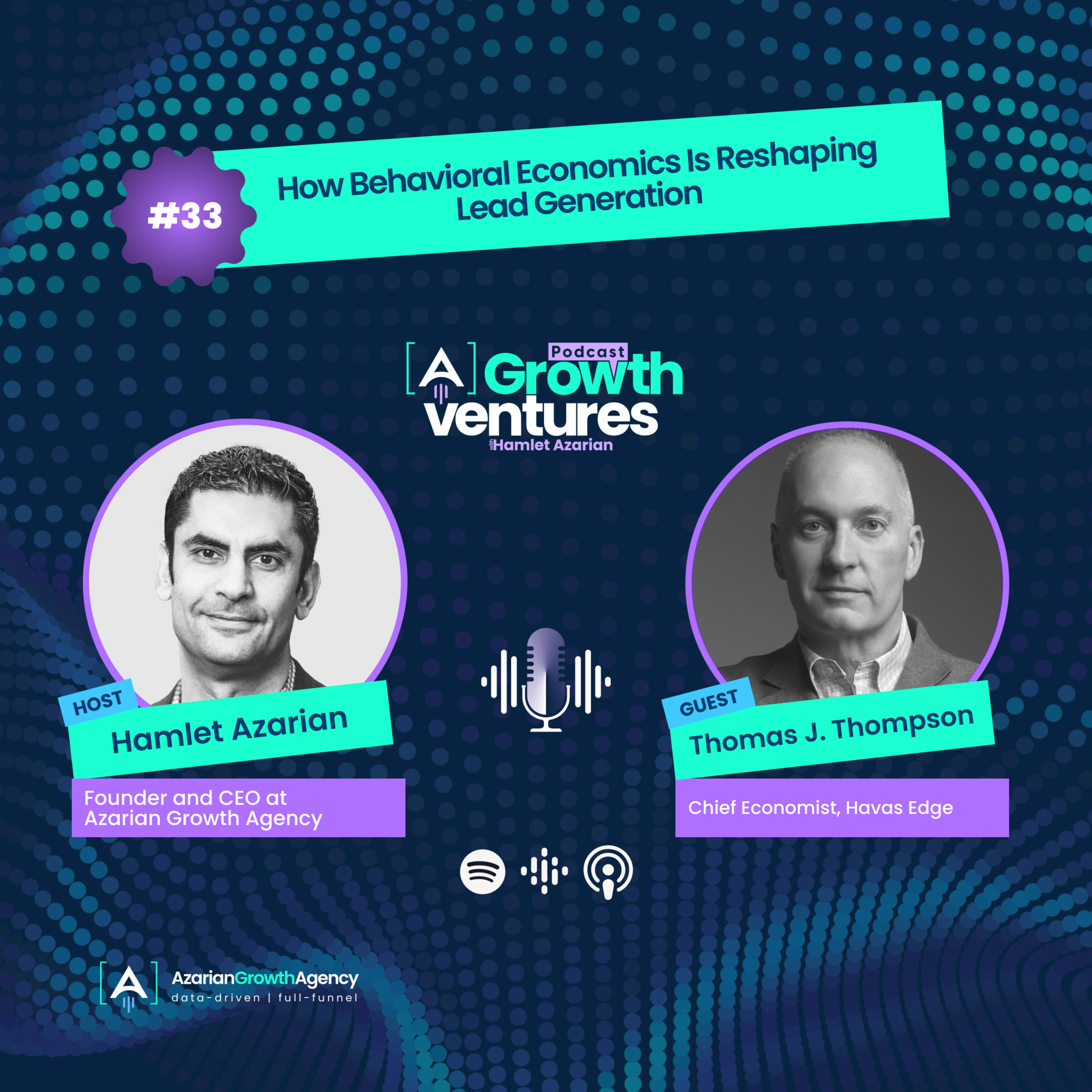 "Better Leads Come From Better Decisions" - How Behavioral Economics Is Reshaping Lead Generation[A] Growth Ventures Podcast with Hamlet Azarian · on Behavioral economics77 / 100
 Behind the Numbers of Authority: How Smart Leaders Turn Stages Into Revenue - Terry FossumBehind The Numbers With Dave Bookbinder · on Behavioral economics73 / 100
 How Sales Reps Can Use the Reciprocity Principle to Close More DealsSales Leadership with Fexingo · on Behavioral economics72 / 100Rupert Brown - Making Better Career and Family Decisions During Times of Transformation58 / 100[Future of Work] Prof Gudrun Sander - How to Build a Better Workplace that Truly Supports Working Parents88 / 100Ahed Serhal - How to Turn Guilt into Growth: Finding Balance as a Working Parent Abroad71 / 100{CEO Series} Heather Blundell - How to Navigate Leadership While Raising Young Children72 / 100Jess & Darryl Abelscroft - How to Navigate Shared Parental Leave77 / 100