
Between You and AI · 2026-03-31 · 10 min
Key moments - from our scoring
Substance score
42 / 100
Five dimensions, 20 points each
Meta's apparent contradiction - massive talent acquisition alongside massive layoffs - reveals a deeper market restructuring driven by AI's impact on labor value. The episode explores how Meta has invested $14.3 billion in Scale AI to recruit Alexander Wang and his superintelligence lab, while also reportedly paying compensation packages exceeding $100 million to poach talent from OpenAI and Google DeepMind, including 25-year-old Matt Dadeke's ~$250 million package. Simultaneously, Meta plans to cut roughly 15,000 jobs (20% of workforce) to fund $135 billion in AI infrastructure capex and improve productivity. This mirrors industry-wide patterns: Block cut 40% of staff citing AI, Atlassian cut 10%, Amazon eliminated tens of thousands. The episode argues this isn't contradictory but reflects a polarization in labor market value. AI is automating structured, repeatable work - code writing, reports, support - that traditionally justified middle-tier salaries. Companies now need fewer operational generalists but pay venture-capital-like premiums for cognitive leverage: rare researchers and leaders whose decisions can reshape product, strategy, and business model. The result is a flattened job market where standardized cognition loses value while exceptional strategic thinking and technical depth command astronomical premiums.
Meta is restructuring labor around AI productivity: it needs fewer people for execution-based roles (which AI automates) but pays extreme premiums for rare cognitive leverage - exceptional engineers whose decisions reshape product strategy and company trajectory. The $250 million Matt Dadeke offer reflects venture-capital-like competition for talent that can unlock breakthrough AI advances, not traditional salary economics.
Cognitive leverage refers to the rare ability of elite AI researchers and leaders to change a company's entire trajectory, product direction, strategy, and business model. Companies now compete and pay $100M+ packages for this, because losing such talent to competitors or failing to recruit them is more costly than the compensation itself.
Entry-level job creation has dropped 26% in the U.S. over six months because AI agents now handle tasks that previously required entire teams. Combined with mass layoffs (Meta planning 20%, Block 40%, others 10%) and fewer new roles being created, the market is becoming increasingly challenging for generalists and execution-focused workers.
Structured, repeatable, decomposable work is most vulnerable: code writing, report production, analysis, support workflows, documentation, and reviewing - essentially standardized cognitive execution. Middle-tier operational roles are losing value fastest because smaller teams using AI tools can now deliver the same output.
Reverse recruiting is where headhunters work for candidates rather than companies, charging a percentage of salary to help candidates secure employment. It emerged because job market conditions are so challenging that individual workers now need recruitment support to compete, though elite talent like Alexander Wang do not require such services.
Our reviewer’s read on each dimension, with quotes from the episode.
The episode contains a handful of genuinely useful data points and the 'cognitive leverage' framing is worthwhile, but a significant portion of the 10 minutes is consumed by the soccer preamble, host bio, and rhetorical throat-clearing. The core ideas get surface treatment rather than deep analysis.
companies are no longer paying just for individual productivity. They're paying for something much, much more rare, which is cognitive leverage.
AI is flattening the value of standardized cognition and dramatically inflating the value of rare cognition. It doesn't destroy value evenly. It redistributes value unevenly.
The soccer-transfer metaphor as an entry point is a fresh hook, and 'cognitive leverage' is a serviceable framing device, but the underlying economic argument is essentially well-known superstar-economics theory applied to AI - not a contrarian or first-principles contribution.
compensation stops being salary in the traditional sense. It starts to resemble much more, like a venture capital model or elite sports.
It reduces the premium on predictable execution. It increases the premium on strategic thinking and multiplies the premium on rare genius.
This is a solo monologue; there is no guest. The host has legitimate operating credentials (CDO at L'Oreal, Director at Tinder), but this episode is journalistic commentary, not operational practitioner insight drawn from that experience.
Here's your host, Andrea Llorio, speaker and author on AI leadership and innovation. I was, uh, director at Tinder for five years and Chief Digital Officer at l'. Oreal.
The episode is better-than-average on specificity for its format, naming specific individuals, dollar figures, and a sourced statistic; however, several figures carry hedging language ('reportedly,' 'around,' 'something close to') and one key number ($135B capex) appears significantly inflated versus public disclosures.
Matt Deitkin, born in 2001. So yes, he's just 25 years old. He reportedly joined Meta's Superintelligence lab in after accepting an offer of around $250 million.
Meta plans to nearly double its capex this year, reaching something close to $135 billion.
This is an entirely solo monologue with no guest, no follow-up questions, and no possibility of challenge or productive disagreement; the rhetorical structure is competent but the format is inherently limited to unchallenged assertions.
please reflect on all this, uh, almost as a homework, and let me know your thoughts, any questions, reflections, feedback, or even criticism.
Computed from the transcript - who did the talking, and the words that came up most.
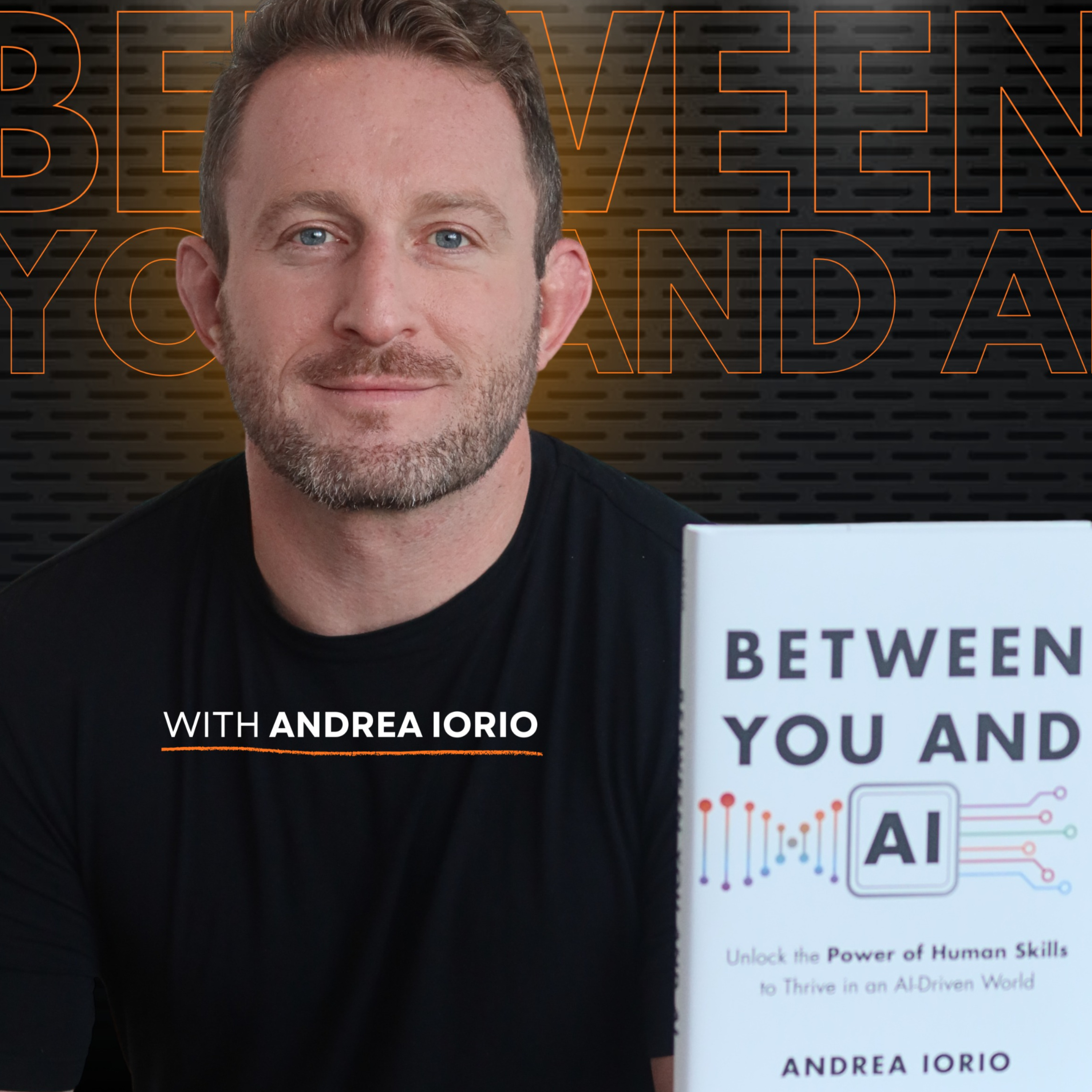
In this episode of Between "You and AI", Andrea Iorio (USA Today bestselling author and keynote speaker) explores the rising value of AI professionals, the strategic investments by tech giants like Meta, and the implications for the future of work and salaries. It highlights how AI is transforming market dynamics, creating a new elite class of high-paid experts, and reshaping employment patterns. Will AI scientists be the new superstars? Key Topics The surge in AI talent valuation and high salaries Meta's strategic investments and acquisitions in AI The impact of AI on workforce restructuring and layoffs The shift from operational to strategic value in the job market The polarization of market value between operational and strategic skills Andrea Iorio Instagram: LinkedIn: Website:
Transcribed and scored by The B2B Podcast Index.
Speaker A: In 2017, something incredible and historic took place. And no, it wasn't Donald Trump's inauguration or Emmanuel Macron's election. It wasn't either the MeToo movement or the arrest of Harvey Weinstein. It was something that, if you like soccer, you definitely remember. It was a transfer of Neymar from Barcelona to Paris Saint Germain for 222 million euros. And yes, to that day, it remains the most expensive transfer in the history of the sport. The only one that came close was Kylian Mbappe's move also to PSG for around 180 million euros. And it's astonishing to even think about numbers like that. And for a long time, this kind of bidding war seemed exclusive to sports. Because think about it, how much would a transfer of a scientist be worth? Or a bidding war between the world's top universities for a single researcher? Probably not even closed. Even in the corporate world, as much as well paid CEOs, uh, are, their compensation is typically tied to performance results, bonuses. But recently something changed with the rise of AI. Major tech companies have started treating certain professionals. And yes, these professionals are AI scientists and engineers, almost like soccer players, people with extremely rare knowledge being fought over at any cost. Whoever pays more, wins. And that's exactly what we're going to talk about today. About this new logic where professionals become million dollar transfers. About the role of Meta in this movement and most importantly, how about what it reveals about the future of the job market. Here's your host, Andrea Llorio, speaker and author on AI leadership and innovation. I was, uh, director at Tinder for five years and Chief Digital Officer at l'. Oreal. I'm also an MBA professor at Funda Salon Cabral and columnist for MIT Technology Review and Wired Mexico. And my latest book is between youn and AI, published by Wiley. Learn everything about me@AndreAYorio.com and so to kick off this episode of between youn and AI, let's zoom in in a moment on Meta platforms, which you probably still know as Facebook, and its founder Mark Zuckerberg, who by the way is also into Jiu Jitsu and MMA as me. And so we've got something in common. But the company has been spending heavily on AI. Uh, that's a fact. It has made acquisitions like the Agentic AI startup Manus for around $2 billion, as well as the AI agent social platform mold book, which made the headlines over the world. But more than buying companies, Meta has started buying something even more valuable, people. A clear example of this was the $14.3 billion investment in Scale AI, which brought closer to Meta its founder, Alexander Wang, who eventually went on to lead Meta's new superintelligence lab. This lab has indeed an ambitious goal to pursue the so called Superintelligence, a hypothetical AI system that would surpass human intelligence. Now, interestingly, so far the results have been far from impressive. The lab has already gone through multiple reorganizations in just a few months, being split into different specialized team and some key talent left early on. On top of that, advances in models like Llama 4 have been heavily criticized when compared to competitors like Google's Gemini. Alexander Wang wasn't the only one, though. Since 2025, Meta Platforms has reportedly made very, very massive offers to talent from OpenAI and Google DeepMind, with compensation packages exceeding $100 million. One of the most striking examples is Matt Deitkin, born in 2001. So yes, he's just 25 years old. He reportedly joined Meta's Superintelligence lab in after accepting an offer of around $250 million. And here's something curious. If you do a quick conversion that's roughly the same as Neymar's transfer. So maybe this isn't just a coincidence, but it's a signal. It's a signal that AI engineers have literally become the new soccer players. And of course, other companies that are also entering this race, like X, uh, AI, which developed Grok and attracted names like Igor Babushkin. But right now, the clear protagonist in this movement is Meta. And now let's pause for a second. Isn't this the same Meta that according to Reuters, citing internal sources, is planning to lay off around 20% of its workforce? Yes, one in five employees globally. Let me get this straight. On the one side, hundreds of million dollars being paid to a handful of top talents. On the other hand, thousands of people are losing their jobs. That sounds like a massive contradiction, but hold on, because when you look closer, it might not actually be a contradiction at all. Look, let's dive deeper. Meta is reportedly planning its largest round of layoff since the 2022 restructuring. The company is considering cutting around 20% of its workforce, which is around 79,000 people, meaning firing for around 15,000 jobs. They've confirmed combined, this is almost as the layoffs in 2022 and 2023, which totaled around 21,000 people. Now, why? There's two main drivers. The first is cost. Meta plans to nearly double its capex this year, reaching something close to $135 billion. Most of that investment is going straight into AI infrastructure data centers Chips, models. And so money, uh, is needed for these capex investments. The second factor is productivity. The logic is simple and brutal. Um, if AI allows smaller teams to do more, then you need fewer people to deliver the same output. And this isn't just an isolated move, it's happening across the entire industry block. For example, by Jack Dorsey reduced its workforce, explicitly citing AI as one of the reasons by 40%. Atlassian cut around 10% of its employees to redirect investments towards AI and enterprise sales. Amazon, um, eliminated tens of thousands of roles to simplify its structure while accelerating its AI investment. And when you look at this pattern as a whole, feeling starts to emerge in the market. Feeling that we can call anxiety, maybe even the beginning of panic. Because the question is no longer if this will happen, but who's next? No, the fact that Meta and other big tech companies are paying soccer player level salaries. Again, although it seems like a contradiction, it's not, because at its core, it's the same logic operating at two extremes of the market. On the one side, companies lay off thousands of people. On the other side, they pay astronomical packages to a tiny group of AI researchers and leaders. And it's a clear reflection of a deep shift in what the market values. For a long time, value was tied to execution, writing code, producing analysis, running processes, managing workflows, documenting, reviewing, organizing, doing things. All of that still matters. But these are largely structured, repeatable and decomposable activities. And precisely because of these characteristics, they are the first to be substituted by AI. Uh, then something interesting happens. The middle of the market starts losing value faster. Because if a company used to need 10 people to produce a certain amount of code, reports of support, well, now it might need six or four. And as long as these people know how to work with AI, well, efficiency goes, um, up and the need for labor volume goes down. And that's exactly why top salaries are exploding. Because companies are no longer paying just for individual productivity. They're paying for something much, much more rare, which is cognitive leverage. An exceptional AI researcher or leader is invaluable because they just produce more or write code faster. They're valuable because they can change the entire trajectory of a company. Change the product, change a strategy, change the business model, change the future. And once you enter that logic, compensation stops being salary in the traditional sense. It starts to resemble much more, like a venture capital model or elite sports. If one person significantly increases your chances of leading the next major AI breakthrough while paying $100 million seems expensive, but losing that person to a competitor or Giving up on that person or not having it on your team could cost far more. In other words, AI is flattening the value of standardized cognition and dramatically inflating the value of rare cognition. It doesn't destroy value evenly. It redistributes value unevenly. It reduces the premium on predictable execution. It increases the premium on strategic thinking and multiplies the premium on rare genius. And the result is a much more polarized job market. Less space for purely operational middle roles, more pressure on execution generalists, and far greater rewards for those who combine technical depth with decision making, context and originality. Um, now the impacts of all this are already visible because, let's be honest, it's harder and harder to find a job nowadays. And this is happening for three main reasons. The first, we've already seen mass layoffs. The second is that fewer new roles are being created. Data from Randstad shows that entry level job creation has dropped by around 26% in, in the United States over the last six months. And this is no coincidence. Many of those initial tasks are now handled by AI. Uh, because that's the third reason. Today AI agents can do what used to require entire teams, which means companies simply need fewer people to produce the same output. And the market has become so challenging that a new concept has emerged. Reverse recruiting. Instead of headhunters working for companies, they now work for the candidates charging a percentage of the salary to help them land a job. Now, let's be honest, people like Alexander Wang or Matt Dadeke don't need reverse recruiters. But the question here is, what about you? And, uh, how much of your work is still stuck in predictable execution? And how much of your value lies in your rare genius? Because here's the paradox. The more unique you are in this market, the more the market will compete and fight for you. So with this reflection, I wanted to wrap up this episode of between youn and AI and I want you to thank for your attention up until now. Please reflect on all this, uh, almost as a homework, and let me know your thoughts, any questions, reflections, feedback, or even criticism. You can send it through my website, Andrei Audio, or on Instagram. Thank you so much for listening. And I'll see you next week with another episode of between youn and AI.
Other episodes covering the same guests and topics, from across The B2B Podcast Index.
 Ep 93: CEO of Redwood Research Buck Shlegeris on OpenAI/HuggingFace Revelations, Fixing AI Safety & Takeover OddsUnsupervised Learning with Jacob Effron · on OpenAI98 / 100
 The 18x Midas Lister Betting $3B on AI (and calling most of it fake) | Navin Chaddha, MayfieldThe Peel with Turner Novak · on OpenAI91 / 100
 Paul Graham On Startups, Ambition, and Great FoundersY Combinator Startup Podcast · on OpenAI88 / 100
 How SSW turned AI into ½ their pipeline - Ulysses Maclaren, COO of SSWSaaS Stories · on OpenAI86 / 100
 EP 148: Is the AI boom cracking? Inside July’s sell-off and beyondBeyond the Benchmark by EFG · on OpenAI85 / 100
 Unscripted with Victor: Agentic AI, Fintech's Future, and the Death of the App EconomyVentures from The Valley · on OpenAI83 / 100
 Tokenmaxxing: Why AI Keeps Getting More Expensive - and What It Means for Leaders.72 / 100AI-xhaustion: The Double-Edged Sword of AI's Impact on Our Mental Health72 / 100The Pope, Anthropic, and the battle for "trust" in the AI industry.64 / 100The Boomerang Effect: Are AI Layoffs for Real, or Just an Alibi?73 / 100The METR chart that shrinks your job every quarter - and is keeping Wall Street up at night.68 / 100