
B2B Go-To-Market Leaders · 2026-06-19 · 53 min
Key moments - from our scoring
Substance score
55 / 100
Five dimensions, 20 points each
Kady Srinivasan brings 15 years of SaaS playbook experience to Freshworks, where she's rebuilding GTM strategy as AI disrupts traditional marketing and sales functions. Her core thesis: go-to-market is fundamentally about building coordinated actions to capture market share in a specific segment - but most companies fail by losing focus on their ICP as they expand. She illustrates this through the concept of 'ICP Plus' - when new products or features attract audiences beyond your original bullseye, many organizations drift in messaging without intentional product-marketing decisions. Srinivasan draws on her consulting background at firms like Clarkston and IRI, where she learned to manage large datasets and make precise decisions at razor-thin margins (1-2% in retail). At Dropbox and Klaviyo, she operated inbound and PLG motions where the distinction matters: PLG often means freemium conversion, but enterprise inbound means multiplayer product experiences with frictionless trials feeding into sales-assist or high-touch sales. The conversation covers how landing zone and initial ACV affect expansion revenue, pricing architecture under complex monetization models, and why net dollar retention above 100% should drive SaaS unit economics - with the CMO playing a central role in pricing and packaging decisions when defining new categories.
PLG typically means freemium users upgrading to premium on a self-serve basis. Inbound motion, by contrast, targets multiplayer users in enterprises who need a frictionless trial experience - and requires paid marketing (ads, content) to drive awareness before a low-touch or high-touch sales handoff converts them into paying customers.
When new features or products attract audiences outside your original ICP (what Srinivasan calls 'ICP Plus'), you must deliberately redesign your messaging and positioning for that new segment rather than drifting along with product development. Most companies fail by not making this intentional choice.
The landing zone ACV should split the difference - not a $1M deal that risks customer dissatisfaction and churn, nor a $30K lowball that leaves expansion upside on the table. The right initial ACV shapes the feature set customers adopt and directly determines how much expansion revenue they can generate.
Net dollar retention above 100% should be the north star, assuming your product is strong enough to retain customers for five years. This enables expansion through upsells and cross-sells, making LTV much larger than initial bookings and flowing through to healthier unit economics.
Pricing typically lives between sales and finance, but when a company is defining a new category, the CMO should own pricing and packaging strategy because they're translating product capabilities into customer value propositions, which is inseparable from go-to-market positioning.
Our reviewer’s read on each dimension, with quotes from the episode.
There are genuinely useful concepts scattered throughout - the 'ICP Plus' expansion problem, the CEO-influence flywheel, and the landing-zone-determines-expansion-revenue observation - but they are heavily diluted by filler affirmations, career autobiography, and generic resilience advice. The ratio of novel claims to padding is mediocre for a 53-minute runtime.
the ICP plus is a different audience. They're looking for something different
the landing zone can determine your expand expansion revenue. So you have to be, you have to experiment your way into what's the right
A few genuinely fresh tactical framings appear - filtering LinkedIn post engagers through ICP fit to build a named-account dinner list is a concrete and non-obvious play - but much of the episode recycles well-worn SaaS frameworks (hero's journey, purple cow, land-and-expand) without meaningfully extending them. The ABCD messaging framework is tidy but not novel.
we would have him post something on, on his LinkedIn. Then we would have uh, people go and look through the people who have interacted with that post. Liked it. Whatever. We would uh, filter that through an ICP fit.
In the world of AI, what's happening is you don't need that much specialized knowledge.
Kady Srinivasan is a legitimate multi-role practitioner - she has held both CRO and CMO titles across recognisable scale-stage companies (Dropbox, Klaviyo, Lightspeed, Freshworks) and owned pricing/packaging, not just awareness. Her depth on go-to-market mechanics is clearly operational rather than theoretical.
I've been a, uh, CRO and I've been a, ah, CMO multiple times now. And so I've kind of seen both sides of the equation.
at Klaviyo, I had that under my, um, my remit. Where we basically helped redesign what the pricing and packaging structure of the company or the platform should be.
The episode contains a handful of genuine data points - Belgium market share jumping 7% to 19%, $5,000 dinner-event budget, 10x MQL claim, the 2019 chatbot timeline, the Michelin-star and vineyard-to-warehouse ICP characterisation - which is better than average for this format. However, many supporting claims use illustrative hypotheticals (the tax-AI example) rather than verified figures, and no sources or methodologies are cited.
we went from 7% market share to 19% in, like, a year's time in some of those geographies
for 5,000 bucks we would get people in a room together, give out awards
The host asks competent open-ended questions and occasionally lands a useful follow-up (probing the trigger for the Lightspeed ICP pivot), but he routinely restates the guest's point back to her at length, inserts his own anecdotes unnecessarily, and never pushes back on a single claim. The dynamic is friendly and unchallenging throughout.
Yeah, yeah, no, very good. Uh, so let's actually step back, bigger picture.
But, uh, but, but again, going back to what you're saying, which is how we got going on this thread.
Computed from the transcript - who did the talking, and the words that came up most.
Send us Fan Mail In this episode of the B2B Go-To-Market Leaders Podcast, Vijay Damojipurapu sits down with Kady Srinivasan , Chief Marketing Officer at Freshworks, to explore what it really takes to build market share in SaaS, and why finding the right ICP is often the difference between accelerated growth and stalled momentum. Drawing from leadership roles across Dropbox, Klaviyo, Lightspeed, and Freshworks, Kady shares lessons from scaling PLG, inbound, outbound, and hybrid go-to-market motions, while navigating the realities of product-market fit, category expansion, and AI-driven disruption. The conversation dives into the evolution of modern GTM, from defining your initial ICP to expanding into adjacent markets without losing your positioning, and why many companies drift away from the messaging and audience that made them successful in the first place. They dive into: Why GTM is ultimately about building market share through coordinated actions across product, marketing, sales, and customer success. How great products still fail when they're sold to the wrong audience or positioned with the wrong messaging.
Transcribed and scored by The B2B Podcast Index.
Speaker A: You kind of learn something or you zig in a different direction than you had expected. You just need to know that it's okay to fail. And the failure is just a one point in time. If you keep getting at it, you will eventually succeed.
Speaker B: Hi there, this is Vijay Dhammaji, um Purappu. And you're listening to the B2B go to market Leaders Podcast, The show where I go behind the scenes with top Go to Market practitioners to discuss their mindset and tactics. Hello again. Thank you for taking the time to listen to the B2B go to market Leaders Podcast. My sincerest gratitude because you have so many options and, and you can do anything at this point in time, but you're taking the time and dedication to listen to and learn. Go to market. Uh, with that as context, I mean, I have yet another amazing guest on the show today. I have the, uh, CMO of freshworks, Kadi Srinivasan. And I'm excited to be speaking and I'm sure you'll get a lot of nuggets, uh, listening to this podcast. So with that intro, uh, welcome to the show, Kadi.
Speaker A: Thank you so much for having me, Vijay. Really great to be here.
Speaker B: Yeah, likewise. I'm sure there'll be so many, uh, advice insights for the listeners here. I've, uh, met you a couple of times. I know somewhat about your work and what you do and uh, yeah, looking forward to really going deeper into so many of those contexts.
Speaker A: Yeah.
Speaker B: But first the signature question, which every listener loves, which is how do you view and define go to market?
Speaker A: Yeah. Oh, that's a very good question. Um, I think the simplest way that I define it is, uh, how do you go and build market share in a specific market category, vertical geography, whatever that is. So what are the coordinated set of actions, uh, that helps you build that market share? That's how I define it in the most simple manner. But obviously, uh, it's simple but not easy to do.
Speaker B: Yeah. So let's double click, triple click into that. Yes. Market share is the output or the end game. A lot of moving pieces both externally and internally. So curious how you approach it.
Speaker A: Um, yeah, so I've worn a couple of different hats, right. I've been a, uh, CRO and I've been a, ah, CMO multiple times now. And so I've kind of seen both sides of the equation. I think the, the market share thing is a very interesting one because you one, you need to have the right product for the right market. So there needs to be some product Market fit. Assuming there is pmf, then you need to go about thinking about who are the people in the market that you can actually go and service that serviceable, addressable market. And then how do you, how do you message your product to those people in a way that makes them, that makes it easy for them to think about and digest what you do? Then you go and actually have those touch points that matter to get them to close. So it's almost, uh, I'm describing it as a linear process. In some ways it is, but it also has to come together in a very coordinated manner. Uh, and a couple of the mistakes I've made in the past is we had an amazing product. Product, um, but we were selling it to the wrong audience. We had an amazing product, we were selling it to the right audience. We didn't have the right messaging at all. And so it's just any part of that process can break down and you end up not being able to get the traction that you want.
Speaker B: Yeah, yeah, no, great, great example and in fact, great insight there. Reminds me of a, uh, very important piece of, uh, advice I heard from a couple of founders yesterday. I was at an event here in Silicon Valley and, uh, two founders were sharing about how they achieved product market fit. So even though it's super relevant for early stage, I think that advice is even relevant and even more so relevant even as a scale.
Speaker A: Yeah, I think that's exactly right. Yeah, I think it's.
Speaker B: Yeah, see, sorry, yeah, so which is essentially about identifying the niche, the segment, what you're referring to. And it's an ongoing game. It's not like one. Once you're there and it's done, it's an ongoing game.
Speaker A: Yeah, I think it's, um. What I found is, you know, when you, when you find product market fit, you have an icp, right? You have a Bullseye Target. And that, that target market really just loves you so much. And then when you get better and better at sales and marketing, you're going beyond the early adopter community in that, uh, ICP and going into the late adopter, uh, early majority, that kind of stuff. So you kind of, you're still staying in that ICP circle, if you will. Right. Think about the bullseye. Then what happens in you grow so much that you start introducing new products, new features, and suddenly your platform is bigger, uh, more extensible, appealing to a different audience. So the Bullseye expands. So I call it the ICP Plus. So it's the people that are outside of your original ICP that You also have to start to. And that's when many, many, many companies kind of lose the thread. They lose the thread of, okay, where do. How do I start to position like I used to position, really well, really strongly, but suddenly now I have this other thing and I'm not quite able to get that bullseye anymore because the ICP plus is a different audience. They're looking for something different.
Speaker B: Correct. Now you hit upon a very important point, right? Yes. Once you identify the segment, I mean, PMF can break at so many points, but you hit upon a nuance, which is the messaging, Right. The message audience message market, message channels, fit and so on. Yeah, right. Uh, and I'm sure we can actually go into a lot of those details because I'm eager and curious to understand how you approach that. But, uh, but, but again, going back to what you're saying, which is how we got going on this thread.
Speaker A: Yeah.
Speaker B: Just expanding market share.
Speaker A: Yeah. Yeah, right. Yeah, no, I think it's, uh, I, I kind of think of it as when you, when you expand market share, um, you are going after net new logos and Net new business. But also, don't forget, you're also going after share of wallet and expansion opportunities as well. So if you have a great product, then you're landing and expanding, and it's a very seamless thing. When you start to become a platform company, you have lot of landing zones, so that expands your TAM and your market. But back to your point about messaging, then you have to be very, very clear, okay, am I messaging the platform, which is a set of components, A plus B plus C, or am I messaging A then B and then C in very specific targeted kind of ways? And that's, uh, kind of a product marketing design decision that needs to happen. And most companies, what I've seen is, and I advise a lot of companies like startups, all the way to series D companies. Most of the companies don't make a deliberate, intentional choice to do that. Right. To say, how are we actually evolving our messaging? What they end up doing is just drifting.
Speaker B: Correct.
Speaker A: Along with how the product is getting built. And because of that drift, suddenly you are defining yourself as a red cat. And then, uh, somehow, 18 months later, you become a blue dog.
Speaker B: Yeah.
Speaker A: And then you don't know how that has happened. So you need to start to get back into what do you want? Do you want to be a white cow? Is that where you need to be?
Speaker B: Purple cow.
Speaker A: Yeah, Purple cow. Yeah, that's actually a better one.
Speaker B: Yeah, yeah, no, very good. Uh, so let's actually step back, bigger picture. Uh, it'll be great if you can walk our listeners through your career journey, how you got started and uh, what led you to what you're doing today.
Speaker A: Yeah, um, it's a very zigzaggy career journey. I had a, um, I started life like ah, many people in I guess my generation growing up in India, we started as a software engineer. Um, and I uh, was quite honestly one of the worst you could think of. Just absolutely hated it. I don't even know why I chose computer science except for the money I guess. And then uh, did that for a couple of years is so bad I realized I had to go to business school. But I was in India and I applied to, in India there was this, the, you know, you have these prestigious uh, Indian Institute of Management and literally got rejected by all of them a uh, couple of times. Then I was like, I don't know what to do. And, and strangely enough at that time I uh, I got married, came m to the US didn't again like, was trying to find a job, didn't know what to do. But fortunately I got into a business school here and that's when it sort of helped uh, take off. So I went to business school. Um, I was trying my best to get into supply chain consulting of all things, but for some reason that didn't work. And so I ended up in strategy consulting. And that was a window into how to solve business problems, which was just absolutely fantastic. You know, one project I talk about, um, we were literally trying to help, um, uh, sorry, craft at that time figure out a breakfast category and the next project was how to launch a skincare line for a celebrity in Hollywood kind of a thing. So just amazing range of things, uh, all related to market share and market development. Fell in love with this idea of marketing which I'd never even imagined that I would be a marketer. I kind of had this really bad connotation of marketers as like really fluffy, you know, talkers kind of a thing. Um, really loved the science behind marketing and realized, oh, there's actually something here. Um, then I made a deliberate uh, effort to get into performance marketing, which back then was the way to connect data and technology, you know, kind of stuff. Did that for a bit, was in Dropbox for a while. Um, and then you know, a bunch of stints across tech. Every, every place was, ended up taking on more pieces of marketing or go to market as, as it uh, happened. And so um, I think at this point I'm, I am in A in a interesting space where I know a playbook, which is a SAS playbook. I've had this playbook in my head for 15 years.
Speaker B: Yeah.
Speaker A: AI is completely changing all of that playbook.
Speaker B: Right.
Speaker A: Everything is getting disrupted from a, uh, again to your point, go to market perspective. It's all fluid. What is marketing. What sales. It's all fluid. So I'm in the space of reinventing everything all over again. So freshworks for me is the opportunity for me to rebuild not only what great uh, marketing is for the company, but what a great playbook is going to be. That's where, that's how I'm here.
Speaker B: Very good. Yeah. And thank you for being so authentic, honest and sharing your early part of the journey, which many of the folks go through it. Right. I mean again, going back to one of the points you mentioned earlier, it's never a linear up to the right. Uh, you clearly identified early on that software coding is not your thing and decided to go to B school and you stuck to it. Even though you got rejected at the IAMs in India, you stuck to it and that really was an inflection point in your career.
Speaker A: Yeah.
Speaker B: And if I look at your LinkedIn profile, so you were at Clarkston Consulting. That, that's where I believe you're talking about the early, all the different consulting engagements and starting consulting.
Speaker A: Yeah, that's right. Yeah. And, and that's the thing, right? Like uh, you, you go to these uh, companies, you, you go into these professions thinking you like get one thing, but you get something completely different. Um, so at Clarkston and then I went to this other company called iri, the biggest learning there was how to manage large amounts of data and be able to process data and to make fine tuned decisions based on that data. So to give you an example, almost every retailer in the entire world runs on 1 to 2% gross margin. Right. That's what they run on. Which means that a single uh, penny of um, pricing on one of their commodities can make or break their year, their earnings and lose like value or all that stuff. So you have to be exceedingly precise. You can't go and say I'm going to increase the price of sausage by from 48 cents to 49 cents because your CEO might get fired the next quarter.
Speaker B: Yeah.
Speaker A: So that taught me the value of data and being able to uh, be precise when it comes to thinking about markets and all that. Took that to gaming where we had tons of data. From there I realized technology is where the real uh, leverages went to dropboxes so every step of the way you kind of learn something or you zig in a different direction than you had expected. You just have to have the resilience to um, be like. You need to know that it's okay to fail.
Speaker B: Correct.
Speaker A: And the failure is just a one point in time. If you keep getting at it, you will eventually succeed.
Speaker B: Right? Yeah, exactly. And uh, one of the board advisors I met a few years ago, that's the advice he gave, which is failing is not really failing. It just shows you that is not the right path and you are that much closer to a winning pick.
Speaker A: Yeah, that's very true. Like you look at um, the. What I, uh, what I advise a lot of younger people who are in their careers too in marketing is they go to these different companies and marketing is 18 month tenure. You know, the CMO tenure. So admittedly something happens, they separate from the company and they, they get very traumatized by it. Especially after the second time you're going through it, you get traumatized. You're like, what's wrong with me? But it's not what's wrong with them, it's the, the fit doesn't exist. So every time something like that happens, it means you're getting closer to a place where the fit is going to be there. So you can't give up. And that's what uh, I found in my life and I, uh, keep telling people about.
Speaker B: Yeah, no, very good. And then so you were in strategy consulting and then you moved and got into the tech industry and that is where you are right now. And I'm looking at electronic ads. Fair enough. Gaming and then Dropbox and then Owlet Baby Care. You shifted to consumer, uh, for some point in time and then you came to Klaviyo. Yeah, if I compare even like Dropbox versus Klaviyo, it's an entirely different go to market motion.
Speaker A: Uh, yes, that's right. Yeah, yeah, it is Klaviyo. Um, so Dropbox was for the most part plg, obviously.
Speaker B: Correct.
Speaker A: Um, but the interesting thing about it is, um, I mean it's not very apparent to the outside, but Dropbox business was actually a heavily inbound, um, motion similar to Klaviyo. So the parallels there are Dropbox overall was plg, but Dropbox business when we were selling into business teams was uh, like uh, heavily inbound, not much outbound. So that way Klaviyo is also exactly the same. You could come in, start a trial, go through that motion. So lot of velocity of leads coming in low ACV Quick close, quick deal cycles kind uh, of a thing.
Speaker B: Yeah. So PLG is your lead gen, if you were to call it. And then, I mean, no, I'm talking about like the. On the business side of things. So that's going really bottoms up, where you first tap into the individual user.
Speaker A: It's not, uh, not quite. PLG is one of the, the levers.
Speaker B: Yeah.
Speaker A: Um, if you. So the way I, you know, I, I think the industry has PLG defined wrong, most, uh, people think PLG means two things. One is it's a freemium user who comes in and then upgrades to premium. That is absolutely one of the ways. But when you, um, these users are also, uh, single player users, they're not multiplayer. So if you're selling into an enterprise, you want multiplayers, Right. So to go after those multiplayers, you have to give them a frictionless experience where they can come and try the product, if that's the kind of product you have. And so that's what I would call the inbound motion. So the inbound motion and the PLG motion was both sources of acquisition. For us to drive that inbound motion, that multiplayer motion, you have to go do ads. Like you have to do marketing. You have to do all of the traditional. Okay, yeah, less, Less enterprisey, but still enterprisey kind of marketing.
Speaker B: Understood. Yeah. Uh, yeah. At some point it'll be good to really get into how you approach that, because there's one playbook or maybe you can get into even right now. So there's one playbook of. Yes, let's say it's an enterprise company and you have like five, two to five individual users who are using, who came through plg, and then now they're paid customers. Right. Enterprise plays typically now you see that there are two to five users, and then you start talking to the management. That's one way where with sales overlay. Sales, you try to figure that out. Sales assist.
Speaker A: Correct. So. Exactly. But, uh, if you think about it, right, like you. Let's take, um, a tax AI Tax assistant. Okay. So you have a prosumer motion, which is you're basically trying to go after all of the people who want it, who want it as a single player mode for their own personal use. So that becomes a motion that you have to define. And some of them may become more paid users at some point because they need more access, more sharing, more whatever that is. But if you ignore that altogether, you have a tax assistant that you can actually go and sell to, let's call it legal firms. And those, these are small SMB customers and they will likely buy two to three licenses. But it is a sale from a package perspective. So to go after those people, you don't necessarily, you can't rely on brand awareness. You have to go and actually target those people through specific marketing. Now when they come to your door, you have the quickest turn, um, uh, hot handoff to a sales team that closes the deal, et cetera, et cetera, or sales assist, you know, whatever that is. And then some of them may upgrade into 50 licenses if they're a big enough company. Then you, if we, if and when you introduce real enterprise features, you start selling to larger firms and in which case you're talking about an outbound motion. So you have a sales team who's actually going outbounding to big legal firms and saying buy 100 licenses from us.
Speaker B: Correct? Yeah, yeah, exactly. And again, going back to the fundamental, the initial conversation which is go to market capturing market share and expanding and defining the segments and so on. So depending on the segments you're targeting, you have to build in and layer in the appropriate go to market motion, correct?
Speaker A: Yeah, exactly. You have to think about the, what is the right marketing that will help you get the messaging in front of them and then once you hook them and they get interested, what is uh, the way to convert them into a sale? Is it through your website, which is plg, correct, or is it through a, uh, low touch sales uh, motion, or is it a high touch sales motion? So it depends on that.
Speaker B: Yeah, fair enough. And then if you extend this conversation and go to Marketplace and going back to one of the points you mentioned earlier that you learned, uh, in your consulting gigs, consulting a job, which is the impact on the financial metrics and the finances.
Speaker A: Yeah.
Speaker B: Right. So how do you go about thinking about the different go to market motions and how does it translate to the on income sheet, income statement and balance sheet and the margins and so on. So how do you think in those directions?
Speaker A: Um, for SaaS, it's um, for uh, you know, for consumer tech, when I was at Outlet, for instance, when you're selling a, a product which is like a one off, it's a much easier thing, uh, to construct a P and L, you're just basically saying, I'm selling this one product to this person, I expect hundred of those people to show up. And this is the gross margin impact of manufacturing it. This is, you know, all that kind of stuff. In SaaS, it becomes so much more complex. In AI, it's even more complex.
Speaker B: That's True.
Speaker A: Because of the, both the pricing models as well as the um, the way you're thinking about the. Their ltv. So if you, the. The. My heuristic has always been you, you bring somebody in with the expectation that they're going to be around for five years on your platform.
Speaker B: Mhm.
Speaker A: So you have, your platform should be good enough that your net dollar retention should be higher than 100%. Right. So that you're getting value from it. And then at some point because you may have the right features, you are then helping expand them so that your net dollar retention goes to 170%, not just 100%. So your LTV becomes a much bigger chunk. Uh, even though your bookings are going to be m very limited. Um, and so that flows into kind of that P and L. Ah. As you think about it, um, where I think it gets complicated and we saw some of this in Klaviyo is when you suddenly start to have different ways of m. Monetizing your customer base. Some you sell as licenses, some you sell as consumption and that becomes super uh, complicated. Honestly, that's one area that I have to dig into a little bit more in terms of how you recognize revenue when you have those vastly complex metering systems.
Speaker B: Correct. Yeah. No, but you brought up a good point. Right. Which is you go in with the assumption of hypothesis that first of all your product has to be good. I mean that's, that that's a given. I mean no amount of marketing and sales can fix the issue. If the product is okay or average. That's number one. And second, I like the way you approached it Kathy, which is around assume that yeah. Once you get a customer, once you earn a customer, they're there for five years. Yeah. And then think about the financial implications like the ndr, uh, and then the upsell, cross sell motions and everything that can play into that one customer or the customer segment.
Speaker A: Yeah, yeah. It's also interesting. Right. Like the, sometimes the way you land uh, in like the kind of feature set that you land a customer in can determine how big their expansion can be.
Speaker B: Right.
Speaker A: So the landing zone can determine your expand expansion revenue. So you have to be, you have to experiment your way into what's the right. Because if you, if you have them come in and take to and sign a million dollar deal right off the bat, unless they see massive value, you lose them. They don't, that's too much. But you don't want to start with 30,000. So what's the right middle ground?
Speaker B: Yeah. So curious. I Mean, typically, most of that lever or, uh, the thought processes between the sales, the sales leader and the finance. So what is your role as a CMO in terms of what is the right balance, at least for initial acv?
Speaker A: Uh, yeah, it's true. Uh, mostly it lives in the world of, um, sales and finance. But the construction of the pricing and the packaging, uh, is not that framework. It lives anywhere the CEO chooses it should live. But at Klaviyo, I had that under my, um, my remit.
Speaker B: Got it.
Speaker A: Where we basically helped redesign what the pricing and packaging structure of the company or the platform should be.
Speaker B: Right.
Speaker A: And it wasn't necessarily because of anything I did. It was more because we were trying to define a category, a new category. So we felt at that time that we could bring in the right value proposition because we were doing so much work on the product side and translating that product to benefits and all that kind of stuff. I think it's more you. You have to have a very strong understanding of what's in the market, how competitive you are.
Speaker B: Yeah.
Speaker A: Um, what, what's really innovative about your feature set and what is the elasticity. Elasticity of your customers? Right. If you have a deep understanding it, and most CROs have this understanding. So then it makes sense for them to be able to get involved there and figure this out. Knowing also that as sales teams go and sell it, they are going to discount, they're going to be special deals. Like, you have to think about the deal desk. You have to think about the applications to revrec and all that kind of stuff. Um, yeah, I know.
Speaker B: We can just go on and on.
Speaker A: It's so many things.
Speaker B: Yeah, so many things over there. Because when you're talking about all those things, in my mind, I'm thinking about, okay, how do you build a narrative? A narrative that even initially opens the doors for the salespeople to engage in the conversation with certain accounts. Right. Let's just. Yeah. If you can share that and then we can go into the next segment. Yeah, it'll be good if you can share how you approach the narrative building part.
Speaker A: Yeah. You know, it can get as complex as multiple years of effort. It can be as simple as, okay, ah, CEO and uh, someone getting in a room and then whiteboarding it.
Speaker B: Yeah.
Speaker A: Um, but I like to keep things simple. I think it's. I use two frameworks. Um, there's one called abcd. A stands for audience. B is benefits. And I'll talk about that in a second. C is, um, compelling RTBs or reasons to believe and D is dramatic differentiation. So whatever you're trying to sell, if you can get clear in your mind, I am selling to, um, attorneys who need tax software to help them manage X, Y and Z. The benefits to them are they can. They don't have to hire paralegals. They can improve productivity. The emotional benefit for them. So there are two, right? Rational benefit, emotional benefit. Uh, and the emotional benefit to them is that they can actually get work done faster and look good in front of their bosses. Whatever the compelling RTB is, 10 of the biggest law firms in the world use the software, Right. And that's social proof. And then the differentiation is, uh, we. We have the best trained AI models that nobody else on the market has. We are the only, or we are the best at X, Y and Z. So you. You literally is. If. When you are a good product marketer, you have to be able to put that entire thing down on one page.
Speaker B: Correct.
Speaker A: So that it's, uh, anybody in the company, anybody in the sales team can just repeat, understand that, repeat that, and just bring it out there. Right. So you use that to start building the story around it. Then you build the story. You're like, what's happening in the world? Um, I don't know if you have heard of something called, um, the Hero's journey.
Speaker B: Yeah, I did. Yeah.
Speaker A: Yeah. So that's the second framework I use, is you build a story, which basically starts with the idea that there's something happening in the world, some big context.
Speaker B: Yep.
Speaker A: And, uh, this hero, the customer, is going on this journey, but suddenly some problem appears or some problem. They have a problem, and they have to overcome that problem. And here's what they like, we are the Yoda.
Speaker B: Yeah.
Speaker A: And here's how we solve that problem. And then this is what you get out of it, you know, kind of a thing. And that makes it exceedingly compelling for, uh, uh, as a. As. And that's as simple as that. You know, like, as simple as putting that together, going to market with it, testing it, experimenting, moving on.
Speaker B: No, great. Great framework. I mean, it's easy for anyone. I mean, especially. There's good advice for the listeners. Just pick a framework. In your case, Katie, you just created this framework, abcd, and made it really simple to understand and made it sticky. I think that that's a key, especially for a good marketer. How do you build concepts that are sticky? Because you need to get your internal audience to adopt and use that at
Speaker A: the end of the day and say that over and over. Or if they change it, then change it in their own ways. Yeah. Agree. Yeah.
Speaker B: All right, let's go get into the next segment of the show which is a go to market success story and a pivot story. I'll let you choose which one you want to start with. Either a success or a pivot. But yeah, all yours caddy.
Speaker A: Um, I think a success story is uh. So you know I talk about this concept of a multi threaded marketer.
Speaker B: Mm.
Speaker A: And uh, one of the things that I did in my previous AI startup was um, I built what we called uh, CEO influence flywheel. So basically what it is is the, the idea of a multi threatened marketer is to how to create these flywheels of growth in both small and big ways. One of the things we identified was our CEO had a massive LinkedIn following like I don't know, some 2 million, 3 million, something like that. And uh, uh, uh, he, we were not doing much with it.
Speaker B: Was it was this at Lightspeed or somewhere? Yeah.
Speaker A: Uh, you dot com.
Speaker B: Okay.
Speaker A: Yeah. So we would, we would go to uh, so we would have him post something on, on the, on his LinkedIn. Then we would have uh, people go and look through the people who have interacted with that post. Liked it. Whatever. We would uh, filter that through an ICP fit.
Speaker B: Yeah.
Speaker A: Get those people either send that list to our BDRs to BDR or of the people that were really ICP fit, like a CEO of X, Y and Z that we were trying to target. We would um, put them on this named account list that we would then invite to a dinner or an event or something like that. And then we did host a couple of those dinners with those people. And that yielded more data, more topics of conversation. So that then becomes another LinkedIn post. Yeah, you see like the way I'm drawing that circle. So that uh, turned out to be pretty effective. I think we drove like 10x MQLs in a short space of time type of a thing, which was pretty um, helpful. I mean I can talk about a bunch of experiments like that that didn't work, but this one was pretty good.
Speaker B: Yeah. And uh, this is a great example. I think it's becoming even more important and relevant in today's world where it's just not the company LinkedIn handle or the brand handle that has to be active. It's eventually people to people. People can get people at the end of the day. And you caught that unique advantage that you had@you.com, which is the CEO active. That's number one. It was not like you had to train the CEO to be active on social media. But then how do you create a playbook? First of all, sit down with the CEO, understand the different themes and then create, have a team behind in creating that playbook and then sending out beacons and signals which are, which the audience are catching. And then based on the title or the responsibilities or the company size, you bucket and steer them into the different, um, like either SDR or It's a dinner roundtable that you mentioned.
Speaker A: Correct, Correct. Yeah, exactly. Yeah, it was fun. It was a lot of fun when we did that. And it's also interesting, exciting people when you crowdsource ideas. Um, yeah, it was fun.
Speaker B: Actually. Let's double click on this concept of multi threaded marketer. You mentioned that. I know we just graze the surface in this, but can you double click on that why it's relevant, especially in the day of AI nowadays.
Speaker A: Yeah. You know, when you, when you think about like the 15 years or 20 years of SaaS, uh, experience that I've had, I, I will almost always organize my team as product marketing, brand and demand gen. Those are the general pillars for marketing. Right. And in, on the sales side you have the same like either geographies or whatever.
Speaker B: Correct.
Speaker A: Um, but, and that assumed that each of those people had a specific skill set that they have built over time. So it was like an apprenticeship type of a model or a junior pmm. Then you become a, a VP of pmm. And, but in. So it was very hard for a VP of PMM to then become a CMO because then you don't have that 20 years of experience in the other. Very few people actually made that jump. In the world of AI, what's happening is you don't need that much specialized knowledge. Uh, you can basically create your own, um, set, uh, of understanding of each of the other things that you don't know as long as you have one spike and you know how to solve business problems.
Speaker B: Correct.
Speaker A: So it, it comes down to how do you clarify what the uh, objective is? What are you trying to go after? Okay, we want to win the market share in this by these five levers.
Speaker B: Right.
Speaker A: Clarify it. Use AI to augment the knowledge that you have and then go run at it. Uh, create these growth loops or flywheels and experiment your way and get, get it done. So that requires a different kind of a marketer. A marketer who is, uh, very conversant with using AI. It doesn't have to be AI native, but knows how to draw on the knowledge, uh, of these other pillars that they don't know. It requires somebody who can have clarity of thought in terms of how to anchor on a specific objective or uh, business outcome. It needs somebody who can think and connect the dots across multiple AI systems and create the right go to market tech stack for themselves and then like go run at it. Right. So that is what I call a multi threaded marketer is a mini cmo essentially.
Speaker B: Yeah.
Speaker A: Um, but for very small, specific localized problems and then you kind of build it all together at some point.
Speaker B: Yeah, not totally. I mean this is something that I'm seeing personally for myself as well as with the others in the industry and customers that I'm working with. It's become very easy for a um, marketer who specialized in one like to your point, spike. Who has a spike. It's very easy to now go and get things done. Earlier you had to lean on like for a content market or a brand person or a demand gen. But now it's so much easier. If you take the example of what you mentioned earlier, let's say it's AI software that you are selling to legal firms and we know that we're targeting a segment like individual users, but we do have a hypothesis and want to experiment it. Okay, how do I sell it and increase it to five seat?
Speaker A: Yeah, yeah.
Speaker B: So as a product marketer or someone who's curious, it doesn't matter. Right. And now with the help of AI, I know that I can do quick analysis and research and put together. This is my business case for expanding from single to a five team segment. And I'll quickly put to the landing page. It can all be done.
Speaker A: Yeah, correct. It can all be done. And so the gating there is not the knowledge, it's uh, how quickly you can take action.
Speaker B: Correct.
Speaker A: How quickly you can learn from it.
Speaker B: Yeah, exactly.
Speaker A: Yeah. So that's the concept of a multi threaded market. It's almost like it comes from my software engineering background. Right. When you're, when you're doing a lot of different things to achieve a certain outcome.
Speaker B: Yeah, yeah, for sure.
Speaker A: Yeah.
Speaker B: All right. Uh, so I know we talked about a go to market success story and how about a go to market pivot story?
Speaker A: Um, pivot as in where we expanded a go to market motion. I'll talk about that for a second. Actually this idea of um, self serve sales assist is the uh, is a good one because we uh, at Klaviyo, you know, we had a, we didn't have a PLG motion, we had a inbound motion like I said. And then we had started to Introduce an outbound motion to go sell to big companies. What we realized was the platform was such that you could come to the platform and uh, ah, basically you have to upload your contacts and then you can try out uh, a few features. People would start uploading about 200 contacts, play around with the features and then they would get stuck when they wanted to do more and they would just leave at that point because there was nobody to help them out because they're free users so they don't get access to professional services and all that. So we introduced the self serve sales assist, which is basically back then, I'm saying back then, it's 2019, was a chatbot, essentially. Um, it was a chatbot that you could interact with and then it would kick you over to a product specialist if it got complex. So we introduced that and immediately just completely opened up a whole M revenue stream for us, uh, for those people who really wanted to do more but couldn't and they were getting stuck in product and we were able to. Yeah, so that I'd say that's, that was one, um, that was one version of a pivot. The other one actually now that I'm thinking about it is uh, at when I was at Lightspeed, we were selling to hospitality customers, which is basically dining restaurants, you know, that kind of stuff. Um, I think the company had started as a, uh, wheel. Sell to everybody on the planet. Small mom and pop shops to Michelin star restaurants.
Speaker B: Yeah.
Speaker A: So my, my um, CEO decided no, we need we, we. Because the product was made for complex workflows that we would only sell to a certain kind of customer. Yeah, that was a crazy pivot to make because you have to retool the entire company to say no more. Small mom and pops only focus on this.
Speaker B: Right.
Speaker A: Um, so I started a project called icp. Icp, um, project, which, uh, crazily enough, I was slacking one of my people late at night. Uh, I said we really have to get this ICP project off the ground. For some strange reason, Slack changed the ICP to Hug Jim. I don't know why. Hug Jim.
Speaker B: Okay.
Speaker A: And then he was, uh, his name is Richard. He's completely confused. What is Hug Jim? I explained it to him. He's like, oh, we, we should just call this Hug Jim. So that became a thing. Like we announced it at SEO. He like made it uh, a project. So everything became about Hagjim. Meaning like we are pivoting to ICP. It was great, but my God, it took me 18 months to do accidental
Speaker B: ICP changed to Hugjim. That, that's uh, a interesting and funny story, right?
Speaker A: Yeah.
Speaker B: Yes. So, so again that the point you made there in that story, Kari, which is the CEO saying, yes, earlier on we are selling to pretty much anyone, mom and pop to high end Michelin star restaurants. But then identifying the segment was the key strategic decision.
Speaker A: Yeah, yeah.
Speaker B: So what really drove, I mean what was the buildup to why it had to come down to that moment and what changed?
Speaker A: Uh, I, so I can't take any credit for that. I think when they were putting together a uh, um, analysis for capital markets day, they realized that uh, we were the best ARPA customers were in a certain segment. So that's where the churn was lowest. ARPA was highest. NDR was amazing. And so then they started digging into it and saying, why are these customers so special? Did we see something uh, like did we do something accidental? But it turned out those customers were the ones who really loved the product. Our CSAT for that customer segment was amazing. Through the roof.
Speaker B: Yeah.
Speaker A: Which also then led to this other questions around. Okay, but why? That means that's because they loved the uh, our ability to take care of their complex. So you know, we, to make this real, we were selling to companies like a vineyard which also had a hotel resort which also had a warehousing operation.
Speaker B: Got it.
Speaker A: And there was nobody on the market who could take that complexity and help them be to uh, to create the, the operations behind it. Um, so that's what we were doing. And so that went, that became a light bulb moment of oh, wow, we have crazy product market fit in this. And um, if we can just get a few more of this, then we are good to go. And the interesting thing about that is we did find that it was all about um, uh, uh, like uh, we did find that majority of that ICP was Michelin star restaurant, like really complex restaurants. When we put a label to, became much more real. Then we started to say, okay, now how do we go? And there are um, I think hundred. No, sorry, maybe I'm wrong. A thousand or so Michelin star restaurants in Paris alone. How do we go convert that? Yeah, so then we went geography by geography, started to really attack that from a market share perspective and say okay, we have 7% of market share in Belgium. What do we need to do? And we would do like really scrappy things. We would create this thing called Lightspeed Awards. And you know, for 5,000 bucks we would get people in a room together, give out awards. You won't Believe it, Vijay, but we went from 7% market share to 19% in, like, a year's time in some of those geographies. It was insane. So clarity and then really diving into, um, like the smallest, smallest surface area you can, you can think of.
Speaker B: Correct.
Speaker A: Go start to attack.
Speaker B: Yes.
Speaker A: And then rapidly do that over and over and over.
Speaker B: Yeah, I mean, that's the point exactly. Which I was mentioning earlier and which the founders mentioned yesterday, which is riches are in the niches. Right. But the key is really identifying or acknowledging that we need to niche down further.
Speaker A: Yep.
Speaker B: So in the case of Klaviyo, what was that trigger that led the CEO and the team to. Okay, now we need to niche down further. Like, what was the trigger moment?
Speaker A: Uh, so this was Lightspeed. Um, Sorry.
Speaker B: Yeah, Lightspeed.
Speaker A: Yeah, I think it was, um, it was mainly the, the analysis that the finance team had put together. I think that's basically what it was. Which was interesting. Right. I don't think I, I, I do a lot of signals that many customers were unhappy. Some customers were amazing. They would give us, um, they were sending us other leads, but we had never not been able to, uh, put that together and say, this is the reason why, like, this set of customers. So I think we like to think that, uh, when we say icp, it's just this one magic wand that creates clarity.
Speaker B: Yeah.
Speaker A: For everybody saying, oh, yeah, we get it, this is icp, this is why it is. But it takes more work to define it. Why are these people icp? What binds them together? Yes. Is it ICP because we want it to be an icp, or is it because there are these, this is the kind of people they are, or this is the kind of customer they are. Or, you know, that kind of stuff. I think that's the most important thing to define as a marketer or even a CRO.
Speaker B: Yeah. No, fair enough. In fact, a lot of folks make this mistake, uh, which is when they go down and start doing this ICP exercise. It's typically like, firmographic or maybe to some extent, technographic. And then you have the type of person they create, all the fictional characters and all that. But what I've seen really work and tying back to your success story, Caddy is around identifying the characteristics. Right. In your case, it was a vertically integrated, um, Michelin star or a vineyard.
Speaker A: Yeah, Right.
Speaker B: All the way from vineyard to warehousing to a restaurant. And they have a unique set of problems.
Speaker A: That's right. Yeah. Yeah, that's right. And I like the way you said that. It was vertically integrated. And then as soon as you say something like that, then suddenly it creates clarity for the sales team. Right. They know who they're going after, they know what to look for, they know what kind of discovery questions to find out.
Speaker B: Yeah, very cool. I know we are uh, almost coming towards the end of the show. I know we can go on and on. Maybe we should get you a uh, second time later.
Speaker A: Sure.
Speaker B: Couple uh, of other questions, uh, like when people come to you for advice specifically around go to market, what are those one or two areas that they think of? Hey, this is something caddy is really good at and we should pick our brains on this.
Speaker A: I think it's what is what, what it has been in the, in, in the past is because I advise a bunch of uh, VC companies as well as uh, as startups is it's always about what go to market motion. Do I need to pick?
Speaker B: Yeah.
Speaker A: Because in my career I've had the privilege of seeing a lot of different things. I've seen constructed plg, inbound sales, outbound partner, and there's always a mix and match of what you have to do. Like you can be a PLG company and then eventually migrate to an outbound version. It's very hard to do it the reverse.
Speaker B: Right.
Speaker A: When you're selling to big enterprise, you have that. It's very, very, very hard for you to re architect everything to become plg. So it's uh, that's the one thing that uh, that uh, people come to me for over and over. The second one is actually ICP definition. A lot of people, companies, uh, especially startup, they go through a period of massive growth in the beginning where they found that early adopter community. Um, but for some reason they can't translate that to the next S curve of growth. Um, and then the questions start like why? And. And then you start losing some of those early customers.
Speaker B: Yeah.
Speaker A: And then you, you have to really think through what does that mean? Who are we going after? What's the subs. Is that a subset of a bigger set of customers, et cetera. The ICP definition is, is one thing that um, it's like a make or break for every company, but especially for startups.
Speaker B: Yeah. And then being really clear and having the conviction that this is the ICP and we're not going any after going after any other ICP is really critical because that will drive the messaging and your sales motion or go to market motion.
Speaker A: Yeah. No. And you know, the other thing is the discipline and holding to it is going to be important. Because I have seen companies which are selling to, uh, their average acv. The way they're set up is they're selling to an average ACV of 30,000. Right. Then suddenly a $1 million opportunity comes knocking on the door. Which salesperson is going to turn that away?
Speaker B: Exactly.
Speaker A: Yeah, but it's going to take six months to close. It's going to kinds of bespoke custom work to be done. And all of a sudden you're putting a bunch of pressure on the engineering team to create some instance that is not the. So at that point, the leadership has to take a decision. Is the cost worth all of this? And if you are in a competitive environment or under pressure for making your numbers, that becomes an extremely hard decision to make.
Speaker B: Yeah, absolutely. So, like, short term, um, revenue win for sure. You get a mini spike. But then is it worth the cost, as you said? Right. Product will be under pressure. Sales, not sales, but post sales would be under pressure to deliver. And then you don't know from a customer support point of view, and who knows, 6:12, 18 months later, that customer would churn.
Speaker A: Plus, uh, your board is telling you, I mean, why didn't you sign this customer? Maybe that's the new direction you should go in. Because all boards want like, big sticky customers. But the minute you, let's say you sign it, you get a small portion of the promised revenue. And what if you don't get the rest of it? You've done all of this, so it's, it's a very man. I, I really, um, I have empathy for CEOs because these decisions are so hard to make.
Speaker B: Yeah, completely. All right, uh, last couple of questions for you. Um, yeah, like, who are like the two, three people who have really helped shape your career overall?
Speaker A: Yeah. Ah, I mean, the, the, the person that comes to mind most is my current CEO, Dennis. I used to work for him, um, back at Dropbox. And he is just one of the most, uh, the smartest guys I've met, but extremely logical, rational and first principles oriented in how he approaches decisions. And, um, though kind of the questions he asks, the incisiveness of his, um, insights and decisions in how we, what we need to do. I've learned so much from him, uh, in terms of like, really driving the business forward and ensuring. He's also a systems thinker. He knows how all of this comes together. And for me that's, that's an important one. So he's someone I really admire and like, I learn from him every day. Every day. Um, I'd say the, uh. I think the, um. Let's see, on the business side, I think that's probably. Those are prob. That's. He. He's definitely the. The. The biggest one I can think of. I did have a few mentors when I was in my consulting company. Um, there. There was a partner there who gave me my first start, uh, if you will. Gosh. Like, the way he managed people, the way he sort of, uh, created a, uh, an environment of safety and respect.
Speaker B: Yeah.
Speaker A: Unbelievable. So I don't think I'm there yet, but that's what I aim to be like. I keep wanting to be in that, uh, on that journey of, you know, where he wants to go. I feel like you can learn from everybody, even though the worst. The best learnings have come from who I thought were the worst managers. Yeah. Because I'm like, I'm never going to be like that person.
Speaker B: Exactly. Yeah. It's like you start building your blueprint.
Speaker A: Yeah.
Speaker B: Uh, in terms of who you want to be and who you don't want to be, based on all these mentors and on both sides. All right, uh, the final question for you is, if you were to turn back clocked to day one of your go to market journey, what advice would you give to the younger caddy?
Speaker A: I actually think, um, I would tell people to go and become a salesperson first. Become an ae. A BDR AE Learn to knock on doors. Learn to accept. No.
Speaker B: Yeah. Yeah.
Speaker A: Learn to take rejection. Because, man, that is a very useful skill set.
Speaker B: So true.
Speaker A: Yeah.
Speaker B: Great. Uh, excellent. Thank you so much, Kari. Enjoy the conversation. Good luck to you and the team at freshwork.
Speaker A: Thank you very much. Thank you. Thank you for having me.
Speaker B: Hi there. Thank you for listening to this episode of the B2B go to market Leaders podcast. I have all of the show notes and a Full transcript on stratov.com
Speaker A: S
Speaker B: T R A T Y-V E.com subscribe on Apple Podcasts or wherever you get a podcast. Leave a rating and a review. Your comments will help other go to Market professionals find this podcast.
Other episodes covering the same guests and topics, from across The B2B Podcast Index.
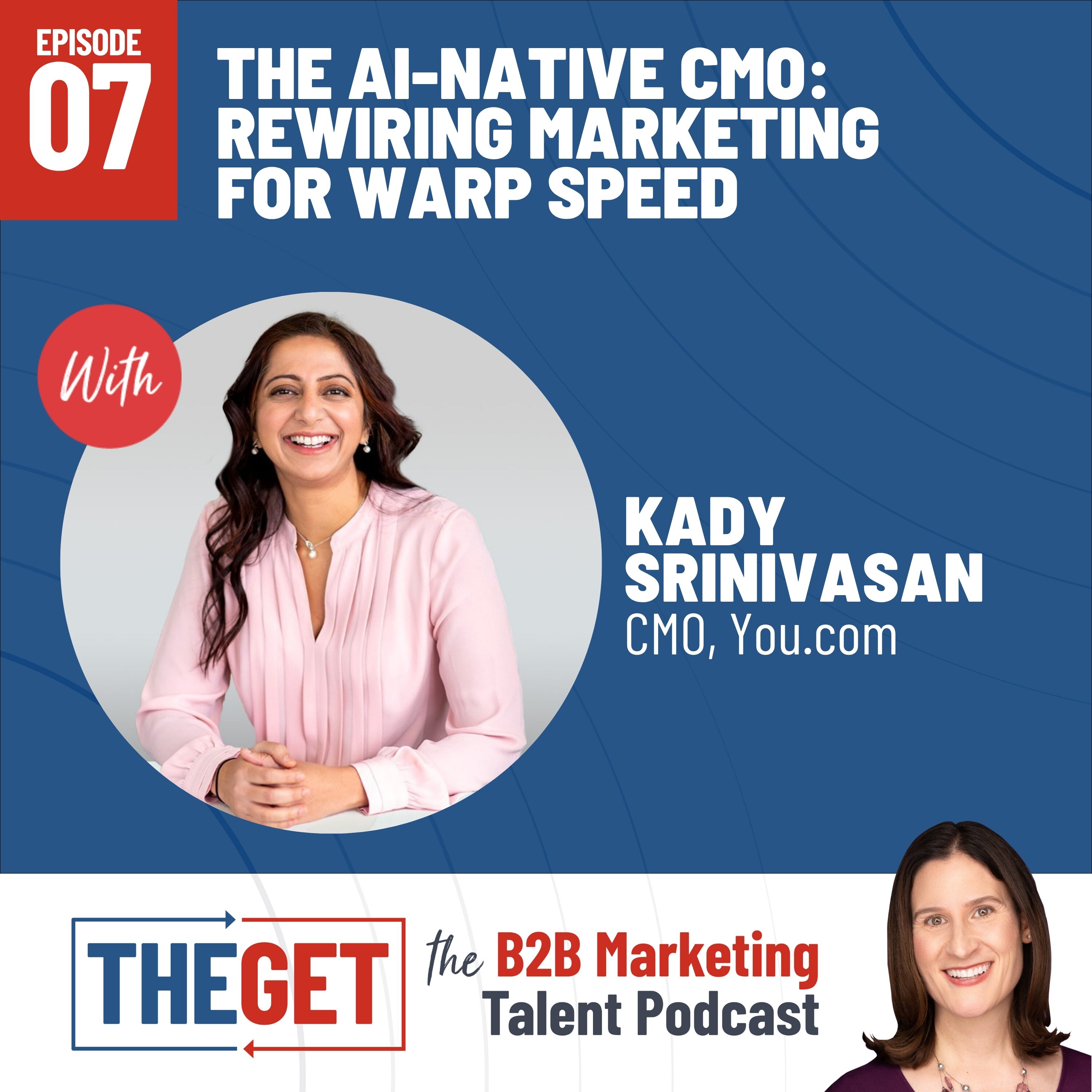 The AI-Native CMO: Rewiring Marketing For Warp SpeedThe Get · features Kady Srinivasan84 / 100
 How Smaller Businesses Beat Bigger Competitors with Gareth LockwoodSpotlight on B2B Marketing · on Ideal customer profile (ICP)84 / 100
 How Private Equity CMOs Build Revenue That Increases Enterprise ValueDemand Revenue · on Ideal customer profile (ICP)84 / 100
 Episode #30: Building on Fundamentals: Why GTM Strategy Drives PE Returns w/ George de los ReyesThe LAB: Value Creation in Private Equity · on Ideal customer profile (ICP)82 / 100
 The Future of Growth Is Product-Led with Wes BushTip Top · on Product-led growth (PLG)82 / 100
 The Creative Testing Gap: Why Most B2B & B2C Lead Gen Campaigns Fail to ScaleThe Revenue Room · on Ideal customer profile (ICP)80 / 100
 From CEO Operator to PE Advisor: PV Boccasam on Why Enterprise Buyers Buy Certainty, Not Software
 From Oracle and SAP to Founder to Stanford: Holly Roland on Building GTM That Compounds with AI
 How GTM Teams Win More by Moving Faster with Kris Rudeegraap, Sendoso CEO
 Inside the Mind of a Chief Growth Officer: Building a Bowtie GTM Engine with AJ Gandhi
 From Hyperscalers to Startup: GTM Lessons from a Former Microsoft & Amazon AI Executive