
ASCM NYC-LI presents Supply Chain Briefs · 2025-04-17 · 27 min
Key moments - from our scoring
Substance score
36 / 100
Five dimensions, 20 points each
Steven Lustig, a strategic operations executive with 20+ years of experience, walks through the multi-layered risk landscape confronting modern supply chains. Beyond the immediate tariff concerns dominating headlines, he identifies geopolitical disruptions (Ukraine war affecting chemical supplies), logistical volatility (container rates spiking from $3-4K to $20K+ across the Pacific), natural disasters (Texas freeze impacting semiconductors and plastics), and emerging cyber risks (ransomware hitting supplier operations). The conversation centers on how companies can build strategic flexibility through multi-sourcing decisions, nearshoring to Mexico or Central America, and onshore/friendshore alternatives - though Lustig emphasizes these require cost-benefit analysis and aren't zero-sum trades. He stresses that tariffs shouldn't dictate supply chain strategy unilaterally; instead, companies need dual or multi-level supplier networks, understanding that geographical proximity to raw materials, customer bases, and local manufacturing infrastructure matter as much as tariff rates. Critically, he argues supplier relationships - built through consistent communication, quarterly business reviews, and genuine partnership (not reverse auctions) - enable the agility needed when disruptions occur. The episode is essential for supply chain directors, procurement leaders, and operations executives weighing nearshoring investments and portfolio restructuring decisions.
Companies face geopolitical disruptions (like Ukraine affecting chemical supplies), logistics volatility (shipping costs and capacity), natural disasters (Texas freeze impacting semiconductors), cybersecurity threats (ransomware at suppliers), and the complexity of globally dispersed supply networks lacking redundancy.
Companies can flex production to lower-tariff countries like Mexico, do final assembly or transformation in nearshore locations to legally reduce tariff impact, maintain 75% production in Asia while onshoring 25%, or stage production across multiple geographies to limit exposure to any single tariff regime.
Friendshoring refers to sourcing from geopolitically aligned countries to reduce supply chain vulnerability to trade wars or sanctions; it's a broader concept than nearshoring (closer geography) or onshoring (domestic production), focusing on political stability and trade relationships.
Suppliers with strong relationships are more likely to flex capacity during disruptions, prioritize your orders, maintain quality and on-time delivery, and participate in continuity programs; reverse auctions and price-only focus signal low relationship value, causing suppliers to destock and de-prioritize that customer.
Companies should audit at least two levels down - both the direct supplier and their suppliers' suppliers - to identify single-source materials or components that could halt production even if primary assembly has dual sources.
Our reviewer’s read on each dimension, with quotes from the episode.
The episode surfaces a handful of genuinely useful operational points - looking two levels deep in the supply chain, the 'golden screw' single-point-of-failure problem, and contract flex provisions - but large portions are padded with host affirmations, platitudes about relationships, and repetitive framing of the same tariff points.
it's looking at least two levels down in the supply chain, who your suppliers are, where they are
if your widget uses, you know, a golden screw, we used to call those during COVID, it's one part from one supplier and everybody needs and you need that. And that holds up your production, you're kind of back to single source for that part
The episode's most interesting angle - that tariff-driven supply chain decisions are inherently unstable and that China-plus-one strategies may be illusory if sub-tier materials still originate in China - has some genuine edge, but the rest is recycled nearshore/friendshore/TCO content circulating widely in supply chain media.
your supply chain should not be dictated by tariffs
if you're looking for a China plus one, are you really achieving that in that way?
Steven Lustig is a legitimate practitioner with 20-plus years of relevant experience and apparent hands-on consulting work with real companies, but he is a small-firm consultant rather than a senior operator who has executed these strategies at scale inside a named enterprise, and no verifiable track record is demonstrated in the transcript itself.
we worked with a number of companies where materials being, the parts we were selling to them were being made in China
I've been thanked by numerous suppliers because I like, oh, you return my calls
A few concrete data points exist - container prices soaring from $3 - 4k to over $20k, the South Texas freeze affecting plastics and chip manufacturing, rough cost-premium estimates of 10 - 15% - but there are no named companies, no project outcomes, no timeline data, and most claims remain anecdotal approximations.
shipping a container across the pacific soared from three, $4,000 to 20 something thousand dollars really quickly
we had several years ago a freeze in South Texas, which is not something we normally expect. That impacted oil and gas. That impacted the plastics industry
The host asks broad, open-ended questions but never challenges a single claim, frequently echoes the guest's points back as affirmations, and the follow-up questions are generic re-asks rather than probing digs into mechanism or evidence.
I think the listeners are going to get a lot out of this. I know that I have personally
I heard a narrative in everything that you were just saying and it's just ringing a bell in my head right now
Computed from the transcript - who did the talking, and the words that came up most.
Joseph Moretta Host of Supply Chain Briefs discusses with Steven Lustig of Lustig Global Consulting the current landscape of Supply Chain Risks. They explore what options companies have in the ever changing world of Supply Chain Management
Transcribed and scored by The B2B Podcast Index.
You're listening to Supply Chain Briefs. Real companies, real challenges, and real solutions. Welcome to Supply Chain Briefs, the podcast that discusses the challenges, innovations, and critical issues of today's global supply chains. I'm your host, Joseph Moretta, and thank you for joining us.
On today's episode, we have Stephen Lustig of Lustig Global Consulting joining us here today to discuss how supply chains are right now experiencing these different kinds of risks that they're undergoing in this current environment and understanding and addressing what those risks are. Lustig Global Consulting enhances company value, profitability, and cash flow while addressing the key risks that they face by establishing a robust, effective manufacturing and supply chain solutions and enterprise risk management programs.
Stephen Lustig is a strategic operations executive with over 20 years of experience who has held leadership positions in supply chain, quality, and project management. um he's worked with uh fortune 500 companies all over and he's got a wealth of knowledge so with that being said please help me in welcoming steven to the show welcome steven thank you very much happy to be here excited to chat happy that you're here too steven um i think this is going to be a great episode i think it's very timely information for for the listeners and for everybody that might be tuning into this at a later time.
So with that being said, Stephen, kind of just want to jump into things. So given the current environment, the current landscape that we're facing right now, because there's a lot to talk about with this issue, what are the current supply chain risks that we face today? Yeah, thanks. Great question.
And our supply chains are so complicated now that there's a wide variety of risks that we face and it's really important that we you know are aware of those and therefore we can look at how we might want to address those so you know obviously as we're recording now tariffs is the subject of the week or month so it would be a remiss for me not to mention that clearly that's a risk for your supply chain related to cost and continuity of supply really kind of falls into the geopolitical and trade risks that you see you know obviously the tariffs that we talked about in addition inside there you see non-tariff trade barriers you see other geopolitical issues such as for example when you know when the war started in ukraine there was a lot of concern over certain chemicals that and materials that were needed for different industries and so you see a lot of that those type of things in the geopolitical but there's more than just that there's the fact that our supply chains are so spread out what are the logistical issues you know are there going to be transportation issues some of us may remember when shipping a container across the pacific soared from three, $4,000 to 20 something thousand dollars really quickly.
Obviously, there's a risk to your supply chain and the cost there. You've got geopolitical situations in countries. You've got natural disasters, right? We had several years ago a freeze in South Texas, which is not something we normally expect.
That impacted oil and gas. That impacted the plastics industry that depended on that. it also shut down temporarily a integrated circuit a chip factory that you used in a lot of electronics you know beyond that you can range to cyber security right what happens if one of your suppliers gets hit by ransomware and they can't access their systems they can't produce they can't order material how does that impact your supply chain um so we've got a wide variety of risks out there.
And as challenging as tariffs are now, I wish I could say that's the only risk, but obviously there's a lot more. Yeah, I mean, literally, if you can think of how something can go wrong, it will. And that's just the nature of the beast of supply chain is that there are so many different ways that something can screw up your supply chain, whether it's something that you can predict, such as a demand fluctuation, or something that you can't predict, such as, as you mentioned, weather, or some geopolitical happening that's currently going on within the world that we live in.
And, you know, those things, you can't predict them. You can't anticipate them, but what you can do is you can strategically set your supply chains up to be resistant to, so that they can survive whatever impact it is. So they have that kind of flexibility in their, in their, um, built into the network. So you have those options.
Um, so I really, really appreciate that, you know, going into it and even cybersecurity is a very interesting topic. Um, most people wouldn't really think of that as a, uh, as a supply chain risk, but if your system gets hacked by an outside, you know, source and you, and you lose track of data, That could be detrimental to your company. So one thing I was wondering, we were talking about this in the pre-show, is with all these disruptions that are going on in the environment, all this unpredictability that we're facing right now, how can we currently address the risk through decisions such as buy or build or offshore or nearshore, or even I know there's a term floating out there called friend shore.
So I was hoping you could enlighten all of us, the listeners and myself on that. Yeah, great question. So first, you know, one of the principles of good enterprise risk management is to you know assess and determine the risks and then prioritize them It really challenging I say in many cases difficult to mitigate or address every single possible risk You mentioned the ones that we can even predict And so the idea is to prioritize them, look at them, and then see how we can both most effectively address them.
So you mentioned the key word flexibility or optionality. I've been seeing that word a lot as well. And the idea is that you don't have a lot of single points of failure. Yes, and historically, if you looked at some of the lean supply chain, lean manufacturing concepts, the idea of if you take a large enough volume and you, you know, you bid that, you work with suppliers you're comfortable with and that do a good job, and you send it to one supplier and you've got that larger volume and the cost benefits that go with that, and the less work I've heard of dealing with one supplier for that part or material, then you've got some great efficiencies in your supply chain.
And that's great when everything's running well. However, when one of these risks comes to play, whether it's a natural disaster, whether it's a ship getting stuck in the Suez Canal, who had that on their bingo card, right? Right. You know, then you start looking at what are your different ways that you can add that flexibility.
And, you know, that's when you look at it strategically. And it's, you know, the supply chain function, the other, you know, key departments in the company. And you look at your choices, you know, are there options to multi-source your parts, your materials, or your assemblies, depending on what you're buying? At the first level, say whoever's assembling your product, and then second at the next level down, the materials that are going down into your product.
Because it's great if you've got two different factories and two different geographies building your product or widget. But if your widget uses, you know, a golden screw, we used to call those during COVID, it's one part from one supplier and everybody needs and you need that. And that holds up your production, you're kind of back to single source for that part, at least. And so it's looking at least two levels down in the supply chain, who your suppliers are, where they are.
You know, we can look at a lot of things now that might be assembled in Mexico, assembled in Vietnam. But the materials may be coming from somewhere else like China. And so if you're looking for a China plus one, are you really achieving that in that way? And that's when you start looking at these different strategies.
You mentioned them onshore, offshore, nearshore, friendshore. I'm sure people are going to come up with others. The idea is you have to look at the trade-offs when you're wanting to address the risk. Are you willing, in some cases, to maybe pay a little more for the benefit of, say, having a second channel, having a manufacturing that is in our country or near our country, which may take a couple days, less than a week on truck to get to, say, your warehouse or your customer domestically compared to a month or more on the ocean.
And to have that supply set up for you, are you willing to pay 10% more or 15% more, whatever that number means? That's the strategic decisions that the supply chain team and the overall company management needs to address along with sometimes their customers. Are they willing to pay that? Do they want that more secure feeling of some options when some of these surprise risks come into fruition.
Yeah. And I mean, I see it daily and I'm sure you see it too. It really comes down to what are your trade-offs? What are you willing to necessarily give up in order to gain something?
So what is that trade-off? Where is that sweet spot that companies can live comfortably with and understand that it's never going to be perfect? But just because it's never going to be perfect doesn't mean that it's not going to be satisfactory. Right.
I go back to COVID. we worked with a number of companies where materials being, the parts we were selling to them were being made in China and with China factories closing and other factories in other places eventually as well. You know, a lot of questions, and those logistics costs of shipping stuff on the ocean and trying to find ships. You know, some customers got very interested in nearshore sources and solutions.
You know, heavily Mexico could be places like Central America, the Caribbean. And so we engaged with them. We looked at alternates, you know, and there's there's challenges. You know, there's a challenge of maybe getting some of those suppliers up to speed and to the standards you're used to.
But there's also some cost standards. And we didn't find a lot of situations where you got a one to one cost. Like even if you compared the logistic cost of a, you know, of a, you know, a truck transportation from, say, Mexico and being able to hold less inventory because the factory is closer versus, you know, ocean freight. If you compare the costs, it often was not equal.
There was a cost premium. And the question is, you know, how much of that are you willing to pay? Not necessarily for 100% of your solution, but, you know, there's different options. Do you put 75% of it, keep it where it is in Asia, and you build 25% onshore or nearshore?
Are there levels of assembly? Could you do some levels of assembly overseas in Asia and then do final assembly enough to legally meet the definition of transformation in, say, a near shore country and then have less tariff impact, but also less impact from the higher labor costs that you might see? And we found a lot of companies got excited and interested earlier. And then once we started making progress through COVID and once they started seeing that there's a cost premium, that interest level kind of faded away.
And obviously now you see a lot of companies looking at that again. So I kind of think it's a let's not let a good crisis go to waste. Hopefully we be able to come up with some more robust and as you put it flexible solutions after we work through all this Wow Yeah no definitely some good good good points there Good information I think the listeners are going to really this is such a timely message right now because of the, like I said, the geopolitical arena that we're currently in right now.
So definitely can appreciate that. And just because I know it's on the forefront of everybody's mind right now. Just want to go back. I know we touched on it a little bit, but can we dive deeper in what these companies, what are our listeners who are being impacted by the tariff situation?
What can they really do? You know, what decisions can they make that are going to set them up in this unknown arena right now? What can they do? Yeah, no, that's a very timely question and very relevant.
So glad you asked. No surprise that we want to cover that given everything that's going on. It's interesting, I posted on LinkedIn last week, an article, and we'll talk about this a little bit now, you know, your supply chain should not be dictated by tariffs. and part of that was well you're not even sure what tariff is going to be there the next day and sure enough actually the next day the tariff a lot of the tariffs on many countries were delayed now i do not have a crystal ball that told me that was going to happen but what we do know is that things are changing and we don't know what it's going to be like in the near or medium term future um and so the idea is that yes tariffs should play a role in determining your supply chain strategy, but it can't be the only answer because you need to be having your supply chain obtaining the materials, the assemblies, the parts from places that make sense for you geographically, which may be near the raw materials or the subcomponents.
It might be near where your customers are. It has to be places where you also have the infrastructure, the know-how, their local supply chain to support those industries. You just can't suddenly, say, make aluminum die casting or electronic component circuit boards someplace if you don't have somebody to give you the components and the machines and the trained engineers. And so, yes, considering tariffs, especially if they're over 100%, is a key part of that discussion, but it's not the only thing.
And it needs to be considered strategically for that. And you need to understand all of those types of things, how that affects your supply chain, how that affects you and your customers in order to put this together. So yeah, I, you know, there's a challenge. You've got a tactical challenge of people who have parts on boats on the ocean, waiting to get into a port.
And I have, you know, not a lot of great solutions on what you do with those. Hopefully those can be delayed. I've heard some ships are slowing down or not docking quite yet in order to hope and wait that certain tariffs get reduced before they impact. So, or you're not receiving them at the port at least.
So, you know, there's some tactical thing there. Strategically, that's where that flexibility comes in. You know, right now there are countries that don't have the same tariff impact. And yes, they may have slightly larger costs overall if you look at the labor.
But wouldn't you rather be, say, if this was feasible, producing this stuff in Mexico, flexing up that volume, having the ability to volume up and down, flexing up that volume you're producing in Mexico now, you know, yeah, maybe you're paying some tariffs for that. I'm, you know, I can't even keep track what the tariff is per country right now myself. But it's a lot less than 100 something percent, wouldn't you rather say absorb that 10, 15 percent cost premium limited to no tariff and produce your product there in higher percentages now until we can get a better feel for what this looks like later on with other countries?
That's where that flexibility comes in. And if the answer is right now we don't have that flexibility, yeah, it's something you want to work on and you can't like rush that. It's not something setting up a factory tomorrow but it's something you want to be prioritizing, dedicating the resources, the expenses to, so that you can have that flexibility as soon as possible and that you have it for future situations that arise, whether it's tariffs or natural disasters or whatever.
So, yeah, there's not a lot of here's what you can do with your product that you've already got made, including stuff that might be finished goods inventory at your supplier overseas, right, that you're liable for. But what do you do going forward? Or if you do have multiple, some companies do have multiple sources for this. That's the option to now, how can they flex up?
What supply agreements do you have? What contracts do you have that say they are obligated to flex up to your forecast a certain percent? You know, that's something that can be in the standard and contracts I've negotiated. If everybody's going to say, and I'm just using Mexico here, this Mexico factory, maybe it's not your own.
Maybe it's a contract manufacturer. And everyone's saying, hey, can you build more percentage volume of these now? Where are you in that priority list? And where does your contract, where does your relationship with that company put you in that priority list?
And that stuff, again, to look at, you know, you can look at those contracts now and those relationships now. obviously better to have that in place earlier but now we can learn from that for the future definitely definitely and I I heard a narrative in everything that you were just saying and it's just ringing a bell in my head right now and that is the importance of establishing your supplier relationships because that's where I feel and maybe I'm wrong but this is just personally where I feel if you have good supplier relationships and you can depend on these suppliers, you, they know who you are, you know who they are, and then you can start working together to be more proactive rather than being reactive.
And I think that in the realm of supply chain, that is going to be one of the key differences that companies are going to see more success with by having those relationships established previously, you know, coming into this situation rather than trying to set them up now. Yeah right Agreed And it you know it something you can just suddenly say hey I want a relationship now It something you build over time It something you build in person through visiting even if they in a different country even if they in a different continent It's something you build in many countries here, but more so in other countries, having meals with them, going out to dinner, you know, having that out of the office, out of the factory relationship, being able to compromise when things are not ideal.
You know, there's things that are important for them and not as important for you as the customer. There's things important for you and not as important for the supplier. So there's opportunities to do some give and take there. But developing that relationship longer term is really important.
And it's one reason I don't, on supply chain topics, I'm not a huge fan of reverse auctions because it's not good for relationship building. It doesn't necessarily, unless it's done very specifically, it doesn't necessarily account for, you know, not only the relationship, but, you know, the on-time delivery, the quality, the supply continuity, the customer service. You know, that when you get to that point, even if you say that you're considering that, a lot of suppliers look at a reverse auction and they think it's price and that the relationship is down to price.
and yes, you want to negotiate and yes, you want to competitively quote. You want to understand the market. You want to look at dual sources when possible, but you want to still do that where you value the relationship and where you communicate that to them through the measures that you share with them, through how you metric them, through how you communicate and score them, say, in quarterly business reviews and things like that. Yeah.
And, you know, when we, you think of a business podcast or a supply chain podcast, such as Supply Chain Briefs, you think that it's all about the bottom line. You know, you hear about the bottom line. What's good for us? You know, make sure we get ours before they get theirs.
And while, yeah, there is an element of that in, you know, you got to make sure that you're paying the right price, that you're not paying well above what the market value is, it really boils down to what kind of relationships are you establishing between different companies? And supplier relationships is so critical, especially in today's landscape, where we're seeing so much of this fluctuation. Tensions are high. The geopolitical relationships are skyrocketing, impacting multiple industries, not just my industry, not just your industry, but just multiple industries.
And this is what people really need to understand. And I think the pandemic really put a spotlight on this for us, is that no matter what industry you're in, you have a supply chain whether you're ordering from the manufacturer itself or you're buying through a distributor that's all part of your supply chain and i think the pandemic really did highlight that for us and companies really started to open their eyes yeah i mean and i think there's a couple aspects that one is looking beyond the price to the total cost of ownership right tco which includes those things i talked about right are they delivering on time because if they're not that could impact your factory.
Is it a quality good? Because if not, again, that could impact your factory, your customers, whatever. You know, are they responding to your purchasing team's issues, right? Do you have good inventory programs with them, right?
And supply continuity programs. And have you partnered with that? Because those programs are partners off chips. Often there's, you know, more longer or more enhanced forecasts that are provided from the customer to the supplier in exchange for having an inventory or continuity supply program.
So which kind of programs have you formally put in place and negotiated with those companies? And then there's the more informal relationship. Do you answer their emails? Do you take their calls?
Do you meet with them when they're in town? Do you meet with them when you're in their town, right? All this sounds very basic, but I've been thanked by numerous suppliers because I like, oh, you return my calls. Oh, I'm I'm coming to town.
You take time to meet with me. To me, you know, it's just a common courtesy, but, you know, apparently doesn't always happen. And, you know, that's the relationship aspect that's so key. We can do all the sort of, you know, AI data analytics that we want and we should, but there's still that human relationship building that's critical.
Absolutely. 100%. I couldn't agree with you more. Stephen, this has been a fantastic conversation, very timely.
I think the listeners are going to get a lot out of this. I know that I have personally. Folks, if you're listening to this conversation and you want to know more, Stephen, do you have a website that they can go to? Absolutely.
It's www.lustigglobalconsulting.com. And, you know, I'll be happy to answer any questions people might have.
Please reach out to me through there. Can they also find you on LinkedIn? They can also find me on LinkedIn, Stephen with a V, Lustig, L-U-S-T-I-G. Beautiful, beautiful.
Well, Stephen, I really want to thank you for taking the time. I know that, you know, scheduling this was a bit tricky with my schedule and your schedule, but we got it done. I think, like I said, the listeners are going to get a lot out of this. This is probably one of the more timely conversations that we probably could have had, and I'm really super appreciative of it.
Just as a talking point, you can always find our podcast on YouTube, Spotify, and Apple Podcasts. Be sure to download this and listen to it later on or wherever else you can find your podcast. Stephen, thank you again, and we'll be in touch, okay? All right.
Take care, Stephen. This has been an episode of Supply Chain Briefs, which can be downloaded on Apple Podcasts, Google Podcasts, Spotify, YouTube, or wherever else you get your podcasts from. Real companies, real challenges, and real solutions. Real companies, real challenges, and real solutions.
Other episodes covering the same guests and topics, from across The B2B Podcast Index.
 Scaling a SaaS Selling to Skeptical Scientists with Mike Klein, CEO of GenomenonSaaS Scaling Secrets · on Quarterly business reviews86 / 100
 Leading Without a Playbook w/ Stephanie BlairThe Customer UnSuccess Podcast · on Quarterly business reviews81 / 100
 From Audit to the CISO SeatSimplifying Cyber · on enterprise risk management77 / 100
 Mindset - Stay On MissionStay Hungry · on Quarterly business reviews76 / 100
 AI and the Future of Internal AuditSpeaking of Risk and Audit · on enterprise risk management74 / 100
 Building a $4 Billion AI Infra Company | Benny Chen, cofounder of Fireworks AIInfinite Curiosity Pod with Prateek Joshi · on Total Cost of Ownership (TCO)73 / 100
 S3 E4 - ASCM NYC-LI Supply Chain Briefs presents Continuous Improvement with Beau Groover Founder and President of The Effective Syndicate
 S3:E3 - ASCM NYC-LI Supply Chain Briefs presents Continuing Education for Supply Chain Professional
 S3:E2 - ASCM NYC-LI Supply Chain Briefs presents S&OP vs S&OE with Bill Mrzlak President of Chain Sequence
 S3:E1 - ASCM NYC-LI Supply Chain Briefs presents Perils to Profits with Ernesto Levy, CEO, Radienz Living
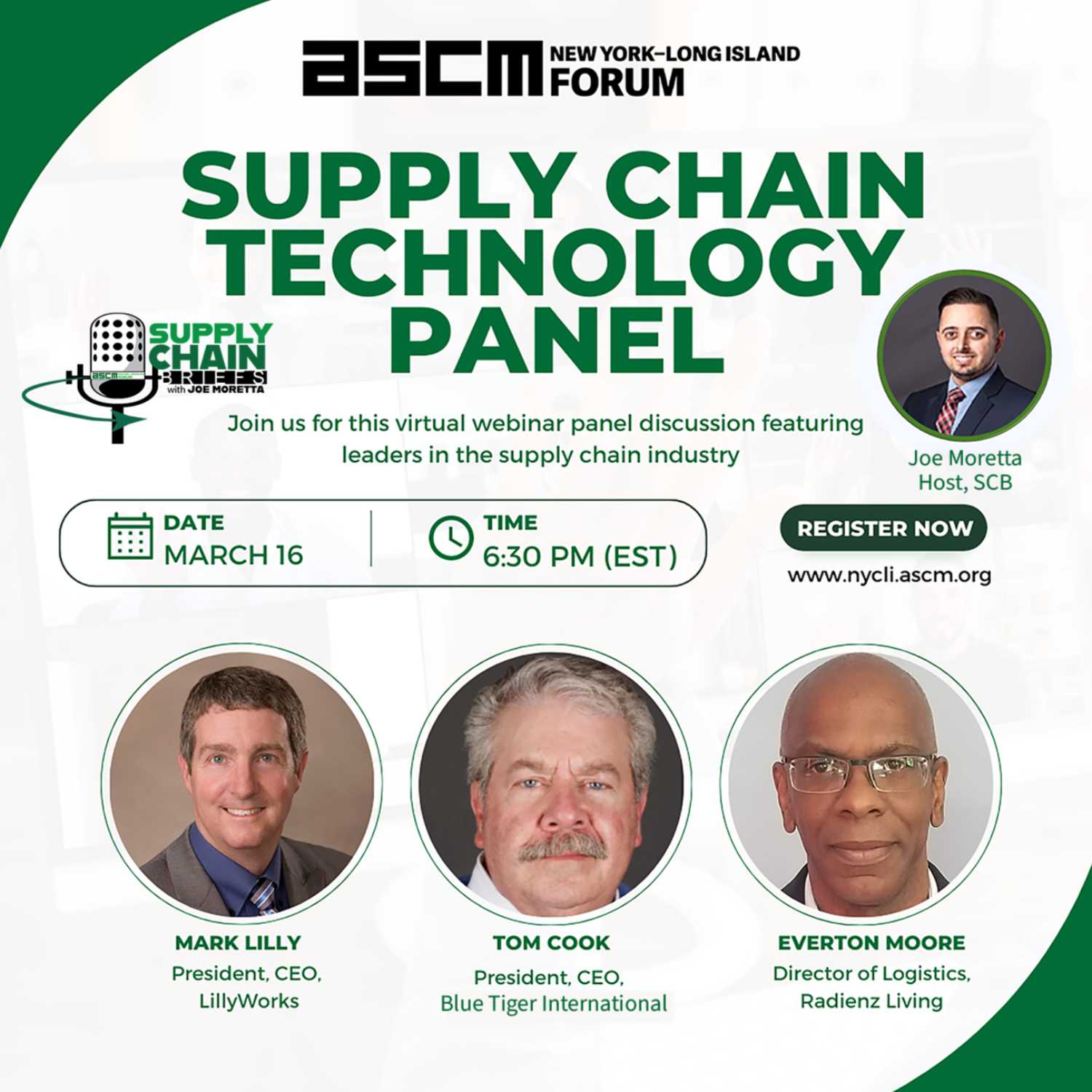 S2:E2 - ASCM NYCLI Supply Chain Briefs presents Supply Chain Technology Panel Discussion