
10 Minute Martech · 2026-07-21 · 12 min
Key moments - from our scoring
Substance score
44 / 100
Five dimensions, 20 points each
Bob Regular brings two decades of digital media experience to explore AI's transformational impact on advertising. Unlike previous fads, he argues AI is foundational - but distinguishes between genuine capabilities (improved workflows, better analytics, autonomous media buying based on brand objectives) and overhyped trends destined to fade. Dynamic creative optimization exemplifies the latter: the industry's push toward one-to-one personalization with infinite creative permutations is statistically impossible and will plateau into pragmatism. Similarly, the democratization of video production, while real, faces consumer behavior headwinds - people watch video rather than click it, limiting performance upside. Regular uses compelling analogies (Tesla's full self-driving adoption curve, historical credit-card skepticism) to explain how humans will gradually cede control to AI systems, with competitive advantage shifting to brands with stronger yields. His hot take: OpenAI and emerging AI platforms will hemorrhage ad dollars from Google and Facebook by offering fatigued users a virgin experience, disrupting the walled gardens' 20-year dominance.
Foundational: AI improving workflows, productivity, analytics, and removing human decision-makers from strategic media buying. Fads: dynamic creative one-to-one personalization, agent-to-agent autonomous transactions, and the assumption that video will perform like traditional performance creative due to AI production democratization.
It's statistically impossible to test all permutations of one-to-one personalized creatives; the industry's extrapolation that you need unique creative per person contradicts testing realities, so it will eventually retreat to practical constraints.
Much longer than expected due to trust deficits; Regular compares it to online credit-card adoption, which took 20+ years to normalize - agent-to-agent trust will similarly require extended cultural and regulatory groundwork.
Simple mechanisms like subtle color shifts, single shakes, or 3D rotations with user-controlled sliders move the eye to the ad without interrupting the user's content consumption, driving higher engagement than static display.
OpenAI and emerging AI company ad ecosystems are capturing budget migration by offering users a virgin, non-ad-saturated experience as fatigue with traditional walled-garden ad density grows.
Our reviewer’s read on each dimension, with quotes from the episode.
There are a handful of genuinely useful observations - DCO statistical limits, video clickability conditioning, agent-to-agent trust timelines - but they are diluted by large stretches of generic high-level commentary about AI 'transforming' the industry and 'improving workflow,' which adds little for a working operator.
statistically it's actually impossible. Right. Test all those permutations
consumers have been programmed that videos are not clickable. We don't click on video
The DCO permutation-testing impossibility point and the video-clickability conditioning argument are mildly contrarian and worth noting, but the episode leans heavily on well-worn analogies (Tesla self-driving, PayPal trust) and the walled-garden-disruption-by-OpenAI thesis is already widely circulating.
you don't actually need one unique creative per person. Right. You don't really need that much experimentation. And statistically it's actually impossible
consumers have been programmed that videos are not clickable
Bob Regular is a working CEO of a digital media company with evident hands-on experience in ad operations and creative experimentation, making him a genuine practitioner rather than a thought-leader circuit guest; however, he is not a recognisable top-tier operator with documented scale and the insights stay at a conceptual rather than operational level.
we have a, you know, the typical ad of 300 by 250 that you know, around for 100 trillion years. We've been experimenting with making it 3D
We've been experimenting a lot with animation and been experimenting with ad behaviors
The episode is almost entirely assertion-based; concrete details are limited to a standard ad unit size and a vague banner-shake experiment, with no campaign metrics, dollar figures, lift data, or named client examples to substantiate the claims about what is or isn't working.
the typical ad of 300 by 250
a banner that just simply shakes back and forth once
The host opens with a generic 'how is AI impacting change' question and repeatedly capitulates with 'yeah,' '100% agree,' and 'yep, yeah' rather than pressing for evidence or drilling into the specific claims; the better questions (fads, experiments, hot take) generate the episode's most useful content but are still under-followed-up.
Yeah, I think the uh, control freak in me gets very uncomfortable with that concept. I don't think you're wrong
100% agree with that. Yeah.
Computed from the transcript - who did the talking, and the words that came up most.
The digital ad industry loves a fad, and Bob Regular has watched enough of them come and go to know which AI trends won't survive contact with practicality. The Infolinks Media CEO has been in digital media since the era when measurement itself was the revolution, and he brings that skepticism to today's hype. Bob joins Sara to explain why dynamic creative optimization collapses under its own math, why the coming flood of AI-made video will disappoint performance marketers who forget consumers don't click video, and why agent-to-agent buying faces the same trust problem credit cards did online 20 years ago. Then he shares what's actually working: small, testable ad experiments in animation, color, and 3D that get attention without interrupting. 3 Takeaways: Dynamic creative optimization has a math problem: you don't need one unique creative per person, and testing all those permutations is statistically impossible anyway. AI makes video cheap to produce, but consumers are programmed to watch video, not click it, so the coming video flood will work for branding and hit a wall on performance.
Transcribed and scored by The B2B Podcast Index.
Speaker A: I'm Sarah Fatz and I lead community and awareness at Progress.
Speaker B: This is 10 Minute MarTech, the Dynamic Creative. It's starting to be discussed, to be extrapolated to a place where you don't actually need one unique creative per person. Right. Uh, you don't really need that much experimentation and statistically it's actually impossible. Right. Test all those permutations and I think that will eventually die down in some practicality.
Speaker A: That's Bob, regular CEO of Infolinx Media. Let's get started. Bob, you've been in the digital media space for a minute. Um, we've seen a lot of transformational periods over that time and a lot of changes. How do you think AI is impacting the change that we're seeing today?
Speaker B: Well, our industry, the digital media advertising industry, loves fads. And so we chase fads all the time. Whether they're um, meaningful or whether or not they're just conceptual, they just make us excited. And there have been a lot over the years. But I do think that AI is foundational. I think this is a true tectonic shift for digital media, frankly, for all media. We had print and we had radio and we had television and very exciting mediums. But if you advertised on them, you had an intuitive sense on whether or not it was effective. It wasn't scientific, it wasn't hyper data driven. And when the Internet came in and I was a part of that phase, what was super exciting to advertisers and to the industry in general was measurement. The ability to know that you spent a dollar and you got a specific impression, a specific click and you generated a specific conversion and you had the democratization of performance. Now AI is entering and I think what's going to happen with AI as a result of the capabilities, it will improve workflow, it will increase productivity, it will increase an improvement of analytics. It's going to do all those things. But I think those things are really, frankly, um, table stakes. I think what's really going to do is it's going to remove, um, our role as the decision maker and the strategist of what it is that we buy, what was the result and whether we're happy with it or not. And that's the most interesting thing is we're going to say to the systems, I want to buy media, to meet these audiences for my brand. Buy what you think is the right thing to buy to deliver the best outcomes for me. And I think that's a suspension of everything that's gone on in the history of buying media. Where us as people. Right, ultimately came up with the plan, the strategy, the execution, the workflow, the result. And we decided whether or not we felt good about that. And that suspension of reality. Right. Is just starting to unfold and that's where AI will transform it.
Speaker A: Yeah, I think the uh, control freak in me gets very uncomfortable with that concept. I don't think you're wrong, but I guess my question to you is, do you believe that there still needs to be a human in that loop? Even if AI is determining the strategy, it's determining you still have to have human, human inputs to get to that point. Where do you think the human belongs in that entire process?
Speaker B: Yeah, so, so I use, I like analogies. I think it helps people. Right. Understand things. Uh, I have a Tesla, uh, my full self driving feature on my Tesla. When it first came out, I was very attentive, I was incredibly careful, I was incredibly thoughtful and I would take control very fast with minor problems. If you look at what my status is five years later, I'm almost not present, I'm paying attention, but it's very loose attention, very casual attention. I'm oversighting, I'm not engaged. And I think in the media buying phase, we're hyper engaged right now. We're almost like micro analysts and we've let the mls, the machine learned optimizers, work, but we're very attentive to, they have flaws. And I think as the AI starts to take over, it'll remove more and more of the capabilities of us to oversight and it'll just start to do what it thinks is the right thing to do and it'll tell us that it's the right thing, that it should have done and it'll deliver. And I think the advantage you have in media acquisition and marketing branding in the future will be whether or not the value of your brand and the yield value of your brand and what you're trying to achieve is, is competitive enough so that the other folks using the same AI.
Speaker A: Right, right, right.
Speaker B: Have uh, an advantage or disadvantage over you.
Speaker A: 100% agree with that. Yeah. Well, when you talked about some of the tectonic shifts, you also talked about the fact that there are fads right now in AI. Do you have some that you would call out as, and they may be interesting and they may be useful today, but that you think might be more of a fad than having the sticking power of some of these other things we've just talked about?
Speaker B: Yeah, I think some of the fads right now is the dynamic creative, uh, the ability to be able to build so many creatives on the fly.
Speaker A: Right.
Speaker B: I think dynamic creative is an excellent capability and I do think there's a relationship between who's the audience and who's the creative. Um, but I think that it's being at least it's starting to be discussed, to be extrapolated to a place where you don't actually need one unique creative per person. Right. You don't really need that much experimentation. And statistically it's actually impossible. Right. Test all those permutations. And so there's a lot of excitement around dynamic creative optimization and being able to create creatives on the fly and all kinds of different creatives on the fly. And I think that will eventually die down in some practicality. And then, uh, I do think that we will see and this is not a fad, it's a great thing, but we'll see. Sort of this, you know, it's a cliche term, but democratization of video, which is a lot of folks could not afford to build video for a long time. And so you just build display ads. Right. And you wouldn't build video ads because it's expensive production wise. I think today building a video ad is piece of cake. AI can do it for you. A lot of tweaking, of course. Um, so I think there's going to be a lot more video. And so there's a large chasing of video. The reason I think that may not work out as well is consumers have been programmed that videos are not clickable. We don't click on video. Right. We watch video. And so I think there's a movement around let's do a lot of video. And that's great. It's great for branding, it's great for experience. It's emotional. Um, but as a performance creative, it has limits. The other thing is I think that this workflow stuff, uh, I've seen huge advances in improving it. Right. Also, um, but I think it's my experience it's overblown. I do think that you have a person that you can extrapolate their productivity. I don't know if you can necessarily eliminate, uh, them from the. At this stage, I haven't seen the ability just eliminate. Right. And the bot will do it all perfectly. So far I see a lot of hallucinations still. Right. Even, even anthropic. Dario will say it hallucinates. We're not sure why. I do also want to add one last thing. I really do think agent to agent relationship is overblown and it will Take a lot longer. I think there's a huge trust element there. And I'll go back, uh, into history, use the analogy again, is we take it for granted today that you'll buy things online and you'll use your credit card and you don't even think about it anymore. Right. But you rewind the clock 20, only 20 years. And getting someone to use a credit card online was a herculean task. It had uh, no trust. Right. And it was complicated, it was difficult. And so companies like PayPal and other things were used to try and help again democratize and make it easy to buy online. You know, agent, agent. I think it will take a lot of time for Sarah's agent to buy from Bob's agent, negotiate prices, say that it was the right thing, just execute without an approval. Right. And everybody will just be cool with that.
Speaker A: Yeah, yeah. Well, and with that comes experimentation. So I would love to understand what are some experiments you've been trying or people on your team have been trying to um, recently that have, have been really successful things that you were excited about. Um, AI or not. Um, but just in the digital marketing space. Yeah.
Speaker B: So we've been exper. We've been experimenting a lot with animation and been experimenting with ad behaviors that get the attention of folks like yourself so that you're, as you're reading your article, it's not interrupting you and taking you away, but you will actually notice the advertising. Right. And it's funny, there are very simple things like whether it be color or whether it be a slight animation. For example, if you had a banner that just simply shakes back and forth once, Right. It moves your eye from the center to the location just for consideration. Simple things like that. Uh, we have a, you know, the typical ad of 300 by 250 that you know, around for 100 trillion years. We've been experimenting with making it 3D where it rotates continuously, right. Around and around in three dimensional and gives the consumer a little slider that lets them rotate it. So we're experimenting with the placement, we're experimenting with the animation, we're experimenting with the colors, we're experimenting with these things to try to break through. And it's been going really, really well. And we've been using AI to help us with some of those experiments.
Speaker A: Great. So tell me this, who do you follow for inspiration or information?
Speaker B: So I follow a lot of folks and I follow across many different genres and I find that you know, to be the best because I think ad, uh, tech is or digital media is a mixture of culture, a mixture of economics and certainly a mixture of uh, societal oriented stuff. So on, you know, on the ad tech, digital media side, I really like architecture. I like Ari very much. I think he's very sharp, understands the space really well, has sort of a wonky look on it. Open Market is also a great podcast that I like to follow and it's really great, you know, on, on cultural oriented, um, oriented stuff. I like, uh, Scott Galloway's many different things. I find that he's also very interesting. Uh, I like middle of the road folks like Smirkonish, I don't know if you're familiar with him, but very middle of the road. Right. Not too left, not too right. Very thoughtful in many dimensions for cultural things. And uh, Lex Friedman. I'll throw in the last one if you've got the tolerance to listen to three to four hours. Not many people do. Right. But it's a mixture of economics and culture. So those are some of my, my awesome follows. Uh, there you go.
Speaker A: Love it. Uh, one last question for you. Do you have a martech hot take
Speaker B: a lot of the classic money that is living in the walled gardens today? Our Googles, our Facebooks, that has done a great job of vacuuming, a great job of vacuuming up the media dollars as a result of measurement is now about to be disrupted meaningfully by OpenAI by the AI companies allowing advertising to come into the ecosystem. And the reason is not because AI is better. There's fatigue. There's fatigue. And how do those platforms react to fatigue? They show more ads.
Speaker A: Yep. Yeah.
Speaker B: Now, right, you've got, you've got ads and chatgpt and other things starting to evolve and yes, they're antiquated. But my hot take is you're going to see uh, a magnetism draw of money moving in search of that new virgin user experience and response that those folks on the classic walled gardens are going to struggle with.
Speaker A: Yep. Love it. I love it. Bob, it has been great talking today. Thank you so much for your time.
Speaker B: You're welcome. I've loved it. Thank you.
Speaker A: Appreciate Sarah listeners, thanks for tuning in. Make sure you like and subscribe wherever you get your podcasts. Till next time, I'm Sarah Fatz and this is 10 minute part time.
Other episodes covering the same guests and topics, from across The B2B Podcast Index.
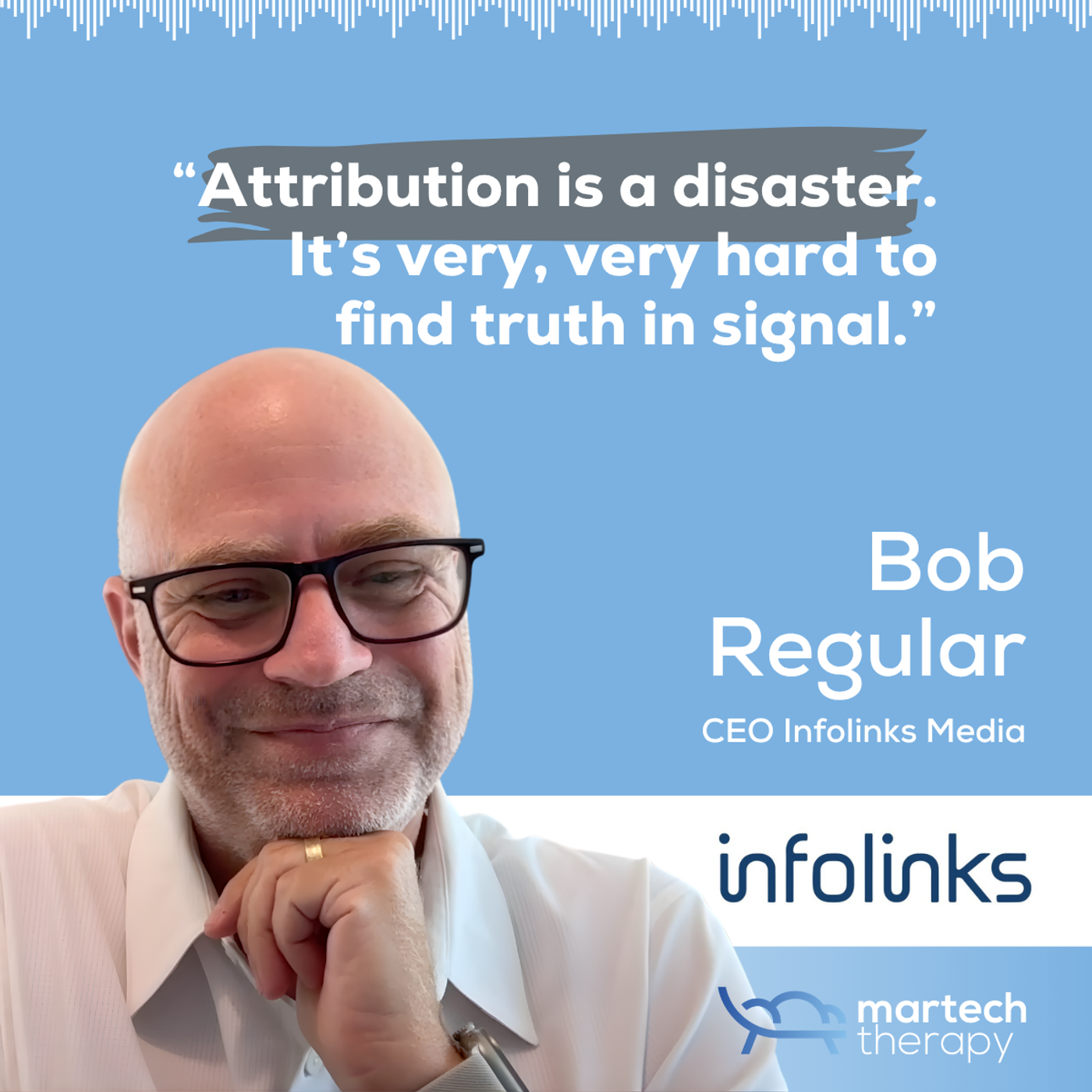 Adtech, AI, and the illusion of speed with Infolinks CEO Bob RegularCouch Confidentials by Martech Therapy · features Bob Regular85 / 100
 The One Ad Channel That Doesn't Annoy People (And How to Buy It)Humans of Growth · on Dynamic creative optimization82 / 100
 Episode 262: Jansen Teng, Co-Founder of Virtuals Protocol on building the Infrastructure for AI Agent SocietyBase Layer · on agent-to-agent transactions70 / 100
 Michael Treff | A Mid-Year Update From the B2B Front LinesCMO Confidential · on Dynamic creative optimization68 / 100
 Unilever's Branden Goodman on the New Rules of Consumer DiscoveryBRAVE COMMERCE · on Dynamic creative optimization67 / 100
 Agentic Payments: The Questions the Industry Needs to Answer Before Scaling | Robert Kraal, Co-Founder at SilverflowPurpose Driven FinTech · on agent-to-agent transactions65 / 100Neil Tewari: Marketing Can't Be the Company's AI Bottleneck61 / 100Greg Joseph: AI’s Future in Personalizing Streaming Ads75 / 100Allan Malcolm: The Future is Marketing Generalists, not Specialists54 / 100Kabir Daya: Human Connection Still Drives Discovery66 / 100Heike Young: Taste Gets You in the Room; Results Keep You There64 / 100