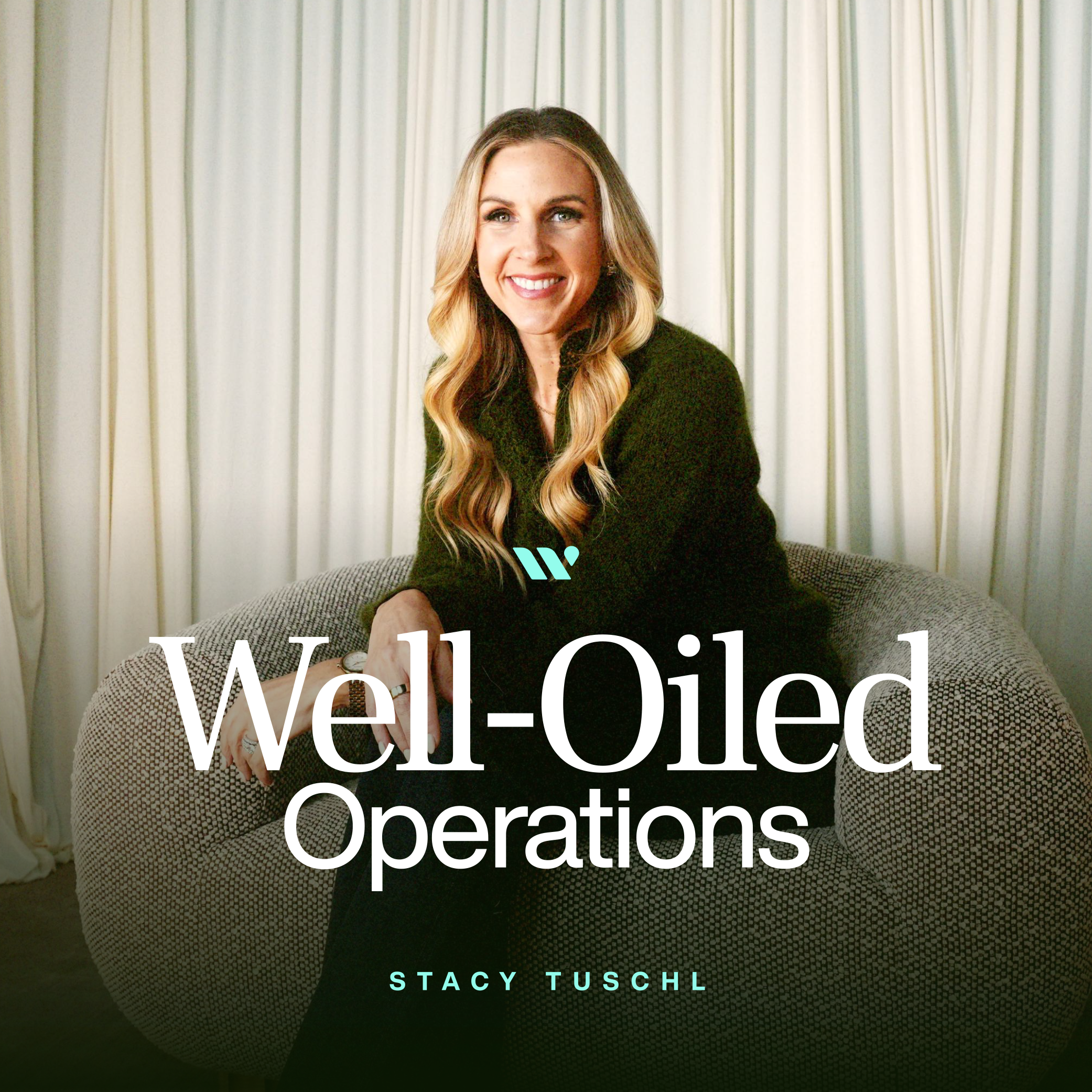
Well-Oiled Operations with Stacy Tuschl · 2026-06-03 · 13 min
Key moments - from our scoring
Substance score
32 / 100
Five dimensions, 20 points each
Stacy Tuschl draws lessons from a mastermind meeting with Cody Sanchez, an award-winning journalist who scaled to 6 million followers by leveraging personal brand as her core distribution engine. The episode addresses three foundational problems costing seven-figure business owners hundreds of thousands annually: excessive spending on paid ads ($50k-$100k/month with 20-30% year-over-year increases), founders stuck in operations instead of strategy, and misalignment with their ideal customers. Tuschl explains that personal brand isn't about influencer status but building owned distribution infrastructure - companies leveraging audience ownership reduce reliance on paid channels by 50-70% within 18 months while improving lead quality. The second shift involves systematizing before hiring, moving from 'operator mode' (handling every red light) to 'owner mode' (focusing only on strategic decisions). The third non-negotiable principle: genuinely loving your customers. Tuschl illustrates this by recounting her decision to shut down a seven-figure program misaligned with her values to launch Well-Oiled Operations, betting on the right people and problems even through nine months of minimal revenue.
Companies that build owned audiences reduce reliance on paid channels by 50-70% over 18 months while improving lead quality and margins, versus the typical $50k-$100k/month spend on ads that increases 20-30% annually.
Owner mode focuses on strategic decisions, vision, and major relationships that only the founder can handle; operator mode means being stuck running every tactical decision. Building systems first lets operators run documented processes, freeing the owner for owner-level work.
You don't need 2 million followers; you need the right 2,000 people to know who you are, what you stand for, and why you're different, attracted through clear point of view and consistent value delivery.
She shut down a seven-figure program that didn't align with her values and launched Well-Oiled Operations instead, enduring nine months of minimal revenue before experiencing explosive growth by obsessing over the right customer problems.
She believes that if you don't love the people you serve, you'll quit when it gets hard and your resentment will kill the business from inside, so genuine love for customers is non-negotiable.
Our reviewer’s read on each dimension, with quotes from the episode.
The episode surfaces a handful of usable framing devices (rent vs. equity for ad spend, the red-light factory-floor metaphor) and one cited data point, but the majority of the runtime is repetition of those same three themes plus standard business-coach filler. A smart operator gets perhaps two or three minutes of genuinely applicable ideas from 13 minutes of content.
Every dollar I was spending on ads was gone the second that campaign ended. It didn't build anything. It didn't create an asset. It just bought temporary visibility.
You need the right 2,000 people to know who you are, what you stand for, and why you're different.
The 'paying rent vs. building equity' metaphor for paid attention is a passable reframe of well-worn owned-media doctrine, but the other two pillars - systemise your ops, love your customer - are textbook business-coaching staples with no contrarian angle or first-principles argument to justify them. Almost nothing here would surprise a reader of standard entrepreneurship content.
You all paying rent for attention and rent goes up every year But some of you could be building equity instead
fall in love with your customer or don't build the business
There is no actual guest; this is a solo monologue by the host recounting second-hand lessons from a day at Cody Sanchez's office. Stacy has legitimate operator credentials (8-figure business, 50+ employees, 23 years), but the episode delivers no primary conversation with a practitioner of Cody Sanchez's calibre - only paraphrased quotes.
Last week, me and a group of business owners spent a full day at Cody Sanchez headquarters in Austin, Texas.
I've been doing this for 23 years. Today, I run an 8 figure business with over 50 employees.
There are several concrete anchors - named companies/people, a dollar range for ad spend, a year-over-year growth rate, and a cited book with explicit numbers - but key claims (e.g. 'an explosion,' 'very little money') remain vague, and the Rand Fishkin statistic is not fully traceable as stated.
The average business at our level was spending $50k to $100k per month on paid ads and that number was going up 20 to 30% year over year.
This is what Rand Fishkin documented in Lost and Founder. Companies that build owned audiences reduce their reliance on paid channels by 50 to 70% over 18 months
This is an uninterrupted solo monologue with no interviewer, no follow-up questions, and no productive tension; the episode closes with an explicit sales CTA for a free scorecard, confirming it functions primarily as a lead-generation asset rather than a substantive conversation.
And that's exactly why we created the 2026 Business Scorecard. It is a free audit that shows you exactly where you're losing time, money, and leverage in your business right now.
So I came home and I asked myself again, am I still in love with my customers?
Computed from the transcript - who did the talking, and the words that came up most.
GRAB the 2026 Business Scorecard: Book a 30-minute call with me here: In this video, I'm breaking down the three biggest problems every 7 and 8-figure business owner is facing right now and what I learned spending a full day at Cody Sanchez's headquarters with a room full of business owners at our level. I'm showing you the real cost of being invisible, why the average business at our level is spending $50K-$250K per year on paid acquisition when brand authority could cut that in half, and the exact systems shift that removes you from the red lights so your business gets easier as it grows.
Transcribed and scored by The B2B Podcast Index.
Attention has become the new currency. The average person checks their phone 150 times a day. Most people spend more time curating an online experience than living an in-person one. And as a business owner, you have never had an opportunity like this to reach your ideal customer at scale.
But here is the problem. Most business owners are still paying rent for that attention instead of building equity in it. If you haven't dialed in your personal brand, your operations and defined how to actually serve your ideal customer by 2026, you're not just behind, you're late to the game. Let me show you why.
Last week, me and a group of business owners spent a full day at Cody Sanchez headquarters in Austin, Texas. If you don't know who Cody is, she's an award-winning journalist. She worked at Vanguard, Goldman Sachs, State Street, First Trust. She left corporate to build contrarian thinking and grew it to over 6 million followers.
She did all of that by leveraging her personal brand as the core distribution engine for every single thing she's built. So we spent the day learning from the strategist who helped her scale that brand. And what we learned isn't about becoming an influencer. It's about solving these three biggest problems that every business owner is facing right now.
And in this video, I'm going to dive into those three things. How your brand can transform your business by 2026 by lowering customer acquisition costs and expanding your reach without burning through more cash. How to remove yourself from operations so that you can work on what actually moves the needle. And why you must fall in love with your ideal customer if you want to build something that actually lasts.
Now, let me give you context first. I've been doing this for 23 years. Today, I run an 8 figure business with over 50 employees. So when I say the problems we're about to solve are real, I mean they're costing business owners at our level hundreds of thousands of dollars a year, possibly month.
And here's why this matters. The bigger my business gets, the harder it is to find a group of business owners at my level or higher. So about seven years ago, I curated a mastermind of seven and eight figure business owners. And some of the people from that group are still in my life today.
Now, we created something special. Twice a year, we meet up, we mastermind together, we dive deep into our businesses, and we book experts to learn from. In the past, we've had Layla Hermozzi, Dan Martell, Donald Miller, Roland Frazier, and this year, we booked Cody. And what we learned solved problems that we've been throwing money at for years.
So let's dive in. Let's start with the real cost of being invisible. I remember sitting in Cody's conference room and her strategist put up a number on the screen that made everyone very uncomfortable. The average business at our level was spending $50k to $100k per month on paid ads and that number was going up 20 to 30% year over year.
I spend way more than that by the way. CPMs are rising competition is increasing and platforms are changing algorithms And then she said something that hit different You all paying rent for attention and rent goes up every year But some of you could be building equity instead And that is when it clicked. Every dollar I was spending on ads was gone the second that campaign ended. It didn't build anything.
It didn't create an asset. It just bought temporary visibility. Meanwhile, there are business owners reaching the same people for free because they built their personal brand years ago. And here's what I learned that day.
Personal brand isn't about content creation. It's about building owned distribution. Here's the deal. You might be thinking, Stacey, I don't have a personal brand.
I have a company. I'm not the face of my company. But what you have to understand is a lot of these companies out there, we know who the founders are. We know Sarah Blakely.
We know Jeff Bezos, right? We understand who the founders are and where some of us are watching that journey online. I follow Sarah Blakely. So I'm talking to each and every one of you that own a business.
When you put yourself out there consistently, two things happen that completely change your economics. First, your cost of customer acquisition drops because people have been watching you for months before they ever reach out. They already know you. They already trust you.
They want to work with you. The sales cycle that used to take six months now takes a few hours. Because you're not starting from zero, you're starting from trust you've already built. Second, your reach expands without spending more.
Every piece of content compounds. Every post potentially reaches people you could never afford to reach through ads. That's not influence, that's infrastructure. This is what Rand Fishkin documented in Lost and Founder.
Companies that build owned audiences reduce their reliance on paid channels by 50 to 70% over 18 months while improving lead quality and your margins. That's what happens when you stop paying rent and you start building equity. You need to understand that you don't need 2 million followers to make this work. You need the right 2,000 people to know who you are, what you stand for, and why you're different.
And the way you do that is simple. Have a clear point of view. Show your work publicly. Be useful first.
For me, it's systems over hiring. It's infrastructure before people. That's my point of view. And it attracts the right people while filtering out the wrong ones.
When you consistently add value in your space, when you answer questions publicly, when you share frameworks, when you build authority, then authority creates the kind of reach that money can't buy. Now, the second thing that stuck with me happened over lunch. We were talking about operations and someone asked Cody, how do you manage everything? How do you scale without losing your mind?
She said, I don't think your goal should be to fire yourself from your business. I think there's something better. She explained it like this. Imagine your business is like a factory floor with a production line.
At each station, there's a light. When something goes wrong, the light turns red. Before you build systems, every single light is yours. You're running station to station and the lights never stop turning red.
Clients need something red light Team has a question red light The decision needs to be made red light You drowning in red lights And the more you grow the more lights there are which is why your business is getting harder, not easier. But here's what changes when you build systems first and you hire operators to run them. Most of those lights aren't yours anymore. Your team handles them because they have a documented process to follow.
The light turns red, they know exactly what to do. they handle it than the light turns green. You're only responding to the lights that only you can solve. Strategic decisions, major client relationships, vision, and direction.
That is owner mode instead of operator mode. Sitting there, I realize this is exactly what we've been helping business owners build for years. The shift isn't adding more people, it's building the infrastructure that makes people effective. This way, they can run the process and you can work on what actually moves the needle.
Vision, strategy, the things that only you can do. That's how you scale without losing yourself in operations. And if you want us to help you build this infrastructure so you can step into owner mode, there's a link in the description to book a strategy call with our team. We'll show you exactly where you're stuck in operations and how to systematize your way out.
Now, the third learning, and this one is a non-negotiable. Love your customer. So we were doing an open Q&A with her where we could ask any question we wanted. And someone asked about team culture.
And Cody said something that made the room go very quiet. Anyone who talks badly about our customer gets fired. Not warned, fired. She explained, if you don't love the people you serve, you will never build anything that lasts.
Because the moment it gets hard, you'll quit. The moment a customer is difficult, you'll resent them. and your resentment will kill your business from the inside. Sitting there, I realized this is a conversation that doesn't get talked about a lot.
As a business owner, you must be obsessed with solving your ideal client's problem, not tolerating them, not managing them, obsessed with making their lives better. The most successful businesses aren't built by people trying to extract value from their customers. they're built by people that are obsessed with creating value for their customers. When you genuinely love the people you serve, when you're obsessed with solving their problems, when you wake up thinking about how to make their lives better, success becomes inevitable.
So this happened to me a few years ago. I started to sell something because people were just saying, hey, you're good at it, you should sell it. So I was. And I started to attract some clients that I wasn't necessarily in love with.
and what happened was we ended up shutting down that program and actually launching Well-Oiled Operations because I knew I couldn't sustain this forever. I wasn't in my brilliance. I wasn't surrounding myself with the people that I wanted to be hanging out with all day long and we completely let go of a seven figure a year program to launch Well-Oiled which by the way yes we're very successful now but the first nine months of Walt Oiled we made very little money It was such a gamble It was scary But I knew that if I just obsessed over the right people right with the right program with the right problems that I wanted to actually help, there was no way it wasn't going to work, which is why I held on nine consistent months when it wasn't working.
And then month, like nine and a half, it was an explosion. And we have been on a rocket ship ever since. And when you have the right people, the right program, sales is so easy. You're not hard selling.
You're not manipulating people. It's just you serving at your highest level because you're in your true brilliance, because you're aligned with them. Your growth becomes their growth. Your success becomes their success.
And that alignment creates loyalty that no competitor can break. So I came home and I asked myself again, am I still in love with my customers? Not tolerating them, not appreciating them, loving them? Do I wake up excited to solve their problems?
Do I study what keeps them up at night? Am I obsessed with making their business better? Because if I'm not, I'm building on a foundation that will crack the second it gets hard. But when you genuinely love your customer and you're truly aligned with their success, everything else gets easier.
The content you create feels natural because you're talking to somebody you care about. The products you build work because you're solving problems you're obsessed with. The business you're building lasts because it's rooted in service, not in extraction. And that's the third learning, is fall in love with your customer or don't build the business.
So here's what I want you to take away from this. In 2026, there are three things that will separate the businesses that 10x from the businesses that plateau. One, they'll stop paying rent for attention and start building equity through personal brand. Lower CAC, higher reach, compounding, distribution.
Two, they will remove themselves from operations by building systems first, then hiring operators to run them so they can work on the vision. No more red lights. Three, they'll fall in love with the right customer, obsess over their problems, build from a place of service, not extraction. Those three shifts will create more leverage than any tactic, any quick tip, trick, etc.
Now I know what you're thinking, Stacey, this sounds great, but where do I even start, right? You might be a little overwhelmed. And that's exactly why we created the 2026 Business Scorecard. It is a free audit that shows you exactly where you're losing time, money, and leverage in your business right now.
You'll answer a quick 15 questions that will diagnose three things. Where are you paying rent instead of building your equity, where you're stuck in operations instead of working on what moves the needle, and whether you're truly aligned with serving your customer or you're just going through the motions. At the end, you're going to get a personalized score and a clear roadmap for what to fix first in 2026. The link is in the description.
It takes five minutes and it's going to show you exactly what is costing you the most right now because the business owners who audit their foundation in 2026 will 10x. The ones who don't will keep paying more to get less. So grab the scorecard, figure out where you're leaking, and then let's build something that actually scales.
Other episodes covering the same guests and topics, from across The B2B Podcast Index.
 How to Stop Micromanaging Your Team in 7 Days
 How I'd Start a Business in 2026
 Why Everything Breaks When You Step Away
 The Psychology of Making Success Inevitable
 Build Systems Like This