The Procurist · 2026-02-28 · 16 min
Key moments - from our scoring
Substance score
22 / 100
Five dimensions, 20 points each
The procurement function faces a perfect storm of geopolitical instability, supply chain fragmentation, and resource constraints that have pushed organizations to the breaking point, creating urgent demand for fundamental systemic reimagining. The material identifies agentic AI - systems that autonomously observe, plan, execute, and monitor multi-step workflows - as the pivotal technology driving this transformation, with McKinsey analysis suggesting 20x productivity gains by eliminating friction across source-to-pay processes. The eight core trends span technology architecture (category convergence, connected S2P stacks, orchestrated ecosystems), intelligence capabilities (AI interoperability, connected analytics), functional modernization (modular CLM systems), and operating models (human-centered design, hybrid organizational structures). For procurement leaders, this represents a fundamental shift from full ownership and siloed control to full oversight through transparency and integration, with success requiring investment in data governance, explainability in AI systems, and the emergence of new roles like data translators who bridge business requirements with technical architecture.
Agentic AI is designed to autonomously observe, plan, execute, and monitor complex multi-step workflows without human intervention until human judgment is required, whereas generative AI simply creates content like summaries and text. In procurement, agentic AI can handle entire sourcing events - from compliance checking to RFX generation to bid management - without human intervention until final negotiation strategy.
McKinsey analysis cited in the report suggests a 20x increase in raw productivity potential is achievable because agentic systems eliminate friction and latency across the source-to-pay process, don't take breaks or forget steps, and can process enormous datasets instantaneously.
The report identifies five core agent families that augment existing procurement roles: strategy agents (monitoring market shifts and flagging supply risks), sourcing agents, contracting agents, purchasing agents, and compliance agents (ensuring real-time policy and regulatory adherence).
Fragmented systems storing information in inconsistent formats undermine accuracy and trust in AI outputs, so successful organizations treat data quality and governance as strategic priorities rather than IT problems to enable reliable intelligent systems.
Data translators are bridge builders who speak both the language of specific business requirements (like real-time spend classification) and database architecture, ensuring all pieces of the hybrid procurement stack communicate effectively and shape decisions across functions.
Our reviewer’s read on each dimension, with quotes from the episode.
The episode names eight trends but treats each as a high-level label rather than unpacking meaningful operational detail. Most claims are self-evident to any practitioner already aware of AI trends, and the few minutes spent on each trend produce little that is non-obvious beyond the broad vocabulary.
the biggest obstacles are resistant mindsets and stagnant operating models
procurement control no longer comes from owning every step in a single platform Instead control flows from real visibility and deep seamless integration
The episode repackages widely circulating ideas - composable stacks, agentic vs generative AI, data quality as a strategic priority - without adding a contrarian or first-principles angle. The 'full ownership to full oversight' reframe is the closest thing to a novel construct, but it is asserted rather than argued.
The key strategic decision is no longer that old build versus buy debate... It's now control versus composability
Procurement's influence grows exponentially through transparency and the value it creates for the wider organization. not by holding on to silo control
There are no guests at all; the episode is a scripted two-host summary of a vendor yearbook, with no practitioner, CPO, or operator sharing firsthand experience. The hosts are explicitly reading and paraphrasing a third-party report rather than drawing on any direct professional track record.
it's coming straight from the sources contained within the ProcureTech 100 yearbook for 2025-26
Thank you for joining us for this analysis of the ProcureTech 100 sources
The sole named data point is a McKinsey '20x productivity' figure that is cited without a study name, date, methodology, or any qualifying context. No companies, named CPOs, dollar figures, timelines, or implementation case studies appear anywhere in the transcript.
The material cites a McKinsey analysis. It claims this transition could result in a 20x increase in raw productivity potential
The report calls them data translators
The dialogue is visibly scripted, with one host supplying exactly the right cue for the other's next point; the one moment of apparent challenge - questioning the 20x claim - is immediately defused with a non-answer about AI not taking coffee breaks and never revisited. There is no genuine pushback, follow-up pressure, or productive disagreement across the full episode.
what evidence suggests that's even achievable when you're dealing with these complex, often bespoke enterprise environments? Well, the potential really lies in the ability to just eliminate friction
That's a great way to put it
Computed from the transcript - who did the talking, and the words that came up most.
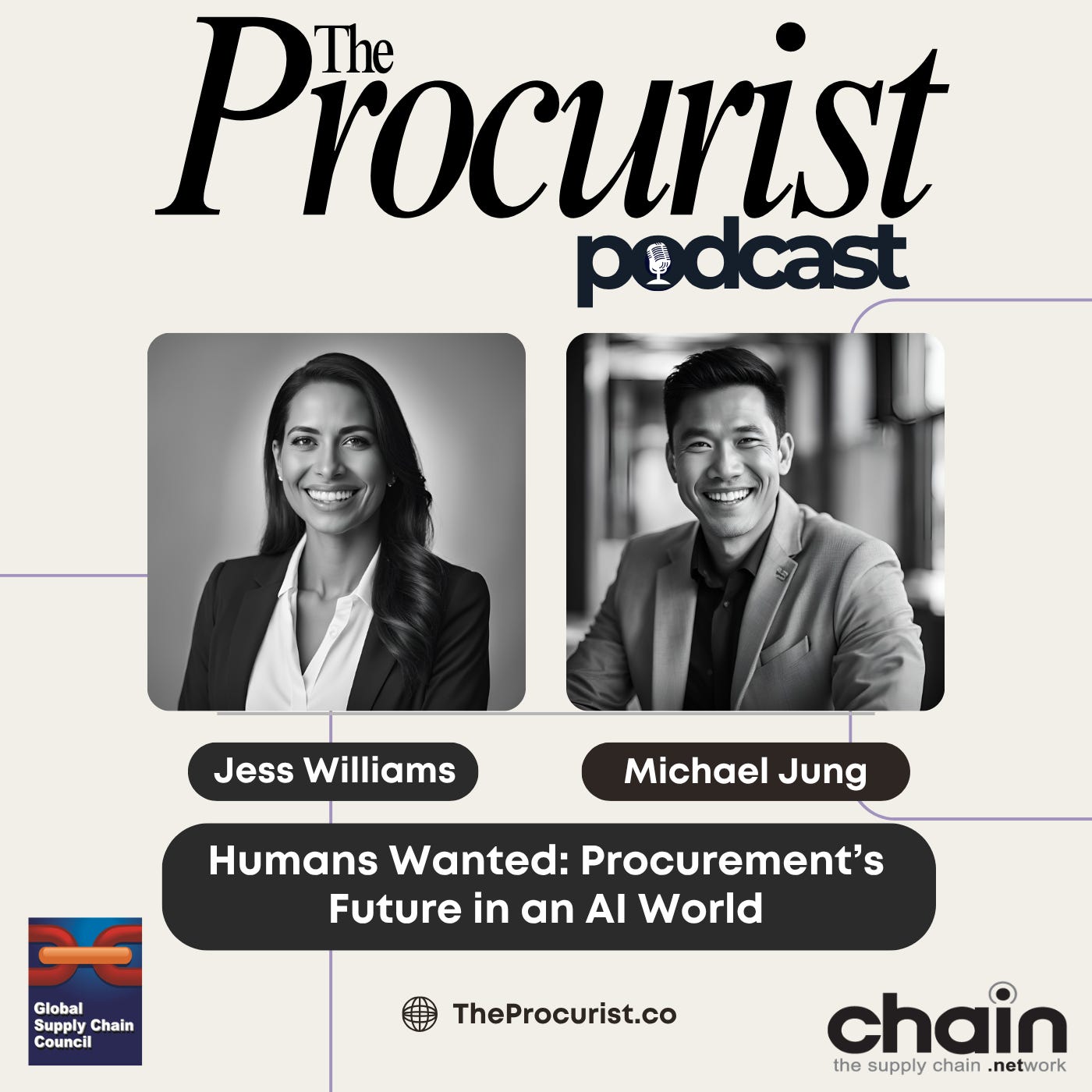
In this episode of The Procurist podcast , hosts Michael Jung and Jess Williams unpack the ProcureTech 2025/26 report and the eight collective insights identified by the judges. They explore how digital procurement is moving away from rigid, siloed systems toward connected, interoperable ecosystems. The discussion covers Category Convergence and the rise of orchestrated Source-to-Pay stacks, the emergence of hybrid operating models that balance global control with local agility, and the growing focus on human-centered procurement experiences. The episode also dives into how connected intelligence, modern contract lifecycle management, and practical AI use cases are finally translating data into real-world business value. Get full access to The Procurist at
Transcribed and scored by The B2B Podcast Index.
Welcome to the Procurus podcast. We are diving into some truly critical intelligence today, and it's coming straight from the sources contained within the ProcureTech 100 yearbook for 2025-26. That's right. And this is, you know, it's so much more than just a vendor list.
It's really a strategic map. A map showing the most pioneering digital solutions that are transforming procurement, not just here, but globally. For sure. And for you, the learner, our mission is to move through this quickly, but very thoroughly.
We're pulling out the definitive guide to these tech shifts. Focusing specifically on the eight core trends that leading practitioners and CPOs have identified. Yeah. The goal here is for you to walk away understanding not just what the new tech is, but why the whole strategic approach to procurement is being, well, completely redefined.
Okay, let's unpack this. I think we need to start by setting the scene, right? This intense pressure cooker that procurement is in right now. Why is this all happening with such urgency?
Because the function is genuinely at a crossroads. It's facing this perfect storm of compounding challenges. I mean, you can see it everywhere. You really can.
Think about it. Continuous geopolitical instability, supply chains that are just fracturing under economic nationalism, inflation pressure that won't quit. And of course, the rising strategic risks around cybersecurity. And organizations are being pushed to deliver more and more value.
Unprecedented value, yeah. But their internal resources are stretched so thin. Frankly, a lot of teams have just reached the absolute limit of what their current operating model and their human capacity can possibly handle. It sounds like that breaking point, the moment where doing more with less finally just snaps the system.
That's a great way to put it. There's just too much complexity, too many unknowns for human teams to manage on their own anymore. But I guess that turbulence creates an opportunity. Precisely.
It's created this intense appetite for change. The key realization among industry leaders is that, you know, small incremental adjustments aren't going to cut it. So the solution has to be something bigger. It has to be a fundamental systemic reimagining of procurement.
And that's being fueled overwhelmingly by advancements in digital tech and I think most pivotally artificial intelligence. And that right there, that brings us to the biggest, most impactful finding in this material, which is this massive shift toward agentic AI. Yes. We need to be really clear about what we mean here.
We're not just talking about chatbots or, you know, text generation, are we? Absolutely not. This is about agentic AI, which is very distinct from the more common generative AI. Generative AI creates content.
It writes summaries. agentic AI is designed to observe, plan, execute, and monitor complex, multi-step workflows all on its own. Autonomously. Autonomously.
It only intervenes when human judgment is truly required. The thoughtful application of both is leading procurement toward overseeing the autonomous execution of all those transactional workflows. That phrase, autonomous execution, is incredibly powerful. But let's challenge the scale of this for a second.
The material cites a McKinsey analysis. It claims this transition could result in a 20x increase in raw productivity potential. Yeah, 20 times. 20 times.
It's a huge number. I mean, what evidence suggests that's even achievable when you're dealing with these complex, often bespoke enterprise environments? Well, the potential really lies in the ability to just eliminate friction and latency across the entire source to pay process. Yeah.
The analysis suggests 20x is possible because, you know, agentic AI systems don't take coffee breaks. Right. They don't forget steps, and they can process these enormous data sets instantaneously. Just think of a low-complexity sourcing event.
An agent could get a request, check compliance, pull supplier data, generate an RFX from a template, manage the bids, do initial risk scoring. All without a human touching it. All without human intervention until you get to the final negotiation strategy So the system handles the sheer volume of that monotonous procedural stuff This means the human role isn eliminated It just it completely redefined Correct. The human worker transitions from, you know, doing the repetitive work to directing it, to coaching the system.
And what does that free them up to do? They can now focus almost exclusively on the high value activities, developing complex strategy, generating unique market insights, and strengthening those critical supplier relationships that require empathy and real negotiation. It shifts procurement's value proposition entirely. The report breaks this down into five core agent families.
Can you just quickly run us through those? Sure. They basically augment existing roles in strategy sourcing, contracting, purchasing, and compliance. Okay, so give me an example.
A strategy agent. A strategy agent would continuously monitor market shifts and internal demand and then automatically flag supply risks or maybe new category aggregation opportunities. Or a compliance agent would dynamically ensure every transaction adheres to policy and regulations in real time. So they're like these super-powered invisible assistants built right into the architecture.
That's a perfect description. But a shift, this profound, this move toward autonomy, it has to be facing some serious friction. What's the material flagging as the biggest hurdles? And look, the material is pretty blunt here.
The biggest obstacles are resistant mindsets and stagnant operating models. It's the people part. It's always the people part. Technology often moves faster than organizational readiness.
People resist change, especially when it means giving up control of processes they've managed for years. Plus, many organizations are focusing AI investment on the wrong problems. Like what? Like automating simple forms instead of redesigning entire strategic workflows.
And the warning in the report is stark. It says refusing to invest in these capabilities isn't just a missed opportunity, it's framed as an existential threat. It is. The competitive gap between organizations that adopt this technology thoughtfully and those who just cling to legacy processes, that gap is going to become insurmountable and very, very quickly.
Okay, and here's where it gets really interesting because that architectural shift brings us right into the core trends shaping the technology stack itself. Let's start with trend one, category convergence. This was one of the most dominant themes in the research. The traditional rigid walls between procurement, function sourcing, contracting, analytics, performance management, they were just rapidly dissolving.
We see that everywhere. A supplier management platform suddenly has robust contract functionality or a sourcing tool starts looking like an analytics engine. It creates a really complex environment for leaders trying to buy the right tech. Oh, absolutely.
So how does a leader avoid accidentally buying duplicate tools in their new composable stack? That is the core challenge. The market is evolving into these flexible, composable ecosystems. These are platforms designed to connect and integrate, not force you into a single proprietary world.
So you need a new framework for thinking about it. Exactly. Procurement needs a new, more sophisticated way to assess functionality. Look for a strong, flexible core platform and be able to plug in best of breed modules, even from competitors, without everything breaking.
And this leads directly into trend five, the rise of the connected S2P stack. The term S2P is, it seems, being reconstructed. We're moving away from those huge, monolithic, end-to-end suites. We are.
And historically, those S2P suites were often just a collection of acquired tools that were kind of bolted together. Yeah, with clunky interfaces and data silos all over the place. Right. Now, the emphasis is on connected, flexible ecosystems.
Even the established players are investing heavily in new, integrated architectures to compete. The goal isn't to force everything through one massive platform anymore. So what the strategic difference What the new philosophy The key strategic insight is that procurement control no longer comes from owning every step in a single platform Instead control flows from real visibility and deep seamless integration across the whole system So a shift from full ownership to full oversight.
That's it, exactly. From full ownership to full oversight. Procurement's role is to give the business the freedom to act quickly, while ensuring every dollar spent aligns with enterprise goals. That influence grows through transparency, not through siloed control.
OK, moving on to the intelligence aspect. Let's tackle trend two, creating real world value with AI. This is about being more thoughtful, right? Not just automating for the sake of it.
Exactly. Procurement's initial, sometimes indiscriminate desire to automate anything and everything has matured. The focus now is really pragmatic. AI has to augment humans to help them act faster and with higher accuracy.
And the report says the next wave of progress here will be defined by one thing. Interoperability. It's the mandate now. Why is that so critical beyond just convenience?
Because meaningful outcomes from AI rely entirely on its ability to connect seamlessly with all that existing legacy data and process infrastructure. No organization is going to rip out decades of systems overnight. Of course not. You need a hybrid model.
You must have a hybrid model where standardization and adaptability can coexist. AI is rapidly becoming embedded in the architecture. It's not just a feature you bolt on anymore. It's the engine running the whole system.
But that intelligent engine, it relies on one thing, clean fuel. And that brings us right to trend three. Connected intelligence that turns data into action. The role of analytics has totally expanded.
It's gone from simply providing access to data to providing interpretation. It's about knowing what matters most instantly within the right context. The focus has pivoted from speed-like automating data entry to substance. Substance meaning smarter decision making.
Smarter decision-making guided by contextualized intelligence in real time. Analytics is now a prerequisite for any strategic action. But every team I talk to faces the same major barrier when it comes to leveraging that data. Fragmentation.
And fragmentation is lethal to intelligent systems. You have all these fragmented systems storing information in inconsistent formats, and that just undermines accuracy and critically trust in the output. So the cost of preparing the data is huge. It's consuming enormous resources globally.
The successful organizations are treating data quality and governance not as IT problems, but as strategic priorities. They are the foundational layer for all reliable intelligence. Let's see how that intelligence impacts a specific function, like legal. Trend four, modern CLM, contract lifecycle management.
Right, which is going through a massive reset. The industry is moving away from those monolithic heavyweight CLM suites toward more modular ecosystems built for speed and flexibility. And AI does the heavy lifting now. It really does.
It can summarize key clauses, highlight deviations from standard policy, and surface critical risks across thousands of contracts in, you know, minutes. That speed is transformative. But in contracting, where precision and legal risk are everything, trust has to be the top priority. How do you stop people from relying too heavily on a black box?
This is where explainability becomes non-negotiable. The most advanced systems combine the automation with transparent insights. They show not only what a risk is, but how the AI reached that conclusion. Citing the specific clause or data point.
Exactly. So as automation handles this routine review, the professional's role changes. They have to balance confidence in that machine-generated insight with their own professional judgment and legal expertise. Trust built through explainability is just as important as the speed.
All right, moving into our final segment on operating models, trend six, human-centered procurement. This feels like a really fundamental philosophical shift in how technology is even designed. Absolutely We moving beyond systems built primarily for compliance and cost control which often means systems built for the auditor right Right not for the actual user Toward environments designed for collaboration insight and empowerment for the user Procurement is now focused so heavily on experience design, making tools intuitive for every single stakeholder.
If the system is hard to use, adoption fails. And compliance degrades. And compliance degrades. As simple as that.
That focus on user experience suggests a pretty significant shift in the skills required of procurement professionals themselves. It does. Professionals who once focused on just strict process enforcement are evolving into relationship managers. They broker strategic partnerships.
They surface value through data-driven dialogue. So less policing policy, more driving business outcomes. Exactly. The most forward-looking solutions blend intelligence with empathy to enable just that.
That professional shift feeds directly into Trend 7, the hybrid operating model. What does that structural shift actually look like for a global organization? It's about structural agility. It's balancing that centralized governance, which you need for compliance and scale, with local agility for specific business needs.
The model blends enterprise platforms, specialized niche tools, and even in-house innovation into one adaptive ecosystem. So the key strategic decision is no longer that old build versus buy debate. No, the material redefines it completely. It's now control versus composability.
Leading teams will often buy an orchestration platform to quickly green maturity and compliance, but they retain control of their integration and their data layers. And that requires a new kind of talent. The report calls them data translators. Yes.
Let's define that role. What does a data translator actually do? They are the bridge builders. They're the people who speak two languages.
The language of a specific business requirement, like finance, needing real-time spend classification, and the language of database architecture and system integration. So they make sure all the pieces are talking to each other effectively. They ensure all those connected pieces of the hybrid stack are communicating, interpreting insights correctly, and actually shaping decisions across the functions. Okay, finally, let's wrap with trend eight.
Orchestrated ecosystems. Integration is procurement's new key differentiator. It is, and orchestration is the framework for managing all that complexity. It's the living system that manages the flow of data and execution across that diverse hybrid stack we just talked about.
This sounds like technology decisions are no longer being made in a silo just for procurement's benefit. Exactly. They're now being made through an enterprise-wide lens, ensuring interoperability flows seamlessly across procurement, finance, supply chain, and risk. The architecture becomes this dynamic living system that accelerates performance across the whole organization.
Much greater than the sum of its parts. Far greater. So what does this massive transformation really mean for you, the learner, today? We've covered eight pretty complex trends.
I think the synthesis is clear. Procurement is moving toward autonomous execution with agentic AI. Connected ecosystems are replacing siloed tools. And the highest human value is shifting toward strategic direction and relationship building.
And I think the ultimate takeaway is that procurement's influence grows exponentially through transparency and the value it creates for the wider organization. not by holding on to silo control. So if the new benchmark is operational clarity and full oversight replaces full ownership, you have to ask yourself a question. What is the single most critical data asset that procurement leaders must secure governance over in the next 12 months to enable this new reality?
And the material has a point of view on this. It does. It suggests that supplier data, the foundation for managing risk, performance, sustainability, everything, that is the key strategic battleground. Securing that foundational data is the first step toward enabling the whole orchestrated ecosystem.
That's a powerful, provocative thought for you to consider as you direct your future strategy. Thank you for joining us for this analysis of the ProcureTech 100 sources. We hope you feel informed and ready to act. Stay curious, and we'll see you next time.
Other episodes covering the same guests and topics, from across The B2B Podcast Index.
 Radiology Can't Keep Up. Here's Where AI Actually Helps | Dr. Nina KottlerRethink Imaging · on Agentic AI96 / 100
 Can responsible AI beat hallucinations?The ITPro Podcast · on Agentic AI95 / 100
 How People Intelligence Is Helping Shape Cisco’s AI Workforce TransformationDigital HR Leaders with David Green · on Agentic AI92 / 100
 Agentic AI in the Commercial Workflow with Johnson Controls CDIO Vijay SankaranEnterprise AI Innovators · on Agentic AI88 / 100
 Turning AI Agents Into Revenue Workflows With OutreachTech Talks Daily · on Agentic AI83 / 100
 Unscripted with Victor: Agentic AI, Fintech's Future, and the Death of the App EconomyVentures from The Valley · on Agentic AI83 / 100
 Humans Wanted: Procurement’s Future in an AI World
 Beyond Automation: Building the AI-Ready Procurement Team
 Rethinking Global Sourcing
 Digital Masters vs. the Rest: What the 2025 CPO Survey Reveals
 The Procurement Revolution