The Data Masterclass Podcast · 2026-06-22 · 59 min
Key moments - from our scoring
Substance score
54 / 100
Five dimensions, 20 points each
Karthik Ravindran brings 27 years at Microsoft, with 15 focused on data and analytics, to discuss how organizations can move beyond polarized AI narratives to create genuine competitive advantage. He argues that while AI is powerful, the real differentiation comes from combining probabilistic AI capabilities with deterministic human judgment, context, and accountability. The conversation explores three foundational elements: data (your AI is only as good as your data), context (it can only be as great as your context), and trust (it can only scale as much as afforded by trust). Ravindran emphasizes that practitioners across all disciplines - product managers, engineers, designers, data stewards - should focus on how AI eliminates dull, repetitive work while serving as a thought partner in high-value, differentiated activities. The discussion addresses real implementation challenges like hallucinations, context loss in long documents, and the need for precise prompting, using examples from Microsoft Purview data governance and practical AI tools like Lovable. Valuable for data leaders, product managers, and technologists deciding how to operationalize AI without displacing human expertise.
Karthik advocates a 'human plus AI' model where AI amplifies human work by automating dull, repetitive tasks while serving as a thought partner on high-value, differentiated work. The key is ensuring humans retain control over context, judgment, and accountability - the truly human elements - rather than trying to automate those away.
Hallucinations often result from applying probabilistic AI to deterministic business problems where clear rules and definitions should be explicitly provided. Organizations should clearly define business context, goals, and rules upfront rather than letting AI discover them, reducing unnecessary token usage and hallucination risk.
Karthik frames it as three layers: AI is only as good as your data, as great as your context (business definitions and rules), and scales only as much as your trust (governance, human controls, and accountability mechanisms). All three are required; data alone is insufficient.
Practitioners should continuously 'raise the ceiling' of their own differentiation by shifting focus to higher-value work once AI handles routine tasks - product managers move from specs to functional prototypes, engineers from writing code to systems architecture, data stewards from manual curation to defining business context for AI-assisted processes.
Natural language precision is critical; the more specific and clear you are in prompts and context definitions, the better the outputs and the less token waste. Beyond that, practitioners need judgment to evaluate AI results critically (catching hallucinations) and the ability to encode learnings into reusable skills and context for repeated use.
Our reviewer’s read on each dimension, with quotes from the episode.
There are a handful of genuinely interesting framings - data+context+trust as a layered AI readiness model, the deterministic vs. probabilistic distinction for context design, and contextual data quality nuance (balance sheet vs. forecast accuracy) - but they are heavily diluted by 1+1>3 platitudes, 'embrace the tech' exhortations, and long passages of mutual agreement that add no new information.
your AI can only be as good as your data, but it can only be as great as your context. So good to great. Then the third dimension is it can only truly scale as much as afforded by your trust
Revenue accuracy is not a binary 0 or 1. If your revenue is reported on a balance sheet that's being shared with the street, guess what, it better be 100% complete and accurate. But if your revenue is instead in a forecasting model... It can be directionally accurate to like the 90th percentile
The 'linguist, economist, judge, artist' persona-archetype reframe for the AI era is genuinely fresh, and 'tokenomics' and 'token billionaires vs. non-token billionaires' as practitioner concerns is an underrepresented angle; however, the dominant narrative - AI augments rather than replaces, humans must embrace change - is the most recycled take in enterprise AI discourse.
I think increasingly we need to look at it through the lens of being linguists, uh, artists
We are all going to have to become economists because guess what? AI is not cheap. Tokens are not cheap.
Karthik Ravindran has 27 years at Microsoft including hands-on data governance product work (Purview), data team leadership, and now worldwide go-to-market accountability for data and AI - a practitioner with genuine scar tissue, though his current role is vendor-side GTM rather than an operator building systems inside a customer organisation.
Been at the company for 27 years. The last 15 years have all been focused on the data analytics... built and ran data teams in the company, both in product units as well as our internal data office, went on to do product management and engineering for Microsoft Purview data governance
you can genuinely turn the tech loose on a physical data estate. Feed it some context in terms of your business glossary and definitions and literally have it come back with, I would say that, I say a 70, 30, 80, 20, well curated set of baseline catalog, uh, assets
Two named data quality vendors (Telmai, Cluden), a concrete revenue-accuracy example with percentile thresholds, and a reference to the Foundation Capital context-graph paper (Jaya Gupta) are bright spots, but no customer case studies, no ROI figures, no deployment timelines, and no hard performance benchmarks appear - most claims stay at principle level.
I'm not sure if you looked at Telmi, T E L M A I and then there's also Cluden and then there's a uh, bunch of other products that are coming to the market
the context graph, a concept that was uh, initially surfaced by Foundation Capital and Jaya Gupta
The host brings relevant practitioner experience and occasionally surfaces useful topics (SQL evolution, persona archetypes, pace anxiety), but questions are consistently vague or compound, there is no pushback on any claim, and large portions of air time are taken by the host's own monologues that crowd out follow-up probing.
What's your take right now for what's going on in Data and AI
So where these unique slides from your perspective
Computed from the transcript - who did the talking, and the words that came up most.
In this engaging interview, Karthik Ravindran, a Microsoft veteran leading data and AI platforms, shares insights on navigating the AI revolution, the human-AI collaboration, and the evolving data landscape. Discover how to embrace AI's potential while managing trust, context, and data quality in a rapidly changing world. WATCH ON YOUTUBE:
Transcribed and scored by The B2B Podcast Index.
Speaker A: Welcome to the Data Masterclass podcast where data leaders share their unique stories in this episode today we talked with Karthik Ravindran, who is general manager Data and AI Go to Market Lead at Microsoft on the topic AI in the A Practical Human plus AI Operating Model. Let's welcome your host, Alexis Plotnikovsky.
Speaker B: Good morning. Good afternoon. So it's a new podcast episode of A Day to Masterclass and look, we have a very interesting guest today. I'm not always telling that this is so interesting, but I'm really excited and I couldn't imagine probably five years ago that we will be in the same podcast virtual room. Um, but so Karthik, welcome to the podcast and I let you introduce yourself.
Speaker A: Thank you so much, Alexei, for having me on your podcast. Such a pleasure to be here. And yes, I mean, five years ago we were working together on the same data challenges at Microsoft and now here we are talking about all of our learnings and experiences. Super jazzed to be here. So, hey folks, my name is Karthik. Uh, I work at Microsoft and I currently lead the worldwide go to market for data and AI platforms. Been at the company for 27 years. The last 15 years have all been focused on the data analytics. And now like all of us, the AI space have built and ran data teams in the company, both in product units as well as our internal data office, went on to do product management and engineering for Microsoft Purview data governance. And now in my current role, get to work with customers across the globe, helping them navigate the data journeys as well as shaping Microsoft's go to market strategy for data and AI platforms. So incredibly excited to be here. Have a ton of respect for Alexei as a practitioner and as a very, very seasoned, uh, knowledgeable data expert. So this conversation today is going to be very fascinating and hopefully it, it, it surfaces some good experiences and learnings that you can benefit from as well. Super excited to be here.
Speaker B: Absolutely. I also Looking forward. So Karthik, you are in a very interesting position. Let's say I am. The second time I'm using the word very interesting in this podcast, but it's truly hard to describe. So you're on the um, very edge of delivery. So, so technology company with a lot of data and AI offerings right now. Hard focus on AI and you are exactly on that edge with all the customers. M telling you what to think about AI and what they think about the company direction and so on. How hard is this? You know, what's your take right now for what's going on in Data and AI.
Speaker A: Yeah, no, that's a great way to kick this off. So, yes, I think if I had to summarize it, I would say right now we are navigating the face of information overload and I'm speaking purely from the customer lens and perspective. Right. Usually the conversations start with, hey, this tech seems really powerful, but we're still trying to figure out what to do with it. And the duck track around the tech is very polarizing. On one extreme, you've got like the extreme amount of excitement for just the technology and its potential to benefit organizations. Then on the other spectrum, you've got the growing, I would say the fear narrative for what this implies for people, for humans, for the future of jobs and various industries and functions. Uh, what is the right way to think about this? How do we balance these two extremes? Generally, when you've got situations with two extremes like this, the truth is always somewhere in the middle. I'm firmly a believer and a proponent of the school of thought that it will be a human plus AI 1 plus 1 greater than 3 equation that will help the truly transformative organizations differentiate with the technology and lead the markets. The narrative in industry today is very heavily skewed towards the tech and oftentimes even dangerously towards the tech trying to displace jobs and human roles in the future. But, uh, I think the reality here is a very simple fundamental we have to understand is the tech is the tech. Like every other tech evolution that's happened so far, it's the applied use of the tech that's going to drive the truly impactful innovation. The tech can do for company A what it can also do for company B. What is truly going to differentiate is the context, the judgment, and the facets that need to complement the tech, many of which are anchored in the human ingenuity and experiences. So to me, I think the need of the hour is to create clarity on how these two facets can truly come together and complement in creating a greater whole as opposed to negating and canceling each other out. So my guidance to general practitioners is you can't resist the tech. You got to embrace the tech. And it's not about you resisting or being resilient to the tech. It's about figuring out how do you work together with a tech to do great things together. Right? And, uh, from a technology perspective and technology leaders, I think it's very important for us to keep focus on that key message and not come across as, uh, hey, the tech is here to replace people in jobs, right? That's not what it's here to do. It's here to amplify people and bring the best out of people. So I think I would leave that as the overarch for everything else that we talk about.
Speaker B: No, I totally agree. I think this time we have on one side of course, much faster capability to do something. So this ability to build, the ability to see the results of your work has never been faster. And I think this is the opportunity which many, I wouldn't say they neglect, but they maybe they don't see it so striking. It clear, right, that you can really go much faster on the main things and you can make it not just faster, you make it sensible. You can build the experiences in the company which would take years before. Right. Or would be a lot of hard discussions about prioritization, about how to get the engineering resources and so on. I mean, I'm remembering even our own time at Microsoft. Right. So engineering resources are always scarce, even in such a tech company. And so ability today to move when you see there is a need or there is a great business opportunity or there is something you can build really for the users to um, benefit. I think this is something super underestimated for people even in the tech roles today.
Speaker A: 100%. And I think you're spot on in your observation that not only can it scale technology practitioners, I think the tech used well can pretty much scale a practitioner in any craft and discipline in terms of really being able to eliminate what you could broadly categorize as being the dull, the daunting and the repetitive aspects of everyone's day to day jobs. To help the practitioners focus more on what is truly their unique differentiation and the value that they can further amplify and bring to the table. And it's very, very important for every craftsperson to look at it through that lens. The lens of like, hey, like even you and me, Alexey, like for instance, if you looked at our day to day, there's probably a set of things that we love doing that we get a lot of energy from that we wish we had the time of the day to go do more of. And there's a bunch of things that we would probably categorize into tax paying or things that are just repetitive and boring. I think there's a genuine opportunity to apply this incredible innovation that's happening in the AI space to help us rethink, hey, if you could leverage this to its fullest, can we shift an equation that's highly favorable towards doing more of what does our unique differentiation and Value prop. And how do we apply this tech to not just automate the dull and the boring, but also to function as a thought partner or co founder in the facets that are unique to us and that differentiate us. So some very specific examples like product managers not needing to rely on an engineer to build that first proof of concept and show what their vision or idea is, being able to shift from writing specs and BRDs to living, I would say working functional prototypes of their vision to make it more real, actionable engineers being able to elevate themselves from having to write every line of code to now being more systems thinkers, to being architects of end to end systems designers being able to really think about the experience that they wish to deliver for their customers and leverage the tech to compose and bring together various permutations of design options for them to experiment with as opposed to needing to get on the the brass tacks of creating each of those options. The list goes on and on and on, right? It doesn't matter what the discipline, what the function, what the craft is. If you really look at this tech and look at it through two lenses, how can it automate the borrowing and how can it serve as my thought partner and co founder in the things that truly are? My differentiation combined with the very unique human context, judgment, foresight, as well as most importantly accountability, because that is something which is human and cannot be replaced, can lead to significantly greater outcomes than anything we've seen in the past. But it is incumbent on every person in every role, in every function to think about it through those dimensions and to not be resistant, to not try to develop resiliency, but to instead embrace and amplify together with the technology.
Speaker B: Love it. One thing which I have picked up from what you just said several times, you've said unique, right? Unique context, unique opportunity, unique value proposition. So where these unique slides from your perspective because we kind of talked about data is everything in AI a couple of years back, then it's migrated to the statement which says context effect, everything is in AI. So kind of moving, like what is this thing which helps us with AI capabilities to differentiate and I heard you say it also about the human filter and that human element which also shapes what's exactly this competitive advantage would be in every way scenarios for AI. But how do you shape it? This proportion of data versus the human element which eventually comes together, it makes this a very strong AI proposition.
Speaker A: Now that's a great topic for us to dive into. So I think like me, you've also probably been unpacking this entire conversation that is shaping in the community around the context layer, right? Everyone is talking about the context layer. It gets referenced in different terms. Context graphs, context layers, semantic layers, you name it. I think it's such a critical topic to zone and on because it also will by nature of unpacking this, bring to surface the very practical applied facets of the human dimension. And while anchored on something that is very critical there to get in place to make sure your AI is successful. So I used to have a tagline which I think several folks also, uh, believe in, which is your AI can only be as good as your data. And I've since evolved that to add in a couple of more dimensions. One dimension that I've layered onto it is your AI for sure, yes, is only as good as your data, but it can only be as great as your context. So good to great. Then the third dimension is it can only truly scale as much as afforded by your trust. So there's data plus context plus trust that is needed to truly unlock this locomotive, right? Because data by itself doesn't shield you from risks like AI hallucinations that could kick into gear. When AI, uh, tries to interpret and understand your context where a lot of that context is actually deterministic. A very fundamental thing for people to think about is the technology at its core is probabilistic. There are things that are just plain deterministic. Trying to apply probabilistic to deterministic can be over engineering, can result in hallucinations, can result in a ton of other risks that you want to be thoughtful about versus when you consciously unpack the system you have, or the solution you're trying to build, or the future you're trying to create. And look at it through the lens of deterministic and probabilistic, you'll start getting to a better balance point of how to make the two work together. And a lot of the deterministic facets requires what is very uniquely human judgment, understanding of context of an organization based on years of evolved experience, the foresight, being able to stitch the past and the future desires of the business to carve a path towards it, and most importantly, accountability when things go wrong. M someone has to take point. The entity that's going to take point when things go wrong with the accountability to establish the trust with customers, partners, stakeholders, is always going to be human. It's not going to be about. So when you bring these two dimensions together, I think the uh, the opportunity for the human in the loop workflows and experiences to Shape the context through a mix of probabilistic AI to help unpack what might exist, combined with deterministic foresight and judgment to define what should be operationalized going forward, compounded with trust and accountability, where there's got to be control mechanisms to make sure that there's governance and there's great fallback mechanisms as well as skill switch mechanisms and other practices to ensure that when the tech may go off the guardrails, like how to rope it back in with the right uh, human elements all brought together with this human plus AI scaling is I think one of the greatest opportunities we have ahead of us. But a lot of the conversation today is so focused on the tech and it doesn't get into these other dimensions, right? Where like even the context layer discussion that we talked about, it's like, oh my God, it's like there's an entire talk truck out there about, oh, you don't need to do anything, just turn AI loose and AI will go figure out your context. And I'm like, really? It's like it can help you harvest what you might have, but uh, really want to be spending like an innate number of tokens and then taking on a whole bunch of hallucination risks to literally instead shape what is just a deterministic definition of your business, your goals, and provide it to your AI so that your AI can get to work on what it can truly help you do, which is create new value aligned with your business context as opposed to trying to discover it every spin of the wheel. Right. So I think uh, some of these facets are very interesting ones for uh, practitioners to think deeply about and also use as an energizing, I would say, uplift into how their individual roles can evolve to helping shape that context and infuse that trust and accountability together with AI to create the best experiences.
Speaker B: Yeah, I agree. And I also see that this trust element, it becomes so, so important. Right? It's not only through, you know, the things which we get through the help of AI. And even like if you put it in a daily operational context we do today also on the Data Master class side, we do a lot of operationalization, a lot of daily work with AI. And uh, just today, you know, early in the day I, uh, was reflecting on myself. You know, I've started the day with some GPT work where I had to translate the documents and this was a 30 page document, I had to translate it and I was hit by unbelievable difficulty to do it with GPT Pro Edition. You know, it said it cannot translate, you know, 30 pages at once. It starts to split it and then start to lose the context, uh, of what it's translated already or not. Then surprisingly, it starts to hallucinate. So it starts to add stuff to a translation which was never in the original document. And in these further pages, four times, it's lost the original document. So it's asking me to kind of can you upload once again the original document? Because I don't see it anymore, right? And I was like, hey, this is the capability which we're supposed to trust in a simple daily tasks. You know, I'm not doing anything complex. I'm not translating, you know, the whole library. I'm translating a 30 page document for one language to an hour. And then, you know, you know, then in just, uh, half an hour later, I had to do some prototyping and I turned to lovable. And lovable was like, in 15 minutes, he built me and visualized everything with such a great accuracy, such a great pickup, you know, what, like, what needs to be done there? And I was sitting in like, okay, so your day in technology depends. Where do you start, right? So if you have this uplifting experience, you go very up with like, hey, technology can do a lot. If you used to get like, I've started today, then it's very daunting. And you have like, hey, we have to think so much about false controls, false trust levers, you know, like, how do we even, you know, get this a little bit more autonomous so that you trust that the work will be completed. Every person in this translation role would never make any kind of mistakes. I saw today by the AI, 100%.
Speaker A: No. I mean, that's a great example of where you literally, in a span of a few hours, experienced the two extremes. One where it's like, wow, it's a great output to start, but, man, if I don't pay attention to the details, you know, I could be sending misinformation, you know, to my clients, my partners, or whoever you're serving. And then on the other extreme, it's like, wow, if I had to sit and do this thing from scratch, it would have just taken me like forever. And look at what I just got bootstrapped, right? Literally with a prompt. So I think it comes down to a few fundamentals, right? It goes back to the context, judgment, trust, and then being able to express each of these dimensions through the expression of natural language. We believe that a huge skill that practitioners, no matter whether technical or non technical, need to really, really focus on harnessing is the ability to express their desires and contexts and needs in natural language. And what I personally found, my practice of AI is the more precise you are, the more clear you are, the greater the outputs. Right. And I do realize that there is a complementary, uh, doctor act that is shaping, which is the models are getting so sophisticated where you don't have to precise and be very, I would say, like, specific about what you want. And there's always a complimentary dimension to that as well, because the less specific you are, you know, the more tokens, the more loops, the more decision and planning iterations, uh, as opposed to, uh, you know, I mean, the less specific you are, the more of all of that. And then the more specific you are, you know, the greater the optimization and probably even the quality of the outputs that you get. And that is an art and science balance that we're going to see increasingly play out. Right. And uh, I've had similar experiences as well, you know, like for instance, analyzing market reports, like doing synthesis by looking at a bunch of different artifacts that are trying to unpack a topic to get a gist. And oftentimes on surface that just looks incredibly attractive. Right. And then when you get into the fine grained details of uh, dissection, as you just did in your experiment, you know, you do find things that are off and, but it does take a couple of spins of the wheel. And then when I go back to the drawing board and look at like what caused it to create something which wasn't like perfect perfect. Well, there's nothing such as perfect in probabilistic tech. What can you do to make that even more higher? Accuracy, quality, completeness. And almost always it comes down to, I think, being more precise in your inputs, all the prompts. And what is really interesting these days is how the technology has also evolved to be able to evolve that in a nitrated fashion. Right. So what used to be prompt engineering became context engineering. Context engineering is today, uh, complemented with skill building and skill engineering. And some of the advances where being able to literally transcribe or record a series of prompts and interactions and then convert them into a replayable skill which can then in the next iteration, save you some of the upfront time and get you faster at your outputs is a great opportunity to leverage though this becomes a very interesting quality challenge and opportunity for us as human practitioners, which is even that human value that we keep bringing in. We got to realize that there are mechanisms where you can continue to iteratively give the AI the intel that it needs to even take on what might be heavy human lift up front and get that to become more scalable through mechanisms like AI skills for instance.
Speaker B: Mhm.
Speaker A: That's a constant virtuous loop. Right. We constantly have to keep up leveling and raising the ceiling in terms of letting go of control to the AI when we feel that we are at a good place where the context that it needs and its ability to repeat that at scale is at a good place. But to do that we have to be willing to share that context and convert it into constructs like skills, for instance. And then also knowing that AI is going to start doing that increasingly, which means we have to keep upping the ante and the ceiling in terms of what is that next level of unique differentiation that we can bring and how do we keep it waiting on it. So it's uh, it's an ongoing process. A great example. You're a data governance practitioner. I've been a data governance practitioner. I'm sure you remember our holy grail days of trying to curate a data catalog. Trying to curate a data catalog. Used to have armies of data stewards trying to figure out how to go do that. But now with all the advances in the AI tech, you can genuinely turn the tech loose on a physical data estate. Feed it some context in terms of your business glossary and definitions and literally have it come back with, I would say that, I say a 70, 30, 80, 20, well curated set of baseline catalog, uh, assets. Right. And in the past that would take us like months and years to go into versus now. The opportunities you have to figure that out is amazing. Is it going to get it right always? No. But every spin of the wheel where it may not get it right, if you have the human in the loop to enforce a signal that helps it get it right the next time, then you're doing a couple of things. You're going to get more efficient in terms of the speed at which you can queue it a catalog. But you're also going to then further diminish and reduce like what used to be your, you make your value, which means now you've got to shift your focus to what's next. Right. So I think some of these things are just the dynamics of the world we are living in. Right. It's a constant raise the ceiling. And my advice to a lot of practitioners is take control and be in charge of that ceiling racing. Don't let it get raised for you by someone else or by something else. It's like the more you can just get Comfortable with the fact that the ceiling is constantly going to keep raising. You got to raise AI ceiling and AI is going to raise your ceiling. It's a yin yang effect, right?
Speaker B: Yeah, I like it actually. I really like it. And you know the thing which I also saw you took a data governance as example and I looked on the data management. So the discipline which I grew up and I spend a lot of time also at Microsoft doing this data management and improvements in the data quality for the structured data. Huh. Nowadays we see like, okay, you can simply run quite quickly some fixes, what would take us long time, 10 years back to really improve the data quality like today. If you embrace it truly with AI, you can do it much faster. And it feels like, okay, there is no future for data management in that sense. And then you come to the context and then you capture a lot of context and then you capture the data which is now created by AI. So it's uh, artificial data, but it complements the original data. So this aspect of data management kind of almost turns back and comes back and says like, okay, so you really got advantage on how you manage structured data. But now you have a lot of things in the context to manage, which also constantly evolving. Right. It's not like a one thing, but its goals. With the more AI we use, the more you have that context to manage and to reapply and so on. And so that AI generated data and then I saw this agentic mesh, you heard this term for sure. So it used to be a data mesh. Now when you think about how you put agents into this um, constructor, you have to federate this work, you have to let it go, you have to get domains and the business to build something on their own. But you need still to govern this together and get access to the right enterprise capabilities and channel them in the right way and so on. So long story short, what's your take on this evolution truly on a data level? Right. So we see things are evolving, the professions are evolving. What is what you see for data coming in, this, coming in the years. So how that whole thing around the data. Roche?
Speaker A: Yeah, absolutely. Uh, let's unpack that. So let's start with the primitives. I think the primitives are what we talked about. The primitives are going to be context, it's going to be the role of the human in shaping the context and it's going to be application of the tech to scale what can be scaled by AI. Ah, way better than humans can scale on their own. Right. So some of these are like the primitive building blocks. And of course the primitive beneath all of this is data as we first started. Now to get to your great probe, I would taxonomize it as the following. I think we got to look at it through the lens of people who are accountable for managing data, operating data, and folks who are going to be accountable for consuming and applying data. That line will also start to blur in my opinion because now with AI making the entire end to end something that can be steered through natural language and the deep domain knowledge that exists in the practitioners who consume and apply the data. In being able to provide that context, I think uh, you're going to start seeing a little bit of like the crossover starting to happen, right, where the consumers and the practitioners applying the data could also become effective data management experts. And the data management folks will have to then raise the bar to the more nuanced facets of data. Like you mentioned, data quality, that's a great one. Mass data management and other research facets which are going to be crucial for the consumers to be able to focus on doing what they should be doing best, which is applying the data. So now if you bring the primitives together with a ah, lens of these two, I would say broad user basis, the practitioners need to embrace the fact that they're going to have to do less of what they needed to do prior manually. And that is not a bad thing. That should not be looked at as a risk to their roles or to their jobs. Right. Instead it should be looked at as an impetus, as an accelerator of them being able to truly distill out the repetitive today from what was the true value that they were adding and how they could focus more on the value creation versus doing the repetitive tasks. So if you took a data quality practitioner as an example, um, like you and I recall the days when we used to have stewards sitting and manually coding and authoring data quality rules. And you're spot on right in saying that gone are those days. Today you've got solutions and there's one that I'll talk about, right, which is, I'm not sure if you looked at Telmi, T E L M A I and then there's also Cluden and then there's a uh, bunch of other products that are coming to the market. It's incredibly impressive. It's like you don't have to set up a single data quality rule. You snap these things onto your data estate and you go from 0 to 16 no time AI, native AI powered experiences where you pretty much get an assessment of your data estate. You get a bunch of optics into the health of your data estate and uh, some, I would say, like assumed, uh, perspectives on what the quality might be based on what the models being used underneath are trained upon. But to your point, the context finesse is so crucial, right? If you took a simple example, let's take revenue. What's revenue accuracy? Revenue accuracy is not a binary 0 or 1. If your revenue is reported on a balance sheet that's being shared with the street, guess what, it better be 100% complete and accurate. But if your revenue is instead in a forecasting model, we are trying to make a projection and uh, a directional forecast. It does not have to be 100% accurate and complete. It can be directionally accurate to like the 90th percentile for example. But your AI is not going to have the context in terms of what's the use case where you're using that particular metric or that particular data. There is going to be an element of human context that is needed to be layered in and broadened to help that AI really disambiguate the nuances of the applied use cases and then to contextualize data quality for each of those use cases. So if you took data quality, there's one size fit all data quality, and then there's contextual data quality based on use cases and Personas. That context is going to very much come from the practitioners. Now can the practitioner seek that and train the AI to pick up more and more of that down the line?
Speaker B: For sure.
Speaker A: But that's going to be a constantly iterative process in the world of rapid innovation and new value creation. Right? So that's one example of a very classic craft as DQM is being redefined, reimagined, you know, where the tech scales for the human complements and together it takes it to a whole different spectrum and level. Similarly, on the data consumption edge, right? It's less about the data consumers needing to go and author their own reports and build their own dashboards. This is the day of talk to your data. It's the day of. It's the age of being able to provide context to your agents so that your agents can, uh, interpret your business, can interpret your workflows, and with your provided context can start taking on more of the automation of tasks that previously required your engagement. It's more you shifting from needing to steer every knob to now being pulled into the loop when your judgment and your trust is truly needed to help unblock a decision or to help progress a workflow to its next step and then spatting up and opening up more time for you to think about what are the more next set of innovative things you can do for the purpose you're serving. Whether it's making our customers more successful, whether it is like working better together with your partners, whether it is like making your employees more proactive. There's always a ceiling to be busted in terms of where the next level of experience can go. But that rapid pace of, I would say iterative co founding, thought partnering, rapid co building together with this technology is something that I think it's a massive change management and many organizations underestimate how much needs to go into that change management. You can call it evolution management, change management, depending on the preferred term. But if organizations and leaders are not intentional about that uh, curve shift and needing to do that by bringing the humans and the tech together, always joined at the hip, I think they'll be missing out on some great dauntable innovation opportunities and ensuring that those opportunities can sustain and survive in time versus just being 15 minutes of fame prototypes, uh, all the difference lies in being able to make the magic equation work even plus AI 1 plus 1 3.
Speaker B: Now that's true. I mean we've seen this also here right now in Europe, the companies which really pioneered that space. Let's take even the example you've mentioned, talk to data and to launch this you really need to establish some base understanding of the company, KPIs, of the context and so on. You will need analysts for this. You will need the people who know how to the data is being consumed and reported today. And you know, we saw this evolution where people in analytics, they got involved into this work and they provide those initial golden paths, they help to shape the agents. And then there was this logical question, but what do I do now? Right? So I almost kind of uh, translate, translated and um, transmitted m my knowledge, you know, to the uh, agents. Now you know, this agent could actually serve as this talk to data capability in place where before we were building the dashboard, so we're doing something else, right? So that's on the one side of this. And then you know, you see that people taking this next selling as you say, right? They move more on our front line. You know, the companies start to deploy the fast things on the market. You know, you need still analysis of how these products perform. Is it making a change? You know, how can you get, you know, the signals which are important for you know, the profit margins and so on. And these are the things which are not today in that standard kind of uh, pre analyzed, pre processed in our dashboard space. So you really need to have a people who has absolute knowledge about the company and the context, you know, to move forward with this. And then people move into the roles and they said oh wow, amazing. Actually I can do so much, you know, which I would otherwise spend some so time on this uh, current, you know, continuous creation. Then my question was, which I will readdress now to you, I said like isn't that a lovely experience at the end? And they say no, but why no? He was doing a very ordinary job for years. Now you moved up, you see the uplifts you on age. You say I don't like the pace.
Speaker A: Mhm. Yeah.
Speaker B: So what's your, what's your advisory on this? I mean like we started with similar, you know that people are overloaded today and they feel that there is a pace which they can kind of difficult to keep on. So how do you manage this as a people with always extreme productivity help and you know, reposition and you know, doing this fantastic work which we otherwise would be, you know, borrowed in regular uh, work. But the pace.
Speaker A: Now look, I think this is a great topic, right? And I think the way I like to navigate this is to talk about Persona archetypes. Like we have lived through the ages, you and me, other practitioners like us, through the ages where the Persona archetypes used to be. Let's just take the data profession for a moment. Data science scientists, data analysts, data engineers, DBAs, so on and so forth. And you can have a similar taxonomy for almost any profession, technical or non technical. I personally think the world of AI is going to require us to think about personal archetypes and our roles and the context slightly differently. I think increasingly we need to look at it through the lens of being linguists, uh, artists,
Speaker B: judges, agree, and so
Speaker A: on and so forth. There's a whole new Persona taxonomy that we have to think about. No matter what your profession, no matter what your core function is linguists, because your ability to express with natural language the task you're trying to accomplish, the unique context that governs your business, the organization you're serving, your purpose, that is an art. The more precise you get at that, the greater you're going to become at that.
Speaker B: Uh-huh.
Speaker A: The next most important thing is actually one that I did not mention in my initial list, which is economist. We are all going to have to become economists because guess what? AI is not cheap. Tokens are not cheap. There's an entire talk tracking industry around this notion of token billionaires versus non token billionaires. I work for a high tech company. There are others who work for high tech companies. And we don't feel the pinch as much because at the end of the day we've got a sleuth of tokens for us to apply in our day to day. But that's not the same case with every single company on the planet. You got to be token, token aware, you got to be token conscious. And you have to really wear that lens of looking at it through the economics, where the economics also has to include this growing concept of tokenomics, where you have to be very, very astute about like, am I using my tokens in the most productive and cost effective way possible? And then you're going to start deciphering the delineation between deterministic versus probabilistic context, the benefit of having an intentional context layer versus not what's the role of the human to shape all of that? And this is where also varying the lens of the economist is going to become incredibly crucial judges. Right? You're absolutely going to have a huge role to bring your judgment, your experiences, your foresight, the fundamental notion of trust, always being human, anchored to make sure you're making the right decisions, the right choices in terms of the AI powered experiences all the way through to the economical impact of those investments on your organization's balance sheet. Right. So these are critical, critical, I would say Persona archetypes. And there's more. Right. But I just gave you some of the top lines that every person, no matter what function, no matter what role in, has to look at and energize for. It doesn't mean it takes them away from being the craftsperson or the uh, the artist that they were in their core craft. But there's a big difference between being just a technical craftsperson versus being an artist. Like a software engineer, writes code, awesome code, is a great craftsperson. When that person now starts practicing systems thinking and starts elevating to letting go of some of that what used to be previously just manual coding to now instead shift focus to stitch systems to bring together the system's point of view end to end, to bake trust in as a foundation versus an afterthought and to address a lot of the fundamentals and being able to truly architect a compelling system together with AI. That's from just being a craftsperson to actually now becoming an artist who can take a canvas, a very vast canvas, and to give it the color and the shape that it needs for it. To really shine end to end. So these fundamental lay person archetypes are going to, in my mind, be the substantial differentiation in terms of how the craftspeople today can truly own their own trajectories, to evolve into the future, shape their future. But to do that, they're also going to have to embrace those notions. You have to get really comfortable being called an artist versus just uh, a software engineer. You've got to be really comfortable being looked at someone who is, oh, you're an economist, dude. You're actually talking a lot about economics versus just the core tech and then from the operations. And that's a good shift. So I think when you bring these two worlds together, there's a great opportunity for every technical craftsperson, function professional to really reimagine what their future could look like and then to own their own and the pen on writing the narrative. I really hope that people start seeing that as a positive and start energizing for it, you know, as opposed to being threatened by it.
Speaker B: Yeah, I agree. I think, you know, there are of course some um, additional dimensions we can think of. You know, I heard this example like if you um, if you look how we work with information. Yeah. Then librarian is a kind of future of work. Because as a librarian in the classical state, you are able to correlate so many different things which you have today. Different information sources, different trust level and so on. We keep it all in our head as librarian professionals, let's say, but we are able to immediately find what's right. So this narrow connections inside helps us with this. And um, I also took a look on this very critically from the software engineering perspective where so much talks right now that okay, this profession doesn't mean anymore and so on has like look, you know, if you take uh, things on software, uh, stack, which we have today across the world, we still have cobalt from 60s and it's not converted even in the relatively modern approach in architecture. Mhm. And now we have this opportunity where yes, you can build faster and more efficient planes on your own or in a small teams with this complement of skill set. If you understand what you need to achieve from the product perspective like you mentioned, and you have these critical coding skills which helps you to not just do by coding, but true vibe engineering, meaning you're applying to structured engineering approach so the product is at the end also sustainable and long term, you have the whole world to rebuild. Like why people are so concerned about this when you have so immersive opportunity of, you know, existing software being used efficiently. Or semi efficiently in most cases, I think mostly semi efficiently or not so efficiently. And you can rebuild this with that true notion of like, okay, this is our goal from the business perspective, this is how it should help. You know, we have some data, we have that context, we have that business goal, what we want to achieve. So let's build it in a way that it's not something chunky, punky, and creates all these constructs which we used to have, but which is kind of fluid, immersive and fastly achievable. This is a great opportunity for everyone in the software and AI in data.
Speaker A: Let's click down into that because I think that particular profession, I think is the one that's the most challenged right now in terms of the dark track that's happening in the industry, which is like, oh, software engineering is going to be dead. And I think to the point you made, and you and I have lived this experience where anytime you want to bring about a transformation and a change management, you got to start by first showing the professionals what their next phase of evolution is. And the work of leadership should be to create clarity on what that next step of evolution is. Right. And that is unfortunately getting, I think, diluted in all of the talk around the replacing of engineering and engineers. I tend to look at it slightly differently, like if you get onto some very specifics, and this is not a laundry list by any means, but I think it's some of the top line. Think about to your point, the opportunity for software engineers to redefine their craft, not just become more business savvy and become more context savvy, but also applying the core technical jobs in building things that are going to continue to be very important for AI to be successful. One example, for instance, is this new conversation in the market around, um, harness engineering. It's a fantastic topic, like, uh, AI needs a harness. The harness needs to have the guardrails, the guardrails need to span. Security, compliance, governance, responsible use of compute, responsible use of tokens. There's, uh, a whole set of fundamentals and primitives that need to go into a harness. And building that harness also needs to be contextual to each organization's objectives and goals. A lot of engineering capacity and horsepower with systems thinking elevated in the practice of engineering is going to be needed to put in place the best harness for AI. Ah, to serve the organization the best. Context engineering has already been talked a lot about though. Context engineering is not just about engineers, it's also about brimming subject matter experts, domain functional experts into the art and science of managing context. Because a lot of the context sits at the edge. Technical engineers are not always the best position to provide business context that needs to come from the edges. And now with AI, there's an opportunity through the expression of natural language for that context to come from any practitioner, not just technical engineers. But what can technical engineers do to build the right human in the loop workflows? The right human in the loop experience is to make that a killer experience that can scale the organization. That's an engineering marvel and opportunity, right? So like this, there are facets of the craft where the craft can truly be looked at through to your point, the lens of evolving into its next phases of maturity, where the human dimensions will continue to be existent, where they'll continue to require strong fundamentals in the basics. You gave a great example of translating a document from one language to another and being able to find glitches in it. Like imagine being able to modernize and take code basis forward into the future, right? One of the biggest risks we have right now is if that deep art and science of understanding code and code optimizations was completely to be diluted. You can't always take for guarantee that whatever AI is going to spit out to you is going to be the most efficient, the most secure and the most well harnessed code base to take and deploy into production. You're still going to require a fair amount of human oversight, context, judgment based on experience to make sure that that really is the case. And that's a great opportunity for humans to also partake in making sure that your craft is not really gone. It's just that together with this tech, you can totally uplevel your craft and go on to do things that you probably would have gone on to do otherwise, right? So this discipline in specific, every, like another example, every MCP API, every tool, every plugin that AI uses is underneath the COVID in some shape or form. It's an API. Who's going to build that, who's going to engineer that, who's going to plug that together for uh, the, the, the different services that are used beneath and called and invoked and orchestrated by AI. Someone's got to go build that stuff, right? So, uh, it's just that the focus of engineering is shifting, you know, to things that are going to surround, complement and help enable AI scale. And there is always going to be that human element there. It's not going to go away. But that clarity, right, is yet to be, I think, mainstream clarity. And it's something that I Think uh, there's a lot of work of leadership to do to unpack and help define.
Speaker B: No, I agree and I feel that this exactly the point which you're making very frequently. And all this distinction between what could be deterministic and non deterministic. It is something which is very different evolution comparing to what you have before, uh, in example of API before you would know exactly all the errors which you can receive with API it's very clear this is the description of the API. And with mcp when you have NLM acting, on the other hand you have no idea what you will get back. So your entire approach from knowing what are you building for, what are the things that you should just ignore, what is what you build the error handling for and so on. This is what defines at the end like is this a successful product or not? For this you need the context. So this, you need this experience. For this you need that human complete understanding of what is what we're achieving end to end. The AI will at least for foreseeable time will never see like truly end to end like in which room you are. What is that whole thing you're trying to achieve? It's even from digital processes. I'm not talking about that many things are in the world not yet digitalized by the way. So I think we have this big, big uh, capabilities, you know, for people who now getting more proficiency with evolving fast using the CI capabilities really as something which helps to build, which is a good partner, not very reliable maybe, but a good, good partner to pick
Speaker A: up a lot of work.
Speaker B: But you have to keep your human knowledge and your expertise on top of this because at the end you will be the one who is accountable for this 100%.
Speaker A: Very well said.
Speaker B: Wonderful. I wanted to check one thing also which I'm really curious about and you know, I'm going back to again to our data professional, uh, side of the house. And um, it's something which I'm really kind of puzzled. Uh, so we work with structured data for a relatively long time if we take the speed of the modern industry. But if you look really it's maybe 50 years as we're using SQL Everywhere. What do you think will happen with the structured data? Uh, the SQL from my perspective was invented not from the good life. If I can say it. You would store the information probably somehow different, but you wanted to store it in a way that it would be possible. Those days back then, you created this whole evolution of, you know, multiple approaches on structuring and retrieving and Having you know, a lot of ah, even more information stored and so on. But it's still not exactly like how we humans will store the information internally on NATO. It's kind of a really native for the way how AI retrieves the information. So what's your take on that SQL evolution? I'm really curious you know to see where this will increase, decrease, evolve, disappear.
Speaker A: That's a great thing, that's a great topic. Yeah, let's unpack that. So I think look uh, the modalities of the data engines underneath with a relational, non relational as in SQL NoSQL NewSQL is largely going to be driven based on I think the modalities of the data and information that not just gets consumed by AI but that also gets served to users and is used to run the future of innovative use cases and businesses. Right. So if you start outside in I think the world is not just today but I would say it's been a few years now, you know since the, the rise of unstructured data and semi structured data has been in the front and that's going to become increasingly so. And a great data related topic to connect the dots to make it real for our listeners is this whole discussion around the context graph, right where the context graph, a concept that was uh, initially surfaced by Foundation Capital and Jaya Gupta, the brilliant person behind that thinking who surfaced a very, very provocative and thoughtful article on the trillion dollar opportunity of the context graph which I think raised a lot of interesting discussions around it. But it really got onto one critical core which is the signals that need to get captured, the data that needs to get captured and reasoned over to create what's called a decision traced. Where the structured capture of data facts and attributes and SQL tables and other databases has been practice that we've mastered over the. But to get from data point A to data point B there was a ton of decisions that had to be made which often gets lost in that flow of work which often gets lost and gets lost in the decision trace process. That process could include unstructured conversations on chat channels. It could include conversations in a meeting completely captured in unstructured recordings. It could include everything from uh, very very highly structured database where the decision gets captured which is almost always never to needing to then stitch back and reverse engineer, hey, how did this attribute become this and what was the process in between to get from here to there that eventually resulted in a decision that either impacted a customer or impacted a partner uh, or other. So this concept of a decision trace and how important it is to bring context to bear. I think is going to be one of the fundamental and forefront drivers to really expand the notion of data estates to not just be about structured but increasingly about semi structured and unstructured structured. And of course combined with just the sheer fact that most of the information artifacts that get delivered, consumed and used in this day and age tend to be more unstructured than structured. Does it mean that structured goes away? No, it doesn't go away. I still think there are some very very critical mission critical transactional facets of a business that will continue to be captured in highly transactional asset capable data uh, stores and systems. I also think there's another new rise of I think uh, an opportunity for where structured engines and data storage mechanisms are going to be crucial and this is going to be metadata capture. Though metadata by its very nature also you could uh, speak to as being a combo of both structured in certain instances and semi structured in others. And you and I have always had this conversation with customers around how important it is to get metadata M management right. You can get data management right, but if you don't get metadata management right, which is now pretty much the foundation for everything we are talking about as context, it's like you don't get to leverage the full responsibility estate right now tying all this back to the technology, I personally see a massive shift happening in the industry right where uh, I would say like 10 years ago it was largely SQL engines. Then over the course of the last decade we have New fancy terms, NoSQL, NewsQL and other such, primarily referring to engine modalities that uh, are surrounding the highly transactional asset characteristics with now more flexible SQL with totally unstructured NoSQL type engines and every one of them have their use cases. But I think where the world is now going towards increasingly is even starting to further blur that line. Like what does that one database or the one engine look like where based on the use case, based on the context, based on the scenarios served, the platform can make the right choices on which modality to use. For a highly asset grade transactional scenario it knows to go pick an asset compliant SQLite database versus for a scenario that needs to process decision traces through a variety of unstructured constructs or even build memories for your agentic systems. It can rely on much more cost and performance efficient NoSQL source. Today engineers, architects have to make those choices. I think increasingly we're moving into a world where those choices are going to start becoming more fluid, especially now more so with the age of AI agents where uh, AI agents are going to increasingly take over some of those, I would say decision making and providing the abstractions that are needed for the users to focus on the true value creation. But we are not quite there yet because the agents also rely underneath on tools and plugins to make all that work together with the data infrastructure and the underlying data platforms themselves have to evolve to a place where that line starts to get more and more blurred. It's a direction that is shaping now more and more with these open, interoperable lake based architectures that is starting to take shape in almost every pronounced data cloud vendor. But the reality today is at the moment there's still that, I would say, uh, delimation underneath the covers of the engines themselves with everyone innovating rapidly to see how can we further blur the line and make it even more seamless and more abstracted. And I think the push from the top in terms of all the scenarios, uh, both across applied scenarios as well as context management is going to be a force, function driver of those next wave of innovations where I personally think soon we'll be living the world of one database versus is needing to talk about SQL and new SQL and NoSQL and everything.
Speaker B: Yeah. So same here, you know, and thank you, you know, for this very detail. It's uh, walkthrough on this, you know, it's exactly sharing the same position on my side. You know, I see that there is this immense pressure right now where we're capturing more and more unstructured things. You know, we're becoming on the edge of this continuous context of dates. Yeah. Uh, and we learned some great techniques, you know, how to keep the quality of the data based on our uh, structured data, uh, experiences and approaches over the decades. But then we really see that there is a much, much more information coming all the time which we need somehow to still process for the agent. You know, we need to store it, you know, we need to store it in a relational way, but not as rigid as it was in uh, an original SQL table. So I think we kind of are shifting towards this. And then you know, for me also as data professional, technology professional, I'm super curious what you say right now. This kind of one table, one platform, one data source which just serves data as a valuable assets and it understands all the signals and um, interrelationship between the different business elements and data elements. That's a superpower. I can't wait to see this. I want to see how this will function really. But I think we are Moving towards that real change, you know. And why I see this time is also so important because today I feel that we are a little bit retrofitting today. Uh, we already moving faster with that technology edge and information recovery especially in 2026. But we are still a bit kind of obliged and limited with the stack we have today. We need to write back often into structured data just because we have no other choice. Um, and as we shift this heaviness when unstructured in the contextual, it should start to prevail, it should start to push the limits and create some next level concept which then will on the other hand I think super support that agentic and AI move for entire world. If we would have today imagine we have a um capability available in this one data source, one data storage which would be as cheap and as stable as we have a SQL database today. But it's not SQL anymore and it's available for any company you know to use it internally for capturing all type of data and information and context and conversational background and whatever. So this would be truly then transformative for how we work today as a people in um business 100%.
Speaker A: I think it's going to be a journey of migration and modernization. Right? In fact with migration increasingly being better looked at as intentional modernization like we've lived through those ages where people just do the lift and shift migrate from on prem to cloud to do things like data center exit and get cost savings. But I think now we are entering the phase where it's no longer just about lift and shift migration, it's about intentional modernization. The platform vendors obviously have to abstract the complexities beneath that we talked about and we're still not quite there yet. Because you brought up an interesting one, cost considerations there's another one which is like transactional integrity. If you look at the most really, really rock solid asset compliant engines today, they are still very much relational SQL engines and there are certain facets of I think transactional scenarios. We shall still lean on those engines. The vendors are starting to do a really good job, starting to put the facades on top but underneath the covers it is still making dynamic routing choices towards one or the other. I think the engine unification and then the performance facets like kind of data lake based architecture truly serve the uh, nanosecond real time latencies. I mean some claim they can but but realistic tests will show you that there's still distance to be covered. So I think that is still good reason for why beneath the covers there is still some differentiation and how things get implemented. But I think from an agent perspective, from a user perspective, not just an agent, but even application development perspective, I think those lines have to get more seamlessly blurred and abstracted for the consumers. And that I think will be the first wave of innovation. And then as the technology starts to get uh, richer and richer, I think there's going to be even greater opportunity to fuse even what today feel like things that cannot be fused. And then uh, I think the 1 DB vision is not too far off at the age of AI and the velocity of AI. But it's not just going to be AI solving it. There's also going to be a ton of very smart engineering professionals putting their brain power behind figuring out how to truly take all the fundamentals, network, compute, storage and elevate it to a place where this kind of line blurting can happen. Right. So fascinating times. Super, uh, excited for where this whole direction, uh, trends.
Speaker B: Yeah, exactly. I think it's an excellent wrap up. Again with that focus. How much actually we still need that human power, that human in this entire intention of modernization, as you would say. And it's really so much for us to do. Okay, we are grateful that we have AI, but honestly we're just catching the surface of how much we can do in modernization, technology, modernization of businesses, making people we know more democratized and easy to access, those technical capabilities and so on. I think we are just scratching the surface. So you know, where we started is like, okay, what's the narrative? I think narrative for me is that we never been living in a more powerful and more interesting times for humans, like truly positively how much we can do with technology and how much we can go ahead and do something meaningful in that space and a meaningful change which is achievable.
Speaker A: 100%. 100%. No, I mean, you well summarized it. I mean for me it's very simple. It's like as humans, we have to embrace this moment, we have to reframe our moment and we have to own the pen on that reframing. Right? You can't be sitting and waiting for someone to come and write your narrative and write your journey. It's like, uh, no, take ownership, look at your craft, look at your unique strengths. Think about how you can apply this tech to your advantage. You know, don't look at it as something that's here to take away your role or take away your profession. No, it can only happen if you let it do. Right. And if you stay in control of uh, your profession and chart your own course and look at it through some of the dimensions we talked about today. I think the future has never been more exciting than what it is today.
Speaker B: I think we need to finish on this one because it's a perfect statement and fully agree with this. I'm glad we had this conversation here and thank, uh, you for being with us today. Uh, it's truly privileged to have you with us and, uh, looking forward for more conversations.
Speaker A: Likewise, Alexey, thank you so much.
Speaker B: Thank you.
Speaker A: Kartsek Data Masterclass, where great data journeys begin.
Other episodes covering the same guests and topics, from across The B2B Podcast Index.
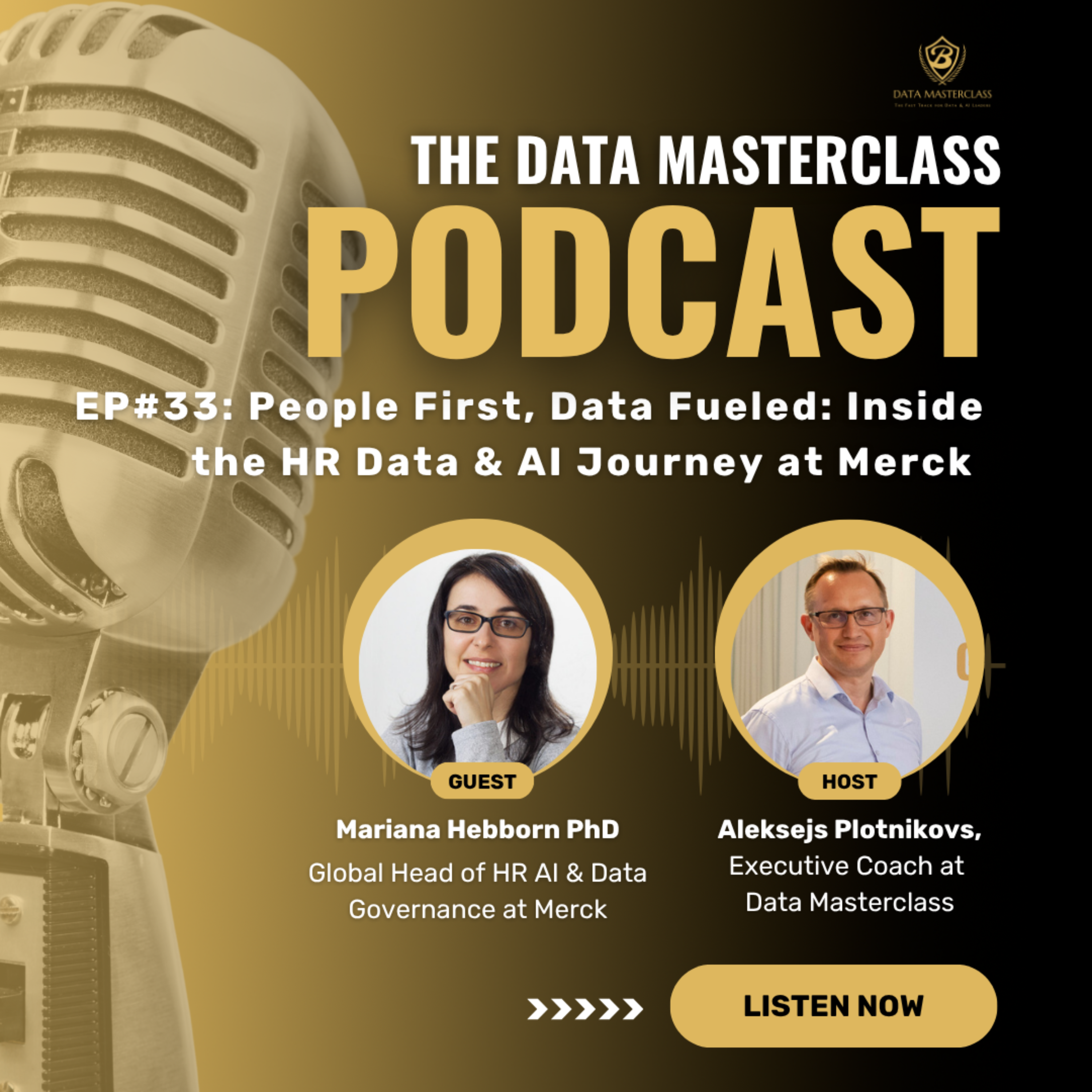 Podcast #33: People First, Data Fueled: Inside the HR Data & AI Journey at Merck
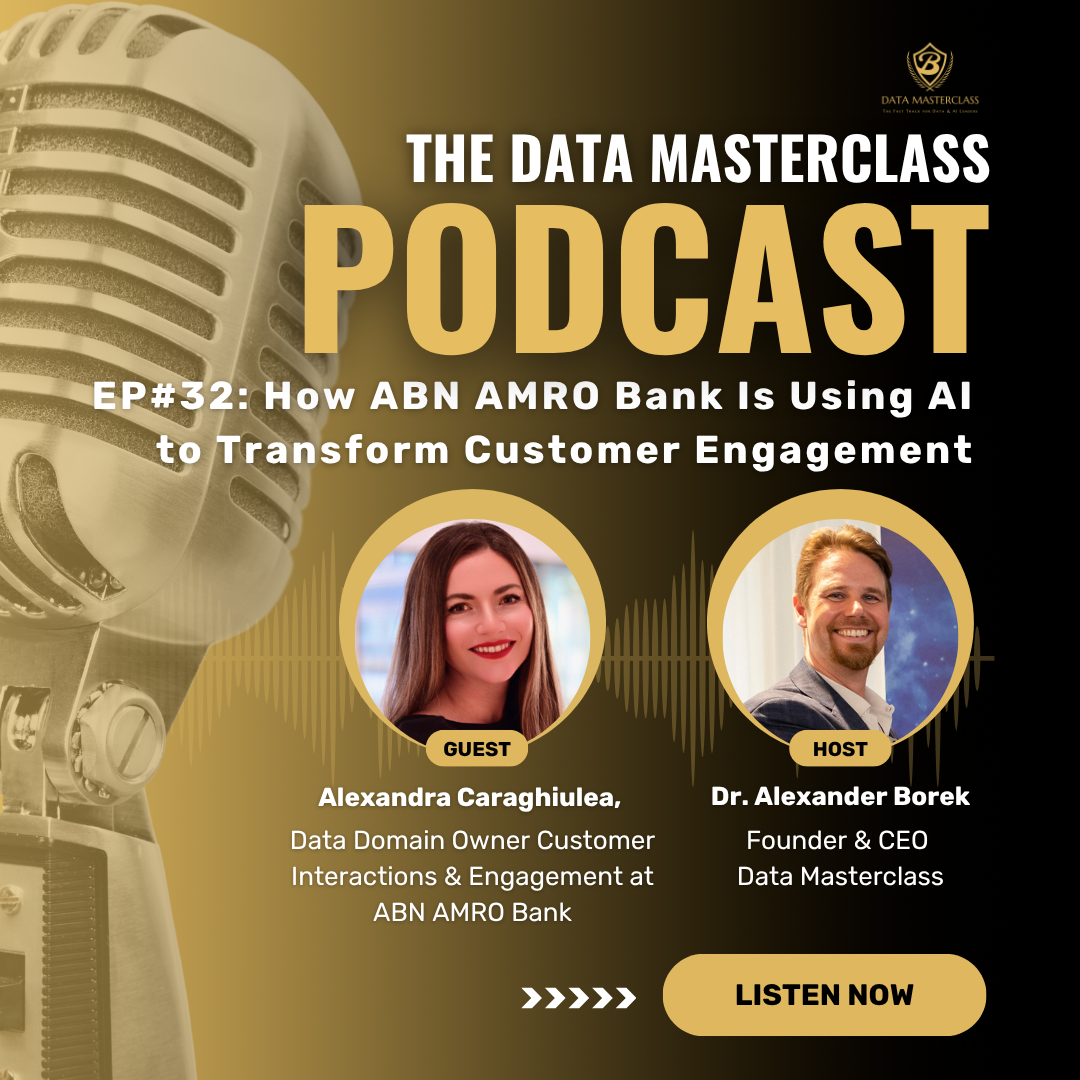 Podcast #32: How ABN AMRO Bank Is Using AI to Transform Customer Engagement?
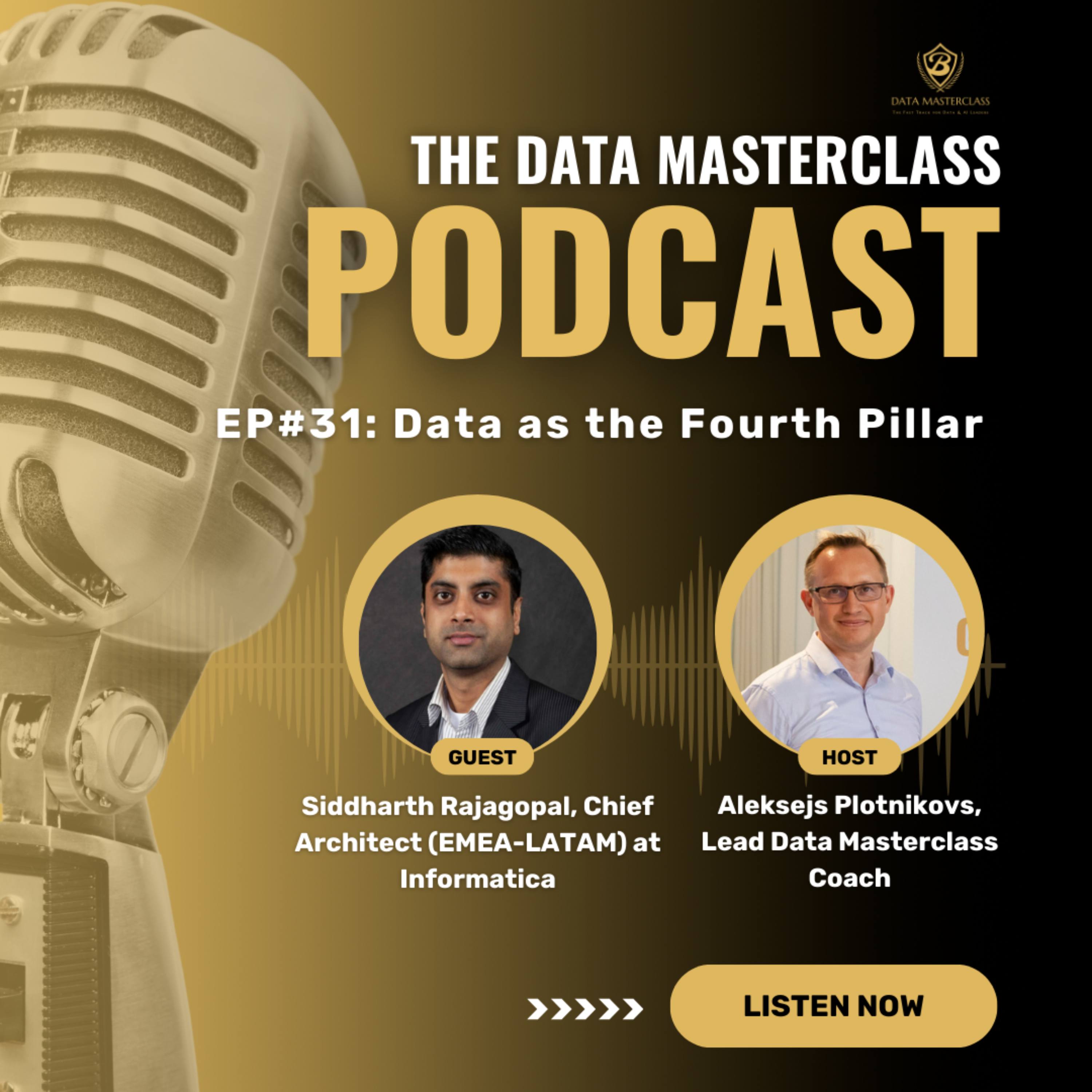 Podcast #31 Data as the Fourth Pillar
 Podcast #30 How Europe can win in the Data & AI game - Professional's Edition
 Podcast #29 Driving data success with people, process & platform at flaconi