
Ship It Weekly · 2026-06-05 · 20 min
Key moments - from our scoring
Substance score
65 / 100
Five dimensions, 20 points each
Brian Teller examines five critical infrastructure and security stories with a unified theme: as automation gains more authority, the invisible boundaries controlling what it can do become increasingly important to understand and monitor. The Kiro CLI vulnerability demonstrates how AI tooling approval mechanisms can be bypassed through stdin - a boundary bug rather than a simple parsing error - affecting tools that can execute commands, modify code, and access cloud CLIs. Amazon Braket's pickle deserialization issue shows that quantum computing services aren't exempt from classical security problems; the vulnerability exposes how SDK clients can trust metadata fields that lead to remote code execution when untrusted data reaches deserialization paths. AWS Organizations' new CloudTrail events for account join/departure represent a long-overdue governance improvement for managing security boundaries and guardrails. KEDA 2.20 and 2.19 releases illustrate how autoscaling system changes - particularly event recording moving to the events.k8s.io API group - represent production behavior changes requiring careful testing and RBAC review, not just version bumps. The lightning round covers Kubernetes Dashboard archival (with Headlamp as successor), Google Cloud's managed MCP server for AlloyDB (agent data access control), Kafka 4.3.0, and Atlassian's AI productivity claims. The through-line is understanding where authority and trust boundaries actually reside when automation increases.
CVE-2026-9255 allows crafted input piped into Kiro CLI through stdin to be treated as user confirmation, bypassing approval for commands that should require explicit user approval. The vulnerability treats the confirmation input path as accepting stdin when it should be restricted to direct user interaction.
CVE-2026-9291 in Amazon Braket SDK before 1.117.0 allows remote code execution when the SDK deserializes job results using pickle.loads() on attacker-controlled data. An authenticated user with S3 write access to the job output bucket can exploit this to execute code on clients reading those results.
AWS Organizations now emits account-joined-organization and account-departed-organization events to the management account, including join/departure method and timestamp, allowing teams to create alerts and govern account membership changes through EventBridge and CloudWatch.
Event recording moved to the events.k8s.io API group, which may affect RBAC, event scraping tools, alerting, and incident reconstruction; this is a production behavior change requiring testing and verification of event collection and dashboard compatibility.
Kubernetes Dashboard has been archived and Headlamp is the supported path forward; platform teams should explicitly decide which cluster UI to support, including auth configuration and allowed actions, rather than allowing migration to happen by accident.
Our reviewer’s read on each dimension, with quotes from the episode.
The episode packs substantial technical insight throughout: security implications of approval boundaries in AI tools, deserialization vulnerabilities in modern cloud SDKs, governance gaps in AWS Organizations, and hidden production risks in autoscaling systems. Each story includes concrete threat modeling (e.g., who can write to S3 buckets influencing client code execution) and operational consequences. The recurring theme about 'boundaries' vs 'automation authority' is genuinely non-obvious and ties together distinct technical topics into coherent operators' concerns.
Approval needs to be treated like security controls, not UX prompts. Security controls.
If the client treats those results as trusted instructions for how to deserialize data, then whoever can write to that bucket may be influencing code execution on the client side.
The framing of security and operational issues around 'hidden boundaries' is distinctly original - rather than treating CVEs as isolated patches, the host connects approval systems, deserialization trust, account membership, and autoscaling through a unified lens of displaced or forgotten authority. This is not standard tech podcast coverage. The specific observation that 'more PRs is not automatically more throughput' and pushback on AI productivity claims without system design context avoids recycled takes.
The button is not the boundary. The input path is.
Storage is not trust. Storage is just where the problem waits politely until something reads it.
This is a solo host episode with no guest interviews. The host, Brian Teller, appears to be a technical operator/commentator but the episode format does not include guest segments or expert interviews, making this dimension inapplicable in the traditional sense.
I'm Brian Teller from Teller's Tech, and this is Ship It Weekly.
The episode names specific CVEs (CVE-2026-9255 for Kiro, CVE-2026-9291 for Braket), version numbers (KEDA 2.20 and 2.19, Kafka 4.3.0, Braket SDK 1.117.0, Kiro CLI 1.28.0), specific AWS features (CloudTrail events for account join/departure, EventBridge integration), and concrete attack vectors (pickle.loads on attacker-controlled data, stdin piped into approval prompts). However, some claims lack supporting data or timelines (e.g., the Atlassian productivity numbers are mentioned but not detailed).
AWS published a bulletin for CVE-2026-9255 affecting Kiro CLI versions before 1.28.0.
CVE-2026-9291 affecting Amazon Braket SDK versions before 1.117.0. The issue involved job results.
As a solo host format, there is no guest interaction, but the host demonstrates strong internal structure and progression, building suspense around implications rather than just listing facts. The narrative arch from Kiro approval bypass → Braket deserialization → org boundaries → autoscaling → lightning round effectively builds toward the meta-theme of displaced boundaries. However, without pushback, follow-up questions, or debate, the conversational dimension is limited to monologue clarity and thematic coherence rather than dialogue craft. The closing ties threads together well but lacks the dynamic challenge element of true conversational substance.
So yes, the AI tool asked for permission. And stdin answered for you, which is funny in the way that makes you stop smiling after about half a second.
And I have to admit, there is something funny about quantum computing getting a very normal Python pickle bug.
Computed from the transcript - who did the talking, and the words that came up most.
This episode of Ship It Weekly is about automation’s hidden boundaries. Brian covers Kiro CLI CVE-2026-9255, where piped stdin could act like user approval, Amazon Braket SDK CVE-2026-9291 and the very normal Python pickle risk hiding inside quantum job results, AWS Organizations finally emitting CloudTrail events when accounts join or leave an org, and KEDA updates that remind us autoscaling upgrades are production behavior changes. The bigger thread this week is that automation does not remove boundaries. It moves them. Approval paths, trusted data, account membership, scaling signals, platform access, and AI-generated output all need clear ownership and visibility. Brian also covers Kubernetes Dashboard being archived with Headlamp as the path forward, Google Cloud Remote MCP Server for AlloyDB, Apache Kafka 4.3.0, and Atlassian’s AI-native SDLC productivity claims. Sponsored by @Scale: Systems & Reliability, happening June 25 at the Meydenbauer Center in Bellevue, Washington.
Transcribed and scored by The B2B Podcast Index.
Your AI coding tool asks for permission. Then stdin answers for you. That is not a sentence I expected to say this week, but here we are. This week, we've got Kiro CLI with an approval bypass through piped input.
Amazon Braket with a very normal Python pickle problem inside a very expensive-sounding quantum SDK. AWS Organizations finally logging account membership changes to CloudTrail. And KEDA releases that remind us autoscaling upgrades are not just version bumps. Then in the lightning round, we'll hit Kubernetes dashboard being archived, Google Cloud's managed MCP server for AlloyDB, Kafka 4.
3 .0, and Atlassian's AI productivity claims around more pull requests and saved developer time. The theme this week is pretty simple. Automation keeps getting more authority, but the boring boundaries still decide what happens.
I'm Brian Teller from Teller's Tech, and this is Ship It Weekly. Welcome back to Ship It Weekly. The show where we look at the DevOps, SRE, cloud, platform, and security stories that actually matter when you are the person who eventually has to keep the thing running. This week is a nice mix of AI tooling risk, cloud governance, Kubernetes operations, and the ongoing question of what happens when automation gets more power than people realize.
We're starting with Kiro CLI and a bug where crafted piped input could be treated like user approval. Then we'll talk about Amazon Braket SDK and an insecure deserialization issue in quantum job results. After that, we'll get into AWS Organizations finally emitting CloudTrail events when accounts join or leave an organization. Then we'll talk KEDA 2.
20 and 2.19. because autoscaling upgrades can move assumptions around events, permissions, scalers, and monitoring. In the lightning round, we'll hit Kubernetes Dashboard being archived with Headlamp as the path forward, Google Cloud Remote MCP Server for AlloyDB, Apache Kafka 4 4.
3.0, and Atlassian's AI-native SDLC productivity claims. And the human closer this week is about hidden boundaries, because the scary part of automation is not always what it can do. Sometimes it's what we forgot it was allowed to do.
So let's get into it. First up, Kiro CLI had a pretty interesting security issue. AWS published a bulletin for CVE-2026-9255 affecting Kiro CLI versions before 1.28.
0. The short version is that crafted content piped into Kiro CLI through stdin could be consumed as confirmation input, and that could allow tools, including shell commands to execute without the user actually approving them. So yes, the AI tool asked for permission. And stdin answered for you, which is funny in the way that makes you stop smiling after about half a second.
Because this is not just a random command-line parsing bug. This is an approval boundary bug. A lot of AI coding tools are built around the idea that the agent can suggest actions, but the user approves the risky parts. That approval step is the thing that makes people feel safer.
The tool says, hey. I want to run this command. The human looks at it and says yes or no. That is the mental model.
But if crafted input can accidentally or intentionally flow into the confirmation path, now that boundary is not really where people thought it was. And that matters because these tools are not just answering trivia questions. They can read files. They can inspect repos.
They can call tools. They can run commands. They can modify code. They can sometimes interact with cloud CLIs, Kubernetes configs, package managers, and all the usual developer machine chaos.
So when approval gets weird, the blast radius gets weird too. The practical lesson here is bigger than Kiro. If you are building or adopting AI tools, Approval needs to be treated like security controls, not UX prompts. Security controls.
That means you should think about where approval input can come from. Can it come from standard in? Can it come from a file? Can it come from pasted content?
Can it come from generated content? Can it come from previous agent output? Can it come from something the model read and then accidentally turned into an action? Because when an AI tool has access to execution, The approval path is part of your trust boundary.
And trust boundaries are where boring bugs become very interesting. For operators and platform teams, I would treat this as another reminder to be careful with agent tooling in high trust environments. Keep tools updated. Avoid running agentic CLIs with broad permissions unless you really need to.
Be careful piping untrusted content into tools that can execute actions. And do not assume that a confirm before running prompt automatically means the human is the only thing that can confirm. The button is not the boundary. The input path is.
Second story. Amazon Braket SDK had an insecure deserialization issue. And I have to admit, there is something funny about quantum computing getting a very normal Python pickle bug. Like, yes.
We are doing quantum workloads and advanced simulation and cloud-managed quantum jobs. But also, somewhere in the middle of that, Python Pickle is still standing there with a folding chair. AWS published a bulletin for CVE-2026-9291 affecting Amazon Braket SDK versions before 1.117.
0. The issue involved job results. The SDK trusted a data format field in job result JSON. And under the wrong conditions, it could call pickle.
loads() on attacker-controlled data. That could lead to remote code execution for a remote authenticated user with S3 write access to the job output bucket. This is a very specific vulnerability, but the pattern is extremely familiar. You have an SDK.
You have job output. You have S3. You have metadata that says what format the data is in. And somewhere in that chain, the client trusts the metadata too much.
Then the parser becomes an execution path. That is the lesson. Deserialization bugs are not old news just because the service sounds modern. Pickle is dangerous when used on untrusted input.
That sentence has been true for a very long time. And apparently, it is still true even if the words around it include quantum computing. For DevOps and platform teams, I think the takeaway is about the trust boundaries around job output and storage buckets. A lot of systems treat output buckets as boring storage.
The job writes results. The client reads results. Everybody goes home. But if the client treats those results as trusted instructions for how to deserialize data, then whoever can write to that bucket may be influencing code execution on the client side.
That changes the security posture. So yes, patch the SDK. But also, think about the surrounding pattern. Who can write to job output buckets?
Are those buckets shared? Are they cross-account? Can temporary jobs write results that other systems later consume? Are clients running in developer environments, CI, notebooks, or production workflows?
And are any of those clients deserializing data in a way that assumes storage means trusted? Because storage is not trust. Storage is just where the problem waits politely until something reads it. Before we get to the next story, a quick word from this week's sponsor, @Scale: Systems & Reliability.
@Scale: Systems & Reliability is happening June 25th at the Meydenbauer Center in Bellevue, Washington. The event is focused on the infrastructure behind AI-scale systems, reliability, high-performance compute, storage, networking, and the operational side of AI-driven systems. So if you are thinking about how reliability changes when AI workloads, agents, and automation enter the picture, this is worth a look. Register today at atscaleconference.
com/events/systems-reliability-2026 or use the link in the show notes. All right, back to the show. Third story, AWS organizations now emit CloudTrail events when accounts join or leave an organization. And this is one of those updates that sounds small until you remember what AWS Organizations actually represents.
An AWS Organization is not just a billing container. It is a security boundary. It is where SCPs apply. It is where centralized logging expectations live.
It is where guardrails live. It is where account ownership and governance gets enforced. So when an account joins or leaves an organization, that is not just an administrative event. That is a security and governance event.
AWS says organizations now emit account joined organization and account departed organization events to the management account. Those events include things. like the join or departure method and timestamp. You can feed them into CloudWatch alarms, EventBridge roles, or whatever your alerting and governance process looks like.
And honestly, this feels like one of those things that should have already existed, which is not a compliment exactly, more like a very cloud engineering version of relief. Because account movement is the kind of thing you want to know about immediately. If an account leaves your organization, what happened to the SCPs? What happened to centralized CloudTrail?
What happened to Config rules? What happened to Security Hub aggregation? What happened to access policies that assume the account is still under org control? And if an account joins your organization, is that expected?
Is it coming from an acquisition? A sandbox? A delegated admin flow? A weird test account someone created with a personal email in 2021 and is now trying to bring home like a stray cat.
The practical takeaway is pretty simple. Do something with these events. Do not just mentally file this under nice AWS improvements. Create EventBridge rules.
Alert on account join and departures. Send them somewhere your cloud platform or security team actually watches. Attach context if you can. Was this account expected?
Who owns it? Which OU did it join? What guardrails apply? Was the departure planned?
Do we need to investigate? Because the worst time to discover an account left your organization is later, when you are trying to explain why the normal guardrails did not apply. Account membership is not just billing metadata. It is control plane state.
And control plane state deserves alerts. Fourth story. KEDA has had a couple of releases. worth operators actually reading.
And I know, a KEDA release note is not exactly the kind of thing that makes people cancel dinner plans. But autoscaling changes are production changes. KEDA sits in a very sensitive part of the system. It watches external signals.
It decides when workloads should scale. It interacts with Kubernetes events, RBAC, metrics, scalers, and workload behavior. So when KEDA changes event recording, scalers, permissions, or assumptions, that is not just a version bump. That is part of how your workload responds to pressure.
The on-call brief this week flags KEDA version 2.20 and version 2.19 changes, including event recording moving to the events.k8s.
io API group, plus scaler changes and additions around things like OpenSearch, Elastic Forecast, and Kubernetes resources. The event recording change is the one I would pay attention to because events sound like observability garnish until something breaks. Then suddenly, everybody wants to know what scaled, when it scaled, why it scaled, what failed, and which controller said what. If events move API groups, that may affect RBAC.
It may affect tools that scrape or watch events. It may affect alerting. It may affect the way your team reconstructs scaling behavior during an incident. And that is the hidden risk with autoscaling systems.
When they work, nobody thinks about them. When they fail, everybody discovers they are part of the incident timeline. The practical takeaway is not avoid KEDA upgrades. KEDA is useful.
The takeaway is to treat autoscaler upgrades like production behavior changes. Read the release notes. Check RBAC. Check event collection.
Check dashboards. Check scaler-specific changes for the triggers you actually use. Test the upgrade in a non-prod cluster with real-looking metrics if you can. And make sure your team still knows how to answer the basic questions.
Why did this workload scale? Why did it not scale? What signal was it watching? What did KEDA think was happening?
And where would we see that during an incident? Autoscaling is one of those areas where it just works is great right up until it very much does not. Now let's do a quick lightning round. First, Kubernetes Dashboard has been archived and Headlamp is the path forward.
We have mentioned Headlamp before, so I'll keep this short. The new angle is that dashboard being archived means platform teams should decide what the supported cluster UI actually is. If developers, support engineers, or internal teams rely on a UI to inspect workloads, logs, events, or namespaces, that UI is part of your platform surface. So do not let the migration happen by accident.
Decide what you support. Decide who gets access. Decide how auth works. Decide what actions are allowed.
And please, do not replace one risky dashboard with another risky dashboard and call it modernization. Second. Google Cloud Remote MCP Server for AlloyDB is generally available. I know we have covered MCP a lot, so I'm not going to make this the whole show.
But the trend matters. MCP is moving from local developer demos into managed cloud data access. That means the questions get more serious. Who can connect?
What data can the agent reach? What identity is used? What audit trail exists? And can the agent only read?
Or can it take action? Managed MCP is not just convenience. It is another control plane for agent access. Third, Apache Kafka 4.
3 .0 is out. For most people, a Kafka release is not something you rush into production during lunch. At least I hope not.
But it is worth tracking because Kafka sits under a lot of real-time systems, event-driven platforms, data pipelines, and very nervous on-call rotations. The high-level takeaway is simple. Read the release notes. Watch client compatibility.
Check broker upgrade paths. Check the features that affect your actual deployment model. And remember that Kafka upgrade is rarely just a Kafka upgrade. It usually involves consumers, producers, schemas, connectors, monitoring, retention, partition behavior, and some service nobody remembered still uses the old client.
Fourth, Atlassian published AI-native SDLC productivity claims around more pull requests and saved developer time. The numbers sound good. More PRs. More time saved.
More development throughput. And I am not against that. But more PRs is not automatically more throughput. If planning, review, testing, security, release, and operations cannot absorb the extra output, then you may not have improved flow.
You may have just moved the bottleneck. AI can absolutely help teams produce more work. The leadership question is whether the system can safely absorb it. Because more code is not the same as more value.
And it is definitely not the same as more reliable production. The human closer this week is about hidden boundaries. That is the thread running through all of this. Kiro CLI had an approval boundary.
Amazon Braket had a deserialization boundary. AWS Organizations has an account membership boundary. KEDA had an autoscaling and event visibility boundary. Kubernetes Dashboard and Headlamp sit on the platform access boundary.
MCP sits on the agent data access boundary. Kafka sits on the event pipeline boundary. And AI productivity claims run straight into the boundary between output and actual throughput. The scary part of automation is not always what it can do.
Sometimes it is what we forgot it was allowed to do. That is the part teams need to keep looking at. What counts as approval? What counts as trusted data?
What counts as an account boundary? What counts as a safe scaling signal? What counts as supported platform access? What counts as developer productivity?
Those are not abstract questions. Those are production questions. Because automation does not remove boundaries. It moves them.
And if you do not know where the boundary moved, you may not know what you are trusting anymore. And that is where staff and principal engineering work often lives. Not just picking the tool. Not just approving the upgrade.
Not just reading the headline. But asking where the authority actually sits now. Who can approve? Who can write?
Who can scale? Who can access? Who can deserialize? Who can query?
Who can ship? That sounds boring. But boring is usually where the real risk is hiding. So the takeaway this week is simple.
When automation gets more powerful, look for the boundary. Then make it visible. That's it for this week of Ship It Weekly. We covered the Kiro CLI approval bypass, Amazon Braket SDK insecure deserialization, AWS Organizations CloudTrail account membership events, KEDA autoscaling changes, and a lightning round on Kubernetes Dashboard and Headlamp, Google Cloud Remote MCP Server for AlloyDB, Kafka 4 4.
3.0, and Atlassian's AI-native SDLC claims. If this episode was useful, follow or subscribe wherever you are watching or listening. If you're on YouTube, hit subscribe.
If you are in a podcast app, follow the show there. And if you know someone on a DevOps, SRE, platform, security or engineering leadership team who is dealing with AI tools, AWS governance, Kubernetes autoscaling, or platform access, send this one to them. It helps the show grow and it helps me keep making this kind of content for people who actually live with these systems. You can find the weekly brief at OnCallBrief.
com and more episodes and this week's show notes at shipitweekly.fm. I'm Brian Teller from Teller's Tech. Thanks for listening.
And remember, If your AI tool asks for permission, your SDK trusts a pickle, your account leaves the org, or your autoscaler changes behavior, the question is not just what happened. The question is where the boundary was supposed to be.
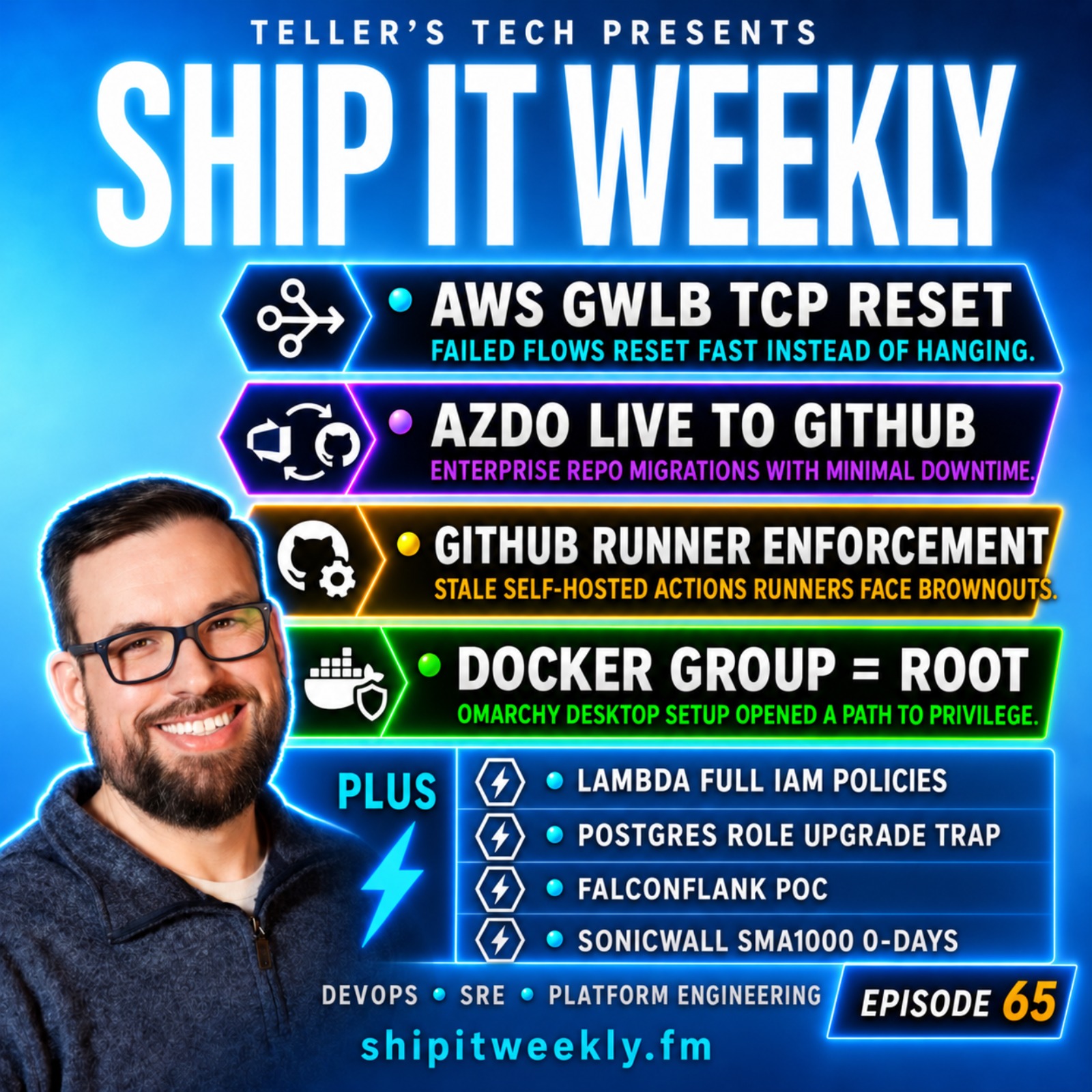 AWS GWLB TCP Reset, Azure DevOps Live Migrations to GitHub, GitHub Runner Enforcement, Docker Root Risk, Lambda IAM Updates, PostgreSQL Upgrade Traps, SonicWall Zero-Days & Better Incident Reviews77 / 100
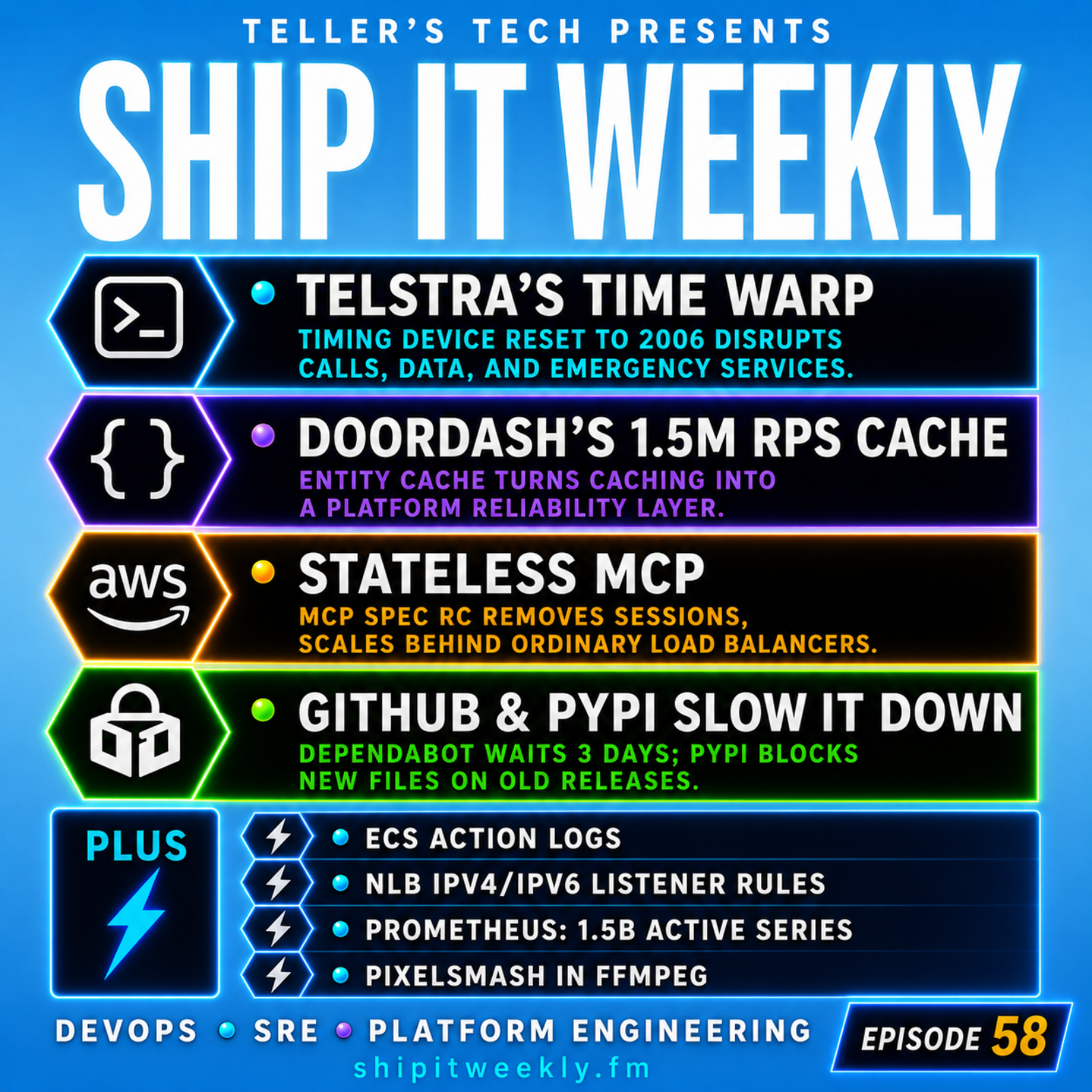 Telstra’s Time Sync Outage, DoorDash’s 1.5M RPS Cache, Stateless MCP, GitHub and PyPI Supply Chain Delays, and Why the Quietest Infrastructure Often Has the Biggest Blast Radius97 / 100
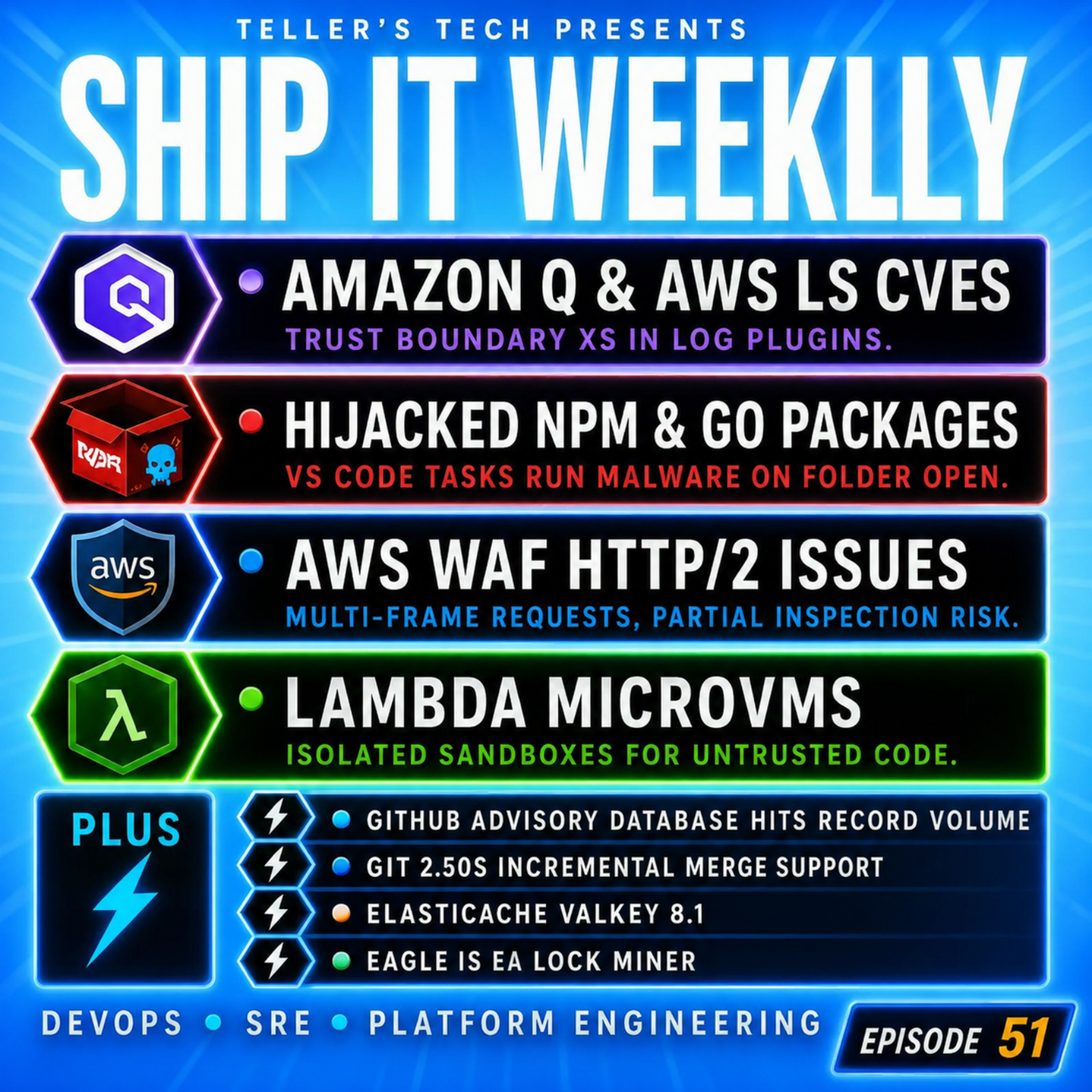 Amazon Q CVEs, Hijacked npm and Go Packages, AWS WAF HTTP/2 Issues, Lambda MicroVMs, and Why Execution Is the Boundary Now88 / 100
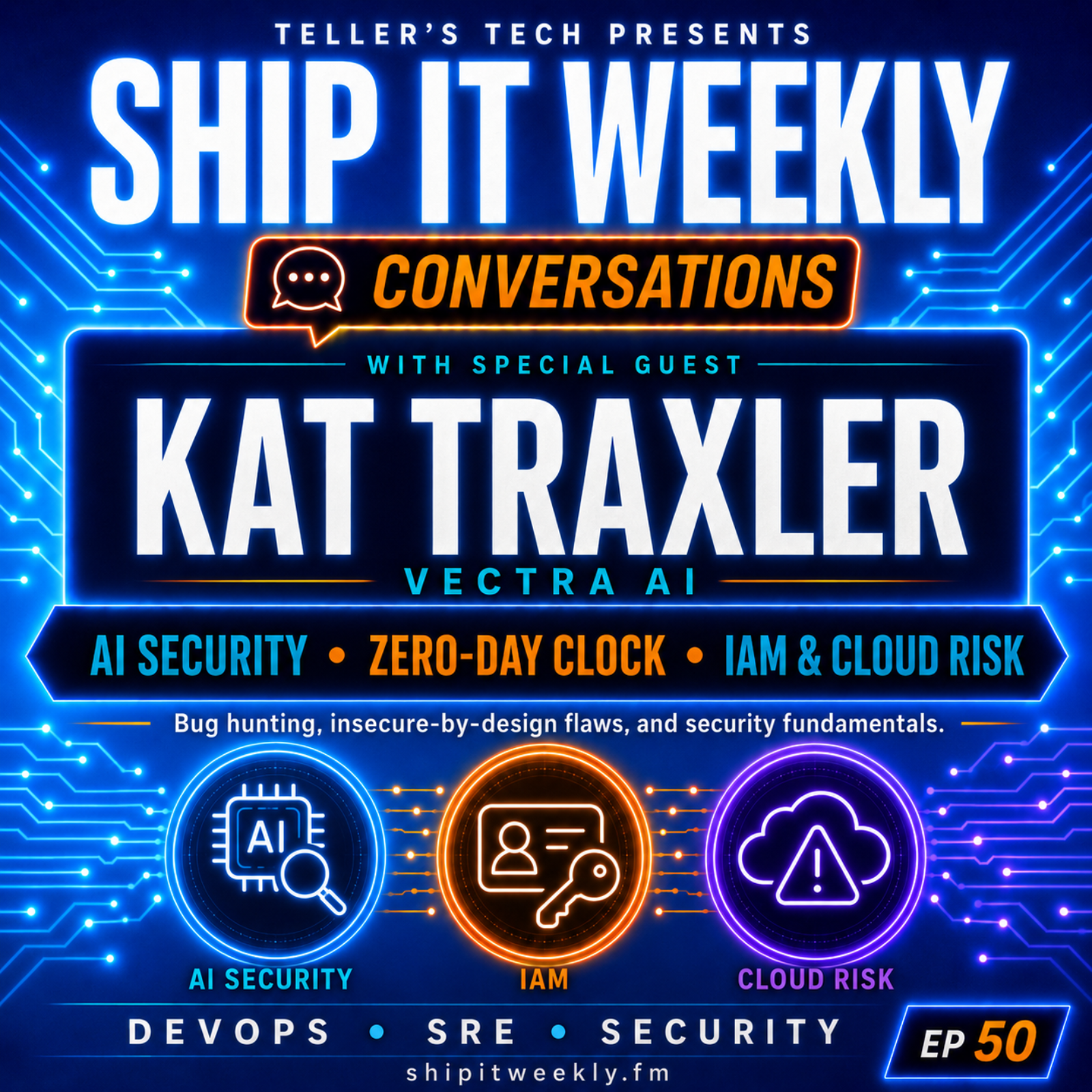 Ship It Conversations: Kat Traxler of Vectra AI on AI Security, the Zero-Day Clock, IAM, and Cloud Risk96 / 100
 containerd CRI Vulnerabilities, Datadog PostgreSQL HA on Kubernetes, AWS DevOps Agent with Datadog MCP Server, EKS Control Plane Egress, and Why Users Feel the Wait70 / 100