
Reformation Leadership Podcast · 2026-04-11 · 38 min
Key moments - from our scoring
Substance score
39 / 100
Five dimensions, 20 points each
Darcy Ogandaga, an 18-year Internet business veteran, reveals that the gap between casual ChatGPT use and running a fully autonomous global business has nothing to do with coding skill - it's entirely structural. The episode synthesizes three powerful frameworks: foundational business architecture from Ogandaga (who emphasizes that AI multiplies zero to zero without a proven conversion mechanism), cinematic avatar technology via Heyjin's latest platform (enabling creators to remove the physical content bottleneck), and Futurepedia's seven-level AI mastery roadmap. Ogandaga's core insight dismantles the myth that viral hacks matter; instead, he stresses extracting leads to a self-hosted virtual headquarters (a website with first-party data), avoiding the algorithmic risk of rented platforms like Facebook, Instagram, and TikTok. His cascading workflow - one three-minute video generating 160 monthly touchpoints across six video platforms, 21 podcast feeds, and AI-translated geographic variants - demonstrates what true multiplication looks like. The episode speaks directly to entrepreneurs, content creators, and digital agencies wrestling with automation anxiety, offering concrete mechanics: how platform algorithms suppress external links (necessitating comment-based extraction), how Heyjin's verified cinematic twins eliminate filming bottlenecks, and how Claude/ChatGPT can translate creative vision into technical prompts. For B2B operators, this maps the journey from treating AI as a search engine to architecting predictable, scalable customer acquisition systems.
He uses cascading automation: one three-minute video is manually posted to four platforms (personal Facebook, Instagram, professional page, LinkedIn), then API connectors automatically push it to YouTube and TikTok. He simultaneously broadcasts live to two Facebook pages, LinkedIn, and YouTube; the audio from these streams is automatically distributed to 21 podcast platforms. AI translation models then create localized versions in other languages (like French), using voice cloning to preserve his acoustic properties, all without additional recording.
Social platforms like Facebook suppress posts with external links because their revenue model depends on keeping users inside their ecosystem. A hyperlink to an external website (your virtual headquarters) is algorithmically detected and throttled to protect daily active user metrics and time-on-site. This is why Ogandaga strategically places extraction links in comments rather than main posts.
Heyjin's Sea Dance 2.0 creates a dynamic cinematic digital twin - not a static talking head. The avatar understands micro-expressions, skeletal kinetics, and spatial lighting, allowing creators to place themselves in complex environments (like being chased by police on a stage) with dynamic camera movement and sound design. After one training session recording, the model becomes a reusable asset that generates broadcast-quality video without further filming.
She feeds Heyjin's technical documentation URL directly into ChatGPT, then describes her creative vision in plain English ('I want a scene of me on a stage being chased by cops'). ChatGPT, armed with the rulebook, translates this into a highly technical shot-by-shot prompt with correct camera angles, lighting, and motion parameters - eliminating the need to learn complex cinematography syntax.
The seven levels represent a progression from treating AI as a generic tool to architecting autonomous systems. Level one, the 'Fancy Search Engine,' is where 95% of professionals remain - using free ChatGPT to write emails or summarize PDFs as minor conveniences. The framework helps identify exactly where you're bottlenecked and what mechanical shift moves you to the next tier of leverage.
Our reviewer’s read on each dimension, with quotes from the episode.
The episode contains some genuine tactical specifics - the cascading content distribution workflow, voice-cloning translation for geographic markets, and the link-in-comments suppression mechanic - but roughly half the runtime is filler affirmations, hype framing, and throat-clearing between speakers. The seven-levels framework offers useful scaffolding but is borrowed verbatim from a third-party source (Futurepedia), not original synthesis.
He posts three times a week. That's the core input. But because of this cascading architecture, the six video platforms, the multi stream live feeds, the 21 podcast destinations, the translated geographic models he's generated, generating over 160 distinct pieces of content every single month.
Darcy notes that putting a link in the main post kills your reach by roughly 20% immediately.
The foundational arguments - own your email list, social platforms are rented land, AI is a multiplier not an originator - are widely circulated digital-marketing principles from at least a decade ago. The voice-cloning geography workflow and the solo-unicorn end-state show some fresh framing, but the episode never argues from first principles or takes a genuinely contrarian position; it synthesises known ideas into a cohesive narrative rather than generating new ones.
AI multiplied by zero equals zero.
You cannot underwrite a stable business model on the hope that a black box algorithm is going to smile at your content. You're building a skyscraper on a tectonic fault line.
There are no actual guests interviewed in this episode; it is a synthetic two-voice dialogue summarising three secondhand sources (Darcy Ogandaga's coaching materials, Nicky Saunders' demos, Futurepedia's listicle). The speakers themselves appear to be AI-generated narrators, so the listener receives zero first-person practitioner testimony, and the episode ends with an explicit CTA to a free book, revealing its promotional nature.
Our first source comes from Darcy Ogandaga, who is a veteran Internet Business coach.
this brings us to our second source. Looking at the work of creator Nicky Saunders
The episode names real tools (Heygen, Zapier, Claude, NotebookLM, Granola, OpenClaw, Manus), traces a specific workflow step-by-step, and drops concrete numbers (160 pieces per month, 21 podcast destinations, 20% reach suppression, 4 - 15 seconds per avatar shot). However, every figure is asserted without citation and sourced secondhand from materials the listener cannot verify, and the workflow numbers are presented as a single creator's unaudited claims.
He uses API connectors to automatically pull that video from those initial uploads and push it natively to YouTube, making it five places. Another automation pushes it to TikTok. That's six platforms from a single three minute recording session.
He rips the audio from that live stream and an automated system pushes it out as a podcast to 21 different destinations.
The format mimics conversational rigour with occasional staged pushback and follow-up questions, but Speaker B always has a perfect pre-loaded answer, revealing fully scripted dialogue with no genuine tension or challenged claims. The one explicit pushback ('let me push back on that for a second') about viral agencies is immediately deflected into agreement within two exchanges, and the episode resolves every topic tidily without forcing any guest or source to defend a hard position.
But let me push back on that for a second.
It's a fair pushback, but I think we have to separate the lottery winners from the casino owners here.
Computed from the transcript - who did the talking, and the words that came up most.
Master Coach Darcy Ogandaga and others discuss why your digital data is your most valuable online asset. In a world where social media platforms can change at any moment, owning your audience, emails, contacts, and content is the key to long-term growth, protection, and income. Discover practical insights on digital ownership, business stability, and building real online assets. For more info, get our free book now at
Transcribed and scored by The B2B Podcast Index.
Unknown: Right now, like at this exact second, there is a creator out there reaching these highly engaged audiences in Singapore, South Africa, the Congo. And they're delivering these really complex insights in flawless, localized French. They're pitching a digital product processing transactions. But the wild part is, here's the catch. That creator does not speak a single word of French.
Unknown: Not a word.
Unknown: They haven't physically recorded a new video in like three weeks. And, um, they are currently asleep.
Unknown: It's crazy.
Unknown: It is. So today we're doing a deep dive into how that gap, you know, between playing around with ChatGPT to write a polite email and running a fully autonomous global Internet business, it actually has nothing to do with being some kind of coding genius.
Unknown: No, it really doesn't. Like, if you look at the architecture of what that creator is doing, it's not about raw intelligence. Right. Or having access to some secret million dollar server farm. The tools they're using are largely accessible to anyone listening right now.
Unknown: Anyone with a laptop.
Unknown: Exactly. Uh, the difference is entirely structural. It's about, you know, understanding the specific level of the AI landscape you're operating on and realizing that most of us are using these hyper advanced systems to do the digital equivalent of, um, hammering a nail with a microscope.
Unknown: Yeah, which is exactly why we're doing this deep dive. If you're listening to this, you already know the space. You've seen the endless flood posts on your feed promising that some new software update is gonna, like, make you a millionaire by Tuesday.
Unknown: Oh, it's exhausting.
Unknown: It is so exhausting. So our mission today is to cut through that noise by synthesizing three really distinct, powerful perspectives from our sources. We're gonna look at the foundational strategy of an Internet business model from an 18 year industry veteran. Then we're examining the bleeding edge execution of cinematic AI avatars. So how to physically remove yourself from the content bottleneck. And finally, we're gonna very concrete diagnostic roadmap detailing the seven levels of AI mastery.
Unknown: And that roadmap is so critical because right now, I mean, people are feeling this intense anxiety about obsolescence.
Unknown: Oh, for sure.
Unknown: They feel like if they don't learn the newest prompting framework that got released yesterday, they're just falling behind. But when you piece these three sources together, you realize that all those shiny new tools, they're completely irrelevant if you don't have a systemic container to put them in.
Unknown: Okay, let's unpack this because I want to start right there with the container. Our first source comes from Darcy Ogandaga, who is a veteran Internet Business coach. I mean, he has been operating online for 18 years.
Unknown: 18 years in Internet time is like a century.
Unknown: Basically a dinosaur. Yeah, he's been navigating Facebook algorithms since 2008. He watched the rise and fall of chronological feeds, the pivot to video, the pivot back to text, the explosion of short form. He's seen it all. Yep, and his core message is a pretty massive reality check. He says most people are approaching AI completely backward.
Unknown: It is a harsh reality check. Yeah, because he observes that people are just obsessed with the output mechanism before they even have an economic engine. Right, like they want an AI tool to write a 300 page book in an hour, or they want a tool to generate a fully functioning website in 10 minutes. Or spin up a perfect webinar script.
Unknown: Yeah, give me the hack.
Unknown: Exactly. But they are entirely skipping what he calls the foundational Internet business model.
Unknown: And his argument, which honestly feels a bit like a gut punch, is that AI multiplied by zero equals zero.
Unknown: It's precisely the math we need to look at. AI is a multiplier. Right? It's not an originator of fundamental business strategy. Think about the mechanics of a business. You need a mechanism for generating attention, a mechanism for capturing leads, and then a mechanism for converting those leads into revenue.
Unknown: Standard business stuff.
Unknown: Right? But. But if your conversion mechanism is mathematically zero, meaning you literally have no proven way to turn a stranger's attention into a transaction, then taking an AI agent and multiplying your content output by 10,000 is just going to give you 10,000 times zero. Wow. You're just generating noise faster and more efficiently than ever before.
Unknown: Yeah, I mean, we assume everyone listening knows why an email list is valuable. The classic owned audience model isn't exactly new, but Darcy points out something crucial about the execution in this AI era. He warns really heavily against the rented space trap. Yeah, the rented space he lists out. You know, your Facebook, Instagram, TikTok, YouTube, X LinkedIn. They are not your business. They are rented space. But let me push back on that for a second.
Unknown: Oh, uh, hey.
Unknown: Because there are entire digital ad agencies and multi million dollar creator empires built entirely on reverse engineering virality on those specific platforms. So if it's just Rente, why is there an entire economy dedicated to going viral there?
Unknown: It's a fair pushback, but I think we have to separate the lottery winners from the casino owners here.
Unknown: Oh, like that.
Unknown: Yeah. I mean, yeah. Yes, agencies optimize for retention metrics and hook rates to achieve virality. But Darcy's point is about the predictability of Customer acquisition cost cac. When you rely on organic virality on rented land, your CAC is incredibly volatile
Unknown: because you don't control the rules.
Unknown: Yeah, exactly. One week the algorithm favors your format, the next week the platform updates its underlying code to prioritize some different media type to appease its shareholders. And suddenly your reach drops by 90%.
Unknown: Right. The algorithm rug pull.
Unknown: Yeah. You cannot underwrite a stable business model on the hope that a black box algorithm is going to smile at your content. You're building a skyscraper on a tectonic fault line.
Unknown: Um, so the real objective is extraction.
Unknown: Complete extraction. He emphasizes the absolute necessity of a virtual headquarters.
Unknown: And that's, that's just a website, Right?
Unknown: It's a specific self hosted destination, your actual website, where you capture first party data. Because if you do not have that data securely in your own database, like emails, names, locations, you do not have leverage. You don't actually have a business.
Unknown: And here is where the mechanics of that extraction get really interesting to me, especially when we talk about how these social platforms fight back. Darcy talks about his strategy for giving away a free ebook to capture those leads. He posts a visual, writes a description, but he purposefully does not put the link to the ebook in the main post.
Unknown: Nope, he hides the link in the comments. Now I've seen creators do this, but can you break down the actual mechanism behind why this is necessary, you know, before we even get to the AI automation part?
Unknown: Well, it all comes down to the fundamental economic incentive of the platform. A social media network's valuation is primarily based on daily active users and time on site.
Unknown: Keep people scrolling.
Unknown: Right. Their entire advertising revenue model depends on keeping a human pair of eyes inside their ecosystem for as long as mathematically possible. So when you place a hyperlink in your main post that directs a user to your external virtual headquarter, you are directly attacking the platform's core metric.
Unknown: You're a leak in their pipeline.
Unknown: Exactly. You are a leak.
Unknown: So the algorithm is literally designed to detect that link and suppress the post.
Unknown: Yes. Darcy notes that putting a link in the main post kills your reach by roughly 20% immediately.
Unknown: The system just programmatically throttles the distribution. So the human strategy, bypassing that penalty by placing the extraction link in the comments, uh, where the parser might not penalize the parent post as heavily, that is the prerequisite. You have to understand the physics of the environment before you build the AI machine.
Unknown: Okay, so the foundation is built, we understand the suppression mechanics. We've got our virtual headquarter. Now, how does the AI multiplier actually kick in for him because reading through his workflow, it is relentless.
Unknown: Relentless is the word. He operates this cascading robot workflow. Let's trace the data flow of just a single piece of content.
Unknown: Okay.
Unknown: He starts by creating one 3 minute video. He uploads, uh, it to his personal Facebook page, M. Then to his Instagram which you know, shares backend infrastructure.
Unknown: Yeah.
Unknown: Then to his professional page, then to LinkedIn. That is four manual touchpoints.
Unknown: But then he hands it off to his automations.
Unknown: Right, Exactly. He uses API connectors to automatically pull that video from those initial uploads and push it natively to YouTube, making it five places. Another automation pushes it to TikTok. That's six platforms from a single three minute recording session.
Unknown: And that's just the video architecture. But where his system truly scales is the audio. He talks about going live, right?
Unknown: The live broadcasts.
Unknown: He uses cloud based broadcasting software to push a live feed simultaneously to two Facebook pages, LinkedIn and YouTube. But the live video is just the raw material. He actually calls the audio the real engine.
Unknown: And this is the part that shows what a multiplier really means. He rips the audio from that live stream and an automated system pushes it out as a podcast to 21 different destinations. 21 Apple, Spotify, Amazon, everywhere with zero additional recording time.
Unknown: But let's go back to the hook of our deep dive, the geographical scaling, the translation multiplier. Explain how he's hitting markets in Singapore and the Congo without speaking the language.
Unknown: Oh, this is fascinating. He feeds that ripped audio into an AI translation model. But it's really important to understand the mechanics here because this isn't like the old Google Translate spitting out a robotic text to speech file.
Unknown: Right? Not the old robot voice.
Unknown: No. These modern models use voice cloning and phone matching. The AI analyzes the timbre, the cadence and the unique spectral frequency of Darcy's actual voice. It translates the transcript into French and then generates a new audio file where the French words are spoken using the exact acoustic properties of Darcy's English voice.
Unknown: That is wild. It preserves the emotion and the brand identity perfectly.
Unknown: It creates a localized remix, pitches his French ebook and pushes it out. And the math on this, when you look at it, is staggering.
Unknown: Do the math for it.
Unknown: He posts three times a week. That's the core input. But because of this cascading architecture, the six video platforms, the multi stream live feeds, the 21 podcast destinations, the translated geographic models he's generated, generating over 160 distinct pieces of content every single month. 106, 160 touch points running 247, all designed with one singular objective. Capturing leads and routing them back to his virtual headquarter.
Unknown: So when you have an automated system generating that volume of top of funnel awareness and you're capturing the data on the back end, you don't need an anomalous viral hit.
Unknown: No, you don't. You have a highly predictable, mathematically sound Internet business.
Unknown: But. And I know if you're listening to this, you might be identifying the massive friction point here, because the math makes sense, the architecture makes sense, but let's be realistic about the human toll. Even if the distribution is automated, generating the core content to fuel a 160post a month machine requires a human being to sit in front of a camera three times a week.
Unknown: Right.
Unknown: It requires lighting, setups, makeup, multiple takes, energy editing. If you or I tried to maintain that indefinitely, we wouldn't just burn out. Our quality would completely degrade.
Unknown: Absolutely.
Unknown: The system breaks when it hits the physical limits of the human body, which
Unknown: is the perfect transition to the necessary evolution of this model. Because if section one is about building the economic engine, Section two is about removing the ultimate biological bottleneck.
Unknown: Your physical presence.
Unknown: Yes.
Unknown: And this brings us to our second source. Looking at the work of creator Nicky Saunders, she introduces us to a technology developed by Heyjin, specifically their Sea Dance 2.0 update. Now, for the listener, I think we need to clarify what we're talking about here.
Unknown: Yeah, we should define it, because when
Unknown: most people hear AI Avatar, they picture those stiff, uncanny valley talking heads from two years ago. You know, the ones where it's clearly a stati photograph and only the lips are moving slightly out of sync.
Unknown: Yeah. That era of technology was essentially advanced puppetry. What Nikki is utilizing is an entirely different computational paradigm. Hagen's Avatar 5 creates what we call a cinematic digital twin.
Unknown: Cinematic is definitely the defining word here because Nikki shows an example she built, and her reaction is visceral. She's yelling like, I can't believe I made this. Her digital twin isn't sitting statically at a desk, staring dead eyed into a webcam.
Unknown: Not at all.
Unknown: The avatar is in a complex spatial environment. She is standing on a stage, literally getting chased by police officers.
Unknown: Right.
Unknown: There are dynamic camera panning movements tracking her across the scene. There are environmental sound effects, there's a music score. And she did not film a single frame of this physically.
Unknown: To really understand how profound this is, we have to look at the rendering mechanics. A cinematic twin like this isn't just a Face mapping. It requires the AI to understand human micro expressions, skeletal kinetics, spatial lighting. The workflow fundamentally detaches the creator's physical body from the ongoing creation process, which is the dream. It is. You sit down in front of a high quality camera one time, you record a training data set. So speaking, gesturing, looking in different directions, the neural network processes that data, learning the specific geometric topology of your face and the unique ways your muscles move when you speak.
Unknown: And then it's just done.
Unknown: Once that model is trained, it becomes a permanent deployable asset.
Unknown: It is the equivalent of having a Hollywood backlot, a union camera crew, a lighting director, and a stunt double, all compressed into an application living on your laptop. You never have to wait for golden hour lighting again. You don't have to rent a studio.
Unknown: Exactly. And the specific mechanism inside Hagan that makes this environment generation possible is called avatar shots.
Unknown: Okay. Avatar shots.
Unknown: It allows a creator to use a single text prompt to generate anywhere from 4 to 15 seconds of high fidelity cinematic video featuring their digital twin interacting with a virtual environment.
Unknown: But. And this is a big but, let's address the reality of generating those environments. Writing the prompts to achieve cinematic quality can be incredibly intimidating.
Unknown: Oh, it's basically a new language.
Unknown: Literally. I look at these professional AI video prompting guides and it reads like the manual for a Boeing 747. It's not just make a video of me, it's like, adjust the focal length to 35 millimeters, set the dynamic lighting to volumetric, Apply a subtle tracking pan from left to right. Ensure shallow depth of field. If you don't have a background in cinematography, you are going to get terrible results.
Unknown: It's a massive barrier to entry. But Nikki shares a workflow hack that is nothing short of brilliant because it uses AI to bridge the knowledge gap of using another AI.
Unknown: Oh, I love this hack.
Unknown: Right? Instead of trying to memorize hey Jin's complex Seedins 2.0 technical documentation, she just takes the URL of that exact guide and feeds it directly into a large language model like ChatGPT.
Unknown: This is such an elegant solution. Break down the translation happening there for the listener.
Unknown: She is essentially uploading the rulebook. So once ChatGPT processes all the technical parameters required by Hagan's generation engine, Nikki simply types her creative vision in plain conversational English. She just says, I want a scene of me on a stage being chased by cops.
Unknown: Just a normal sentence.
Unknown: Just a normal sentence. And ChatGPT, armed with the context of the Hagen documentation, acts as the translator. It instantly synthesizes that Basic idea into a highly technical shot by shot prompt. Correctly formatting the camera angles, the lighting instructions and the motion parameters required by the video model.
Unknown: It translates human imagination into machine readable parameters.
Unknown: Exactly.
Unknown: And the efficiency gain is undeniable. She noted that using this translation method, it only took her two renders to get the exact flawless cinematic shot she visualized. She didn't spend four hours tweaking focal lengths. Two attempts and she had broadcast quality footage.
Unknown: It is a perfect demonstration of tool synergy using a text based reasoning model to perfectly format the input constraints for a diffusion based video model.
Unknown: But look, we cannot talk about perfectly replicating human faces, cloning voices and placing them in fabricated environments without addressing the massive, glaring elephant in the room.
Unknown: Safety stuff.
Unknown: Yeah. We see the headlines every day about celebrity deepfakes, financial scams using cloned audio, non consensual image generation. If a listener is thinking about building their brand on this, they have to wonder, is an enterprise tool like this actually safe? Or are they contributing to an ecosystem of identity theft?
Unknown: It's a critical concern, and Nikki addresses it head on. We really have to draw a hard line between open source models that are designed with zero guardrails and enterprise grade platforms designed for legitimate commercial creators.
Unknown: Right.
Unknown: A platform like Heyging operates on a strict biometrically verified system. You cannot simply scrape a photo of Tom Cruise or your CEO or your ex, upload it, and make them say whatever you want.
Unknown: You can only synthesize yourself.
Unknown: Exactly. The system requires active synchronous verification to prove that the person in the training footage is the person actually operating the account. Your likeness is cryptographically protected. It is a closed, secure ecosystem, not an open sandbox for deep fakes.
Unknown: And Nikki provided a really fascinating personal anecdote that proves how deeply these safety guardrails are hard coded into the platform.
Unknown: Oh, the background image story.
Unknown: Yes. She tried to upload a reference image to use as the backdrop for her avatar's video. But that specific image happened to contain a poster of the late rapper Nipsey
Unknown: Hussle in the background, and the system completely rejected the render. It flagged an immediate error stating reference images must not contain human faces.
Unknown: Wow.
Unknown: The computer vision algorithm scanned the environment, detected the geometric patterns of a human face on that poster, and instantly triggered a safety protocol. Doesn't matter if it's a poster or a real person. If it detects an unauthorized face, it shuts down the process entirely.
Unknown: So, connecting this back to Darcy's business model from the first section, the ultimate takeaway here is leverage by utilizing verified cinematic twin technology, you completely shatter the physical bottleneck of content creation. You can feed your 160 post a month machine localized into different languages, placed in dynamic, attention grabbing environments without physically exhausting yourself.
Unknown: And crucially, you aren't sacrificing your hard earned brand equity to generic, faceless AI slop.
Unknown: Right? You are still front and center. You're building parasocial trust with your audience, even if you are literally asleep while the video is being rendered, captioned and posted.
Unknown: But having the strategy and having the avatar, that's only 2/3 of the equation.
Unknown: Exactly. We have the business engine, we have the physical cloning. But if you're a listener sitting at your desk right now, how do you actually master the day to day execution of these tools? How do you move from being someone who asks ChatGPT to rewrite an email once a week to someone who is architecting this kind of autonomous ecosystem?
Unknown: This is where our third source becomes invaluable. Futurepedia published a diagnostic roadmap, the seven levels of AI mastery. Okay, and this isn't just a list of tools. It's a psychological and operational progression. It helps you identify exactly where you are currently bottlenecked and what precise mechanical shift you need to make to reach the next tier of leverage.
Unknown: Let's walk through these levels in detail, because I guarantee every single person listening will recognize themselves in one of these stages. Let's start with Level 1, which is titled the Fancy Search Engine. I would argue 95% of the professional world is stuck right here.
Unknown: Definitely.
Unknown: You have a free OpenAI account and you treat it exactly like Google. You ask it for a recipe, you ask it to summarize a PDF, or you ask it to draft a polite decline to a meeting invitation.
Unknown: It's the most rudimentary interaction, and the source notes a crucial psychological marker of level one. At this stage, AI, uh, does not feel like a superpower. It just feels like a minor convenience. Yeah, you're staring at a blank text box, inputting a generic command and getting a generic, slightly robotic output. You are not utilizing the reasoning capabilities of the model. You're just querying its training data.
Unknown: Which brings us to level two, the prompt Engineer. This is the paradigm shift. This is the moment you realize that the specific syntax and structure of your request completely dictates the quality of the output. The model isn't generic. Your instructions are.
Unknown: Moving to level two requires adopting a structural framework. And the most universally effective framework relies on four instruction, context, constraints, and examples.
Unknown: Right.
Unknown: At level one, you type Write a blog post about real estate. The output is useless fluff. At level two, you engineer the prompt. You write. Write a 500 word blog post. That's the instruction quote for first time home buyers in Austin, Texas who are anxious about interest rates. Its context. Do not use any complex financial jargon and do not use bullet points constraints. Here is a paragraph of my past. Match this casual, empathetic tone perfectly.
Unknown: That four pillar structure alone is the difference between a useless draft and a publishable piece. But there is a hack here that completely changes the game. If you're a listener struggling to figure out what context the AI actually needs, let's say you're that real estate agent and you don't know what details will make the post pop. You can just ask the AI to interview you. Mhm. You type. I want to write a blog post for first time buyers in Austin. Before you write a single word, ask me the five most important questions you need answered to make this the most effective post possible.
Unknown: It's a brilliant inversion of the dynamic. You're acknowledging that the neural network understands its own latent space better than you do. It knows what variables will trigger the highest quality semantic connections. And there's another indispensable shortcut at level 2, specifically regarding the frustration of iteration.
Unknown: Oh, uh, the back and forth.
Unknown: Yes. Often you'll spend 20 minutes going back and forth with the AI. Make it punchier, you know, less aggressive. Add a stat about property taxes.
Unknown: It's exhausting.
Unknown: Exactly. But when you finally achieve the perfect output, don't just copy the text and close the window. You ask the model to reverse engineer the journey. You instruct it. Analyze the final result we just achieved. Now rate the single master prompt I could have used at the very beginning of this conversation to generate this exact output on the first try.
Unknown: I love that. And then you save that master prompt to a document. You never have to do the 20 minute dance again. But here is where we hit the ceiling of level two. Even if you have 50 beautifully engineered master prompts saved in a word doc, starting a new chat every single time, pasting in the prompt, pasting in your brand voice guidelines, pasting in your company history, the friction becomes unbearable.
Unknown: That physical friction is the catalyst for moving to level three projects. And baked in context, this is where AI transitions from an external tool into an integrated daily environment.
Unknown: Right. So if you are using CLAUDE or the premium version of ChatGPT, you have access to dedicated workspaces. Claude calls them, um, projects. Let's say I run a boutique consulting firm. I Don't just use a general chat. I build a Q3 marketing project.
Unknown: And the power of that project lies in the concept of baked in context, which utilizes a technology called retrieval, augmented generation, or ray. When you set up this workspace, you upload your standard operating procedures, your brand voice documents, your ideal customer profiles, and like the last six months of your successful marketing, emails.
Unknown: So it knows everything.
Unknown: Exactly. The system vectorizes all of those documents. It turns your entire business history into a mathematical knowledge base.
Unknown: So when I open that specific project on a Tuesday morning and say, draft an email for our new webinar, I don't have to explain who we are, who we sell to, or what tone to use. The AI is already completely briefed. It automatically pulls the relevant context from the uploaded documents and generates a draft that sounds exactly like my brand.
Unknown: And at level three, you also develop a discerning palette for different foundational models. You realize that treating AI as a monolith is a mistake. You start routing specific tasks to the architectures best suited for them.
Unknown: Like what?
Unknown: Well, you might recognize that Anthropic's Claude 3.5 sonnet is vastly superior for nuanced copywriting encoding. But Google's Gemini is better connected to live web data, and OpenAI's models are exceptional at structured data analysis, you basically
Unknown: become a manager of models. But to break the threshold into level four, and here's where it gets really interesting. You have to leave the comfort zone of text based chatbots entirely. This is where the landscape gets incredibly exciting.
Unknown: Level four is defined as the AI ecosystem and agnostic tools. The realization here is that using a large language model to solve every digital problem is like using a Swiss army knife to construct a suspension bridge.
Unknown: It's possible, but awful.
Unknown: Exactly. It has the tools, but it's deeply inefficient. Level four is about adopting purpose built specialized AI applications.
Unknown: A perfect example from the source is Google's Notebook lm. Because if you're a researcher, a lawyer, or a student and you have 50 dense hundred page PDF documents, you do not try to paste them into ChatGPT. You upload them into NotebookLM. And we need to explain how this actually works, because it's not just using a search function to find keywords in your PDF.
Unknown: No, it is building a localized knowledge graph. When you upload those 50 PDFs, the AI reads them and maps the semantic relationships between every single concept across all the documents.
Unknown: Okay, so what does that mean in practice?
Unknown: It means it plots a mathematical link between a statistical footnote on page 4. Of document A and an offhand quote on page 87 of document F. So when you ask a complex synthesis question, it navigates that graph to generate an original insight that does not explicitly exist in any single document, complete with citations linking back to the source text.
Unknown: It is breathtaking. Another level four tool they highlight is Granola, which transforms meeting culture. Instead of frantically typing notes while a client is talking, which totally ruins your ability to be present and read the room, the tool just runs in the background.
Unknown: Yeah, Granola is amazing.
Unknown: It uses advanced speaker diarization to separate your voice from the client's voice, transcribes the audio with perfect accuracy, and then synthesizes the transcript into structured action items, decisions made, and follow up emails.
Unknown: But the most disruptive paradigm introduced at level 4 is a concept called Vibe coding.
Unknown: Vibe coding. I love this term. For the listener who has never written a line of HTML or Python in their life, what does this actually look like?
Unknown: In practice, it utilizes integrated coding environments like canvas in OpenAI or artifacts within Claude. Historically, if you wanted a custom software tool, say a specific interactive dashboard to calculate the ROI of your consulting services based on three different dynamic variables, you had to hire a developer, write a spec sheet, and wait three weeks.
Unknown: With Vibe Coding, you just describe what you want in plain English.
Unknown: Exactly you type. Build me an interactive ROI calculator with sliders for monthly traffic, conversion rate and average order value. Make it look sleek and modern. The AI doesn't just give you a block of code to copy and paste. It writes the react components, renders the user interface, and displays a fully functional interactive application right there in a window next to your chat.
Unknown: And if you don't like how it looks, you don't have to debug the code. You just type. Change the background to dark mode and make the calculate button neon green. The AI rewrites the code and the interface updates instantly in front of your eyes. It completely democratizes software creation.
Unknown: And um, as you get comfortable with Vibe coding, you start encountering the bleeding edge of level four early agentic workflows. Tools like Manus, where you get your first taste of autonomous execution.
Unknown: Let's define agentic for the listener because we've talked about prompting where it's a constant ping pong match. I ask, you answer what changes with an agent?
Unknown: With an agent, you stop providing step by step instructions and start providing overarching goals. You hand the AI an objective. The agent contains an internal reasoning loop. It independently breaks that massive goal down into a multi step plan, determines which external tools it needs to Achieve each step, executes the tasks, reviews its own work, corrects errors, and only returns to you when the final goal is accomplished.
Unknown: You take your hands completely off the steering wheel.
Unknown: Yes.
Unknown: Which requires a massive mental shift. You are no longer an operator. You are an orchestrator. And that mindset shift is the exact entry point to level five. Automation's running without you.
Unknown: At level five, you fundamentally change the question you ask yourself every day. You stop asking, how do I use AI to do this manual task faster? And you start asking, how do I engineer a background system that performs this task permanently so I never have to look at it again?
Unknown: Wait, you are building the automated robots that Darcy was talking about in his business model back in section one?
Unknown: Exactly. You're moving into the infrastructure layer. You start using platforms equipped with webhooks and API connections like Zapier's new AI Copilot, or platforms like Lovable and Google AI Studio.
Unknown: Give me a concrete example of a level 5 workflow. Let's go back to Darcy's virtual headquarter.
Unknown: Perfect. Imagine a potential client lands on your website and fills out a contact form. In a level two world, you get an email notification. You manually copy their name into your CRM, you Google their company to see what they do, and you spend 20 minutes writing a custom email referencing their recent company news.
Unknown: Right. Very manual.
Unknown: In a level five world, the moment they hit submit, a web hook triggers a Zapier automation. The automation sends the data to a database. It simultaneously triggers an AI agent to scrape the web for the prospect's LinkedIn profile and their company's recent press releases.
Unknown: So the agent synthesizes all that research in the background.
Unknown: Yes. It synthesizes the research, sends the data to Claude to draft a highly personalized, contextually brilliant welcome email. Queues that email in your outbox as a draft and pings your slack with a summary of the prospect's company size and pain points. All of this happens in the four seconds it takes the prospect to load your thank you page.
Unknown: Wow.
Unknown: It runs continuously247 without a single human touch.
Unknown: That's the definition of leverage. But level six is where the source takes us into territory that honestly sounds like science fiction. Level six is system building and agentic workflows. This isn't just triggering an email draft. This is orchestrating highly complex, multi agent software environments.
Unknown: At level six, you're operating as a senior software architect and the AI models are your engineering team. The source points to tools like Claude Code's planning mode. We aren't just vibe coding A simple single page ROI calculator. Anymore we are talking about commanding the AI to build full scale AI powered web applications, custom chrome extensions or massive internal company dashboards, feature by feature, manipulating complex code bases across multiple files simultaneously.
Unknown: And the frameworks required to manage this are wild. The source explicitly mentions nad. This is where we cross into the realm of agents managing other agents.
Unknown: It is the automation of management itself. Think of level six like the kitchen of a Michelin star restaurant. You are the executive chef. You do not chop the onions, you shout, we need a beef Wellington for Table 4. In a NAID framework, an overarching manager agent receives your request. Um, it independently routes a subtask to a prep cook agent, uh, to locate the ingredients in the database, routes another subtask to an assembly agent to write the code. The manager agent oversees the process, reviews the code for errors, sends it back to the assembly agent if it fails a test, and finally presents you with
Unknown: the completed application you just asked for the dish. The AI delegated the labor. But then the source brought up openclaw and I have to be honest, this part gave me a genuine spike of anxiety.
Unknown: It should openclaw represents the extreme frontier of level six and it fundamentally alters the risk profile of everything we've discussed. OpenClaw is an open source personal AI agent, but unlike ChatGPT, it does not live isolated in a browser tab, right? It runs locally, persistently, directly on your machine. Perhaps a, ah, dedicated Mac Mini sitting in a closet or a virtual private server.
Unknown: So it's a persistent digital entity.
Unknown: Yes, and it utilizes the computer use API. It can physically parse the document object model of a website, meaning it can literally see buttons, text fields and dropdowns on your screen, and it can move a virtual mouse to click them. You give it access to your web browser, your email client, your calendar. It remembers context across days and weeks, it operates continuously in the background, and you communicate with it exactly like you would a human assistant via messaging apps like WhatsApp or Telegram.
Unknown: So the example they give is crazy. You are at the airport and you text openclaw on WhatsApp. Uh, book me a direct flight to Chicago for next Tuesday morning. The agent reads the text independently, opens a browser window on the Mac Mini in your closet, navigates to Delta's website, enters the dates, selects the flight and clicks purchase, but wait to click purchase, it needs to enter payment information. People are handing over live credit cards to autonomous AI agents.
Unknown: They are. And this is where we must issue a massive unequivocal warning. The expert in our source was intensely upfront about this reality. OpenClaw is highly technical and it carries serious, tangible, potentially devastating security risks. We're talking about granting an autonomous agent running on open source code unrestricted access to the live Internet and your financial credentials.
Unknown: If that model suffers a hallucination, or if it scrapes a website containing a malicious prompt injection attack, it could be disastrous.
Unknown: It could misinterpret an instruction and buy 10 first class flights to Chicago. It could accidentally delete a crucial database while trying to organize your files. It requires extreme caution, a robust understanding of local security environments and strict hard coded guardrails. It is absolutely not for beginners. You do not hand your corporate Amex to a script you downloaded from GitHub unless you are a true level 6 master who understands the code executing in the background.
Unknown: Okay. Consider the warning delivered. Proceed with extreme caution. But if delegating your credit card to an autonomous sous chef agent is level 6, what on earth could level 7 possibly be?
Unknown: Level 7 is titled the Aspirational Unicorn. It is a predictive state. The roadmap acknowledges that nobody is truly operating fully at this level yet. But it is the inevitable mathematical destination of compounding all the technologies we've just discussed. It's the concept of a true solo unicorn. A one person, billion dollar company.
Unknown: One single human founder, no employees.
Unknown: One founder sitting at the center of a web of automation. Their entire company consists of a massive, perfectly orchestrated workforce of specialized AI agents. You have autonomous agents dynamically adjusting ad spend across platforms. You have cinematic digital twins endlessly generating personalized localized marketing content. You have sales agents negotiating via email, product development agents writing and deploying code updates, and customer service agents resolving tickets flawlessly 24 hours a day, seven days a week, in every language on earth.
Unknown: Okay, let's take a breath and synthesize all of this, because the ground we just covered is staggering. If we step back and connect the dots between our three sources, the journey to becoming that level seven solo unicorn, or even just using these tools to build a highly profitable, sustainable lifestyle business that buys back your time. It does not start with trying to vibe code an app or downloading dangerous open source agents.
Unknown: No, it starts with immense discipline. It starts with the unglamorous foundational Internet business model we analyzed in section 1. You must have a strategy. You must own your audience. You must have a virtual headquarter and a mathematically sound system for capturing leads and driving conversions. Without that economic engine, you're multiplying the row.
Unknown: But once that foundation is solid, you scale your output using the cinematic tools from section 2. You deploy tools like Heygen to create your digital twin, shattering the physical limitations of the human body. You let the avatar do the heavy lifting of generating hundreds of localized touch points without ever burning out.
Unknown: And you orchestrate this entire symphony by consciously methodically climbing the ladder from section three, you recognize where you are stuck. Whether it's prompting from scratch every day at level two or doing manual data entry at level four. And you build the automated bridge to the next level of leverage. It is a deliberate progression from operator to architect.
Unknown: If you are listening to this right now and you realize you are stuck, if you want to actually start executing on this, if you want to stop posting and hoping on rented space and actually build that foundational automated system we talked about at the very beginning, we have exactly what you need to do next. We want to bring the conclusion for people to go get Coach Darcio Gandaga's free book. It has all the tools and equipment that you need to make this transition happen. Go immediately to reformationleadership.com best-free II tools I'm going to say that one more time so you can type it in right now it is reformationleadership.com best-free AI hyphen tools get the foundation right before you worry about the robots.
Unknown: Because the foundation is the only thing that will anchor you in reality as the velocity this technology accelerates. Which leaves us with a deeply fascinating, almost philosophical question to ponder as we look at the trajectory of these tools. We are rapidly moving toward a world where eventually everyone will have access to this leverage. Everyone will have a flawless cinematic digital twin that never stutters, never looks tired and speaks 30 languages. Everyone will have a perfectly automated, mathematically optimized sales funnel. Everyone will have an army of AI agents running their operations without error 247.
Unknown: The playing field will be completely leveled by perfect infinite automation.
Unknown: Exactly. So once we all reach level 7, once perfection, hyper efficiency and infinite scale are cheap, democratized and accessible to everyone on Earth would become the ultimate scarce resource. Is it possible that in a perfectly automated, flawless digital landscape, the only thing that cannot be mass produced raw, unedited, spontaneous, vulnerable human imperfection will actually become the most valuable and highly sought after commodity of all?
Unknown: Something to think about until next time.
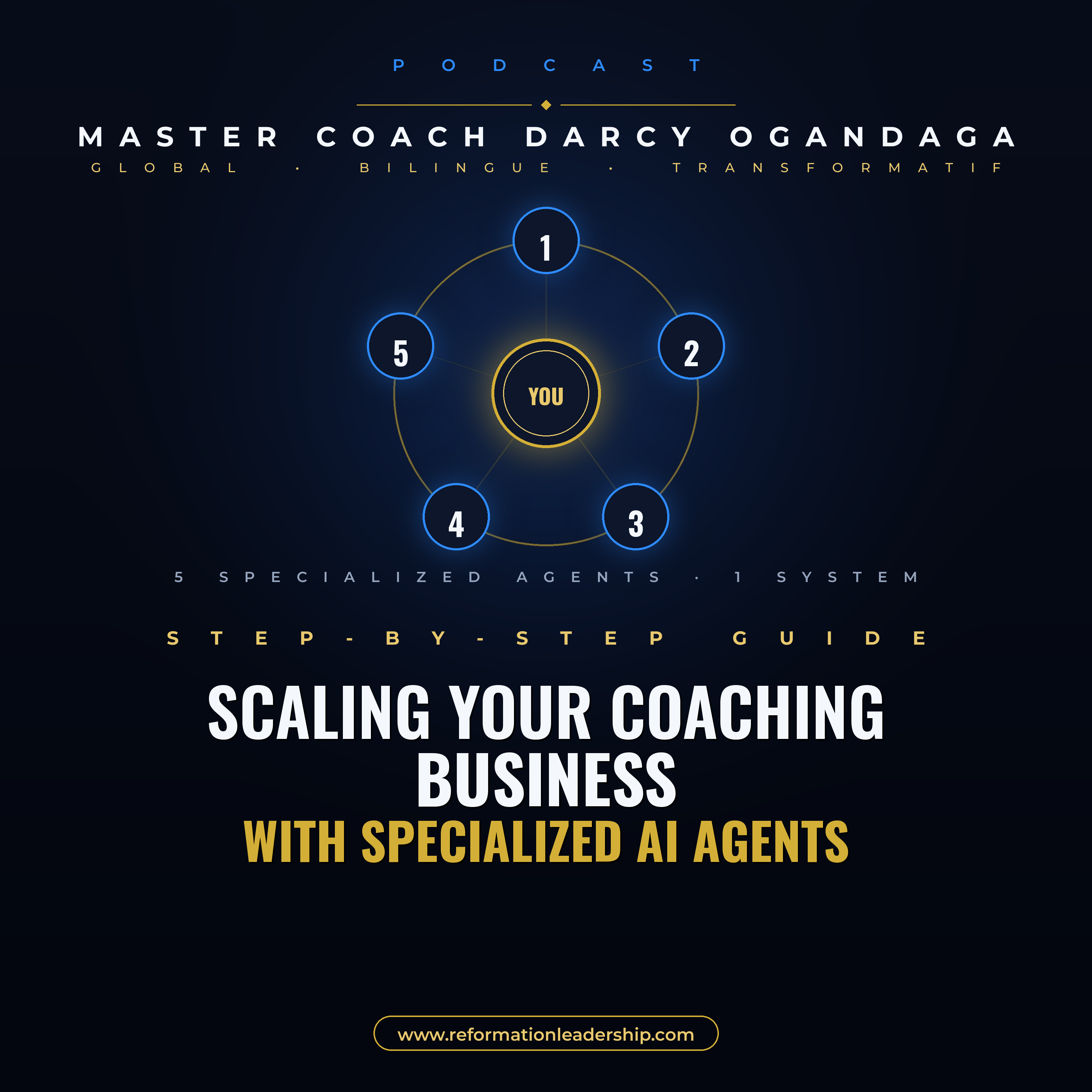 Scaling Your Coaching Business with Specialized AI Agents"51 / 100
 The Power of Digital Media Beyond The Church Walls50 / 100
 How to protect your internet business if your social media get disabled55 / 100
 AI Plus Nothing Is Still Zero and The Truth About Audio Podcast52 / 100
 Netflix vs YouTube: Why Owning Your Audience Is Everything with Master Coach Darcy Ogandaga38 / 100