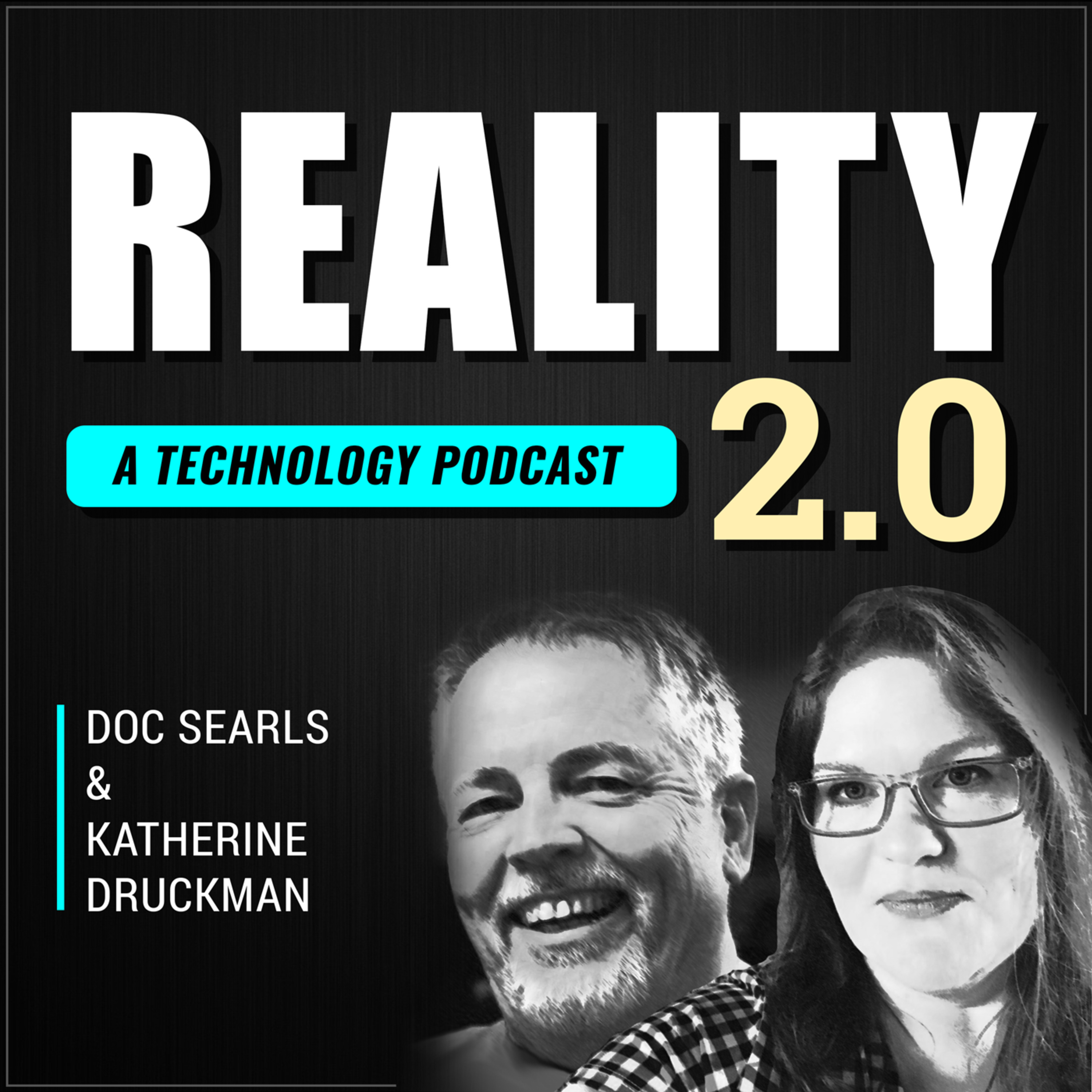
Reality 2.0 · 2024-03-02 · 33 min
The Cluetrain Manifesto, published 25 years ago in March 1999, emerged from a website and manifesto created by Doc Searls, Chris Locke, David Weinberger, and Rick Levine - journalists frustrated with how poorly the early internet was understood. Originally 95 theses arguing that "markets are conversations" and that hyperlinks subvert hierarchy, the manifesto became a cultural touchstone, cited in over 10,000 books and tweeted daily even decades later. The core vision centered on individual empowerment, human voices in business, and the rejection of treating people as mere consumers or eyeballs. Searls reflects candidly on both the manifesto's successes - its memetic staying power and influence on business thinking - and its profound failures. Despite the manifesto's ideals, surveillance has become ubiquitous: cars track drivers via built-in cell modems, smart TVs harvest viewer data as a revenue model, browsers are compromised, and privacy is nearly extinct unless users employ extreme measures like Tor or Faraday cages. Companies continue to treat people as data sources rather than conversation partners. Searls remains a cyber-utopian, believing in the internet's potential while actively fighting for personal AI tools and privacy protections that would restore the individual agency the Manifesto promised.
Published in March 1999, Cluetrain was a website and manifesto by Doc Searls, Chris Locke, David Weinberger, and Rick Levine containing 95 theses arguing that markets are conversations and hyperlinks subvert hierarchy. It became a bestseller in early 2000, was published in nine languages, and has been cited in over 10,000 books; the term itself is tweeted at least daily even 25 years later.
Thesis seven - 'hyperlinks subvert hierarchy' - is among the most prophetic, as the egalitarian, end-to-end design of the internet remains fundamentally true and challenges centralized power structures.
Despite advocating for individual empowerment and privacy, surveillance capitalism has instead rendered people as tracked subjects; cars embed cell modems that report on drivers, smart TVs harvest and sell viewer data, and comprehensive tracking occurs across browsers and devices unless users employ extreme privacy tools like Tor.
Chris Locke was the heart and voice of the manifesto, pulling the group together and authoring the pivotal graphic that read 'we are not seats or eyeballs or end users or consumers; our reach exceeds your grasp,' which energized the team to write the full manifesto.
Searls advocates for personal AI - AI tools that help individuals manage their own health, finances, correspondence, contacts, and data - rather than AI controlled by tech giants like OpenAI; he believes this restores the individual agency and empowerment the Manifesto originally promised.
Computed from the transcript - who did the talking, and the words that came up most.
Doc Searls and Katherine Druckman discuss the Cluetrain Manifesto on its 25th anniversary, how the world has and hasn't changed since, and about SCaLE 21x (Southern California Linux Expo) coming up March 14. Site/Blog/Newsletter FaceBook Twitter Mastodon Support Reality 2.0
Transcribed and scored by The B2B Podcast Index.
Speaker A: Foreign. Welcome Back to reality 2.0. We're back again. Uh, we're taking things a little slowly these days, but hopefully it's worth it. The wait in between. Uh, so Doc and I. I know, yeah, we've gotten a lot. Really busy, both of us actually. So, um. But yeah, so today we have a few things to talk to catch up on one of them. Is that Doc's book or Doc and other people. But, uh, yeah, anyway, clue train is 25 years old, so that's cool and we'll have some stuff to talk about, but we also want to talk a little bit. We'll get to later, but we're both going to be at Scale at the Southern California Linux Expo and that's coming up. Uh, March 14th I believe is the first day. And we'll be there. I'm giving two talks. Doc will be there. We'll probably have stickers. I don't know. It's going to be crazy. I'm pretty excited about this.
Speaker B: Yeah, it's funny, I just uh. As you know. But the audience doesn't yet. Um, uh, Ilya Rabinovitch, who puts it on, has been bothering me to come to Scale since it started and I just responded to his email inviting me from 2003. So 21 years later, I'm finally going to make it. And you know, so I. He's going to be surprised to see that. Anyway, yeah, and we've had him on. We had him on this podcast.
Speaker A: I don't know if we had him on this one. We talked to him on Floss Weekly. Yeah, look up the Ilan Rabinovitch, uh, Floss Weekly and you can hear a whole history of Scale and more. And I think it came out just before last year's uh, uh, Scale.
Speaker B: A good and noble effort on his part. That's good.
Speaker A: It's a really good event. I mean we've talked about it here, we've talked about it with Kyle and other people. Um, it's just a really good kind of still grassroots community event. It feels like every other open source event is. Well, there's that. There's also All Things Open, which I really like. That's in the fall. So you've got Scale in the spring and all things open in the fall and both are excellent. Uh, and then everything else in between is kind of run by the Linux Foundation. It's bigger and a little bit glossier. But, uh, I really like.
Speaker B: Yeah, more corporate because they're a trade association and uh, Scale is a bunch of geeks.
Speaker A: Yeah.
Speaker B: Which is the soil from which all open source sprang in the first place.
Speaker A: Exactly. So, yeah, I'm really looking forward to it. It's going to be good. I have to cut it a little bit short, uh, because I'm then heading to Kubecon in Paris. I'm not complaining about that because I'm looking forward to the food, but it is going to be a lot of travel.
Speaker B: Paris is great.
Speaker A: Yeah.
Speaker B: You know, Yeah. A good thing for me because scale is in Pasadena is that there's a house where we stay. Uh, it's actually empty most of the time. Uh, a friend's house where we keep a car. We keep our west coast car there. Our Santa Barbara car actually lives in LA because it's closer to the airport. And so, um, I'm going to be able to stay, you know, free in a place and drive over in our own car. It's going to be pretty cool.
Speaker A: Ah, that's pretty cool. I will not. I will be walking to the.
Speaker B: I could pick you up.
Speaker A: Yeah, I mean it's a couple blocks. It's not, it's not a bad walk. But yeah, it'll be really fun. And um. Well, I mean, I might as well. So the talks I'm giving are on Saturday morning. One of them, ironically or not so, is about podcasting, so you might want to check that one out. The other one is about secure security and software security and consuming open source software and things like dependency management and that kind of stuff. So, so that should be fun. Um, but the, the other fun talk that unfortunately conflicts with one of mine is Kyle Rankin's talk. So I should probably plug that. You, we, you all probably know Kyle and he's come on and talked to us about the topic of his presentation, which is his knitting clock that he made. So that's going to be cool. And, and I'm sad that I will have to miss it because I will
Speaker B: and you will both miss it because I want to be at, ah, your podcast.
Speaker A: Yeah, you got, you got to come in and hang out with the podcasting geek.
Speaker B: Yeah, Yeah, I don't knit, so.
Speaker A: But you might after.
Speaker B: You know, I don't know, I've had some instruction we have on, uh, on this show, uh, from Kyle. So, uh, it's not like we're in the dark about it, which is good. I should plug my talk. It's uh, you should. It's a. There's an organization, uh, that does. That's pulling together lots of efforts on personal AI. That's AI that we have for ourselves, um, not where we are a suburb of OpenAI or Copilot or whatever it is that Microsoft, I mean Google is calling whatever they're doing today, uh, or this week. Um, but Sam, uh, Altman, who is the CEO sometime and again CEO of OpenAI at their developers conference last November I think it was, actually said this. He said, uh, what they're all about is individual empowerment and agency on a scale we've never seen before, which I made the title of a blog post and then the Kawaii people said you need to come and talk about that at scale. And so to me the, you know, the thing that matters, you know, my punch list for personal AI is, you know, has to do with my own health, finances, property, correspondence, contacts, calendar, travel, shopping, you know, and my own data collection of stuff. And it's, it's massive and it's out of control and I need to, I need AI to help with that, whatever that is. And so it's going to be about that. And uh, I don't expect to ever get any. I don't expect to be empowered, uh, in a huge way on my own by OpenAI or any of them. Uh, I think we need our own. So. And there are lots of people working on that. You don't need. I actually saw a talk today where it was yet another demonstration that you don't need a giant data center filled with Nvidia processors, um, laboring to give you some pattern recognition on your own computer about something that Wall street takes care of it. What's that?
Speaker A: Wall street sure thinks so.
Speaker B: Sure, Wall street loves it and they love Nvidia and I wish I had Nvidia stock, but I don't have anything.
Speaker A: Um, yeah, so the Kawaii Personal AI Summit, if you're looking for it, you go to the scale website which is socallinuxexpo.org and then you can look under co located events and that's how you'll find it and you'll see Doc's picture there and I'm definitely coming to that session and that will be cool. And um, ironically again not so funny how these all come full circle. Our last uh, episode actually was about this very topic.
Speaker B: Yeah.
Speaker A: And I think we explore it further.
Speaker B: Yes. And I think I first met you in person at a Linux conference of some kind. Yeah, they had a mechanical bull and you're the only one with the guts to ride the mechanical bull.
Speaker A: It was um, two, uh, Linux World in San Francisco. Yep, there was a mechanical bull. It was dressed as a hard Drive. But it was Booth. And I was like, yeah, I'll do it. I mean, I was young. I wasn't that young, but I was young enough to be stupid.
Speaker B: You were younger. That's when you do it.
Speaker A: Always do those things when you're younger, frankly, heavier. So I went over like a ton of bricks. Like, stick a sack of rocks on a mechanical bowl and see what happens. And that's.
Speaker B: I just know you got a lot of cheers. That's what I remember. I thought, this girl is special. Nobody else is doing that.
Speaker A: And I was very much not later in life, you know, when I played roller derby and whatnot. I might have had the core strength to last more than a half a second, but probably not even then.
Speaker B: I would never get any of those.
Speaker A: It was rough.
Speaker B: I would have broken in two or have a heart attack or both or, you know, m. My mechanical hip would be thrown out.
Speaker A: I'm glad I got on the thing. You know, it's one of those life experiences, you know, that everybody should have, I think. Yeah. But it was definitely humbling.
Speaker B: So, to the topic at hand, should I jump into it? Do you have any thoughts?
Speaker A: Yeah, yeah, no, Yeah, I, I. Well, so, okay, I'm gonna. I've. I've never actually read all of Clue Train parts of it, and I've always felt a little bad about that. Like, I really need to. I've got a copy. I've definitely read parts of it, a couple chapters here and there, but. But, uh. So I feel like I can't comment. Even though we've had conversations about it many times over the years in lots of different contexts too, which is we talked about your experiences with the publisher, we've talked about your experience writing it and all of that and things that came out of it, but I don't know that much about it.
Speaker B: Well, the interesting thing about it, for me, and I mean, we always like round numbers. So it was 25 years ago, in March, March 25, that we published the website. And the website was such a hit. And this is before there was social media. This is in 1999, March of 99, um, that, um, we immediately got book proposals, uh, and we took money and we wrote a book. And by the end of August and then next January, the book came out, um, and was immediately a business bestseller. We just basically expanded the website into a book. And, um, and it was, it was a radical statement. I mean, um, and it was along with the work I did at Linux Journal and on helping the world talk about Open Source. It's the most consequential thing I've done, I think. Um, and in the sense that if you, if you, I mean over 10,000 books. The last time Google disclosed how many books would show up in a Google book search, over 10,000 books mentioned the word clue train in them. And um, back when X was still Twitter, the word clue train was tweeted at least once a day. Um, and this is again 20 some years after it was first uttered. And the word itself is made up. So it's kind of a fun thing. It's kind of this Easter egg you can find, you know, if you do a search for it. And uh, it derived from a joke. Uh, the joke was that, uh, about a company in Silicon Valley, uh, where the clue train stopped four times a day for 10 years and they never took delivery. Kind of a common at the time anyway, knock on any big company that, that was kind of clueless. And the funny thing about it is the guy that used that expression to me and I remembered it has no memory of ever telling me that. He just kind of made it up. But anyway, guy's name is Tony Wessels. Uh, anyway, um, three of us, yeah, three of us were m journalists making our money in marketing and, and being very frustrated with how poorly the Internet was understood. The Internet really only took off after graphical browsing came up. Uh, which is really embedded with Mosaic in 94. ISPs didn't come along until 95 in a big way and even not that big a way. I mean the phone and cable companies weren't involved at all. You had to go to some, you know, company. I mine was Batnet in Palo Alto, but there were many. The Little Garden in San Francisco and Panics in New York. These are private, small ISPs. And that early, now we call web. One era was uh, one of a lot of great discovery and a lot of self publishing and a lot of fun development that was very strong in user agency. Uh, we weren't just users, we were writers, we were authors, we were cartoonists, we were, we were people with thoughts and opinions and who found that we could now publish on our own. We didn't need to be part of some larger thing. And we had email and email was also an open and free collection of protocols. And we were, the three of us, I think the four of us actually, because we brought in the technical guy last. Um, that was Rick Levine, but Chris Locke and David Weinberger and I started talking on the phone in late 98. We had these conference calls back when you still had those as actual conference calls. Uh, and we did this, um, just talked about, well, we need to public, we need to write something, maybe put it out there that, that gives our thoughts on what everybody's not understanding about the Internet. Uh, and on one side it was a kind of an anti marketing screed that was all about how to do better marketing as well by being real with people. And on the other hand it was all about individual empowerment. And Chris, uh, Locke, who was really the heart and voice of the manifesto, uh, because he's the one, he's the one that pulled all of us together. And uh, he's gone now sadly. But, um, uh, he is a great writer. A really, all of us are good writers, but he was a really special character. Um, I used to joke about him that he never crossed the bridge. He didn't burn, um, because he just didn't tolerate any bullshit. And he made fun of it and just had an awful lot of, of fun skewering people and, and bad ideas and things and, and doing it eloquently. He was kind of the Hunter S. Thompson of, of tech at the time, I think. Anyway, Chris is also really good with graphics. He sent out this little graphic to us that, that said we are not seats or eyeballs or end users or consumers. We are human beings and our reach exceeds your grasp. Deal with it. And that totally adrenalized us. We, the other three of us, it's like, okay, that's it. We have to write this thing. And we came up with 95 theses because that worked for Luther. And we called it a manifesto because that worked for Marx. And it is one of the butt ugliest sites you'll ever see. Uh, it's@cluetrain.com that one word, clue train.com. and if, and if you go there, most of what you see is straight out of, you know, straight out of 1999. And some things have been appended to it since. Like we wanted signatories, people, uh, who would sign it. And we cut it off at about 1,000 because the page loaded too slow and everybody was on dial up back then, um, anybody who is an ordinary citizen and not working in a company, uh, and just a lot of cool conversations happened around it. And that's when we got contacted by uh, a bunch of people that wanted to, wanted it to be a book. And the book, after it came out in early 2000, um, was immediately a business bestseller, uh, both on the New York Times bestseller list and on Amazon. And uh, eventually came to be published in nine languages. And it still sells, it still sells on Amazon even though, and perhaps because the entire book, the original book, is online at the Cluetrain site for free. Anybody can read it. Just go to the site and look around for where you can or just go to cluetrain.com book. I think that'll get it for you. Um, and uh, the opening thesis was markets are conversations. And that's interestingly something I had been saying just as a matter of course in my own work for decades. But it wasn't until it went into the Clue Train manifesto that it took off and it was probably the most quoted line. And after that the conversation everybody talked about, oh, are you in the conversation? The conversation about most valuable player. Who's in the most valuable player conversation that pretty much started with that book, um, where conversation became the term for um, a topic. Um, and the marketers totally ran with it. The problem, and this is the downside of it really the way I would say that there are several ways Clue Train has not succeeded. One way it succeeded is it stayed popular, it became a meme. It hasn't gone away as a meme. Um, a lot of people salute it, A lot of people say it changed their lives. That just woke industry up and a bunch of other stuff like that. And I think those things are all to some degree true. But I'd rather talk about where it's failed because that's, I don't think of it as so much as failure as we haven't succeeded at this yet. And, and that is that we are still to go back to Chris Locke's original thing. We are still seats, eyeballs, end users and consumers. And our reach does not exceed the grasp of the big companies out there. We didn't even imagine this at the time, but they're tracking us like marked animals and privacy is pretty much non existent. Uh, if you're using a, if you have anything but the most locked down browser, unless you use the Tor browser or the Epic browser or one of the others, that, that's in a mode where nothing is remembered by anybody. And half the websites don't work half
Speaker A: your phone into a like aluminum foil. Yeah, I mean, that's your other option.
Speaker B: Yeah, yeah, exactly. I mean if you've, unless you've Faraday caged everything in your life, um, you're highly exposed and, and it's not just on your phone, it's in your car. Every new car sold has a cell phone in it that's narking on you.
Speaker A: Uh, did I Take a picture. Did I show you the picture of my gdpr? Notice when I first started for the first time it has this whole thing, there's a long privacy statement, things you can consent to and opt out of and it was kind of mind blowing, you know.
Speaker B: Yeah, yeah, yeah.
Speaker A: It's a 2021 model so that, that's. And I don't know exactly when that started but yeah, it's kind of amazing.
Speaker B: I think it started in the early teens. And um, uh, but your television, it's the same thing with your tv. There is not a TV sold that it does not want to narc on you and want to. And one of the reasons like a Vizio TV is cheap, it is one of the cheapest and a Hisense and a TCL are your cheaper TVs is because they're selling your data all over the place. They're making it up on this weird back end and it's not your data, it's data about you, metadata about you. And it's uh. Those are just two examples and we're fighting this fight. I've been fighting that fight ever since and I'm um, going to continue fighting that fight. But it's one of the ways that um, the clues that the companies wanted in spite of their more enlightened marketers were ones that were utterly privacy compromising, uh, and bad. And um, and unfortunately marketers that are plugged into that system far outnumber the ones that, that honored what Clue Train was about. So, so there's that um, but I, you know, anyway I'm optimistic about it still because I'm a cyber utopian. That's what got us together to write Clue Train in the first place. And I remain that I want to see the upside of things rather than the downside so, but work toward them. So that's pretty much where we're at.
Speaker A: It was obviously incredibly prophetic. I mean I can say the ideas in Clue Train probably they changed my life. I mean they, they had a profound effect on what I do for a living frankly. The way I mean I, it helps that you know we have the shared Linux journal history but, but where I ended up, I'm, I'm quite literally in a position where I have conversations with people, you know what I mean?
Speaker B: Yeah, yeah, yeah.
Speaker A: Like a very literal interpretation of that and it is to advance a commercial interest to you know, uh, but it also happens to be very fun and interesting but the way that we think about um, businesses interacting with businesses and consumers and has changed quite a lot And I think a lot of it has to do with the ideas that came about as a result of Clue Train. So it was obviously incredibly prophetic. But I wonder what else. I mean, besides that, obviously that most quoted thing that markets are conversations, what else was the most prophetic thing that came out of it?
Speaker B: Well, so, um, thesis number seven, um, is one of David Weinberger's. And, uh, it says hyperlinks, um, subvert hierarchy. And I think that's just utterly true. It's been true from the beginning. It's still true. The fact that anybody could link to anything, um, that we don't need permission for it, uh, the inherently egalitarian nature of the net, um, that it's an end to end system by design. It does not by design privilege one node over another. Um, uh, those are a big part of what Cloutrain says. An awful lot of the other 95 theses are frankly packing material. We just got it. They just got us to 95. There are some that are a little bit wrong. I mean, one of them says, um, forget the advertising, we don't care. Just go away. It was something like that. I forget what it is exactly. But something that was quite positive about it, I think, and it still applies, is that, um, it was very big. And this is mostly David and Chris talking is very big about the human voice. And, and, and that's one reason we have podcasts now. I think it's that people, People want to deal with human beings. They want to deal with other human beings. We would like to have AI help us for this or that. We would like to have machine answers for some things that are easily answered by machines. Um, obviously we wouldn't have search engines. We wouldn't have the more constructive forms of AI, for example. But, um, you know, if, if you have a problem, like I was talking to you offline earlier about how I found that the IP address for this drop on our Xfinity, um, ISPs lines, um, the one I'm talking to you over right now, it's on a. You know, it's blacklisted for spamming. I'm sure no spamming happened from here, and it may have been a priority occupant of this house. Who knows with. We're new in this house, in this location. But, um, I really need to talk to a human being at Netgear about how to make this get fixed, because Netgear is the router and, or the cable modem router. And there's something I have to do inside of That I am told by Comcast, um, which runs Xfinity. And I need a human being there. I'm going to give up until that happens. You know, it's. There are so many things for which you need human beings. And uh, and we are human. Human. We're talking animals. You know, we, we learn from each other. Uh, and, and that was a huge part of what Clue Train said that, that companies tended to sound like companies and people sound like people and companies are comprised of people. Uh, Chris Locke said, you know, you pop the top off any company and what you find are people in there. And those people often know more about the company than what the company's marketing people are saying and know better things. And there's just, you know, and that's what your business, that's what you do. And you know, at, at Intel, I think. Am I wrong about that? That's kind of your job. Well, to be a human voice inside the company.
Speaker A: Human voice, yeah. Inside and out. Yeah.
Speaker B: There's so many inhuman ones there, I guess.
Speaker A: I mean at the end of the day, yes, it is my job to be a human that talks and communicates in a human way and not in a glossy uh, ah, kind of polished non human robotic way. And I think that's, that is um, not that anybody else does, it's just, you know. But it is. Yeah, I mean that's certainly, you know, it's why we're here. We're here to have real conversations to move, move things, move common goals forward. Right. That's what open. I mean again, my specific role is an open. It's part of the open ecosystem. So our specific goals are to move things forward like, you know, a lot like any. Again we, we, we mentioned. I don't know actually maybe this is before we were recording or. No, no, we were. The Linux Foundation. A lot of events. Right. Corporate, uh, um, trade union basically. Right. A bunch of entities come together to move things forward that are in everybody's common interest. One in my current area of interest is security. So, so I'm interested in moving that conversation forward to make things better for other people. But you have to have a real human conversation in order to do that.
Speaker B: Yeah, um, that's my soapbox. No, that's a good box.
Speaker A: You can't, you know, it's not something that can be automated away. It's not. I mean the automation helps but anyway, it's a human, It's a human problem and a human. And will require human solutions.
Speaker B: They used the uh, national ah, Lampoon when They existed early on they had a, a fake um, newspaper like a. Beautifully done. It looked just like a real newspaper is the Dacron Ohio Republican Democrat. That was the name of the newspaper. And uh, and it had an insert in it that was from a company called Swill Mart. And they're, and there's their, their slogan was where quality is a slogan and that's, that's the corporate voice you were talking about. And also it's more than coincidental. It's, it's quite, it was a cause. I mean the Clue Train happened. I mean we started working on clue train in 98. It was in early 98 that the term Open Source was really created by the. I mean it had been used by military before that but it became the you know, a uh, topic, you know and the job for both of us after that. I mean I worked on Linux but um, both worked for Linux Journal. But Open Source was really the cause, the kind of. And Cluetrain was part of that movement. Um, if Open Source hadn't taken off in 98, I'm not sure we would have written Clue train in late 98 and early 99 written a website and I'm not sure we would have done that. Um, because a lot of the wind at our sails were people like Bruce Perrins and Eric Raymond and many others that Larry, uh, Augustine, Mad Dog, uh, so many of them that were now friends and talking about this stuff and we're involved in the conversations that led up to Clue Train being published. So you can see the fingerprints as it were of Open Source in there. It's probably mentioned in the book at least as well because the book was written that summer. It's a little bit later, A little bit more happened by then.
Speaker A: So I know we have to wrap up pretty soon. So I think maybe a tease episode. Yeah, well we'll do another one and we'll talk about. Because I want to. And I'll put this in your head because I kind of want to know. The next thing I would like to talk about is, you know, if you were to revise it today, 25 years later, I wonder like how, where, where would that be? Like uh, I kind of want to change. Like if you were approaching the same whatever problem, if you can call it that, that you were addressing at the time 25 years ago, how might you address that differently?
Speaker B: That's a good one.
Speaker A: And what would the new problem. M mean the new problem might be completely different, but the new problem is different.
Speaker B: Yeah. So a couple things. First we did have a 10th anniversary edition that came out in 09, um, that had um, uh, additional chapters by each of the four original authors. Mine was called Markets or Relationships. And that was based on a bunch of things I learned since then. Uh, but uh, dan, uh, Gilmore, JP Rangaswamy, Jake McKee I think were three others that we had write a chapter for that one. And then in 2015, if you go to the Clue Train site and then append new clues to it. Let me make sure this works as I'm talking, um, uh, David Weinberger and I wrote new Clues as an, as an appendix kind of an addendum. Uh, I see cleartrain.com and then I add new clues. Uh, it should be there. Yeah, it is New clues. Um, we had a dead armadillo on the COVID of the first, first one. There's an armadillo chained to a bike in this one. And the point we wanted to make there is, and this is one of the things we didn't say in the original that's important is that is what the Internet is. What is the Internet and whose is it? And our case is that the Internet is not what gets built on it. It's not, uh, the big gatekeepers as Europe calls them. Um, it's not platforms, it's us. It belongs to us. It is ours, kind of in the same way as Earth and the gravity are ours. And so new clues added a lot. Now I've talked to David about this. He said, boy, I'd change a few things in that too by now. So that's a good question.
Speaker A: Time for an update.
Speaker B: Yeah, it is time for an update,
Speaker A: maybe, but think about it.
Speaker B: And yeah, but here's what, but here's what I'm going to do is here's my plug for my, myself here. Um, on my blog, which is a doc.searls.com I'm going to be writing a series of blog posts that are about Clue Train and, and we're answering that question to, to me, it's all about human agency. It's all about, it's all about our own power, both individually and collectively. And um, evidence of that is abundant. But yet the bigs want to control us still. You know, you listen to marketing talk, uh, you know, we are seats and eyeballs and injures as consumers. And we, we are targets that they want to acquire and manage and control and lock in. And that's the language they use. And um, uh, we are more than that. And so that's kind of what it's about still. And I'll be writing about that.
Speaker A: Well, cool. So, yeah, so next time we'll hear more. And I guess our final thoughts are maybe another plug for remind people. See us at scale.
Speaker B: See us at scale.
Speaker A: My personal AI summit and another plug. Actually, I'm also, um. Well, no, I'll save that plug for later. I'll save that plug for the next episode. Yeah, do a little spoiler. I have another plug. Good. Later.
Speaker B: Put them on pins and needles. Okay, cool. That's great.
Speaker A: Thanks, everyone.
Speaker B: Thanks, everybody.
Speaker A: Until next time.
Other episodes covering the same guests and topics, from across The B2B Podcast Index.
 Formal methods with Hillel WayneThe Pragmatic Engineer · on Open source95 / 100
 Episode 120: Progressive Delivery, with Heidi WaterhouseSoftware Defined Interviews · on surveillance capitalism86 / 100
 Privacy, Power, and Prediction: Reclaiming Control of Your Personal Data, with Carissa Véliz | Lawyerist PodcastLegal Talk Network · on surveillance capitalism85 / 100
 Weights & Biases: Following the "Gradient of Admiration" to Million-Dollar Deals with Lukas BiewaldFounder-Led Sales Stories with Pete Kazanjy · on Open source85 / 100
 AI Without Compromise: Why Data Sovereignty Is the Next Enterprise BattlegroundDisambiguation · on Privacy75 / 100
 How to Price When AI Becomes Your Buyer with Steven ForthImpact Pricing · on Open source70 / 100Episode 159: Building Sustainable Open Source: Keeping the Lights On53 / 100Episode 150: How to Write a Tech Book80 / 100Episode 158: Reality 2025: Bridging AI, Security, and Open Source ChallengesEpisode 156: AI: The New Tool for Individual Empowerment?Episode 155: Project Bluefin and the Future of Linux