
Leadership Performance Under Pressure · 2026-03-25 · 11 min
Key moments - from our scoring
Substance score
22 / 100
Five dimensions, 20 points each
High-achieving leaders with ADHD-like operating systems - characterized by interest-driven rather than importance-driven attention, performance under pressure, and difficulty with sustained focus on routine tasks - often excel at fast problem-solving, big-picture vision, and decisiveness, but risk burnout through inconsistent follow-through, reactive management, and excessive intensity. Dex Randall argues this isn't a diagnosis problem but a design problem. Rather than fighting their wiring, these leaders can adapt: externalizing structure through systems and visibility instead of relying on internal discipline; reducing active priorities to minimize task-switching and build credibility through completion; deliberately designing their roles to play to strengths; building teams with complementary operators and detail-focused finishers; and protecting recovery time - which paradoxically unlocks larger vision and bolder thinking. The episode reframes burnout not as insufficient effort but as misalignment between how the leader operates and how their role is structured. Leaders like this often fear that slowing down means losing motivation, but evidence from figures like Dan Sullivan (Essentialism) suggests the opposite: less intensity, fewer meetings, and more unstructured thinking time produce higher-level performance and emerging ambition.
Interest-driven rather than importance-driven attention, motivation tied to urgency and novelty rather than importance, high mental energy that isn't always consciously directed, impulsivity, hyperactivity, difficulty with steady execution under constant mental noise, and emotional intensity with mood swings.
Fast thinking and problem-solving, big-picture vision, decisiveness under pressure, and ability to create momentum - which is why they've often reached leadership positions successfully.
Externalize structure through systems and visibility; reduce active priorities to avoid task-switching; design your role around your strengths; build complementary teams with operators and finishers; and protect recovery time to unlock creative thinking.
Rest and unstructured thinking time, as described in Dan Sullivan's Essentialism, are stronger contributors to leadership performance than constant intensity; a fried mind cannot be creative, and leaders who step back often find larger vision and bolder thinking emerge.
Pair tasks and roles with character and disposition, not just expertise; bring in detail-focused finishers and operators to complement visionary starting; diverse teams with psychological safety outperform homogeneous ones and amplify individual performance.
Our reviewer’s read on each dimension, with quotes from the episode.
The episode offers a coherent framing of interest-driven vs importance-driven attention and five adaptation strategies, but most points are familiar coaching truisms (delegate, rest, reduce priorities) with little that a smart operator hasn't already encountered. Filler phrases and generic affirmations consume meaningful airtime.
interest driven attention, which can be deep and sustained rather than importance driven attention
Sustained high completion rates will do more for morale and allow you to meet commitments more easily
ADHD-as-superpower is an extremely well-worn topic in leadership content, and the five strategies offered (externalize structure, delegate, protect recovery) recycle standard executive-coaching frameworks without a genuinely contrarian or first-principles argument. The 'contrarian scheduling' teased is never actually explained.
I teach a slightly contrarian style of scheduling that gives vital structure
Greg McEwen, in his admirable book Essentialism, describes rest and play as two of the strongest contributors
This is a solo host monologue with no guest at all; the host self-identifies as a burnout coach with a coaching practice, but no evidence of operating at scale, specific client outcomes, or senior practitioner credentials is provided in the transcript.
In my coaching practice, I teach a slightly contrarian style of scheduling
If you'd like personal support to work more closely with your mind instead of fighting it, come and see me
The episode is almost entirely abstract; there are no named companies, no client case studies, no metrics, no timelines, and no dollar figures. The only concrete references are name-drops of two popular books, and even Pareto's rule is misspelled ('Perillo's rule'), suggesting shallow sourcing.
Using Perillo's rule, they've given themselves fewer work hours, fewer meetings
Statistically diverse teams perform better
The episode is a scripted solo monologue with no interlocutor, no questions asked or answered in real time, no pushback, and no follow-up probing; the only 'questions' are rhetorical coaching prompts directed at the listener rather than genuine investigative dialogue.
ask yourself why. What belief has you choosing to overwork as a virtue or a necessity?
So if pulling back doesn't appeal to you, ask yourself why
Computed from the transcript - who did the talking, and the words that came up most.
Listen if you’ve ever wondered why you perform best under pressure, struggle with consistency, or feel like your focus doesn’t always match your ambition. In this episode, Dex explores a common but often unspoken pattern among high-performing leaders - traits associated with ADHD - and how they show up in leadership, performance, and burnout. This is not about diagnosis. It’s about recognising a leadership operating style, understanding its strengths, and learning how to work with it more effectively. Dex walks through: Why this pattern shows up in high achievers The strengths that often drive success The hidden costs that can lead to inconsistency and burnout Practical adjustments to improve performance and sustainability How to protect recovery and build a leadership style that works with your mind, not against it Key takeaway: Energy management is leadership performance. Precision matters more than intensity. - Resources: Leadership Performance Coaching LINKEDIN: @coachdexrandall YOUTUBE: @dexleadercoach See for all links
Transcribed and scored by The B2B Podcast Index.
Speaker A: Hi everyone. My name is Dex Randall and this is the Burnout to Leadership podcast where I teach professionals to recover from burnout and get back to passion and reward at work. Hello my friends. Dex here. And this today is for you. If you're sharp, driven, capable, but your focus isn't quite consistent, you do your best work under pressure, but it's costing you. And you possibly wondered at some point, do I have adhd? I know I've wondered. But this episode really isn't about diagnosing anything. It's about a pattern of leadership I see all the time, especially in high achievers, um, and what they can do to perform at their best within this pattern. So let's see, maybe you have a similar operating system including interest driven attention, which can be deep and sustained rather than importance driven attention. Motivation tied to urgency, novelty, meaning again, not so much importance, high mental energy, but uh, not always consciously directed. So here's a, uh, deeper look at some of the traits we'll talk about today. You maybe see yourself in some you're likely to be strong in crisis, exploratory and curious. Fast to execute in high interest areas, slower in steady execution under constant mental noise. Impulsive, easily distracted, hyperactive, intense or overwhelmed with emotions that are hard to regulate, subject to rapid mood swings and have difficulty switching off. And this pattern works amazingly well often, um, for very many years. But it ends in a tailspin of exhaustion. So let's quickly look at what your superpowers might be. If that's you. If you have these superpowers, no doubt you are recognized, respected and appreciated for them. Number one, fast thinking and problem solving. Number two, big picture vision. Number three, decisiveness under pressure. Number four, ability to create momentum. So if you have those, that's why you've succeeded. Part of the why, because you didn't get to your current position by accident. The other side though, of those superpowers is the potential for inconsistent follow through. Um, as your mind spots some other exciting activity to dive into. Too many balls in the air at once, forgetting that you're just one person, reactive instead of intentional. In leadership, your best plans and scheduling are abandoned in the moment urgency, resulting in being a demanding, impatient, and possibly domineering boss. Team tension. Do you see them walking on eggshells and burnout cycles where your fractionalized, speeding brain keeps just needs a break. If some of that's true, you might also see that you've built your success on this intensity and now that intensity is what's wearing you down. There are some simple adaptations you can make like any leader would to make the most of your own leadership style. Some shifts that can be particularly useful. Number one, externalize structure. Stop relying on internal discipline. Make it easier to do what you need to get done. Uh, use systems, deadlines, visibility. In my coaching practice, I teach a slightly contrarian style of scheduling that gives vital structure which is designed to keep racing minds on track, to avoid distractions and stay with what is important, will promise for a deadline and maintains long term success and credibility for distracted people. It works really very well. Number two, reduce your active priorities. To manage your time and attention successfully, it's very helpful to reduce priorities and task switching. Push next week's work into next week. Give yourself time to to make measurable progress where it matters. Because task switching might be seductive, but it's very inefficient and wears down your energy and self confidence. Sustained high completion rates will do more for morale and allow you to meet commitments more easily. This is basically doing fewer things and getting them finished properly. Number three, design your role. You may take umbrage with me on this, but hear me out. As a leader, as a professional, you can adapt what you do to the way that you do things. Won't that serve you better than dropping the ball or tying yourself in knots of anxiety? The critical leadership skill of delegation is central here and it serves not only to extend your team's skills and build trust with them and lift productivity, but also to recognize that each human has their strengths and weaknesses, including you, and to make the most of that because criticizing yourself for the way your brain works improves nothing and diminishes what you can achieve. So lean into strength and reduce friction zones. Number four, build around your blind spots. If you know you're a visionary starter, the interest peters out as the project goes on. Um, bring in operators, finishers, detail focused people to help you. Every team has the potential to work better than the sum of its parts when it nourishes individual talent. Pairing tasks and roles with character and disposition, not purely expertise. And a well oiled team is not homogeneous. Statistically diverse teams perform better, uh, providing of course psychological safety is created. You then as a leader are simply the ringleader, supporting team collaboration and team trust. With a little eq, you can clarify and accommodate your own strengths and weaknesses and those of your team, which will amplify performance for all of you. Number five, protect recovery. On those days when you've gone hard and probably hit a wall, find a way to notice that. Step back, acknowledge your efforts and your tiredness and Give your mind a rest. Greg McEwen, in his admirable book Essentialism, describes rest and play as two of the strongest contributors to leadership performance. If you don't give yourself downtime where your brain has time to find creative solutions, then you won't find them. A fried mind can't be creative. Some of the most successful leaders in the world have found that less really is more. And they've divested the small stuff, what Dan Sullivan calls the 80%. Using Perillo's rule, they've given themselves fewer work hours, fewer meetings, fewer commitments, and then more hours, days or even weeks off work, to let their mind free to shine in new, unfettered ways. So if pulling back doesn't appeal to you, ask yourself why. What belief has you choosing to overwork as a virtue or a necessity? Ask yourself if that belief is still valid today. How does your work rate correlate with your results? And what are you afraid might happen if you slow down? When I ask clients this, a common fear is that they're going to become lazy or lose motivation. It doesn't happen. It's not in their nature. Those who do step back, slow down, and create space to think bigger often find something unexpected. A larger vision, more powerful emerges, bolder thinking, broader ambition, new possibilities. For those of us with speedy, driven minds. And I include myself in that. This shift is vital, not just for sanity and health, but, uh, as the gateway to the next level of performance, moving from constant doing to higher level thinking. So energy management is the same in some respects as leadership performance. So if you've heard some familiar patterns in this episode, it's not about labels. It's not about fixing yourself. It's about leading in the way that actually works best for you. Because you don't need more intensity or effort. You need more precision. When you learn how to work, uh, with your mind as it is, instead of fighting it, everything else gets easier, including your results. If this hits close to home, start by looking at how you're structuring your work, not how hard you're pushing. Because most of what we call burnout at this level isn't lack of capability, it's misalignment in how you're operating. And if you'd like personal support to work more closely with your mind instead of fighting it, come m and see me. Let's build a plan for a better future for you. You can see the leadership performance coaching link in the show notes. Thank you so much for listening today. I hope it was food for thought, and I really appreciate you being here with me. I'd be especially grateful if you'd share this podcast episode with others who may benefit. Catch you next time.
Other episodes covering the same guests and topics, from across The B2B Podcast Index.
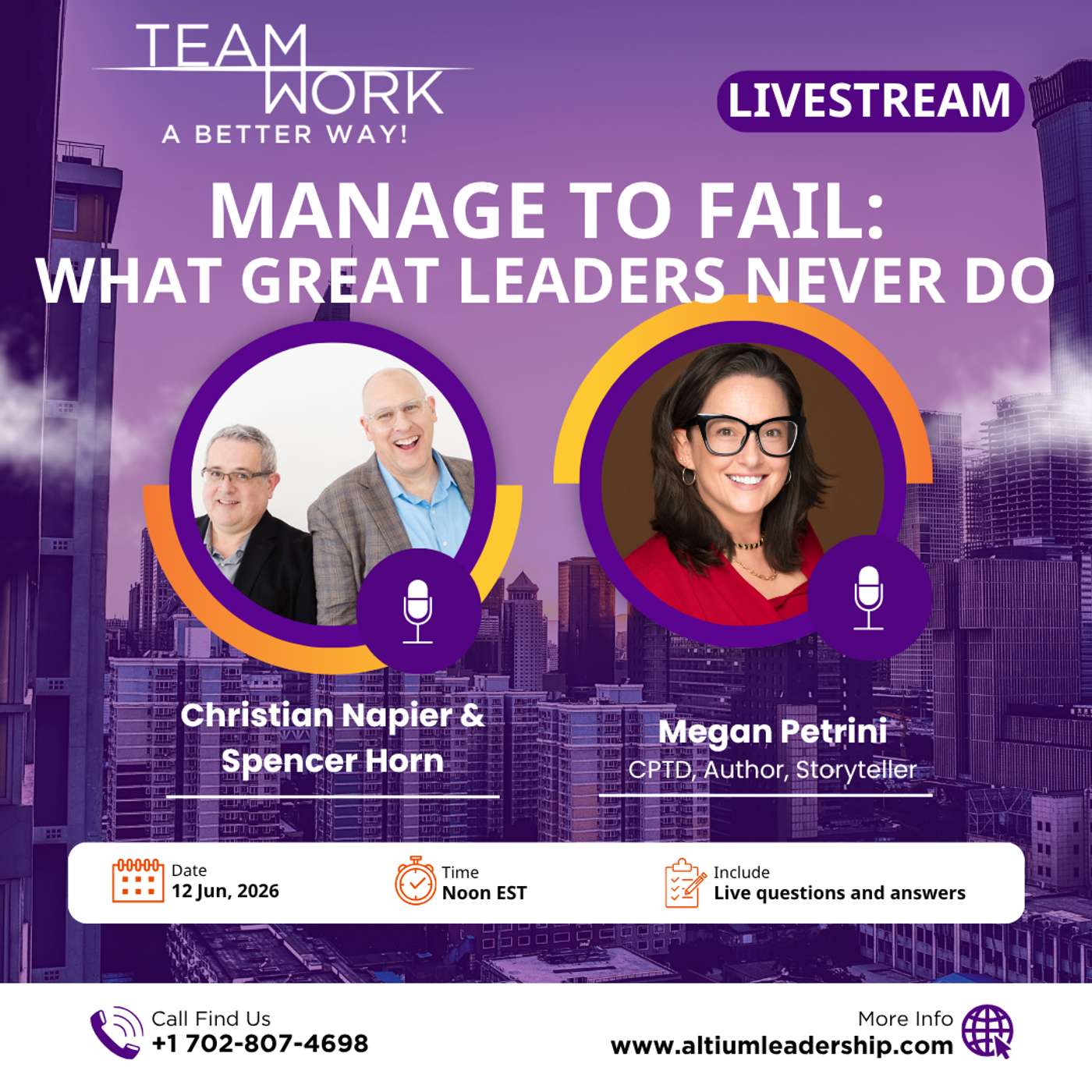 Manage to Fail: What Great Leaders Never DoTeamwork - A Better Way · on teamwork82 / 100
 The Strategic Pause: Navigating Chaos and High-Stakes Leadership | Ep. 88 ft. Norman LeachLeadership in Quarters: 15-Minute Culture Insights · on Psychological safety in teams76 / 100
 Hiring In The Age Of AIThe Digital Transformation Playbook · on Psychological safety in teams74 / 100
 Episode 365: Chess Club v. Drama Club: Where do you find your people and what does this mean for your professional style? Sally Bridgeland on culture and leadership.The Fiftyfaces Podcast · on Psychological safety in teams63 / 100
 Organizational Transformation in the AI Era: Building Teams that Adopt, Adapt, and ThriveThe B2B Revenue Executive Experience · on Psychological safety in teams63 / 100
 Why Your Neurodivergent Students Are Disappearing with Vanessa Castañeda GillThe Better Leaders Better Schools Podcast · on ADHD62 / 100
 Ep#230 Reach Top 5% Leadership Performance36 / 100
 Ep#229 How to Get Your Team to Succeed Without You46 / 100
 Ep#228 How to squeeze 30% more discretionary effort out of your team44 / 100
 Ep#227 10X - How to Lead Bigger39 / 100
 Ep#226 The Fatal Mistake Of Being Too Available56 / 100