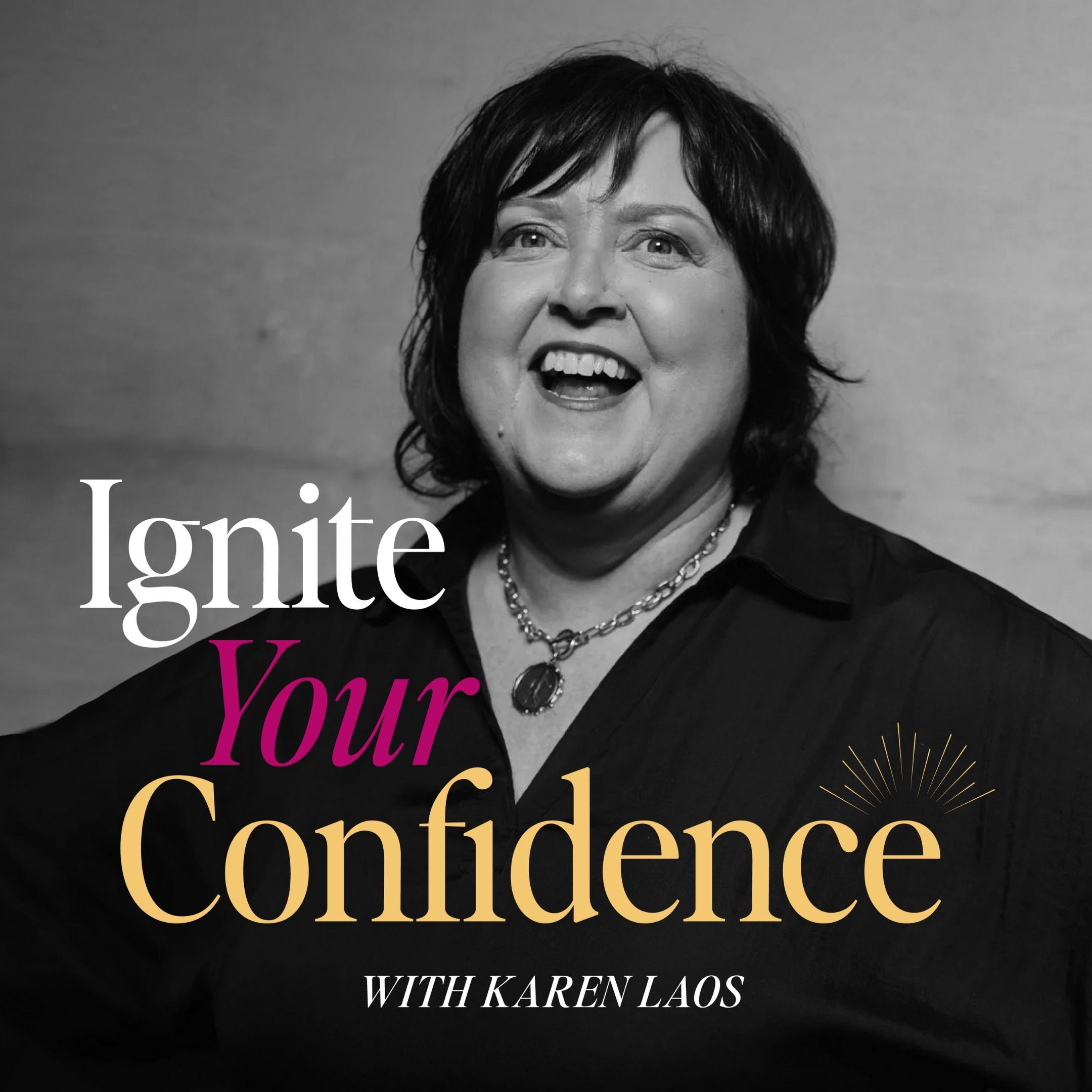
Ignite Your Confidence with Karen Laos · 2026-07-01 · 12 min
Key moments - from our scoring
Substance score
23 / 100
Five dimensions, 20 points each
This episode challenges the pervasive belief that leaders must be liked by everyone. Karen Laus uses her own experience interviewing for a radio host position - where she was asked if she could handle 50% of listeners disliking her - as a pivot point to discuss how approval-seeking undermines authentic leadership. Drawing heavily on *The Courage to Be Disliked* by Ichiro Kishimi and Fumitake Koga, Laus frames the release of approval-seeking as the "ultimate freedom" and reframes boundaries as "standards" you refuse to compromise. The episode is part one of a two-part series offering five concrete tactics: quantifying the cost of silence, building evidence of survival through weekly challenges, monitoring your apology habits, recognizing that people recover from boundaries, and systematizing rejection through exercises like Allison for Gail's "collecting nos" practice. This is essential listening for female leaders who struggle with people-pleasing, over-explaining, or seeking permission instead of making recommendations - patterns that directly erode executive presence and credibility.
Karen recommends noticing your approval habits throughout the day by asking yourself if you apologized unnecessarily, softened your opinion, asked permission instead of making recommendations, or over-explained. She suggests replacing 'I'm sorry' with 'I'm sexy' as an internal reframe to break the habit, though this is meant as an internal laugh, not for boardrooms.
Karen shares her experience leaving corporate to start her business and setting a boundary with a friend by charging for resume reviews instead of doing them free; the friendship survived and the friend moved on quickly. She notes that emotionally healthy people typically recover from boundaries within five minutes and don't dwell on the conversation.
Karen's boss pointed out she always presented information but asked others what they thought first; she taught herself to lead with 'here's my vote' to signal her own perspective directly and diplomatically. This technique works in meetings and group settings where you normally defer to others' opinions first.
Give yourself one small challenge every week, such as sharing an unpopular opinion, asking the question everyone is thinking, negotiating a fee, saying no without guilt, or leaving work on time. Each successful experience teaches your brain that you're okay even when someone isn't thrilled with your decision.
Allison for Gail, author of *Likable Badass*, has students collect 10 'nos' over a month or two by asking for things in low-stakes environments like airplane seat upgrades, discounts, or introductions. The exercise builds rejection tolerance and usually reveals that far more people say yes than expected, reducing fear of causing disappointment in others.
Our reviewer’s read on each dimension, with quotes from the episode.
The episode offers five tips that are largely generic personal-development advice (say no, set boundaries, collect rejections) with minimal novel framing for a B2B operator. The reframe of 'what's the cost of being liked' is the most interesting inversion, but the rest is padded with personal anecdotes and obvious conclusions.
What's the cost of being liked? It's not something we think about too often.
I taught myself to say, here's my vote.
The episode's central concept is borrowed directly from a named bestselling book, and the five tips recycle standard self-help fare (say no, notice approval habits, get comfortable with rejection). The 'here's my vote' reframe is a mildly fresh tactical suggestion but not a counterintuitive or first-principles idea.
I chose to title this episode, The Courage to Be Disliked, is because I have learned a tremendous amount from this wonderful book called The Courage to be Disliked.
here's my vote. So many years ago when I was working in a corporation, my boss said to me one day, Karen, you always come to meetings with all of the information.
This is a solo-host monologue with no guest at all. Karen Laos is a speaking and confidence coach who left corporate work in 2003; there is no practitioner, operator, or domain expert present to lend credibility or depth beyond the host's own coaching anecdotes.
Welcome to Ignite Your Confidence for women in leadership who want to speak up and stand out. I'm your host, Karen Laus.
I was focusing at that time more on career coaching.
There are a handful of concrete references - the named book and authors, the '10 million copies' figure, Alison Fragale's 'collect 10 nos' exercise, and a 2003 career pivot - but no business metrics, revenue data, or case studies relevant to B2B operators. Most evidence is personal anecdote.
It is by Ichiro Kishimi and Fumitake Koga. It has more than 10 million copies sold worldwide
Allison for Gail, who's the amazing person and author who wrote likable badass has a fabulous exercise that she gives her students
As a solo monologue there is no interview dynamic, no follow-up questioning, and no productive disagreement. The questions posed are entirely rhetorical and surface-level, functioning as rhetorical scaffolding rather than genuine intellectual probing.
So I want to start with first of the number one is asking yourself, what's the cost of being liked?
Did I apologize when I didn't need to?
Computed from the transcript - who did the talking, and the words that came up most.
How much of your life is driven by the need to be liked? In this episode, I'm sharing why the courage to be disliked is one of the greatest gifts you can give yourself. When you stop seeking everyone's approval, you make room for confidence, authenticity, and the kind of leadership that earns respect. You'll walk away with five practical strategies to help you speak up, set boundaries, and trust yourself - even when not everyone agrees. In this episode, you'll learn: Ask yourself, "What's the cost of being liked?" Before staying silent or saying yes when you mean no, consider what it's costing you - your confidence, opportunities, time, energy, or credibility. Build evidence that you'll survive. Challenge yourself to do one uncomfortable thing each week, whether it's setting a boundary, asking for what you want, or sharing your opinion. Confidence grows through action. Notice your approval habits. Pay attention to the moments you over-explain, apologize unnecessarily, soften your message, or stay quiet to avoid disappointing someone.
Transcribed and scored by The B2B Podcast Index.
Welcome to Ignite Your Confidence for women in leadership who want to speak up and stand out. I'm your host, Karen Laus. Here you'll get all of the tips and tools that you need to stand out with unshakable confidence. Let's jump in to today's episode.
Today's episode is the courage to be disliked, the ultimate confidence. many years ago, I was interviewed to be a radio show host and it was newer in my career. I was quite young and I was really excited about this. I do the interview and at the end, the guy says, okay, I just have one more question for you.
I want you to picture this. You do this, you do your show afterward, 50% of the people are going to love you. They're going to say all these amazing things about you. They're going to say how much they loved the show, loved what you talked about.
And then 50% of the people are going to hate you. They are going to say the meanest, most awful things to you. And I need to know if you can go home and then come back and do it all over again the next day. Let me tell you, I was not ready for that.
I was definitely not ready for that. And that I believe was truly a divine appointment of God preparing me for a more public life, which I have now. And I continue to be working on these things. So I want to say that from the perspective of somebody that is still a work in progress and have come a very long way.
Now, why I chose to title this episode, The Courage to Be Disliked, is because I have learned a tremendous amount from this wonderful book called The Courage to be Disliked. For those of you that are watching the YouTube, you can see the book that I'm holding up. It is by Ichiro Kishimi and Fumitake Koga. It has more than 10 million copies sold worldwide, and it is a fascinating book.
And when we can release how people that release the need to be liked, that is the ultimate freedom. So a more positive way to look at this related to that freedom piece is, can we hold our ground? Can we stay true to ourselves rather than being so fixated on being liked? So there's lots of things that we could talk about today.
And I want to give you, this is actually going to be a two-part series. This is part one. I've got 10 tips for you total for the two episodes, but today I specifically have five. So I want to start with first of the number one is asking yourself, what's the cost of being liked?
It's not something we think about too often. What's the cost of being liked? For example when you about to stay silent or avoid conflict ask yourself what will this cost me Maybe it credibility Maybe it time Maybe it money energy respect It is fascinating when you think about it the other way around, because usually we think, what's the cost of being disliked? I don't want to be disliked.
I want to make everybody happy. But let me just give you a newsflash, which is something I realized a long time ago myself is, oh, not everybody's going to like me anyway. So why not be true to myself? There is no way that you can please every single person.
And we all know this. It's still, though, sometimes harder to actually live it out. I will never forget when I was in high school. So my maiden name is Habiger.
And my boyfriend at the time, we were walking through the halls of high school. And a guy didn't say hello to me that was walking by. And most people said hello to me. So I was bringing that up and he said, oh my gosh, she wasn't being very nice, but it's kind of funny when I look back to this, somebody didn't like Karen Habiger.
What? Somebody didn't like you. I can't believe it. It wasn't very nice, but it was very memorable because at the time it really felt like a personal attack.
Why didn't he like me? And it is amazing how much energy we can waste when we're so fixated on somebody wanting to, or wanting someone to like us. Number two, build evidence that you'll survive. Even if someone doesn't like you, give yourself one small challenge every week.
So for example, try sharing an unpopular opinion. And a way that I would recommend this as a specific tip is to use what I call, and I taught myself this, here's my vote. So many years ago when I was working in a corporation, my boss said to me one day, Karen, you always come to meetings with all of the information. And then you look at us and you say, what do you all think?
I want to know what you think. And that stopped me in my tracks. I had never really thought about it because I was always, I grew up that you're always focused on everybody else's needs. You make sure everybody else is comfortable and to have somebody care about what I thought, first of all, just was a foreign concept, to be honest, or at least me believing that they cared.
And it was simply my habit was making sure everybody else is first. So I taught myself to say, here's my vote. What I like about that is that immediately people know, oh, everybody gets a vote and it's direct and diplomatic. So another more examples of building evidence that you'll survive, ask the question everyone is thinking or negotiate the fee when you normally wouldn't have.
Say no without guilt. That might be a little harder one, but it's worth considering. Leave work on time for those of you that work in an office Decline a meeting that isn necessary Or even say hey am I the best person to be here Maybe somebody else on the team would be a better fit and would give them an opportunity. Every successful experience you have teaches your brain this.
I'm okay even when someone isn't thrilled with my decision. Number three, notice your approval habits. Ask yourself throughout the day, did I apologize when I didn't need to? And as a reminder, instead of saying, I'm sorry unnecessarily, remember to first start by saying I'm sexy.
It can make a difference. It's a great way to make you laugh. And it's also maybe not to say out loud in a business meeting, but inside saying to yourself, did I soften my opinion? Did I ask permission instead of making a recommendation?
Did I over explain? Did I stay quiet to keep the peace? Awareness is the first step toward changing the pattern. Let's go with number four.
Notice that people recover. People recover. We tend to assume that one boundary will ruin a relationship. It can be terrifying.
This brings me back to when I left my corporate job to start my business back in 2003. I was focusing at that time more on career coaching. And I will never forget that I was terrified when I started the business because I had the habit in my friend group of reviewing their resumes for free. So one woman asked me to do it.
And I was terrified to say no, but I knew I had to. And it was so liberating. I mean, that was a long time ago now, but I remember that so vividly because I was able to say, I would love to do that for you. Now that I charge for it, because I'm doing that for a living, I would need to, I would need to, you know, an hourly rate of X, Y, Z, whatever it was.
So it's so liberating when you set boundaries and it didn't ruin the relationship at all. She did say no, but that's okay. We still spent time together. And in reality, think about it this way.
Most emotionally healthy people move on quickly. You don't have to spend hours worrying about a conversation they stop thinking about five minutes later. And then number five, get comfortable with hearing no. The more you experience rejection yourself, the less you'll fear causing disappointment in others.
Allison for Gail, who's the amazing person and author who wrote likable badass has a fabulous exercise that she gives her students. She's a professor. What she does is collecting nose. And in the case, in the course of, I believe it's a month or two, she has them collect 10 nose, see if you can collect 10 And then that helps to build that muscle And she said most of the time so many more people actually said yes it was hard for her students to collect the nose I thought that was fascinating.
Practice asking for things in a low stakes environment, because that'll help you with the higher stakes situation. So things like a better seat on the airplane or an upgrade, ask for a discount. At retail, a lot of people don't do this, But for example, if you're at a mom and pop shop or boutique, that might be a time to say, is there any flexibility on the price? Or if you buy two or three items, is that something that you'd be able to offer a discount on something to the tune of that?
Or maybe it's even asking someone for an introduction and see what happens. I said no today to someone because I was doing a group thing for a community that I'm in. And she said, I was reviewing people's videos and giving them feedback on how they come across. And she said, Oh, would you be so kind to do this?
I said, well, because I do this for a living, I wouldn't be able to do it one-on-one unless you were paying me, but we can do this as a group again, or we can try to get some people together, something like that. So those are my five tips for you today. And my reminder to you is be more aware of times when you are wanting to be liked rather than saying what you mean or asking for what you want. And that will be a game changer.
I know for me, I continue to work on this. I'm getting better and better and better. And so I want you to know I'm in it with you. And I've also learned a few things.
So boundaries work. And another way to think about boundaries, sometimes another word lands better for people is standards. What are the standards that you uphold that you won't let anybody push against? So it's determining, and really it's just a decision.
What do I want to hold fast to and where might there be flexibility? And knowing the difference so that you're not waffling and wavering with every situation that you're in. Have a wonderful rest of your day. And remember that if you know somebody that is looking for a speaker for their event, I would love an introduction.
And if this podcast has been valuable for you, it is tremendously helpful to have reviews on the site. So please review when you can. I would be incredibly grateful. And it gets more people that need to hear about these things in the circuit, however you want to put it, getting the information that's needed to help everybody speak up and stand out.
And that's a wrap of another episode of Ignite Your Confidence. I'm your host, Karen Laus. Thank you so much for listening. If you loved today's episode, please subscribe and Libre Review.
It helps other people find the podcast faster, and it certainly helps me. Remember, you too can stand out with unshakable confidence.
How to Build Relationships Through NetworkingThe Perfect Comeback: What to Say to Condescending or Awkward CommentsThe Cost of Talking Too Much (and how to fix it)Unshakable in Life’s Storms: The Power of Hope through CommunityThe Hidden Cost of Indecision