
Humanize IT · 2026-07-20 · 23 min
Key moments - from our scoring
Substance score
52 / 100
Five dimensions, 20 points each
The hosts frame AI's trajectory by comparing it to the 1997 internet landscape, when technologists could reasonably predict outcomes like Google's dominance and the browser wars' conclusion. They argue we're now in a position to forecast AI's near-term evolution with similar confidence. Rather than standalone chat interfaces, the future involves AI integration into core business systems - what they call 'harnesses' - that orchestrate data and intelligently suggest actions within existing workflows. This shift mirrors the move from dial-up email checking to always-on notifications. The discussion emphasizes practical enterprise adoption: AI will power ERPs, assist field technicians with real-time pricing and inventory intelligence (84 Lumber lumber price drops, Ingram bulk orders), and handle routine knowledge work like SOPs and duplicate problem-solving. However, token costs will become a critical pain point, driving demand for efficient models and raising scrutiny around free alternatives. The hosts highlight the risk of free AI services that compensate through data harvesting or content manipulation, using news media paywalls as an analogy. They conclude that businesses adopting AI-assisted workflows - through tools like Humanize AI's integration with PSA and RMM systems - will gain significant competitive advantages, while those ignoring AI will fall behind rapidly.
A harness is an orchestration layer that connects all business data sources and systems on the backend, so that AI assistance feels seamless and integrated into an employee's workflow - like having an assistant automatically suggest relevant documents, SOPs, or prior solutions without the user having to request them explicitly.
Efficiency improvements in model architecture and token usage will allow businesses to accomplish the same tasks with fewer tokens, while orchestration layers (harnesses) will select the lowest-cost appropriate tool for each specific job rather than routing everything through expensive flagship models.
Free AI models often compensate for their cost through data harvesting, content manipulation, or undisclosed partnerships; businesses should either verify that efficiency gains are transparent and architecturally sound, or pay for reputable services - and be intentional about what data they send to free services to manage IP and security risk.
Companies that integrate AI into customer acquisition, product delivery, and employee workflows will effectively amplify their capacity - comparable to hiring 10 times more staff - while competitors who ignore AI will fall behind rapidly in speed, efficiency, and customer targeting.
The hosts favor Anthropic's Claude as the most likely to become dominant (like Google or Microsoft) due to its ethical positioning and reliability, though domain-specific and cost-efficient alternatives will coexist for different use cases rather than creating a single winner.
Our reviewer’s read on each dimension, with quotes from the episode.
The episode contains moderate substance with some useful framing (AI as an always-on orchestration layer, cost efficiency as a coming focus, specific use cases in MSP contexts) but padded with repetition, casual tangents (Internet Explorer history, generac generator ads), and abstract speculation. The 'harness' concept and token cost discussion offer practical takeaways for B2B operators, but much of the runtime is conversational throat-clearing rather than densely packed insight.
Harnesses are like orchestration layers and they, they connect all the data for you on the back end
Tokens equal cash
The episode relies heavily on well-worn comparisons (AI like 1997 Internet, always-on connectivity parallels, Clippy references) and recycled frameworks (AI integration into workflows, cost efficiency concerns). While the 'harness' concept is articulated with some freshness and the MSP-specific angle is relevant, the overall thinking is derivative of existing venture-backed narrative around AI-as-infrastructure. Few genuinely counterintuitive or first-principles arguments emerge.
So this is kind of like 1997 Internet
imagine like you know being in any kind of field like where the AI itself isn't a general AI
Skip Zigler is presented as a technical practitioner with networking and systems integration experience (ISDN rollout, MSP work), which is relevant to the topic. However, neither host demonstrates operator-level scale (C-suite revenue responsibility, scaling a major business using AI, enterprise-wide deployment stories). They are informed commentators rather than battle-hardened practitioners who have shipped AI solutions at meaningful scale.
the networking guy back there
we're integrated, we're becoming a partner uh, in an msp
The episode is light on concrete data, named companies, metrics, and timelines. References are mostly generic ('Anthropic,' 'ChatGPT,' 'Claude') without specifics on deployment scale, ROI, or pricing. The '84 Lumber' example is illustrative but vague. The $10,000 API bill anecdote is borrowed and unverified. Token cost discussion lacks actual pricing benchmarks or case studies. Too much hand-waving about future scenarios without grounding in current evidence.
Did you know that 84 Lumber reduced the prices of 2 by fours by 3 cents today
why do I have this ten thousand dollar appy bill
The hosts engage in a casual back-and-forth but lack sharp questioning, productive friction, or follow-up depth. Most exchanges are affirming ('Yes,' 'Yep,' 'That's right') rather than probing. Neither host pushes back on vague claims (e.g., 'harnesses will choose the best tool for you' - how, exactly?). The discussion of free AI models touches on risk but doesn't interrogate trade-offs rigorously. Questions are often leading rather than genuinely investigative.
Yep
Yeah, and I do see a shift in that
Computed from the transcript - who did the talking, and the words that came up most.
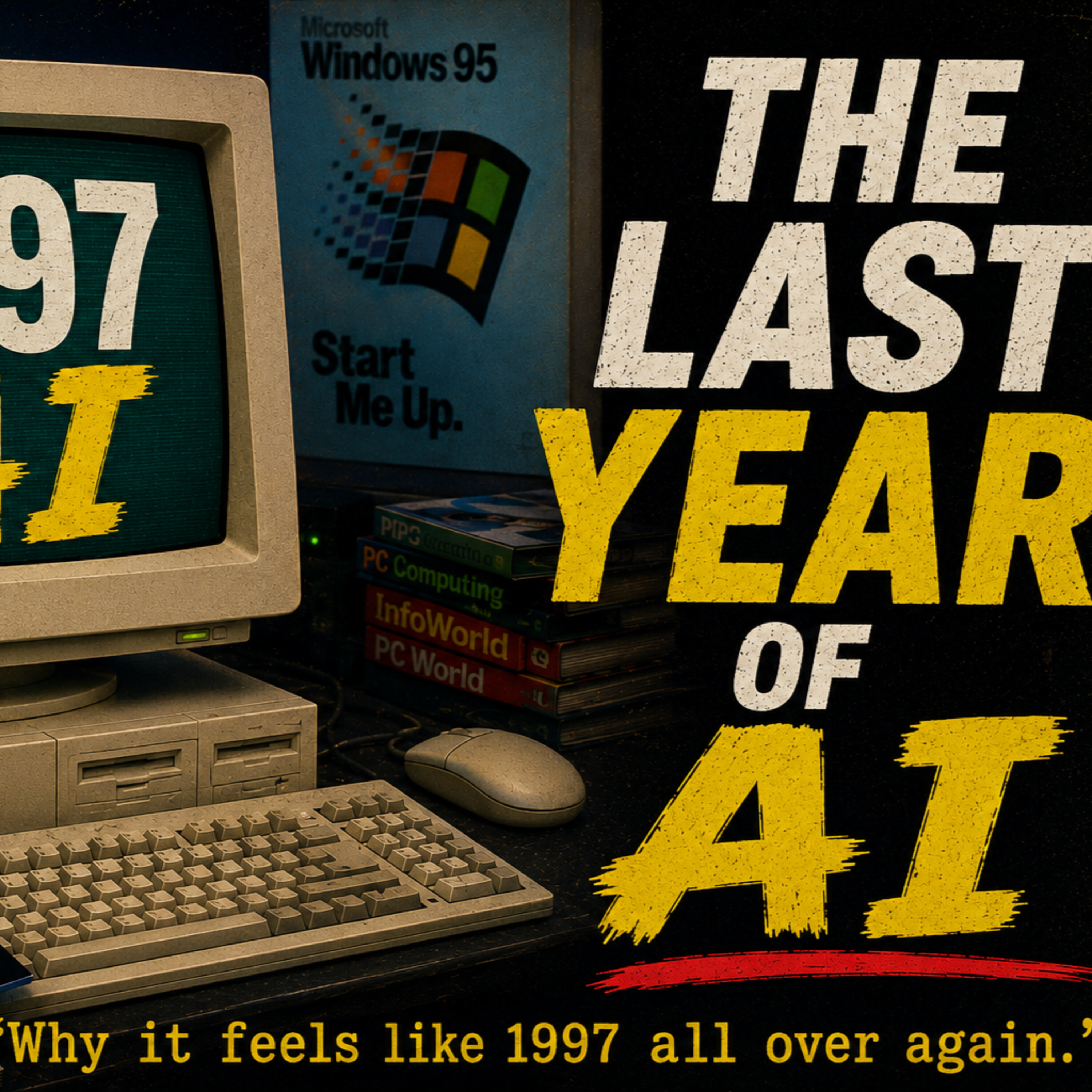
In recent years, Artificial Intelligence (AI) has transformed the landscape of technology, yet many still wonder about its future trajectory. Are we headed towards a predictable outcome, or is the chaos of rapid development leading us into uncharted territory? This blog post aims to shed light on the direction of AI, drawing parallels to technological advancements from the late 1990s.
Transcribed and scored by The B2B Podcast Index.
Speaker A: Welcome to the Humanize it podcast, where we keep the human first. Each week, hosts Adam Walter and Skip Zigler will guide you through topics on how to empower m your business in this new world being disrupted by AI. Let's get started with today's episode. All right, everyone. Last week we talked about, uh, where we were. So this is human eyes. It talking about where we were and where we are going. And so this, this episode I want to talk about, like, where are we going? So AI is moving so fast, it'd be nice to know, like, are we going somewhere predictable or are we still so chaotic that we can't tell where we're going? Well, if you ask somebody in 97. So last episode we talked about how we're kind of like 90, 90, 1997 Internet. If you ask a tech person in 97, they had a reasonably good guess as to where we were going. We knew that Dell and Gateway were going to take over PCs. We knew that around there, Google was starting to become this cool new search engine, and the gut feeling told us that was where it was going. Netscape and Internet Explorer were still fighting, and we all had our opinions on which one was better. We probably would have picked Netscape at the time because we just really hated, we really hated Internet Explorer because it was Microsoft.
Speaker B: No, you got, you got that backwards. We hated Microsoft. So we didn't like Internet Explorer.
Speaker A: Yeah, yeah. So, um, we love, we love Netscape because it was like the, and it was a great browser. And today that'd be the equivalent of Chrome.
Speaker B: Right.
Speaker A: So longer story there. Whole other series of podcasts to get to that topic. Anyways, so we had a reasonably good idea where the Internet was going. You can ask somebody. Like in 2002, uh, uh, we knew Google was the, the, the strong force. So just a few years later, we knew that Google was the dominant. That was before they went public. I remember that was again, 2000 or 2001. We knew that, you know, the, the browser wars were over and Explorer had won, with Firefox and Mozilla being a second. And today you got. If you talk to technology people listen to the gut, right? Generally the gut's going to be okay. It's gonna figure things out. And so what we want to do is talk today about where are we going over the next year. And so we're going to go away from chat. Being an AI, like, it'll always be there. It'll kind of be the dominant force for a while because it's easy and people understand it. But what we really want to talk about is who has the best system.
Speaker B: Yes.
Speaker A: So if you talk to Anthropic, you've got Claude, you've got Perplexity, you've got now Claude, uh, is it create or Claude, uh, design. And you've got These specific use AIs within the cloud ecosystem that are extremely powerful. And so I use Anthropic for pretty much everything. And if Anthropic has issues, I just Switch over to ChatGPT or I switch over to another model. But most of the time I'll just like, eh, uh, I'm gonna get a cup of coffee, they'll be up in 20 minutes.
Speaker B: Uh, yeah, and I do see a shift in that. But I want to talk about something that kind of occurred to me in between these two episodes and in aspects of where we're going. So I mentioned just briefly. So my first, you know, always on Internet connection was at the um, the city government that I was working for at the time. And like I said, the first one I brought line was on was an ISDN connection. All right. So it had two 64K channels, right. And you could maintain one constantly. But then when the, the need arose it would bond the two together and you had a, you know, super fast pipe. Right. So as I'm, as I'm rolling this out, there's a lot of our users that are, they're getting it right. Uh, they're saying, oh great, I don't need this modem here anymore, all right. I don't need this device, I don't need this extra phone line. All right. Um, I don't need to wait for it to dial up and connect and, and, and me do this. It'll, when I want it, it will just be there. All right. And so that was an easy to grasp concept, but as the, the networking guy back there, I kind of saw some other things. It's not, no, I've made it easier for you to go check your email. No, I'm making it so that your email is always present because that used to be a thing used to have to dial up, connect, go through this whole process to check your email, then disconnect from your email. Uh, uh, I know in some cases we might want to go back to those days. Right. But that, that, that shifted all. Uh, right. It's just always there. As soon as you get that email you get a notification. And so it integrated email into the literally minute by minute workflow of your day rather than a one point check. I think there is A lot of real strong analogies in that to AI. Rather than going out and using it, it's going to empower everything. So taking the same approach as I did back then, I think we can leverage our technical perspectives and see those. Maybe not the long distance, you know, future on those, uh, with a lot of detail, but the near term. I think we are at a spot now where we can start saying, all right, if this is just always available, if this is just wired in and integrated into the workflow, these are the obvious shifts and changes that will happen with the tools and the things that are in place. By empowering it with AI, it's going to instantly create this effect. All right. And it doesn't require that sophisticated level of crystal balling, like for me, all right, I know you log in, you download, you get, you know, a notification on the X number of emails you have, you log off. All right, I knew that that would shift to emails are just going to show up as, as they come in. That was just technical data. And I think we can take that approach right now to see what we can do today, tomorrow, and in the next phase as a logical technical step of capabilities of how we use AI.
Speaker A: Ah, yeah, it'll be more seamless and that, you know, you'll have, uh. I don't know if it's gonna be voice command. I know a lot of people are really into voice being the future of AI. And that's your Jarvis feel like, where you can just say like, I love the fact that I can just tell Alexa to add something to the shopping list. It's great for me, but you know, like, you know, or we can say, hey, uh, who sings this song? Or, you know, you just say it out loud. Right? It's just convenient. But then there's also the paranoia of like, why do I keep getting ads for things I had in a conversation 10 minutes ago? Like, you and I had a conversation on generac generators. I've been getting ads for generac generators the last 24 hours.
Speaker B: Yep.
Speaker A: I have not searched for one. I have not looked it up. I mean, the, uh, only time I mentioned that was in our conversation where you and I were talking. And now I'm getting ads for them on tubi. Huh, huh. So, so anyways, there's a lot with, there is a little bit of paranoia there. But also, I mean, when we start seeing things like where AI is going, like harnesses. Harnesses are like orchestration layers and they, they connect all the data for you on the back end and all the Issue all, all the stuff so that when you as a human sit down and go to work, you don't feel the orchestration, it just kind of happens. Yes. Like you, like this is where like you're gonna start open up a Word document. You don't think about AI and you start typing and it notices. Like, hey, did you know you typed this document three years ago? Would you like to pull that up right now? Yeah, Clippy might make a comeback. That'd be fun. Where you say, yeah, let me know. Because sometimes you're duplicating work. Sometimes it's like, hey, uh, just letting you know this, this area here. There was an article that came out yesterday on, you know, use of AI in mental health. Would you like to read it and maybe reference it in your, in your article here? And so that it's seamlessly adding on. And that's kind of how a harness works is where it's, it's pulling everything you're doing together and orchestrating in a way that feels normal. Like as if you had ah, an assistant sitting over here proofreading your documents. And so they bec. They, they're gonna become more part of an operating system and the, that where it's just naturally part of your day where you assume it's there and whose is it gonna be? I don't know. You know, I am betting on Anthropic right now. I'm betting on Anthropic being the new Google, being the new Microsoft. There's good things and bad things to that. They have to be highly ethical and that, that is going to help a lot of.
Speaker B: Yep.
Speaker A: I mean Google's whole theme when they first started was do no evil. I mean they get made fun of for it, but that was their theme in the beginning and. Cause they wanted people to be not threatened by the Internet, but there's gonna be people that are gonna say like their systems are all over the place. Like we have ERPs and we've been struggling with ERPs for freaking 40 years. Ask any IT person what they think about the ERP. ERPs aren't even the IT people's problem half the time. It's another team that has to deal with that, that mess. I see AI coming in and solving that mess and orchestrating all of those systems where you're, you're uh, you're putting a layer in where you sit down at your desk and this AI is aware of the entire business's doings. Don't worry about it. There's, there's gonna be Permissions. And there's going to be context there where some people aren't going to be allowed certain information, but the AI is going to be sitting there, you're going to be typing up a document, typing up an email. He's like, I don't know how to do this. Like, oh, there's an SOP for that. Would you like me to pull it up? You're missing that document. Karen has it. You should go talk to her.
Speaker B: Or you know, someone else in the organization just solved that problem yesterday. All right.
Speaker A: Yeah.
Speaker B: Would you like to pop over in
Speaker A: Chicago had that the same thing happen. Mhm. And he put a ticket in and they resolved it like this. So all you have to do is click here, that kind of assistance. And as you go, your AI will get smarter and smarter, smarter. But it'll be sitting in your, in your OS like anything else. And imagine like, you know, being in any kind of field like where the AI itself isn't a general AI, but it's okay, you're a carpenter. Hey, did you know that 84 Lumber reduced the prices of 2 by fours by 3 cents today? Make sure when you put in your orders today that you go over there. You only have to change your price, your customers. But that's higher margin.
Speaker B: That's right.
Speaker A: And so you know to go over and get your lumber from 84 lumber. Or did you know that if you order this part through Ingram that it's going to be $20 cheaper or they've got a bulk of this in, in, in uh, shop. I know that you order these every month and you want to get ahead and order them now and save yourself 2000. The AI will start understanding your workflow. It may not know how many planets are in the solar system, but it will know what your order or what your order pattern is for the next 60 to 90 days.
Speaker B: And those efficiencies aren't kind of back to Claude. Right. And so I'm definitely on the same page with you there. I think Claude is definitely the leader in this space and probably will be for a little while. But that doesn't necessarily mean it is the best tool for all situations. Right. And so when you're working with clients and you're looking for solutions, sometimes it's not just what you can do, it's how you're going to do it. What are the tools? And you know, there's always that, that constant factor of what is it going to cost to implement this solution. And so there may be a variety of tools out there that in some metrics don't compare to one of the Claude models. But for what you're wanting to do and being able to achieve the solution that really fits the situation, there may be plenty of other cheaper or in some cases even faster solutions out there. So having that technical understanding and that ability to wire these things in under the hood is going to be a, uh, very powerful deliverable for a lot of MSPs, you know, our main target audience. It's not that, you know, AI is going to make your jobs go away. No, AI is enabling whole new areas for you to sell services to your customers. So that's, that's a really cool place to be. You know, it's, it keeps you competitive and relative in the marketplace. But you do have to kind of lean in on that and, and get a little creative. But I do think kind of back and forth with our last episode on this one. I, I don't think anybody generally nobody knew what AI was going to do. Last summer. It, we knew it was big, it was powerful, all kinds of cool things. Right. But now that we've got a year really using it, I think we have a much better understanding of at least the next handful of steps for practical application that are viable business solutions. And they're, they're not necessarily things that are just going to evaporate with another, you know, new model release or something. It's, it's architectural. Right. It is just a fundamental element that, you know, the, the phone that you're carrying can access powerful tools. But what happens when you want to embed that powerful tool? Well, there's still limitations for the foreseeable future of the compute power that we can put into a handheld device. Right. So that's a very rigid and you know, trustworthy, I guess, you know, fact that you can work with right now. So what tool will fit best to do the job that needs to be done? Right. And that's going to take some technical under understanding and you know, uh, again be, be a great value to deliver.
Speaker A: Yeah. And that's part of what a harness will do. Right. Harness is going to choose for you what tool is best to solve the job. The other thing that's gonna be huge this next year is cost efficiency. M. So as, as Skip and I constantly are running into, like you run out of tokens, um, you know, there's only so much budget to go around, guys. Tokens equal cash.
Speaker B: Yep, that's it.
Speaker A: And you know, you've got other expenses in the business and you've got to, you Gotta figure out like, okay, how do I save on tokens? Even if I can save like 20%, that's huge. Because as businesses become more reliant on AI, that's gonna be like your electricity bill, it's just gonna keep going up. As you started using more computers, our bills started going up. And so what we wanna see is more cost aware, compliant and safe AIs in businesses that are gonna help us do things. So you're gonna see advertisements like use 20% less tokens, you know, with this, or you know, be for free with this. All tokens for free. But you know, maybe you have to watch a ton of ads like think streaming service this year. People like you're going to see people really concerned with the cost of tokens. And so watch for those free models where they're either selling your data.
Speaker B: Uh, yes.
Speaker A: Or they're manipulating the data. Like right now, anything that's a free news source, assume it's manipulating. It's either it's either costing you in ads or it's costing you in content. That good investigative reporting is still behind paywalls. You have to have a subscription to a good service like Wall Street Journal, New York Times, uh, pick your favorite slanted news media, but you have to pay for it. But if you're getting news for free, there's a slant to it because somebody has to pay those journalists. Either it's the ads or it's a party or it's a special interest group. Same thing with AI. So over the next year, as you become more cost sensitive, be aware. Like either they need to be open about how they're being more efficient with their model. So like let's say if you're saving like 20%, 50%, no problem. That just means they're being more efficient with a harness. Uh, that is efficiency. But if it's like free, be aware somewhere somebody has to pay the bill.
Speaker B: Yes.
Speaker A: Who are they paying the bill and why becomes the answer. So same thing, you should be asking about your news sources, about your data sources. If it is free, if you are seeing it as an article online and you don't have to pay anybody and you see a bunch of ads on the sides, that's a good indicator that this is a bought in paid for article. This is not a uh, independent source. And so when you, when you look at that, be aware that that's going to come over the next year. It's going to be a big topic. Who is got the most efficient uh, AI and how are you using?
Speaker B: Yeah. And I think, yeah, that that cost element is really going to be on it was silly little video uh, skit, uh, that I saw a little while ago and the CEO, you know, burst into the uh, into the off or the conference room there and goes, why do I have this ten thousand dollar appy bill? You know? And everyone's looking at him, M Appy bill? What are you talking about? And finally, you know, one of the coders realizes, happy, do you mean API? And all of a sudden it dawns on everyone, you know, because they had this AI is it, you know, do this, do this, do this. And yeah, there's a cost to it. And kind of the, the punchline on the, on the little skit was $10,000. I can hire people for cheaper than that, you know. So yes, there is a very real cost. But as you get into this and again back to the skill set that you can develop, you know, some of those free models that are out there, their caveat is, and yeah, you need to choose reputable sources, right, uh, you know, of where you get these or even experiment with these sort of uh, tools available to you. And I think the, the more reputable ones are upfront about saying hey, yes, we're offering this free or you know, just unbelievably discounted because we're using it. We're using your data to train our next generation of AI. We're using you for free research and development. All right, as long as you're okay with that and you understand the context that it's in, then that might be a solution. All right? But to wire that up means you need to be very intentional about what you are going to send there. It's free, right? But are you sending your company's IP off to who knows where? Right? So now that wouldn't be good. But if you sent some sort of processing task, right, or a tool use where it's essentially how do I run this bash command, um, then you've not eliminated, but you've drastically, drastically reduced your visibility or your risk in that area. And if you understand that then you can put that in your risk matrix. You can make business decisions about that and you may be able to capitalize on that soft, uh, that cost savings. Or you might look at that and go, no, we're just going to have to pay the money. But then you have the assurance that we're going to keeping things secure, we're managing this with less risk and we can refocus our efforts in other areas because we know this is tightened down the way it needs to be. So again, there's just a lot of very technical details that are emerging here to make this viable for businesses and it's a great opportunity to jump in there and help businesses do well with AI.
Speaker A: Yeah, I, you know, that's, that's just kind of like the focus here. Right? We're coming up on the end of this podcast. What's the next year like? Kind of wrapping this up. Like you're going to see a little bit more natural feel, you're going to see More specific use AIs and you're going to see a lot more business integration over the next year. You're going to see AIs just become a part of the corporate world. Will it become part of the entertainment, uh, world? That's an interesting topic. And I, I, that's another topic for another day. But right now, business wise, you're gonna see it one way or another. Like if you don't have AI integrated into your business, helping you, uh, find more customers, deliver better product, empower your employees, then you're gonna start falling behind extremely fast. Imagine if your biggest competitor were able to hire 10 times more employees. Could you compete with that? I don't know. That's on you. You know your vertical, you know your industry. Imagine if the person next to you started putting up 10 times more product or better product or we're able to target customers faster. What do you do about that? So you gotta catch up and they're using, you're just using your existing data, like humanized AI right now can go in with an MSP and just read the, the PSA rmm, your Microsoft licensing information and just, hey, tell me where my problems are. And eventually once we get to the trust level, we'll start writing back to the ticket system. But what's happening here is we're integrating, we're becoming a partner, uh, in an msp and that's important and that's going to happen everywhere. We're just a little ahead of the curve. All right, Skip, thanks for coming on and looking through the crystal ball for me, you know, or this next year is going to be tight. I wonder where we are going to be, how much these predictions are going to come true. I really think that the efficiency is going to be a huge one over the next year. Everybody's complaining about token costs already.
Speaker B: Yep.
Speaker A: Try run a fable sometime, people. If you really have a lot of money, it'll take care of that.
Speaker B: Mhm. And then I know that for a fact.
Speaker A: Contextual knowledge of AI specific use. AI is going to be a huge thing where this AI solves this problem. All right, everyone. Well, we're trying to get back onto it. We'll try to get these out weekly and we'll see you next time. See you. Thank you for joining us today. If you like our podcast, please subscribe, comment and check out our Facebook page. Also, encourage others who want to see it transform to subscribe as well. We could always use your help.
Other episodes covering the same guests and topics, from across The B2B Podcast Index.
 Rebooting Enterprise AI with MCP and KubernetesPractical AI · on Anthropic Claude88 / 100
 ChatGPT Co-Creator Launches Jev, Salesforce Trains Koa, Self-Improving AIToday’s AI News · on Anthropic Claude87 / 100
 Legal Tech Doesn’t Need More “Lamborghinis” ft. Kara Peterson and Richard DiBonaBetween the Briefs · on Anthropic Claude87 / 100
 AI Is Having Its Dropbox MomentAI Proving Ground Podcast · on Anthropic Claude85 / 100
 Open-Source AI Battle, Google Throttles Meta, Micron Margins Moon | Edward Coristine & Tai Groot, Chad Rigetti, Pim de Witte, Yadin Soffer, Jack Morris, Neil Movva, Jakob Diepenbrock, Chris AltchekTBPN · on Anthropic Claude80 / 100
 CAD, BIM, and the AI Leap: Qonic & Raven!AI Across The Product Lifecycle Podcast · on Anthropic Claude80 / 100
 Legal Review with AI52 / 100
 The last year of AI
 Is MS Office dead?
 Virtual Employees: What are they?
 AI and Skynet: Navigating AI Ethics