
Garlic Marketing Show · 2026-07-10 · 46 min
Key moments - from our scoring
Substance score
71 / 100
Five dimensions, 20 points each
Nir Eyal, author of Beyond Belief, identifies a critical gap in how we understand motivation and behavior change. Most models assume knowing what to do plus wanting the benefit equals action, but Eyal argues this ignores belief - the third, essential component of what he calls the motivation triangle. He draws on research showing that persistence, not intelligence or secret information, determines whether people achieve goals, and persistence depends entirely on whether they quit. The limiting beliefs that pull us toward inaction are rooted in our brain's evolutionary drive to keep us safe, not to help us flourish. Eyal introduces practical tools including predictive processing (the idea that we simulate reality based on our beliefs rather than seeing it clearly) and inquiry-based stress reduction, a 2,500-year-old technique formalized by Byron Katie. This method uses four questions - Is it true? Is it absolutely true? Who am I when I hold this belief? Who would I be without it? - to help people recognize limiting beliefs as just beliefs, not facts. For marketers and business leaders, Eyal frames marketing as a belief engine: companies like Liquid Death succeed not by lying but by shaping customer expectations, which actually changes the customer's experience of the product itself.
Knowledge and incentives alone don't sustain behavior - you also need belief. Without believing in your ability to do something or in the value of the outcome, your brain's natural tendency toward passivity and safety pulls you back, and you eventually quit.
Persistence is the number one trait determining whether people achieve goals, and persistence depends on motivation. Motivation requires belief - specifically, believing in yourself and in the outcome. Without belief, quitting becomes inevitable.
The technique asks four questions: Is it true? Is it absolutely true? Who am I when I hold this belief? Who would I be without it? These questions help you recognize that what feels like a fact is just a belief, exposing how holding it causes suffering and opening the door to letting it go.
Marketing shapes customer beliefs and expectations, which literally changes how they experience the product - this is the 'experience loop' of believe, anticipate, feel, confirm. Companies like Liquid Death make water taste better not through lying, but by incepting special status into the customer's mind.
The brain's primary objective is survival, not happiness or growth. It generates limiting beliefs to keep you safe by pulling you toward whatever you've already done, since that got you here safely. Fear underlies all limiting beliefs.
Our reviewer’s read on each dimension, with quotes from the episode.
The episode delivers substantive ideas about belief as a mechanism for behavior change, including the motivation triangle framework, predictive processing, and inquiry-based stress reduction. However, significant portions involve storytelling (the flowers anecdote) and repetitive reinforcement of core concepts rather than new insights per minute. The core claim - that belief precedes and sustains behavior - is valuable but not densely packed with novel frameworks.
Motivation is not a straight line. Motivation is a triangle that in order to sustain motivation, we not only need to know what to do, we not only need the benefit, we also, and most importantly, need the belief
your brain is simulating reality based on your beliefs. So what it lets in and what it lets out, or what it lets in and what it doesn't let in is determined by what you believe, what you expect
The core insight - that belief shapes behavior and perception - is not new, and the guest extensively references existing frameworks (predictive processing, learned helplessness revision, Byron Katie's inquiry method, loss aversion). The application to marketing and belief as an 'experience loop' is reasonably fresh, but the underlying psychology is well-established. The originality lies in synthesis rather than discovery.
marketing is a belief engine. Uh, I call this the experience loop. That in order for us to actually experience what a product delivers, we have to incept that feeling inside our customers
We are all born helpless. What we learn is hope.
Nir Eyal is a three-time bestselling author with genuine practitioner credibility and deep research engagement. He has authored Indistractable and Hooked, demonstrating sustained focus on behavior change and user psychology at scale. His willingness to revisit his own frameworks and engage with primary research (calling religious leaders, studying prayer research) shows intellectual rigor beyond typical podcast guests. However, he is primarily a writer-researcher rather than an operator who has built/scaled a business.
I spent five years writing Indistractable. It was about this problem that everybody says that is so difficult to overcome. We all feel like we're distracted every day. And So I took five years, I dove into the research. There are 30 pages of citations to peer reviewed studies
I went to a priest, a rabbi, an imam, a monk, and a swami, so on the biggest five religions
The episode relies heavily on anecdotes (mother's flowers, personal prayer journey) and references broad research findings without citing specific studies, authors, or numbers beyond the 11 million vs. 50 bits framework. Mentions of 'Seligman and Meyer,' Byron Katie, and prayer studies lack publication dates, sample sizes, or concrete metrics. The Liquid Death example is mentioned but not deeply explored with data. Most claims are illustrated through narrative rather than specific evidence.
your brain is currently taking in 11 million bits of information...your conscious awareness, what you call the real world, that can only process about 50 bits of information per second
Seligman and Meyer...were very highly esteemed. Seligman became president of the American Psychological Association
The host asks open-ended questions and attempts follow-ups, but rarely pushes back or challenges claims. When Eyal makes broad assertions (e.g., 'everyone has limiting beliefs,' 'beliefs are tools not truths'), the host affirms rather than interrogates. There is minimal probing into counterexamples, limitations, or how Eyal's framework applies to specific B2B scenarios. The conversation is collegial but lacks the adversarial rigor that would test the substance of the claims being made.
Yeah. And uh, I mean, because I think this is just a huge, huge topic because.
It's so powerful. You know, I read that in the book and. Book. Like I said that your book, uh, know, the book's full of these types of exercises
Computed from the transcript - who did the talking, and the words that came up most.
Why do people know exactly what they should do but still fail to take action? Nir Eyal, bestselling author of Beyond Belief and one of the leading voices on behavior design, explores why knowledge alone rarely changes behavior. He explains how belief influences motivation, persistence, and decision-making, introducing practical frameworks that help people recognize limiting beliefs, overcome self-imposed barriers, and create lasting change in both business and life. He discusses why persistence matters more than intelligence, how beliefs shape customer behavior as much as personal behavior, and why marketers, leaders, and business owners should focus on building belief instead of simply providing more information or incentives. The conversation also explores the psychology behind motivation, chronic distraction, perception, prayer, and personal transformation, revealing how changing the stories we tell ourselves can reduce unnecessary suffering while creating greater resilience, stronger relationships, and more meaningful results.
Transcribed and scored by The B2B Podcast Index.
Speaker A: All right, welcome back to the Garlic Marketing Show. Ian Garlic here. And I've got a very special guest, Amazing, uh, three time best selling New York Times best selling author, uh, two amazing book prior to this. And then we're going to talk today about his book Beyond Belief near. Al Nair, thanks so much for being on the Garlic Marketing Show.
Speaker B: Thanks. It's great to be here with you. Thanks for having me.
Speaker A: Yeah, um, I'm super excited because I think that we so underestimate the power of belief and faith. And I know this sounds kind of to you all might be like, well, why, you know, it's marketing. But I, I believe marketing is just empowering belief and, and it's marketing to ourselves. And then I, I've been doing all this research and then your book came along and I was like, I started reading that and then, you know, we connected on LinkedIn. I'm like, oh my gosh, I've got to have him on and talk about this because there's way too many synchronicities. And then also he's also from central Florida. Um, but Nir, you know, your book is, is, is really. And we'll put a link to, in the show notes folks get it. It's, it's a workbook. It is not just here's some ideas. Um, and you know, you should go figure this out on your own. It's, it's actual actionable items. But you know, when you look at belief, what, what was the thing that made you really go, I need to write this bank.
Speaker B: But it really came out of a frustration with, um, some calls I had about my second book. Uh, you know, I spent five years writing Indistractable. It was about this problem that everybody says that is so difficult to overcome. We all feel like we're distracted every day. And So I took five years, I dove into the research. There are 30 pages of citations to peer reviewed studies. And I gave people, you know, the answer kind of on a silver platter. It changed my life. It's, uh, it's science backed, it really works. And I do these phone calls with people. Anybody can call me if they've read one of my books and we can talk about whatever you want to talk about. And um, every once in a while, maybe like one out of every 20 calls, someone would call me up and say, um, hey Nero, I read your book. But, uh, it didn't work. And I'd say, oh, well, tell me more. What happened? Why didn't it work? Let's go step by step. I want to see where it didn't work for you. And they'd say something like, um, uh, okay, let's, let's do it. And so, okay, let's start with step one. Let step one go for you. And they'd say, you know, I, I, I read step one that, um, I just didn't do it. And it's okay, no problem. Maybe step one tripped you up. Let's go on to step two. How did step two go? See? Yeah, you know, I, I read that one too. I really liked it. Really interesting. I just didn't put it into practice either. And at first I thought, you know, is there something wrong with the book? Is there something wrong with me? Like, what's going on? Um, I realized, you know, I also have bookshelves full of books that I haven't put into practice. I've listened to podcasts and YouTube episodes and even hired gurus and experts to tell me what to do. And I don't always put it into practice. Why is that? Why is it that when we know what to do if we want the benefit, we still aren't doing the behavior? Something's missing. And what I realized was that our model of motivation is lacking. That we think that motivation is a straight line. That, uh, if you want the benefit, you do the behavior. And this can be in your life, your customer's life, your employees life, everybody. We have that model of classic economics teach us. You just need an incentive and you get a behavior. If you want the benefit, you do the action. But clearly something's missing. That, what's missing is that, uh, there isn't necessarily just a straight line between behavior and benefit. If it was that easy, we would all have six pack ab be multimillionaires. Because we all want the benefits, we know what to do. If you don't know what to do, look it up. Ask, uh, Google, Ask, ChatGPT. Buy a book on the topic. The answers are all out there. The problem is not that we don't know what to do, it's that there's some, something missing when it comes to motivation. Motivation is not a straight line. Motivation is a triangle that in order to sustain motivation, we not only need to know what to do, we not only need the benefit, we also, and most importantly, need the belief that if I don't believe in my boss, for example, if I don't believe I'm going to get the benefits of working for them, if I don't believe they have my best interests at heart, I don't believe in their leadership. I'm not going to work for them for very long. Conversely, if I don't believe in my own ability to do a behavior, even if I know exactly what to do, if I don't believe that, you know, I'm the kind of person who does that, or uh, I, I, I'm no good at sales. I'm, I'm uh, I'm not a math person. I'm uh, you know, whatever Myers Briggs tells me, I'm a Sagittarius, whatever. If I don' believe that I'm the kind of person who does that kind of thing, I'm also not going to stay motivated. And so for our behavior to actuate, to get what we want, we have to understand motivation and therefore we have to understand the power of beliefs. Now how does all that relate to marketing? Well, marketing is a belief engine. Uh, I call this the experience loop. That in order for us to actually experience what a product delivers, we have to incept that feeling inside our customers. So when you think about for example the role of advertising, people think the role of advertising is to increase awareness, brand affinity. And that's all fine and true, but I think that there's a much deeper and overlooked role to advertising which is that uh, advertising shapes beliefs and that those beliefs actually will create the experience. In one of the chapters in the book I profile, um, uh, liquid uh, death, uh, you know, this water brand that has this, you know, they kind of shook up the bottled water industry. It's just water. It's just water. Even the makers of the product will tell you it's just water. And yet people will get liquid death tattoos and they'll tell you the water tastes better because there's something about the fact that they have incepted within them that this is special, this is different. And so that experience loop of, of believe, anticipate, feel and then confirm this four step loop, feel and believe, uh, anticipate, feel, confirm. This is actually changes the perception of the product itself. And I think that's a pretty revolutionary idea that based on what we are uh, uh, how we are shaping the user's expectation, we're not lying to them, we're creating the experience itself. We're making the water taste better. Even though it's just water. And it's not that it's a lie, it actually does taste better because our beliefs shape our perception of reality.
Speaker A: 100 shapes the perception of reality. But I think, you know, also it shapes our results. You talk about your weight loss, you talk about uh, people that believe they're lucky in the book. And I think those are great stories. I mean folks, it's, it's an easy book, but it's also, I mean, people said my book's hard. So I'm going to tell you it's an easy book to read. But, um, this is, it's, it's shaping results and, and the belief in result. And like we've talked about, you know, we want our clients, we want our customers to get results. You know, how important is belief to the results?
Speaker B: Oh, I think they're, they're crucial m that, you know, you don't sustain long term motivation without a belief. And when it comes to getting results, what separates people who achieve results from those who don't? It's not intelligence. You know, I've met people who are worth a lot of money. Billionaires, uh, 100 millionaires. They're smart, like there's no dummies. But they're not the smartest. Right? I've met many professors who are way smarter. They're not more successful, at least not economically. Now, not that money is the only measure of success, but it's not necessarily that only the smartest people are the most successful. I don't think that's true. And the data doesn't bore that out. It's not, um, it's not some kind of secret information. There's no secrets anymore, right? If anybody knows anything, you're putting it on social media, you're going to write a book about it, you're going to share with others. There's no secret formula. Uh, it turns out that the number one trait of whether you will achieve your goals is persistence. Right? That's it. It's whether or not you quit. Now, it doesn't mean that persistence guarantees success. It's that quitting guarantees failure. And so if you can find the key to persisting, if you can unlock that persistence, you will be much more likely to achieve your goal. Your fitness goals, your business goals, your family goals, your personal goals. Number one determinant is whether or not you quit. And so in order to make sure you don't quit, you need to understand motivation. And in order to understand motivation, you have to understand beliefs. So I would argue that beliefs are actually upstream of behavior, certainly of outcomes. Even our personality. You know, we used to think that, that the big five personality traits were gospel, you know, openness, conscientiousness, extroversion, agreeableness, neuroticism. Turns out even that's starting to be questioned, that even those aren't as stable as we used to think that even those might be influenced greatly by your beliefs. For example, you know, if, if your belief set is one that tells you that people can't be trusted, that people are out for themselves, that life is zero sum, well, that's going to have a direct influence on how neurotic you are. It's a normal response. And so what we used to think was fixed personality traits turns out to just be beliefs.
Speaker A: Yeah. And uh, I mean, because I think this is just a huge, huge topic because. And we, we look at belief as such a, a nebulous word. Right? Like belief and faith. But it is what we believe because if we believe something's gonna work, we're gonna take the actions and see even the smallest actions. Um, and I think that, you know, because I always talk to people about, you know, you, if you want better client results, you have to keep instilling belief in them. You can't just instill the belief in them to get them to sign up and then end customer results and get them to sign up. You have to keep instilling that belief along the way. Now what are the, you know, you're, you've obviously, you know, written the book beyond belief, which. But once you've started that belief, how are some of the, what are some of the mechanisms that you found to keep instilling belief in yourself and your customers and your clients?
Speaker B: Yeah. So, uh, we need to recognize that the brain hates changing its mind. The brain hates changing its mind. That the reason we have what we call limiting beliefs. What's a limiting belief? A limiting belief is a belief that saps your motivation, decreases your motivation and increases your suffering. That's how I define a limiting belief. Why would the brain have that? Why do we have limiting beliefs? We have them to protect us. So there used to be a concept in psychology that we called learned helplessness. You probably heard this term tossed around a lot. Learned helplessness. And these, this was gospel in the psychology community. In fact, the people who, uh, um, coined this term, Seligman and Meyer, were very highly esteemed. Seligman became president of the American Psychological Association. It was as close to gospel as we could get in the psychology community. Everybody knew about learned helplessness. And it's this concept that if you keep trying to do something and it doesn't work, you eventually learn to give up. You learn to be helpless. Well, a few years ago, being the good scientists that they are, uh, Seligman and Meyer re evaluated their research and it turns out they were wrong. Not only were they Wrong. Their conclusions were a 180 degrees the opposite of what they thought were their conclusions. And it turns out we do not learn helplessness. Helplessness is our default state. We are all born helpless. If you think about a baby, a baby, when it comes into the world, is completely helpless. What we learn is hope. So hope must be learned. So the reason that this occurs is because the brain is constantly trying to pull us into passivity, pull us into whatever we've been doing. Because whatever you did yesterday got you here today. And so it's safe. You know, your brain's primary objective is not to make you happy. It's not to help you flourish. It's not to meet your full potential. Your brain doesn't care about any of that stuff. That's icing on the cake. The real primary directive of the brain is to keep you alive. So it wants you to keep doing and thinking and believing whatever you did previously. So even I, I have to reread my own books constantly because even my brain is pulling me back to, oh, uh, that won't work. Don't try. That's too difficult. Because remember, you know, good things are nice, bad things will kill you. So evolutionarily, we're. We're always starting from fear. And fear is the heart of all these limiting beliefs. So from a customer perspective, this is very important for marketing because we need to default into not. Our customer wants to be better. Our customer wants this great thing. Our customer wants. You can make their life so much better. I mean, if. If you've been in sales and marketing for any period of time, you have definitely felt the frustration of, why aren't people buying my product? It can, it can be so good for them. It could do so much good if they bought the product or use the product. And you know how frustrating it can be when people don't understand how much good your product can do for them. Why. Why don't they just adopt it? It's because getting better is not as emotionally salient as not getting worse. Right. That we're constantly trying to keep ourselves safe. It's this idea of loss aversion that good things feel or that, um, bad things feel way worse than good things feel good. And so we're trying to constantly protect ourselves. So that's why our brain keeps feeding us these limiting beliefs. Don't push too far. Don't try that. That hurts too much. That's too difficult. You're not ready for this. That's that constant script in our heads, and it's a constant Script in our customers minds as well.
Speaker A: And you know, when you go to like, you read the book again, um, what are. So do we have to like look and call out the fears on a constant basis and go, hey, they're wrong? What, what do you, what do you see as the tool to prevent that from happening? Prevent us going back to the helplessness?
Speaker B: Yeah, yeah. So, and so the first step is to realize that you don't see the world clearly. That's the most important thing I can give folks. Um, it should terrify us in a way because none of us sees the world clearly. In fact, your brain is currently taking in 11 million bits of information. 11 million bits is the equivalent of reading War and Peace every second, twice. So it's 2,000 pages of text every single second. The light entering your eyes, the sound of my voice in your ears, the ambient temperature of the room your brain is processing all that. But your conscious awareness, what you call the real world, that can only process about 50 bits of information per second. 50 bits is one sentence. Okay, so imagine uh, 2,000 pages of text versus one sentence. And you think you have an accurate portrayal of reality. You don't. You see the world through this tiny pinhole that you call the real world. Because the brain's kind of like the matrix. And the matrix isn't this like alien operated, uh, AI thing that we're plugged into. But we are living in a simulation a hundred percent. It's called predictive processing. That your brain is simulating reality based on your beliefs. So what it lets in and what it lets out, or what it lets in and what it doesn't let in is determined by what you believe, what you expect. So when I say, uh, that uh, we finish each other's
Speaker A: sandwiches.
Speaker B: Sandwiches. Most people say sentences. You've heard this one you saw frozen.
Speaker A: Yes.
Speaker B: You know, it's what, it's what you expect, right? That's what we see, that's what we experience. So we don't see reality clearly, we see reality as we expect it to be. Uh, and that, I think that concept, realizing that fact that we do not see reality clearly is, is the most important first step in um, uh, overcoming these limiting beliefs. And once we do that now there's a whole process, it's called inquiry based stress reduction, which we can walk through as well, if you'd like.
Speaker A: I'd love to, but I, you know, I've heard, I've read you talk about the 6 million. I forgot the number. The 6 million bids versus the one sentence, the two warrant piece. And it makes sense, right? And it makes complete sense. But it's a hard thing for us to process because we think we understand. And I think this is a big aha.
Speaker B: Uh-huh.
Speaker A: For, uh, anyone trying to convince anyone and convince yourself is that we have such a tiny pinhole. And also what we see through that pinhole is constantly evolving based on what we've. What's happened around it. And it's. It's such an important piece. So explain to me now that concept
Speaker B: that you were just talking about, about why, uh, we don't see reality clearly.
Speaker A: No, the how to overcome this.
Speaker B: Oh, okay. Okay. So what do you actually do with it? Okay.
Speaker A: Yeah.
Speaker B: So the best way for me to explain it is with a story. If I just talk about the science, then people's eyes start to glaze over. So I'll tell you exactly how it changed my life. Um, a few years ago, it was my mom's birthday, and I wanted to do something nice for her, so I decided I was going to send her some flowers. Now, I was living in Singapore, she was in central Florida, where you are, and so literally on the other side of the planet. But I decided I was going to do something nice for her. I was going to send her some flowers. So I stayed up till one in the morning. I found exactly the florist who I knew could deliver her exactly the bouquet that I thought she would love. And I was sure that she was going to call me the next day and tell me what a wonderful son I am. That's not what happened. What happened was I call her up the next morning and I say, hey, happy birthday, Mom. Did you get the flowers I sent? To which she says, yeah, I got the flowers. Um, but just so you know, they arrived half dead, so don't order from that florist again. And that kind of hurt my feelings. And I think I said something like, well, that's the last time I buy you flowers. Something else not nice like that. And, um, my wife, who is sitting right next to me, she's. We work together. She knows the research I've been doing. And she turns to me after the call and she says, nir, would you like to do a turnaround on this? To which I say, new, I do not want to do your touchy feeling, hocus pocus mumbo jumbo. I need to vent. Right? Because we are told that that's what we do when someone upsets us. We need to tell them how we feel. Right? We can't keep our feelings inside. We have to get it off our chest, speak our truth. Well, it turns out that the research shows that that is not helpful. That when we complain about people, when we, uh, gossip, uh, about them, when, uh, we vent, we are reinforcing our existing beliefs about them. And just like we don't see reality as it is, we definitely don't see people as they are. We see people as we believe them to be. Or more accurately, we see people as we, we believe we are ourselves. Right. As based on how we are, not how they are. And so, um, I took her advice, I sat down and I did one of these turnarounds. Now, turnaround involves a technique called inquiry based stress reduction, which was developed by a woman by the name of Byron Katie. And, uh, she took a technique that actually is over 2,500 years old. Aristotle did something very similar. And she compacted it into, I think, a very useful, um, tool. And it's been studied now several times. Many studies have shown its efficacy. Here's how it works. You look for where you are stuck. Okay, where's an area of your life that you feel annoyed that is causing you suffering that, uh, you're not able to move past? You know, maybe it's that relationship, like the one with my mom. Maybe it's, um, uh, you know, you've always wanted to start exercising, but you haven't. It's been on your New Year's resolution for ages. You always wanted to write that book you didn't write. Um, you know, you go to the airport and you get annoyed by silly things and silly people. You know, like anything that is causing you suffering, anything, any kind of suffering in your life. And what you're going to do is you're going to ask yourself, why are you suffering? Okay, so my mom was causing me some suffering, and I was suffering because she is too judgmental, clearly. Right. That's what happened. She was way too judgmental. And now Inquiry Based Stress reduction asks us four questions. The first question is, is this belief true? Is the belief true? Clearly. What a stupid question. Wasn't that, I mean, my belief that my mom was too judgmental? Obviously, if someone sends you flowers, you say thanks. You don't complain about the flowers. Right? Right.
Speaker A: Uh, yeah, exactly.
Speaker B: Thank you very much. We're friends.
Speaker A: Okay. You're 100% right. That's it.
Speaker B: Thank you. Thank you. Okay, so the second question, second question is, is it absolutely true? Sounds like the first question. It's a little bit different. It's not. There's that added word, absolutely true, absolutely meaning A hundred percent. No doubt about it. There could be no other reason. Well, the more I thought about it, maybe I could be absolutely sure. Right? It wasn't a law of nature that my mom is too judgmental. So what I realized was that there could be a different reason. I don't know what it might be, but there might be a different reason. Okay, question number three. Who am I when I hold on to this belief? When I believe my mom is too judgmental and hard to please? Who do I become? Well, I'm short tempered. I'm not very nice. I'm this 13 year old version of myself that I don't really like. Okay, now the fourth question. Who would I be if I let that belief go? If I had a magic wand and poof, that belief disappeared, how would I feel? Well, um, just entertain that idea and you can do this for yourself, you know, if you have a belief. I don't have enough time. Uh, uh, I'm, uh, too old for this. It's too late. This is too difficult. I don't like it. I'm not a math person. I'm not into sales or whatever. Whatever, whatever. Ask yourself those four questions. Is it true? Is it absolutely true? Who am I when I hold onto this belief? And who would I be without it? What you'll discover in just a few minutes is that the thing you think is a fact isn't a fact. It's just a belief that holding on to that belief causes you suffering. And that letting it go can be amazing, can make you feel way better. So now it's time for the turnaround. The turnaround asks us, could the opposite be true? So this is how you change your limiting beliefs. Okay, You've identified the limiting belief. You've understood that it's just a belief. It's not a fact. Which is a big step. You've realized it doesn't do you much good to hold onto that belief. So now you're going to collect a portfolio of perspectives. Right? You're not going to change your mind. You're just going to collect other options by asking yourself, could the opposite be true? Okay, so what's the opposite of My mother is too judgmental and hard to please. The opposite is my mother is not too judgmental and hard to please. Well, how could that be true? Well, um, she did thank me for the flowers. She was saying a statement of fact. The flowers weren't so nice. So can I know 100% that she was trying to hurt my feelings? No. Could also be true that she was Just trying to make sure I wasn't getting scammed by the florist. Could be true. Okay, here's the third one. The opposite of my mother is too judgmental and hard to please. Could be I am too judgmental and hard to please. How, uh, could that be true? Well, wasn't I the one who had stayed up till one in the morning rehearsing the exact script that I deserved to hear from my mom about what a great son I am? And when that. When that script didn't come, when I didn't hear those exact words said the way I wanted them, I lost it. So who's being judgmental? I was. Okay, now, here's a fourth belief. The opposite of my mother is too judgmental and hard to please towards me. Could be I am too judgmental and hard to please towards myself. How could that be true? Well, the more I thought about it, when I had spent all this time and money and effort doing something nice and it didn't work out the way I wanted it to, I felt crummy. I felt like I screwed up, like something, like it was my fault. And this is what's called a misattribution of emotion. A misattribution of emotion is when we feel something on the inside and we don't know why, so we have to attribute it to something on the outside, right? I feel crummy. It's her fault. That's what I was doing. And we do this all the time. I feel crummy. It's because there's a war a thousand miles away. It's got nothing to do with this thing. I feel crummy. It's because AI is taking our jobs. I feel crummy. It's because that person cut me off in traffic. I feel crummy. Whatever. Something happens outside that explains why I feel bad inside. Now, out of these four beliefs, okay, I've collected this portfolio, right? Portfolio of perspectives. Which one is true? All of them. Which one is false? None of them. Who cares? Who cares? You see, beliefs are tools, not truths. Beliefs are tools, not truths. So what's so important about this is that when we realize that fact that our beliefs are just perceptions, right? We just make them up. That means we can also change them. We don't have to hold on to them. Because that first belief, the one that was causing me suffering, the one that was limiting my motivation, remember? What's my motivation? To work on my relationship with my mom. If I believe she's judgmental and hard to please, I'm not going to be motivated to work on that relationship. So that first belief, the only way I could stop suffering is if she changed. Now, you don't know my mom, but that ain't going to happen. So if we wait for outside circumstances to change so we can be happy, so we can stop suffering, if you hold your breath, you're going to suffocate. It's not how it works. So instead, I could adopt one of these other three beliefs, which all of a sudden improve my relationship with my mom because I was more motivated to work on that relationship. Now, does it mean, uh, we have to be best friends?
Speaker A: No.
Speaker B: Does it mean we have to hop and skip in the park every day? No, it doesn't mean any of that. It just means I don't have to suffer anymore. And that was the breakthrough that made all the difference.
Speaker A: It's so powerful. You know, I read that in the book and. Book. Like I said that your book, you, uh, know, the book's full of these types of exercises that I think it's an exercise. And like, I. One thing I do want to say is because you, you kind of. It makes it seem a little simple, but it is an exercise. It is working out. I think this is a powerful, powerful tool. Especially like when you work with other. We all work with other people, and we start to judge other people and how we judge them, especially clients. Customers can go down and like you said, and then. And then we treat them incorrectly. You know, the customer's wrong. I can't believe they said that about us. You know, instead of it. They disappeared on me. You know, they must like me and all these things. It's. It's such a powerful tool. You mentioned there. Um, how. I'm just curious, how often do you do that exercise?
Speaker B: Oh, every day.
Speaker A: Really.
Speaker B: Every day. Every day? Every day. Because remember, our brains are. It's not good enough to know. It's not good enough to know. You know, this is where I think, uh, religion is underrated. You know, religion is in the belief business. And, um, there's a lot to be learned from religion. You look at Islam, you pray five times a day. In Islam, Uh, in Judaism, you say a prayer before every meal. Many, many religious practices. You, you mark the moments of the day constantly. Why we need this reminder constantly because our brain will pull us back into our, Our, Our. Our worst self. We need these reminders. Now, I, I happen to believe you don't have to have a supernatural, uh, faith in order to keep doing that. We can do it in a secular way, but Having that constantly repeat that is the only way out. You will not change if you hold onto your limiting beliefs. You will continue to be stuck. So you have to constantly remind yourself of these new liberating beliefs.
Speaker A: Yeah, and I think you. You talk about some studies in the book about, you know, even secular people being taught to pray, which I, I loved, because you talk about your own experience. And I think so many of us, like you were saying in the book, it's, you know, go towards spiritual because we're afraid of religion, we're afraid of praying, and we're afraid the. The identity. But, uh, it really like praying and doing these things regularly really adjusts people's results, don't they?
Speaker B: That's right. I mean, I kind of went on this journey for myself. There's a section of the book, um, which really changed my life. And the section is titled that Prayer Works Even Without Faith. That, you know, I used to pray, uh, when I was six years old. And then I stopped after I was six years old. When I was six, uh, my family had been in the country for only three years. And they got scammed out of basically every dollar they had. Uh, some American saw a family that could barely speak English, and he took advantage of us. And my parents were in really bad shape. They had to almost sell the house. And it was pretty traumatic. So that was the last time I prayed. I remember I would go out, um, uh, to our driveway and I would kind of look up at the sky and I would talk to this voice. And, uh, it was very comforting. And I call that voice God. Um, but then over time, I kind of lost that practice because I thought, well, if I can't prove for a fact that whoever I'm talking to is. Is May, you know, may not be listening, then what am I, what am I praying for? How do I know for. For sure that. That there is a God even? And I kind of stopped and, um, you know, writing this book about belief, I kept coming across this amazing research around how protective prayer is, that people who pray live longer, they're healthier, they have much fewer incidences of. Of mental health issues like depression and anxiety. They make more money, they contribute more to their community. All this good stuff happens to people who pray. But I thought, well, that's. That's not for me because I don't have this faith in the supernatural. So how could I. How could I pray? And then I came across this study which changed everything, that they took three groups of people and they. They, um. One group were people who didn't pray. Okay? That was a control group. The second group were people who prayed out of some kind of faith tradition. So they were Catholic or Jewish or Buddhist, they had some kind of faith tradition. The third group were people like me who didn't have any kind of faith practice. And they taught them how to pray. Okay? But they said when you pray, you can substitute the word God for whatever's meaningful to you. Mother Nature, sum of all forces, um, uh, the universe, whatever you want to pray to. You don't have to use the word God. And what they found was, is that people in the group that prayed with a particular faith tradition and people who prayed even in a secular way, both had a much higher pain tolerance than people who didn't pray at all. So it seems that the very act of prayer seems to have these psychologically protective effects. And so I've adopted that it's something that now is part of my life. Because again, beliefs are tools, not truths. And so I was missing out on this amazing benefit. And it turns out that the largest religious community in America today, like it or not, are people who are nuns. Did you know that? That the largest religious group are not, not the Catholic nuns, not N u N O N E. People who don't affiliate with any group. And many of these people, they call themselves spiritual but not religious. And it turns out the people who call themselves spiritual but not religious have much higher incidences of anxiety and depression disorder. And so what I'm advocating for, um, is, you know, the journey I've made is that, uh, by relaxing this condition, that I can't participate in these rituals unless I absolutely believe for a fact that everything is with blind faith. Every word is true, that I can't participate, that I have no role in a congregation who says, who has a monopoly on prayer? Nobody. Nobody Asks the Pope if he believes absolutely everything in the Bible. No. So why do I have to ask myself that? Can't I take this practice and benefit from it and participate in a congregation in a way that I feel like I contribute to others and that I get peace, uh, and solace and improve my own psychological well being in the process? Why not? Why can't I do that? And so I think that's really changed my life and improved it for the better.
Speaker A: Uh, it's a great chapter. It's amazing concept because you're right. And if we look at religion and why it's there, it's to install things, in my opinion, to install things in general that are beneficial to humans, that they like. If you think about 2,000 years ago, they didn't have time to, to do tons of research on belief and, you know, interview people. They had, you know, they had to have some practice. And this is why it was there. And it's, in every religion is praying. And so, I mean, you know, no matter what it is, I think that's, it's, it was really eye opening and also kind of gave me permission. I think this is great because you're giving people permission in an important way.
Speaker B: Um, I'm so glad to hear that. That's awesome. And it's also a call that there are some congregations that require this purity test. And the reason we see, uh, the secularization of America is because I think there are a lot of congregations that have this. If you don't have perfect faith, you don't belong here. And I think that's really counterproductive. I mean, this is why people don't feel comfortable going in there, into a church or a, uh, place of worship, because they don't feel welcome. They feel like you have to have this purity test, that it's all or nothing. And it's, it's not all or nothing.
Speaker A: Yeah, I mean, I. Growing up Catholic and having studied the New Testament over and over and having handwritten it because I got in trouble one time, I can tell you that that's not what it says, right?
Speaker B: Yeah, yeah, yeah. You know, it's, it's interesting. I went to, um, five religious leaders when I, when I had these questions about prayer. And I asked them all the same question. The question was, can I pray even when I have doubts about God? And I thought they would kick me out. I thought they would say, heretic, get out of here. And they didn't say that. You know, I went to. By the way, it sounds like a setup for a joke, but this is really what I did. I went to a priest, a rabbi, an imam, a monk, and a swami, so on the biggest five religions. And, um, that's not what they said. Even the rabbi, it was so interesting. Um, I asked him this question is, can I pray even when I have doubts about God? And he says, so there's this omnipotent, omniscient, infinite being. And you don't have any questions, you don't have any doubts. You're just gonna buy that hook, line and sinker. Or he gave me even a passage that, uh, I thought was so interesting that, uh, in the book of Exodus, when the Israelites are receiving the ten Commandments, you know, this is the most important uh, part of the book of. The book of Exodus. And, um, they get the Ten Commandments from God. And what do they say to God? They say in the Hebrew, which means we will do and then we will hear. Which if you think about is backwards. Right. If I tell you to do something, you're going to say, why do you want me to do that? And then if you agree with me, then you'll do it. But that's not what they say. They say, first we will do, then we will hear, then we will understand. And I took that to heart that there's something in the rituals that we don't always get the benefits first. Sometimes we have to do it to get the benefits. And I think that opened the door for me to try this. And that's how all beliefs work, by the way, that, you know, facts are facts. You can't change facts. But beliefs are malleable. Beliefs are tools, not truths. And so with all our beliefs, we can try them on for size. We can see, is this a liberating belief or is it a limiting belief? And if it improves our motivation, decreases our suffering, do it. Yeah, why not? We don't have to carry on the same beliefs just because that's what has been programmed into us from our childhood, from our parents, from our teachers, from someone who said something to us about our limitations. We can choose our beliefs for ourselves.
Speaker A: Yeah, uncovering limitations is. It's so important. Um, it's something, you know, constantly working. I think that's it. It's like it's uncovering those limitations because there's.
Speaker B: There's so.
Speaker A: Some of them are so subtle. Right. So. And so. And like you said, the beliefs can be tools, or they actually can be tools to harm us or tools of benefits. Um, and. And that's what I love about the book. But, you know, obviously you wrote the book. It took you a while to write the book, and you're out promoting the book, and now you're hearing feedback. Um, what have you learned since publishing the book and now going out and talking to people about it?
Speaker B: You know, it's been interesting to see how everybody has these limiting beliefs. Everybody has them. That, um, you know, I've spoken to some very successful people, billionaires and people who are broke. And everybody has them. Uh, even the people who you think are so successful, they have it all together. You know, what I'll find is that they'll be very successful in one area and not so successful in another. We've all seen people like this. Right? They're amazing. At making money, but terrible with the family and spend no time with their kids. And their kids hate them. Uh, they have amazing talent, they're super athletic or, you know, something. But a different part of their life is, is, is, is a shambles. And we see that quite a bit because, you know, beliefs are like your face, these limiting beliefs. We all have a face. We all have a face. But if I asked you look at your face, you can't look at your face. Even though you have one. You can't look at your face. How do you look at your face? Not the way you can look at your hands or your feet. In order to look at your own face, you have to reflect. You have to take out something outside of yourself. You take out a mirror to look at your own face. Even though when it comes to limiting beliefs, you can see everybody else's limiting beliefs just like you can see everybody else's faces. You can see all your kids limitations, your spouse, your co workers, your boss, all their limitations. Oh, you can very clearly see. But your own, they're hidden because they feel like facts. But they're not facts. They're just beliefs. And so I've been amazed by how many people who I thought, oh, they've got it all together. We've all got these limiting beliefs. We've all got these areas in our life where we're suffering unnecessarily.
Speaker A: Yeah, I mean, it's, it's true. It's. Every person is doing it. And, um, are there any ways, like any, any of the things that you've really seen of uncovering those limiting beliefs that really taken hold for people? Uh, I mean, obviously for yourself, but like the other people you've been working with.
Speaker B: Yeah, I think some of the, you know, when we talk about limiting beliefs and liberating beliefs, people think it's, uh, you know, it's touchy feely stuff. It's your feelings. I think the most dramatic examples are not just the way you feel emotionally, but physically. That what I'm talking about turns out to be a cure for chronic pain. I mean, real chronic pain, fibromyalgia, insomnia, um, all these conditions. There's a difference between sickness and illness. That sickness is in the body, okay? Broken arm, cancer, that's sickness. Illness is in the mind. Now, it doesn't mean it's fake. All pain is real. All pain is real. And all pain is in the brain because where else could pain be, right? Pain isn't in your back, Pain isn't in your neck or your Elbow pain's in the brain. It's about taking those 11 million bits of information and making sense out of them. Now how we make sense of them is the process of turning pain into suffering.
Speaker A: Mhm.
Speaker B: But that is filtered based on our beliefs and based on fear. So this is called the fear pain fear loop. That the more we fear being in pain, the more pain is caused because the more we pay attention to it, the more we have an episode which makes us fear it again in the future. So this actually turns out to be the cause of chronic pain. And chronic pain is defined as pain with no known physical cause that lasts more than six months. Because it turns out that at about six months that's when the brain can actually tune down the pain meter. Even when you have damage in the body, your body can actually learn to tune it out. That's naturally what it's supposed to do. I mean if you think about, you know, 200,000 years of human history without anesthesia, that's what people did. That's what how people carried on day to day lives. You know, the kings of England used to have parasites and syphilis and all kinds of diseases. And they carried on, not that they weren't in pain, but they, they were able to tune it down because it just became part of everyday life. Whereas today, because we have the miracle of modern medicine, we expect every pain to be dealt with immediately. And when it's not, we fixate on it, we get scared by it. We, we become so afraid about it that it becomes worse. And so understanding that process, that this is a belief driven suffering is unbelievable. It's, it's, it's, it's, it's not just about feelings. It's about actually how we experience pain and suffering in our bodies.
Speaker A: Yeah. And how we experience our feelings. And uh, I mean feelings are perception of our world. Like you're saying it's like it, all these bits of information, our feelings are how we process it.
Speaker B: Right, right.
Speaker A: And, and controlling those feelings and controlling the feelings of the people you work with, understanding their feelings. And it's, it's everything because it's, it's our perception. It's just everything put inside. That's amazing.
Speaker B: And just like pain and suffering are two different things, you know, it's actually two different parts of the brain where pain and suffering occur. Just like sickness and illness are two separate things, Emotions are not feelings. These are all separate things, but we conflate them and confuse them. Emotions are the physiological response, feelings are the interpretation of that response. And so that makes all the difference. You know, for example, if I told, if right now, uh, you started feeling, uh, your heartbeat suddenly and you started getting sweaty and your muscles were suddenly tight and sore, we would have to rush you to the hospital. That means something's seriously wrong with you. But if you felt those exact same physiological symptoms in the gym, well, you're getting a good workout, right? So different belief set.
Speaker A: Different.
Speaker B: And that's the same with emotions and feelings. It's not just how we are experiencing our bodies, it's our interpretation of those experiences that turns the emotions into feelings, that turns pain into suffering as well.
Speaker A: That's uh, so powerful. And I love, I mean, folks like this. Belief as a tool is such an important concept for yourself, but also instilling belief in the people you work with. That's why I want to talk about this in the marketing concept. Uh, yeah, because, and, and how you control someone's feelings and not control it, but you know, how we're understanding it. And, and that exercise of understanding your feelings, understand those, these are all important tools. They're all in the book. Go, go buy the book Beyond Belief. It's, it's a great book. That's. I, I wouldn't be telling you to read it if it's not. But uh, near, you know, we'll, we'll put a link to all of your stuff in the show notes. But what's, um, you know, what's next for all this and for you?
Speaker B: What's next for me? You know, uh, right now I'm so excited about the power of uh, beliefs in terms of, I think it is, it is the unlock code. I mean this is literally the closest we can get to unplugging ourselves from the Matrix. We are chained to these cages of our own device. And when we understand, I mean this is the life unlock. If you can separate pain from suffering, you can do anything, right? You can live the life that you dreamed. Uh, it doesn't mean you're going to have things right When I say that, it doesn't mean I'm going to be rich and famous and sexy and, you know, uh, that's not what I'm talking about. But how amazing would it be even if you didn't get those things, if you didn't suffer?
Speaker A: Yeah, right.
Speaker B: Isn't that the point? Right? I don't believe that we can be perpetually happy. Happiness shouldn't be the goal. It should be the decreasing of suffering. That's the best we can hope for. Happiness is meant to be a fleeting emotion. Evolution didn't create us to be constantly happy. That would make no sense. We want that disquietude. We want the wanting to help us be better. Right? This is how we overturn despots. This is how we create medicine. This is how we make the world a better place. But suffering is unnecessary. That you can have the pain without the suffering. You know, pain minus suffering equals purpose. And when we have that purpose, when we understand why we have that pain and we're changing our beliefs around that story, it doesn't become suffering.
Speaker A: That's amazing. That's. I mean, that's such a great way to end this. Uh, Nir, thank you so much for being on the Garlic Marketing show and discussing. This is so powerful and I loved it and it's so much fun.
Speaker B: My pleasure. Thanks so much for having me.
Speaker A: And, uh, don't forget to go buy his book Beyond Belief. Two other great books. We'll put a link to all those in the show notes. Uh, we'll put a link to your website in the show notes. And if you buy the book, there's some amazing bonuses. Uh, but thank you all for making near and I part of your story. This has been I Garlic and the Garlic Marketing Show.
Other episodes covering the same guests and topics, from across The B2B Podcast Index.
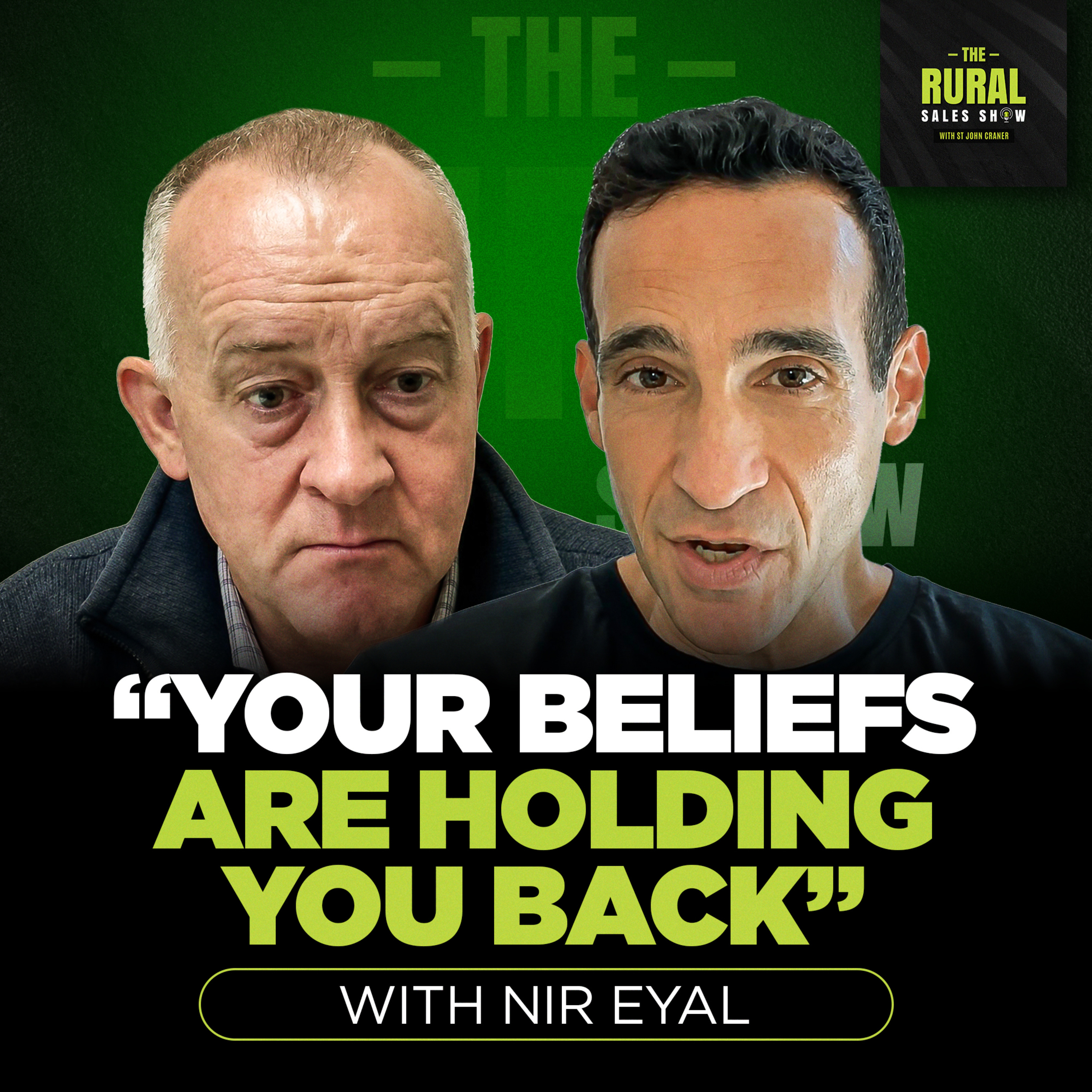 #117: Nir Eyal: Beliefs Are Tools, Not Truths - Here's How To Swap ThemThe Rural Sales Show · features Nir Eyal88 / 100
 599: Replace your limiting beliefs with liberating beliefs - with Nir EyalProduct Mastery Now for Product Managers, Leaders, and Innovators · features Nir Eyal77 / 100
 How Sales Reps Can Use the Consistency Principle to Close More DealsSales Leadership with Fexingo · on Loss aversion78 / 100
 How Liquid Death Used Satire to Sell Canned WaterProduct Marketing with Fexingo · on Liquid Death74 / 100
 "Consumers don't buy features, they buy solutions", with Brian Button and Michal LasmanCMO Convo · on Liquid Death63 / 100
 93. The Stories That Keep Us StuckVisionary's Pursuit · on Limiting beliefs55 / 100
 3 Key Marketing Principles That Built a $150 Million Business with Brian Kurtz of Titans Marketing87 / 100Kevin Rogers on Why AI Is Breaking Brand Trust and How Human Stories Fix It67 / 100Glenn Milliet’s 3 Communication Techniques That Build Faster Connection With Prospects49 / 100Adi Klevit’s HVAC Payment Process That Increased Cash Flow by 50%59 / 100How One Honda Distributor Increased Orders 300% (And Sold Out Inventory) Using “Free” Co-op Dollars79 / 100