
Eye On A.I. · 2026-06-29 · 1h 1m
Key moments - from our scoring
Substance score
39 / 100
Five dimensions, 20 points each
Philip Goff challenges the foundation of modern science itself, tracing the problem of consciousness back to Galileo's philosophical choice to make science purely mathematical. By separating subjective qualities (qualia like the redness of red or the smell of coffee) from the quantitative language of mathematics, Galileo enabled mathematical physics to flourish but created an artificial division in reality that science has never resolved. Goff advocates for panpsychism - the idea that consciousness is a fundamental property of the universe, present in rudimentary forms at the level of particles and fields, and aggregating into the complex consciousness humans experience. He distinguishes between the scientific task of identifying which physical systems correlate with consciousness and the philosophical task of explaining why consciousness and physical reality are unified. Goff addresses the 25-year failed bet between neuroscientist Christoph Koch and philosopher David Chalmers about resolving neural correlates of consciousness, and cites Tom McClelland's recent argument for permanent agnosticism on whether consciousness is biological or computational. On artificial intelligence, Goff is skeptical that large language models will become conscious despite their complexity, positioning himself closer to biological theories of consciousness. He emphasizes that panpsychism doesn't mean everything is conscious - only that fundamental building blocks have rudimentary consciousness, and higher-level unified consciousness requires specific organizational conditions.
Galileo needed to make science purely mathematical to enable its success, but realized subjective qualities like colors, sounds, and tastes cannot be fully captured in quantitative language. He therefore divided reality into the mathematical domain of science and consciousness in the soul, allowing physics to progress while leaving consciousness outside scientific study.
Panpsychism holds that consciousness is a fundamental property of the universe present in rudimentary form in particles and fields, similar to how Maxwell added electromagnetism as fundamental. This reverses the typical problem by starting with consciousness as basic and deriving physics from it, rather than trying to derive consciousness from purely physical properties.
Tom McClelland's recent analysis argues this may be permanently unanswerable - both computational and biological theories interpret evidence through their own existing assumptions. Goff leans toward the biological side and is skeptical that large language models can become conscious, viewing consciousness as rooted in biological systems rather than abstract computation.
The combination problem asks how simple, rudimentary forms of consciousness in particles can combine to create the complex unified consciousness humans experience. Panpsychists either add it as a primitive fact or attempt reductionist explanations, but both approaches preserve panpsychism's core appeal of explaining reality through one fundamental property.
No - panpsychism holds that fundamental particles and fields have rudimentary consciousness, but not every random combination of particles has unified conscious experience. A cup's constituent particles may be conscious, but the cup itself need not have its own unified conscious experience.
Our reviewer’s read on each dimension, with quotes from the episode.
The episode contains a handful of genuinely interesting ideas - the evolutionary mystery of consciousness requiring strong emergence, the McClelland 'permanent agnosticism' paper, and Goff's skepticism about LLM sentience - but the density is low. Large stretches repeat the same panpsychism framing, and almost nothing is actionable for any B2B operator, even one thinking seriously about AI adoption.
I think there's a real mystery of why consciousness evolved
an interesting paper by, um, Tom McClelland at Cambridge, it's just come out arguing for permanent agnosticism on a core question here
Goff's inversion - starting with consciousness to account for physics rather than the reverse - and his evolution-based argument that consciousness must involve strong emergence are genuinely counterintuitive framings. However, panpsychism, the Galileo separation, and philosophical zombies are well-worn philosophy-of-mind fare; the originality is real but bounded by the field's existing literature.
we're going to turn it upside down. We're going to start with consciousness and account for everything else, account for physics, chemistry, neuroscience, and in terms of consciousness
If consciousness brings with it new forms of causation, um, new forms of uh, causal operations that aren't completely reducible to known, understood, um, chemistry, neuroscience, um, if that were the case... that would be wonderful because you could then empirically see from the outside the markers of consciousness
Philip Goff is a legitimate academic philosopher with real publications and a genuine intellectual research program - not a career podcast guest or pure thought-leader. However, 'seniority and relevance' to a B2B operator audience is essentially zero; he is a metaphysics professor and the rubric explicitly rewards operators who have done the thing at scale.
I talk about this a lot in my, oh my, my book, modestly titled why the Purpose of the Universe that is just out in paperback
I was PhD examiner for a wonderful thesis
Goff is surprisingly concrete for a philosopher: the Koch-Chalmers wager with its 25-year timeline and crate of fine wine, the named McClelland and Michel papers, the FMRI resolution figure, and multiple named researchers and theories give the episode more texture than typical armchair philosophy. The specificity is academic rather than business-relevant, and no hard empirical data support the central panpsychism claim.
25 years ago, um, the neuroscientist Christoph Koch bet the, uh, bet the philosopher David Chalmers that this would all be wrapped up by now... a, uh, couple of summers ago, he, he publicly recanted... and gave David Chalmers the crate of fine wine he'd promised him
every, every pixel corresponds to what is a 10,000 neurons or something
The host occasionally lands a productive challenge - pushing back on the ant-consciousness interpretation and the 'universe is not a biological system' objection - but questions are routinely long-winded, self-answering, and leading, giving Goff little to push against. There is no sustained productive disagreement on the central claims, and the host frequently forgets his own question mid-sentence.
When you talk about um, new forms of, of um. I can't remember the way you phrased it, of causality within the brain.
I mean, the universe is not a biological system, right. If consciousness for higher forms of biology is more developed than say, a bird compared to a human, how do you feel about the proposal
Computed from the transcript - who did the talking, and the words that came up most.
What if consciousness isn't a byproduct of complex brains, but a fundamental feature of reality itself, present, in some rudimentary form, all the way down to electrons and quarks? Philip Goff, a philosopher at Durham University and one of panpsychism's leading contemporary advocates, joins Craig Smith to make that case, arguing that modern science's founding move - separating the mathematical world physics studies from the subjective experience we know only from the inside - solved one problem while quietly creating another we've never resolved. The conversation inevitably turns to AI: could a large language model ever be conscious? Goff's answer is a careful, well-reasoned no, not because he thinks consciousness is magical, but because his framework treats it as something closer to the physical substance of reality than an abstract computation, making him skeptical that anything resembling current AI architecture could cross that threshold.
Transcribed and scored by The B2B Podcast Index.
Speaker A: I think the problem of consciousness was built into the way we design science, Right. Uh, by the father of modern science, Galileo.
Speaker B: Can you talk about Galileo's error? Galileo wasn't simply separating the qualia from the mathematics for scientific reasons.
Speaker A: So what did Galileo do? He took consciousness outside of the domain of science.
Speaker B: I mean, the universe is not a biological system, right. If consciousness for higher forms of biology is more developed than say, a bird compared to a human, how do you feel about the proposal that a computer system, in that there is a form of consciousness flowing through the physical system, that if that system is complex enough, a higher form of consciousness can emerge?
Speaker A: Thanks, Craig. Um, looking forward to the conversation. Panpsychism is the view that consciousness goes all the way down to the fundamental building blocks of the physical universe. I mean, in a way you might see it as a continuation of a, of a trend that's been going on for some time now. You know, at the start of the scientific revolution, we thought only we were conscious and animals were sort of unfeeling mechanisms. And then over time we've attributed consciousness to more and more animals, starting off with higher primates, other mammals. Only fairly recently, birds and fish are, ah, typically attributed consciousness. And then, um, maybe a couple of years ago now, there was a couple of hundred scientists signing a letter that they take insect and reptile consciousness seriously. So panpsychists take this to its logical conclusion, holding that not only the simplest forms of life, but the molecules, atoms, subatomic particles making up life, has its own very, very simple forms of consciousness. So we are conscious creatures in a conscious universe. That's the basic idea.
Speaker B: Uh, can you talk about Galileo's error?
Speaker A: What I'm most passionate about is that this is not just another scientific problem we haven't dealt with yet. You know, it's not just, oh, we need to do a few more brain scans and we'll crack it. This is an utterly unique problem. And I, um, mean, and, um, one way into this is, I think the problem of consciousness was big built into the, the way we design science, right, by the, the father of modern science, Galileo, right. He was, he was a great experimental scientist, but he was also a great philosopher. And it was his philosophical innovations that really shaped the foundations of the scientific revolution. So, so Galileo wanted science to be purely mathematical, uh, something we take for granted these days. But at the time it was, it was a radical innovation. But Galileo had to do a little bit of philosophical work to make sense of that. Because the trouble is, I mean, one thing about consciousness, it's the only phenomenon that we have direct access to, right? And, um, that direct access reveals to us something about its nature. You know, that the redness of a red experience, the smell of coffee, the taste of mint, uh, we have direct access to the character of consciousness from the inside. That's one way which this is such a unique phenomenon. But Galileo appreciated you can't capture these subjective qualities we directly encounter in our experience. The colors, the sounds, the smells, the tastes. You can't fully capture those in the purely quantitative language of mathematics. Okay? An equation can't capture that deep red you experience as you watch the setting sun. I mean, there are all sorts of things we can capture about the structure of, say, color experience in mathematical language. But, you know, to make, to make the example vivid, suppose you, we have a blind from birth neuroscientist, right? You can, you can tell them anything you like, framed in the language of mathematics about the objective brain processes involved in color experience. That will never convey to them the redness of a red experience, what it's like to see red. So there's information here, information about the nature of consciousness that we have from the inside that you can't fully capture in a mathematical, purely quantitative language. So what did Galileo do? Well, he took consciousness outside of the domain of science, right? He said if we, if we want this purely mathematical story, this purely quantitative story, we need to take consciousness out of the picture. So he basically divided nature into two. On the one hand, we've got the, the domain of science with its purely mathematical, quantitative story. On the other side, we've got consciousness that's in the soul, that's got these funny qualities, colors, sounds, smells, tastes. And that was the start of mathematical physics, which has gone incredibly well. Uh, but what we've forgotten is that success was premised on dividing reality into two. And I think if we now want to fully bring consciousness into the scientific story, we need to find a way of bringing together what Galileo separated, joining them back together. And I think panpsychism offers the best way to do that.
Speaker B: And Galileo wasn't simply separating the qualia from the mathematics, um, for scientific reasons. There was also a very dominant religious environment that presumably he believed in at some level, uh, that there was a soul and that these things were, uh, features of the soul and not of the physical universe. But, but let me ask you, are you saying that, uh, consciousness is like gravity in the Einsteinian view, that it's a fundamental property of the universe, um, just as space time is a fundamental property?
Speaker A: Yeah, just on your first point, of course, Galileo had some deep difficulties with the church over, uh, his Copernican view that the sun was in the center of it all rather than the earth. I'm not sure his views on consciousness, um, were wrapped up in a clash with the Church though. And in fact, he was in many ways rebelling against the view of the church on this because the Church inherited the view of Aristotle, um, that. That the world is filled with qualities, colors, sounds, smells, taste. This division Galileo made of putting consciousness just in the soul, outside of what physical science can study. That was a very rebellious move, actually. Um, we got used to it now, but it was quite radical at the time. I mean, I think, think actually just Galileo appreciated that. This is a very unique, a very unique phenomenon here. I mean, you know, contrast with other, any other phenomena. Science studies, let's say lightning. Right before we do the science. We've got no idea what lightning is. It could be the anger of the gods, you know, or water. We used to think water was a fundamental element together with earth and air and fire. You know, you don't know what the hell water is till you do the science. But with consciousness, you have a good grip on what it is from the inside by being conscious, by being immediately acquainted with your own experiences. And there is information there about the nature of consciousness that you can't get from the science. As, uh, I say, you know, a blind from birth, um, neuroscientist is never going to know the character of a red experience. So actually there's information we have about consciousness from the inside that needs to be added to the scientific story. So Galileo, in a way, instead of confronting that, he thought, let's just put it on one side. If we just put consciousness on one side, we can stop worrying about it. We can get on with mathematical physics. I think that was a good move because it allowed mathematics, mathematical physics to start. And that's obviously gone very well. But if we want to bring consciousness into the scientific story, we need to somehow take what we know about the physical world from experiments, obviously absolutely crucial. But also what we know about consciousness from the inside. These two sources of information, we need to bring them together. And until we get, you know, at first base in understanding what a unique explanatory enterprise this is, we're not going to make progress in consciousness. But, um, I think I wandered off your. That was. I just focused on the first video question. What was the second video question?
Speaker B: The second was. Do you see it when you, when you talk about, uh, it as a, As A fundamental property. Is it like Einstein's space, uh, time, that it's, um, that it's, it, it just exists as this indivisible quality of, of the universe?
Speaker A: Yeah, Panpsychists definitely take it to be fundamental. And, you know, there is precedent in science, a lot of pressure for taking something as fundamental. I like to give the example of Maxwell, um, with his theory of electromagnetism in the 19th century. Um, Maxwell didn't explain electricity and magnetism in terms of, um, features of reality that science has already committed to. He added new fundamental electromagnetic properties and laws and then built up from that basis. So similarly, panpsychists add consciousness as a fundamental feature of the universe, obviously in very rudimentary forms at the fundamental level. And then the view is that our consciousness, the very complex consciousness of the human or animal brains, is somehow built up from those more fundamental elements. But actually, there's another thing that needs to be said here. It's not just that we are adding consciousness alongside the property science already believes in, like mass, spin and charge and so on. Um, the physicist Sabine Hossenfelder has pointed out in her, uh, in her public writings on panpsychism that would, that would kind of show up in our experiments. Right, if there was this new property, uh, alongside the properties physics already studies, that would kind of show up in our experiments. We'd falsify the standard model of particle physics or something. No, the claim is rather that the consciousness story underlies what physics is getting at, that ultimately, at the fundamental level of reality, according to panpsychists, all there is is consciousness. And, um, the, the mathematical story that physics is telling us arises, emerges from that more fundamental story about consciousness. So it's kind of turning the problem of consciousness on its head. You, you know, the normal way we think about the problem of consciousness is we start with the stuff physics talks about or chemistry, uh, and neuroscience, that story, we try and get consciousness out of that. The panpsychist says, no, no, no, no, no, we've tried that. It doesn't work. It arguably doesn't even make sense. We're going to turn it upside down. We're going to start with consciousness and account for everything else, account for physics, chemistry, neuroscience, and in terms of consciousness. And I think that way of doing it makes a lot more sense and is proved more productive. I think.
Speaker B: In some ways, yeah, you talk about a gradient or a spectrum or I'm not sure the language that you use, but that, that in higher, more complex organisms, consciousness is, is, is more developed and that as you go down the tree of life or of the physical world to the level of uh, electrons and quarks and that sort of thing, that property still exists, but in a very, very simple state. And I think at one time, I mean I've read this, this problem of the combination problem, like how do you get from those fundamental, uh, particles, if indeed they are particles, um, and build up to the level of a complex, uh, organism. Ah. And, and more recently you have this idea of um, I think you call it, uh, cosmic, um, cosmopsychism, where it's this fundamental property that, that flows through or is manifest in every level of physical reality. It's not built up from the quantum field, uh, it's, it's rather coming down the other way. Is that a fair assessment or fair explanation?
Speaker A: So panpsychists hold that the fundamental physical entities have consciousness of some incredibly rudimentary form. M But it's a question for physicists what the fundamental physical entities are. We tend to think of them as particles, electrons or quarks. But actually many theoretical physicists these days inclined to think actually reality isn't made up of particles, it's made up of universe wide fields and particles are just sort of local excitations in those fields. So if you combine that kind of view of panpsychism, we reach the view known as cosmopsychism, that the fundamental conscious mind is, is the universe itself. So we shouldn't think of that as, you know, God or something, or you know, just because something has consciousness, it doesn't mean it has intelligence agency, uh, understanding. These are the very complex forms of consciousness that arise from millions of years of evolution. So if the universe is conscious, presumably it's going to have very, very complicated consciousness. Just because the universe is physically very complicated, but it doesn't mean it's going to have intellectually sophisticated consciousness. It just could be just a kind of meaningless mess or something. Um, but yes, I think you're asking a question about the combination problem, which I guess has become known as the central challenge to panpsychism. Okay, you're postulating these simple forms of consciousness, but how do you get our consciousness out of that? Well, you know, I mean, so there are, there are again a couple of approaches here. I mean there's uh, there's a very easy way of solving this, which is just to add another primitive, as it were, just to say, look, it's just a fundamental fact about our universe that when conscious particles combine in certain ways, they unify together to make new Forms of complex consciousness. Um, so that's what one approach panpsychists can have. That just kind of removes the problem by just adding another primitive. Other panpsychists try to tell a more reductionist story and say no, no, you know, it's just when you get conscious particles in a certain way, automatically a, ah, unified consciousness arises and then try and give some kind of explanatory story for that. Now whichever way you go on this, I think the important thing to realize is you still retain the core explanatory attraction of panpsychism, which is that you explain physical reality in terms of just one kind of property, namely consciousness. That's the aspiration of the panpsychist. Maybe you want to talk a little bit more about that, maybe not, but is to completely bottom out reality in one very simple kind of property. Um, so whether we have to sort of add something to get from simple forms of complex consciousness to more complex forms of consciousness, or whether we can tell a more reductionist story, that's a further question. But still panpsychism retains that. That Occam's razor, uh, respectable characteristic of being able to bottom everything out in just one kind of property.
Speaker B: Yeah, Um, I mean that doesn't. So before we started, I, I was saying that what has gotten me interested in this is all of the talk, uh, in artificial intelligence circles about the potential for complex, uh, computer programs, you know, LLMs to start with. And presumably there will be much more complex systems going forward that, that, you know, on the emergent, um, theory of consciousness that it's this property that emerges from all of the electrical activity in the brain. Um, it just seems that panpsychism works with that theory because complex, uh, computer programs, uh, like a large language model are um, are ultimately physical, uh, processes. Uh, and if consciousness, uh, for higher forms of, um, biology is more developed than say a bird, uh, compared to a human. Is do you. How do you feel about the. The proposal that. That a computer system, in that there is a form of consciousness flowing through the. The physical system, that if that system is complex enough, consciousness, a m. Higher form of consciousness could emerge.
Speaker A: So I mean, the way I think about the challenge of consciousness, I think there's a division of labor between the scientific task and the philosophical task. So I think the scientific task is to work out which kinds of physical activity go along with consciousness. Um, and it's very hard because as we've discussed, we know about consciousness primarily from the inside. If you're looking from the outside, it's very Hard to tell if something's conscious. You know, I can't look in your brain and see your feelings. This is why it's so hard to ascertain whether a fish or a fly has consciousness. So, you know, the, the best we can do is, um, is study human beings, scan our brains. Because if you're dealing with a human being, you can ask them, you know, what are you feeling right now? And scan their brains and try and correlate which kinds of activity are going, which kinds of experience, and then basically extrapolate from the human case. Um, and it's, it's proved very difficult. And look, I, I'm, I'm, I'm optimistic and I'm enthusiastic about that task, but the fact is it, it hasn't thus far got the result, the expected results. You know, there's famously, 25 years ago, um, the neuroscientist Christoph Koch bet the, uh, bet the philosopher David Chalmers that this would all be wrapped up by now. You know, we'd have the neural correlates of consciousness all agreed on. And a, uh, couple of summers ago, he, he publicly recanted, publicly gave in on that, on that bet and gave David Chalmers the crate of fine wine he'd promised him. And, uh, you know, there's more and more people now saying it's not clear we're ever going to be able to conclusively settle this. I mean, an interesting paper by, um, Tom McClelland at Cambridge, it's just come out arguing for permanent agnosticism on a core question here that's, that's of great relevance to AI. Is consciousness biological or computational?
Speaker B: Right.
Speaker A: Um, obviously, whether or not that you think of the human brain as a computer, it can certainly do computations is, is it the more computational aspects of our brains that render us conscious, or is it the more biological aspects? And McClellan goes through, you know, the proponents on both sides, um, Annals, Seth, for example, on the biology side, who I interviewed for my substack last week, actually. Um, and you know, people on both sides of this discussion and thinks actually the way they're interpreting the evidence just depends on the assumptions they already have. It's very hard to ask them, you know, what kind of, what kind of test could you give to sort of settle that where the compute whether consciousness is biological or computational. So it is very difficult. Now, I'm not saying I'm not giving up. I want to keep going with this and I want to keep, I think really what we need is scientists and philosophers working together. What we might have to do, I think, is temporarily fragment the field into, into scientists working under certain philosophical assumptions, working together with philosophers in terms of how the experiments are designed, in terms of how. Of the results are interpreted, and just see which. Which paradigm bears fruit. Because at the moment we don't seem to be. Seem to be making progress. But, you know, I guess as a panpsychist, I'm more on the sort of biological side than the computational side, because for a panpsychistic, consciousness is the stuff of reality. It's, as it were, the flesh and blood of the physical universe. It's not about abstract, you know, computational processing. So my philosophical starting points make me very skeptical that large language models or anything resembling them are going to end up being conscious. No, I don't think. Finally, I don't think consciousness is magical or supernatural. So I think it's going to be possible in principle to have artificial consciousness, but I think we should be thinking of something in the first instance more like an artificial living system. Right. Maybe a, A microbe, an artificial microbe in the first instance, and, you know, building up to something with the complexity of a human being. But I don't think it's going to look like a large language model.
Speaker B: Yeah, well, that's interesting. But, but when you talk about panpsychism, uh, of consciousness, is something, a property that, that touches everything or flows through everything, or everything is manifest through that property. Um, not. That includes everything. And not everything is a biological system. I mean, the universe is not a biological system.
Speaker A: Right, I see, yes. So you might think panpsychists are going to think large language models are conscious because kind of everything's conscious. Well, actually, panpsychists don't think literally everything is conscious. Despite the etymology of the word pan, meaning everything, psyche meaning mind. The claim is that the fundamental building blocks of the universe, whether they're particles or whether they're fields, they have rudimentary forms of consciousness. But it doesn't follow that every random combination of particles has consciousness. So, so a panpsychist isn't going to necessarily think, you know, this cup I'm holding is conscious. They're just going to think maybe the fundamental particles making up that cup have some kind of rudimentary consciousness. But the cup as a whole need not have its own sort of unified conscious experience. So, and m. As I say, this is so the way I divide up the scientific and the philosophical task. I think this is fairly, fairly common understanding, not something unique to me. So it's the scientific task to work out which things are conscious. But then it's a philosophical task to answer the why question. Why, why, why is consciousness and physical reality joined together, correlated in the way science reveals to us? Um, I don't think that is a scientific question. Why is it not a scientific question? Because the task of consciousness is to marry, to bring together this stuff we know about from the inside with the stuff we know about from experiments and observations on the outside to bring them together to find a simple way of unifying them. And that's, that's not just not a scientific task. We're in this period of history where people can't, can't get a grip on that. They think, you know, experiments tell us everything. That's. But I think once we understand, think deeply, for example, about how science was set up. Um, it's, it's, it's not every question could be answered in experiment. And this is one question that is just not an experimental scientific question, although it's very closely related to the science of consciousness. So we need the science and the philosophy working together on this one.
Speaker B: Kamertz and Kamert's, uh, experiments in 2015 with ants where they would put a blue dot on the face of the ant and other ants would attack it because they would identify it as from outside the colony. And the ant, when, uh, presented with a mirror, would furiously try to erase the mark off its face, which would suggest that the ant is aware that the reflection is uh, of itself. I mean that's a form of self awareness. What do you make of those experiments?
Speaker A: Yeah, it's very tricky because. Okay, is that conscious, is that consciousness or is it the behavior of a non conscious mechanism? I mean, maybe it depends what we mean by consciousness here. Maybe we need to really pin that down. Uh, what I'm meaning by consciousness is subjective experience. Your consciousness is what it's like to be you. Feeling pain, feeling tired, seeing color, hearing sound. All these facets of what it's like to be you. Um, so something is conscious if there's something that it's like to be it, if it has any inner experience, a first person perspective. Now it seems completely conceivable to me and to most people, I think that you, you could have a very complex mechanism. Um, let's, let's say, let's pretend for the sake of discussion, you can't get consciousness from silicon. Let's just, let's just say that we find out that's true, you could still build a very complex robot made from silicon, um, stick a large language model inside it. Um, you could have a conversation with it. I think, you know, it's looking that incredible uh, robotics display we saw in Chinese New Year just recently. You know, I think in 10 years time we're going to have robots that behave like us that you can have a chat to. It's not uh, they might not be conscious though, but if they behave like us then they can do kind of self monitoring and they can recognize when there's a mirror image of themselves or something and they, they can mechanistically behave in a way that involves kind of self monitoring and so on. I don't think that, that it follows that they have inner life, that they have a first person perspective. Um, so, so yeah, it's, it's not totally. Yes, a very interesting paper. Another paper is just out. Ah, by Matthias Michelle, a very good um, philosopher who works very deeply in the neuroscience of, of consciousness and um, a philosopher who doesn't, doesn't agree with me on much at all I must say, but I find his absolutely fascinating work for being heavily embodied, embedded in the scientific project and saying, you know, with all of these sort of tests of consciousness there's an assumption. You've just given one. Yeah, that like certain kinds of self monitoring are signs of consciousness or maybe higher order thought is a sign of consciousness or maybe certain other kinds of responsiveness. But when you think about it, it's just not obvious that you need consciousness for those kinds of mechanistic functioning. Um, and other, other scientists of consciousness are making different assumptions about the markers of consciousness. So this is not very uh, optimistic. I mean, look, here's one thing actually that hardly anybody is focusing on. That might be a way forward. If consciousness brings with it new forms of causation, um, new forms of uh, causal operations that aren't completely reducible to known, understood, um, chemistry, neuroscience, um, if that were the case. So that's a very sort of non reductionist story. Philosophers tend to call this strong emergence, right, where there's just new kind of fundamental causal principles pop up, um, that can't be reduced to underlying chemistry and physics. If that were the case, that would be wonderful because you could then empirically see from the outside the markers of consciousness. Um, I don't know anyone in the science of consciousness who's focused on that I think because the dogma of the moment is a very reductionist story that really there's just physics, that's the physics is running the show and everything else is just more or less convenient ways of describing the world. Um, so, so yeah, like it's it's all. We're at a period of the science of consciousness where the rules of the game are not clear. Um, and, and, um, it's exciting as well as stressful.
Speaker B: Frustrating. Yeah. I want to ask again on the, on the ant experiment, I mean, in what you're saying about the mechanistic, um, response, uh, that doesn't require consciousness. That sounds like Chalmers. Um, what did he call them? Uh, zombies.
Speaker A: Philosophical zombies. Yeah.
Speaker B: Philosophical zombies. Yeah. Um, but how else would you explain. And not only ants, but. But birds and different animals that have. Have been. Been that the experiment's been applied to. How would you explain what appears to be a recognition of the self in a reflection?
Speaker A: Well, I suppose I, uh. I just don't see why we shouldn't think of that as something purely mechanistic. I mean, a lot you could equally say, you know, how can we explain large language models responding in a way that seems intelligent, seems to have understanding without any kind of consciousness? Well, you know, once you understand the underlying mechanisms, you can sort of see how these things are trained up, uh, in a way that doesn't seem to. I don't think many people think large language models are conscious. Certainly you don't have to think they're conscious to understand how they're responding. Um, so likewise, I suppose we have certain forms of behavior in these animals that involve, um, responding to self monitoring, as it were, and self monitoring and in some sense building there's some kind of internal model of the self. And behavioral responses make reference to that internal model. Uh, now, I don't. I'm not a, I'm not a biologist. I don't know all the, the ins and outs of the latest theories of how that self monitoring works. But I don't see why it couldn't be. It couldn't be purely, um, mechanistic. Um, but, you know, I mean, look, he is. While we're on this biological case, I mean, here's another issue that I think people aren't focusing on, that I'm always trying to press it. Press. I think there's a real mystery of why consciousness evolved. I mean, certainly, at least maybe there's a bit of a disagreement between us here, perhaps. But if you're like me and you do think it's. It's conceivable that you can have very complicated sophisticated behavior without any kind of inner experience. So, you know, I think we will have that soon with robots and large language models and so on. If you could have that in principle, why then there's a mystery of um, why did natural selection make us conscious? Right. Why not? Because natural selection just cares about behavior. Because it's only behavior that makes, is relevant for survival and that's what natural selection cares about. You know, I'm slightly personifying natural selection here just for ease of exposition. Um, so why didn't natural selections make us sort of complex survival mechanisms that mechanically track features of the environment and initiate various forms of survival conducive behavior? Um, why do you need to have an inner life? Now actually this connects to what I was saying in my last answer. Ah, I think, uh, and this is just, this is just me pressing this at the moment. But anyway, I talk about this a lot in my, oh my, my book, modestly titled why the Purpose of the Universe that is just out in paperback. Quick advert there. Um, I think the solving this mystery of why consciousness evolved must involve some kind of strong emergence. Must involve consciousness bringing into being new forms of behavior, behavioral response, new forms of causation that are not predictable just from the underlying chemistry or physics. Because it's only in that way it could give you some kind of distinctive survival advantage that would make natural selection think, I want a little bit of that, uh, if I can carry on the personification.
Speaker B: So yeah, are there, can you think of an experimental design that, that could distinguish sort of minimal subjective experience from purely functional behaviors in any organism?
Speaker A: Well, if I'm right that consciousness does involve some sort of strong emergence, then in principle there must be a, a noticeable behavioral difference. Um, but the question is, are we at the level of our understanding of the brain, um, to be able to make that problem tractable? So I mean, I recommend to people, uh, excellent book by Matthew Cobb, the Idea of the Brain, which traces the whole intellectual history of our understanding of the brain and the mind, going back to when we thought the mind was in the heart. And, and you know, really the take home message is we know very little about the workings of the brain. I think people get a bit carried away with uh, you know, brain imaging, FMRI imaging. But there's in a sense it's very low resolution, you know, every, every pixel corresponds to what is a 10,000 neurons or something, you know. Now what we do know a lot about is the basic chemistry. You know, how neurons fire action potentials, uh, how chemical messages are sent. And we know a fair bit about the function of big bits of the brain and the overall economy of the brain. What we know almost nothing about is how those large scale functions are realized at the cellular level. You know, how it Works. And so I think really we need to get more of a grip on that to see if, uh, ah, here something different is happening. Here something different is happening that you. We would not have predicted from our, our current known understanding of chemistry and, uh, physics. Um, now I'm not talking about something magical. I'm just talking about relative to the causal dynamics outside of consciousness. If there are sort of distinctive new causal dynamics that emerge, which I think there must be, if there's, if there's a survival advantage to consciousness, I think there must be. But if there are, if I'm right in that, then in principle we could track them. So we can, we can work not just with what we know about consciousness from talking to a patient and scanning their brain. We can, we can hold that in mind. But then we can also look for where there are new causal dynamics emerging. Um, as I say, no one's doing this at the moment. And um, I'm not sure we are at a level of understanding of the workings of the brain to be able to start that research program. But yeah, I mean, look, that is my hunch of where we're going to have to go.
Speaker B: And when you say, uh, causal relationships outside of the known mechanisms of the brain, what, what are you talking about? Are you talking about like telepathy or, you know, these.
Speaker A: Oh, no, no, no.
Speaker B: Normal.
Speaker A: No, no, I'm not talking about anything like that. Um, I mean, let's go back to Maxwell. You know, Maxwell introduced new, uh, electromagnetic, um, laws and properties. Right. He didn't work with the kind of laws that science was already committed to. So my suggestion is when we identify conscious consciousness in the brain, we, uh, will see. This is my speculation. This is my, you know, this is not something that philosophy can, can establish. This is my speculation. I've got a philosophical argument connected to evolution to take this seriously. But it's, it's ultimately an empirical prediction. Um, and that prediction is that when we identify consciousness in the brain, there will be new causal dynamics that we would not have expected. So not, no, not telepathy, not, you know, not my brain moving objects in my room. Just, ah, ah, those, those neurons are firing in a way we didn't expect. I mean, if this, if, if this sounds a bit magical. I mean, I recently, um, uh, was PhD examiner for a wonderful thesis, uh, by a guy arguing, look, that there is no scientific evidence against dualism. Dualism being, you know, belief that there's. The mind is separate from the brain and they kind of interact. And almost all scientists and philosophers think, oh, Science has ruled that out. Science has ruled that out. But this was a very sophisticated PhD thesis that went into cutting edge neuroscience, cutting edge physics, partly engaging with work Sean Carroll has done, responding to my work. Um, and I co. Examined this with Alyssa Nay, who's a very distinguished philosopher of physics who has no time for the soul at all. I mean, I don't either for that matter. Um, but we were both very impressed what a sophisticated piece of work this is. I mean, just to show really, we don't know enough about the workings of the brain to know whether there are new causal dynamics at the level of consciousness. Me, uh, and Sean Carroll have argued for hours about this. He thinks, you know, that would mess with physics too much. I mean, we both agree, you know, we don't, we can't, we don't know enough about the brain to rule it out from examining the brain. But what Sean Carroll says is, you know, you'd have to mess with physics a lot. Well, this PhD I examined by Jonathan Emery, like, of his name there, um, has explored, you know, exactly how you'd have to mess with physics. And it's, you know, there are options there. So, so yeah, so that's, that's my hunch that there will be new causal dynamics and if we can pin them down, then we can say, ah, uh, that's what you need for consciousness. And we'll know, we'll know whether consciousness is computational, biological. But until we get there, or until someone else finds another, I mean, that's my hunch. I'm not saying that's the only, you know, there's lots of different things going on with consciousness at the moment. Maybe someone else will have a better way of doing it, but at the moment it's just, it's just a mess. And to be honest, my view is the trajectory is more and more people from all sides of this debate I've just mentioned, matthias Michel, Tom McClelland, um, are, ah, just saying, it's uh, Eric Schwitz, Gable, uh, as a recent paper, arguing in a similar, from a different perspective, but arguing to a similar point that it, it's just getting less obvious we can do this. It's just, it's just I'm not, and to be clear, I'm not now talking about the stuff I deal with like, uh, you know, why does consciousness exist? Where does it come from? I'm just talking about the science, like which things are conscious, is it computational, is it biological? It's all a bit of a mess. So I've told you my Hunch for like how we can make progress. But that's just me trying to tell people to do that.
Speaker B: When you talk about um, new forms of, of um. I can't remember the way you phrased it, of causality within the brain.
Speaker A: Dynamics.
Speaker B: Causal dynamics within the brain. Could uh, uh, you know, I mentioned to you I had Stuart Hameroff on the program, uh could the microtubules in um, neurons in the brain and you know, he and Penrose have this theory that there's some quantum effect, uh, that takes place there. I mean, could that be uh, a place to explore? I mean, what did you think of that whole theory?
Speaker A: Let me answer that in two parts. Let me first say something about a different way of bringing consciousness and quantum mechanics together. Namely, um, that initial initially proposed by vigner in the 60s, the uh, Nobel Prize winning quantum pioneer, the idea that consciousness collapses. The wave function. Right. So um, I, I and, and um, David chalmers and Kelvin McQueen have, I mean this view hasn't been taken very seriously by physicists. But uh, Chalmers and McQueen have recently um, worked out a very detailed, rigorous analysis of, of how this hypothesis might look and how it might be tested. I think that from a certain philosophical perspective at least, there's reason to take this seriously. Here's how I think about quantum mechanics. There are all these different interpretations. The simplest interpretation actually people might be surprised at this is the many worlds interpretation defended for example by Sean Carroll. This idea that reality is continuously branching into different versions of itself. So this is actually very popular among philosophers of physics, people who normally don't like wacky stuff like Sean Carroll. Why is that? Because it's the only interpretation that requires just the Schrodinger equation, the most basic bit of mathematics. Um, all the other interpretations, add something, add another, another axiom to explain why we don't observe superpositions. Right. If you look at the basic mathematics of quantum mechanics, everything is in a superposition. The particle isn't in one place, it's here and there and there. Um, it's going at lots of different speeds and at the same time. And none of them in particular. We never observe that though. Why do we never observe that? Well, most interpretations of quantum mechanics add some extra axiom to explain that the wave function collapses and we don't see any superpositions. The many worlds theory says no, all of these superpositions exist. They're just the universe branches. So in a sense it is the simplest theory. The big problem with it is how do you make sense of probability? How do you make sense of probability in a world where everything happens. And this is particularly important because the evidence for quantum mechanics involves claims about probability. So I'm with the majority of philosophers of physics thinking we do need to add something to quantum mechanics. We do need to add something beyond just the Schrodinger equation, the most basic bit of the mathematics. Um, maybe collapsing, explain how collapse happens, that we don't observe superpositions. Maybe I should put it in terms of Schrodinger's cat. You know, why do we not see these many living and dead cats? We just see a definitely living cat or definitely dead cat. So we have to add something to make sense of quantum mechanics. Similarly, we have to add something to m. Make sense of consciousness. That's. I think the basic problem of consciousness is we know all this stuff about it from the inside that we somehow have to add to the scientific story. So we have to add something to make sense of quantum mechanics. We have to add something to make sense of consciousness. It would be nice if we could kill two birds with one stone and we could have one extra posit that explains both how consciousness fits in and wave function collapse. So, so I think that's. It doesn't mean it's inevitable. Maybe consciousness and quantum mechanics will have nothing to do with each other. But I think we should explore these models where you try to kill two birds of one stone. Even though they're not incredibly fashionable at the moment. Um, I'm not so keen though on, um, Penrose Hameroff view. Much as I love both of these people, uh, Penrose is my hero growing up. And, uh, Hameroff is a good friend and a very interesting thinker. But I mean, they try to do it the other way around. It's not that consciousness collapses the wave function, it's rather consciousness emerges from the collapse of the wave function. Penrose has his independent view to do with gravity about how wave function collapse happens and consciousness pops out. Um, I'm not sure of the motivations for that. There's certain philosophical motivations around Godel's incompleteness theorem. I don't know if you want to get into that right now, but I think it's certain philosophical motivations that I'm not convinced by that push them in that direction. I think if you're just looking at the science, you're probably not going to be pushed in that direction. So that was a bit long winded. So, yes, I think we need to think about how to bring quantum mechanics and consciousness together. Uh, I think that should be more fashionable. Than it is. But not that keen on Penrose Hammer off view, much as I love those guys. Yeah.
Speaker B: Okay. Another question. Um. Um, you. I mean, you talked about consciousness as the subjective experience of what it is like to be yourself. And I don't know who in consciousness studies came up with the, uh, definition of what it's like to be like. What it's like to be a bat, I think, was the, uh, original. So, uh, why do you think, other than just thinking about it philosophically, why do you think lower forms of life all the way down have some degree of consciousness if you can't experience what it's like to be a bird or a bat? And, and if, um. If, as you said, uh, the, you know, Chalmers philosophical zombies, um, could exist and we would never know. Yeah. So what experiments, um, have led you to believe that there are forms of simpler, uh, forms of consciousness in all organisms?
Speaker A: Yeah, good question. It was Thomas Nagel who, in his famous paper, what's it like to be a bat? In the 1970s, defined. Was the first person to define consciousness in these terms. Although people previously, for example, the panpsychist Timothy Sprig, who was about the only panpsychist in my philosophical tradition for, for many decades, uh, he. He characterized consciousness with that phrase. Um, and I think it's a bit unfair that that's often forgotten about. But anyway. But it was Nagel who first explicitly defined consciousness in those terms. So why do I think particles or fields have consciousness? It's not experiments that convince me of this. It's philosophy. Here is how I see the problem of consciousness. There's stuff we know about consciousness from the inside. There's stuff we know about the physical world from the outside. And, um, the question is, how do we bring them together in a single, elegant, simple, unified picture of reality? We have to. They're both real. They're both real. The physical world we know about from experiments is real. Consciousness is real. How do we put them together? I mean, historically, the, um, the way to put them together is dualism. You know that this is what Galileo did. You know, consciousness is in the soul. It's separate from the body and the brain, but it's intimately connected. Very good Recent work on dualism by Ralph Weir, who's very powerfully argued that pretty much everyone in history was a dualist, um, until recent times. Okay, that's. I think that's a possibility. I don't think that the more I've learned about neuroscience and learnt actually how little we know, I don't think we know, dualism is false, but there's a simpler option. Panpsychism is a simpler option. And panpsychism says there aren't two kinds of thing, there's just one kind of thing. There's just simple forms of consciousness and everything else, not just our consciousness, but the entire physical universe, stars, planets, mass spin, charge, particles, fields, everything emerges from those simple forms of consciousness. That's a, uh, beautiful, simple, elegant theory of reality. Um, so to sum it up, I think, I guess there's three views on consciousness. The one that's most popular, physicalism, is that we can somehow explain consciousness in terms of physical processes in the brain. In the terms of. I actually, I think that doesn't make sense. I think it's, it's actually not a coherent view. Uh, it doesn't, it hasn't properly understood the explanatory project of consciousness where the problem of consciousness comes from the. So I just think it's incoherent. We could talk more about that if you like. Dualism is the second option. That consciousness is in the soul. Okay, it's a possibility, but it's a bit inelegant. Occam's razor, uh, it offends against. Panpsychism is coherent, simple, elegant. So it's the most likely option.
Speaker B: And it's on the basis of that that you believe birds, insects, single cell organisms have some form of subjective experience or is there any experimental evidence that you point to?
Speaker A: It's on the basis of that that I think particles and fields are conscious. Um, whether anything else is conscious, which things are conscious is, I think, a scientific question. And it is, um, it is, as we've been discussing one, that at the moment it's, it's a little bit of a mess to know. How to settle. The ground rules are not, not even in operation as yet. Um, I mean one theory I'm, I'm kind of attracted to integrated information theory, one of the leading contenders of a scientific theory of consciousness. That um, is another reason, I guess, panpsychism is getting taken more seriously because it's, it's, it's in some place very close to panpsychism, that it at least posits that consciousness goes into the inanimate world. That it's um, that it's more widespread in, in the physical universe than we commonsensically take it to be. And what I like about that theory of consciousness on philosophical grounds is that it's the only theory of consciousness that you take. Any system, it will give you a definite answer as to whether it's conscious or not conscious. Uh, all the other theories. There's gonna be borderline cases where you have something, maybe a snail, that sort of neither conscious nor not conscious.
Speaker B: There's.
Speaker A: It's neither that there's something that it's like to be it, nor that there's nothing that it's like to be it. I don't think that makes sense. I think, you know, either, either a snail has feelings or it's an unfeeling mechanism. I don't think there's any. You know, you can get someone who's kind of neither rich nor poor, they're kind of in the middle, or neither young nor old, but something either has experience or it doesn't. That's what I think anyway. And the only scientific theory that gives that answer is the integrated information theory. Um, because very roughly it posits that at the very moment you've got more integrated information in that system than its parts, bam. You get the lights are turned on. Um, but no, look, it's. And um, you know, people might be surprised. How can you, how can you take something seriously if there's no experimental support for it? This is just the, this is just the nature of consciousness. It is, it's not just an experimental question. It's not a normal scientific problem. There's something we know about independent of experiments. Um, and what we know about it can't be known through experiments. We're immediately aware of it and we know its character and its nature from the inside. And then the question is, how does it fit in with what science is telling us? Um, now you could just say you can't, um, answer that with an experiment. You just can't answer it with an experiment. It's not that kind of question. You could say, like my colleague Peter Vickers. Well, we just can't. We don't know then. Okay, fine, say we don't know. We don't know whether it's in the soul. We don't know whether it's just a, ah, byproduct of the brain. We don't know whether pansych. That's an option. I think there are ways of evaluating theories other than experimentally. Experimental sciences is absolutely wonderful and crucial and should never be ignored. But there are also ways of evaluating theories independent of just what's the data. And in fact you find this in science as well. You know, the more theoretical end of physics, it's not just about do the experiment get the results. It's about more theoretical questions of what is more plausible what is more elegant? Uh, what is more ad hoc or interpretations of quantum mechanics thinking? What is the nature of probability? Can many worlds make sense of probability or not? So, yeah, we need to get out of this sort of scientism that
Speaker B: the
Speaker A: only way to find out about reality is just do an experiment and get the data. Uh, we have more sophisticated that. That sounds like. That's the wrong way to put it, because it sounds like it's not sophisticated. You know, we have more ways of knowing than just doing experiments and getting the results. And that's just the reality of the human situation. If people want to know more about my stuff, I do a lot of stuff on my substack written articles as well as video. Video interviews. And so that's the best place to follow me if you want to check out more of my stuff.
Speaker B: Okay.
Other episodes covering the same guests and topics, from across The B2B Podcast Index.
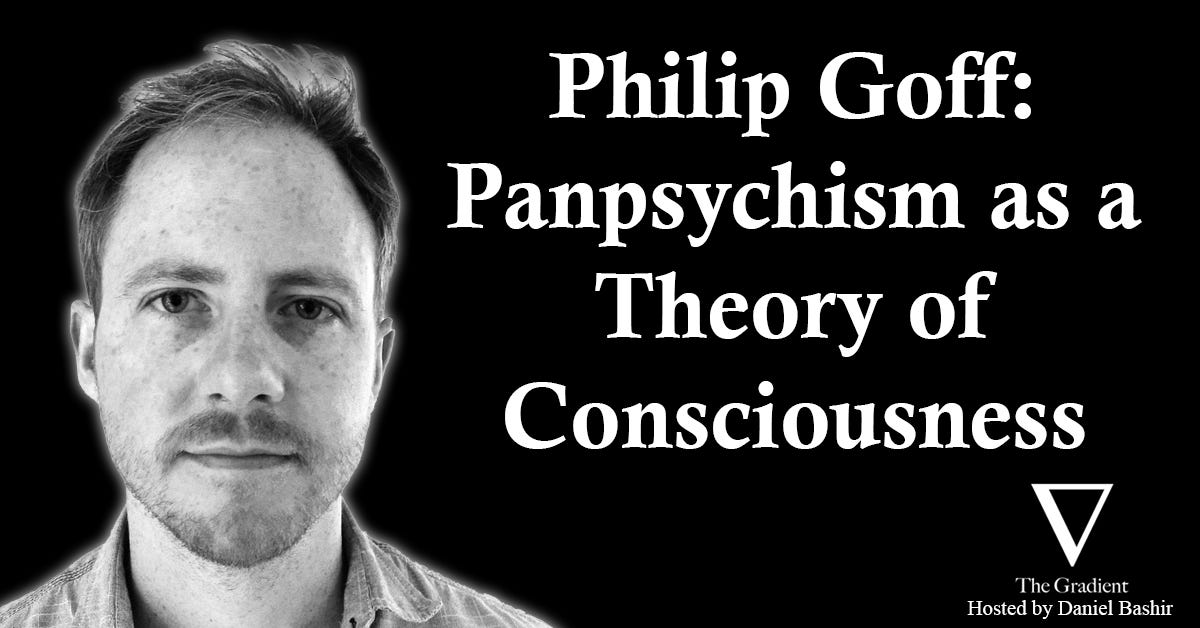 Philip Goff: Panpsychism as a Theory of ConsciousnessThe Gradient: Perspectives on AI · features Philip Goff
 Radiology Can't Keep Up. Here's Where AI Actually Helps | Dr. Nina KottlerRethink Imaging · on Large language models96 / 100
 Ep 90: AI Pioneer Jürgen Schmidhuber on the State of AI TodayUnsupervised Learning with Jacob Effron · on Large language models85 / 100
 How B2B Marketers Use AI to Personalize at Scale for EnterpriseB2B Marketing with Fexingo · on Large language models82 / 100
 Best Hits: Dr. Tomas Chamorro-Premuzic on AI, Leadership, and Why Authenticity at Work is OverratedThe Edge of Work · on Large language models77 / 100
 Harish Peri (Okta): When the Thing Accessing Your Systems Has a BrainThe Road to Accountable AI · on Large language models77 / 100AI Is Reading 15 Million X-Rays a Year With No Human in the Loop | Prashant Warier, Qure.aiOnly 12% of Companies Generate Value From AI. Here's What They're Doing | Sanjeev Vohra, GenpactIndia Is Becoming an Architect of the Global AI Order | Ivana Bartoletti of WiproThe New BRAIN Of the Enterprise | Ryan GavinAI Is Already Resolving 90% of Customer Service Tickets - and It's Getting Smarter | Shashi Upadhyay, Zendesk