Deep Tech Germany · 2026-05-14 · 38 min
Key moments - from our scoring
Substance score
60 / 100
Five dimensions, 20 points each
Marcus Bauer joined his brother Wolfgang and co-founder Nicolaus Meyerhofer at Aviloo in 2020 after a 20-year real estate career, bringing operational structure to a company already running battery diagnostics tests. The core insight: EV batteries are the most expensive single component in electric vehicles, yet manufacturers control all diagnostic data and have financial incentives to obscure degradation. Aviloo's Flash Test - a three-minute hardware-based diagnostic requiring no driving or charging - now covers 96% of EV and plug-in hybrid models across 50 countries and has run over 500,000 tests. The company recently closed €30 million in Series B funding led by Amira Growth with US market expansion via Electrium launching in 2026. The EU Battery Passport, mandatory in February 2027, will require OEMs to publish state-of-health data - validating Aviloo's foundational argument. Bauer explains why independent hardware diagnostics remain essential despite regulatory pressure, how Manheim Express Europe increased used EV conversion rates by 33% using Aviloo's certificates, and the distinction between Aviloo's battery analysis (measuring actual health degradation affecting range) versus competitors like Recurrent that aggregate cloud data without hardware contact.
OEM cloud solutions don't contain the granular battery data needed for accurate state-of-health measurement; only direct hardware connection via OBD interface can extract the diagnostic information required. Software aggregators lack access to this detailed data, making comprehensive battery analysis impossible without physical contact.
No. While the Battery Passport will require OEMs to publish state-of-health data, Aviloo provides independent manufacturer-agnostic verification. OEM-reported data comes from software written by the companies with financial incentives to obscure degradation, so independent hardware diagnostics remain essential for buyer trust.
Used EV sales conversion increased by more than 33%, because buyers and dealers could finally see transparent battery health data and price vehicles accordingly - solving the core trust problem that previously made used EV buyers hesitant.
A car at 60-75% state of health can still be perfectly usable depending on individual driving needs and safety verification; the industry's 80% threshold is convention, not engineering requirement. The key is proper pricing that reflects degradation and ensures the buyer's range needs are met.
A dedicated five-person team handles OBD interface communication with each vehicle's proprietary CAN protocol; for new models from existing OEMs (like the ID7 following ID4 protocols) they work remotely, but new Chinese brands require physical cars to learn communication and train models before coverage is added.
Our reviewer’s read on each dimension, with quotes from the episode.
The episode contains useful operational details and specific business insights (hardware evolution, organizational scaling, hiring discipline, regional market dynamics), but relies heavily on conversational meandering and relatively predictable strategic narratives. The technical explanation of CAN protocols and hardware necessity provides genuine substance, but much of the discussion rehearses standard startup talking points (hiring quality over speed, trusting co-founders' expertise, tracking live metrics) without pushing deeper into non-obvious mechanisms or surprising learnings.
We tried for two years and it was always a struggle. And after two years we said that we stop it and now we build our own hardware, which we did.
I'm calling practically everyone who sends us an interesting CV myself still at that size of the company. And we have now, by the way, over 600 open applications in our system.
The core market thesis - independent battery diagnostics in the absence of OEM transparency - is genuinely novel and addresses a real market gap. However, the guest's framing and reasoning are largely conventional: appeals to consumer safety, standard objections to competitors (dismissing Recurrent as marketing-only), and predictable regulatory tailwind narratives. Little contrarian thinking or first-principles reasoning appears; the guest accepts dominant EV adoption trends without tension and treats hardware superiority as obvious rather than genuinely examined.
We are still the only company globally that provides an independent battery analysis is state of health calculation. But actually our diagnosis goes beyond pure state of health calculation.
I think Recurrent is a marketing support company. They are by far not doing battery tests.
Marcus Behr is a legitimate operating executive with 20+ years in real estate operations and now 6 years scaling a deep-tech hardware company to €30M funding and 600+ employees across 50 countries. He has skin in the game (personal capital invested), hands-on involvement in hiring and decision-making, and direct responsibility for European market leadership and US expansion. However, his operational experience is primarily in scaling execution rather than originating the core technical or market innovation, which limits caliber slightly for a technical product discussion.
I spent nearly 20 years running operations for some of the largest real estate businesses in Central and Eastern Europe. CBRE EHL Acron with a fund with 500 million euros in assets
We grew at a substantial scale. And of course, you know, finding those people, hiring those people is a challenge. Onboarding those people is a challenge.
The episode includes concrete metrics (96% vehicle coverage, 600+ applications, 58% YoY headcount growth, €30M raised at €130-200M valuation, Mannheim conversion rate improvement over one third, 500K+ tests run, 50 countries) and specific technical constraints (five-person team managing CAN protocol integration, new Chinese brands requiring physical vehicles). However, much of the granularity centers on company milestones rather than market dynamics or deeper competitive positioning. Cost structures, customer acquisition economics, and failure modes remain largely abstract.
you cover 95, 96% of all EV and plug in hybrid models on the market
Mannheim Express Europe...by more than a third after introducing your certificate
The host asks reasonable setup questions and establishes context well, but rarely pushes back on claims or demands precision. When the guest makes assertions (Recurrent is "not doing battery tests," regulatory tailwind is inevitable, no major operating decisions would reverse), the host accepts them without follow-up. Questions about decision-making authority, hiring discipline, and US expansion strategy are solid, but lack the sharpness needed to surface real tensions or expose assumptions. The conversation feels more like a structured interview than a rigorous examination.
I think Recurrent is a marketing support company. They are by far not doing battery tests. They are connecting through individual apps, getting some data out of it, but it definitely doesn't give you any information about the battery.
So I think we are now in a far more stable environment. Now. People are buying EVs not because they got so much public funding for it.
Computed from the transcript - who did the talking, and the words that came up most.
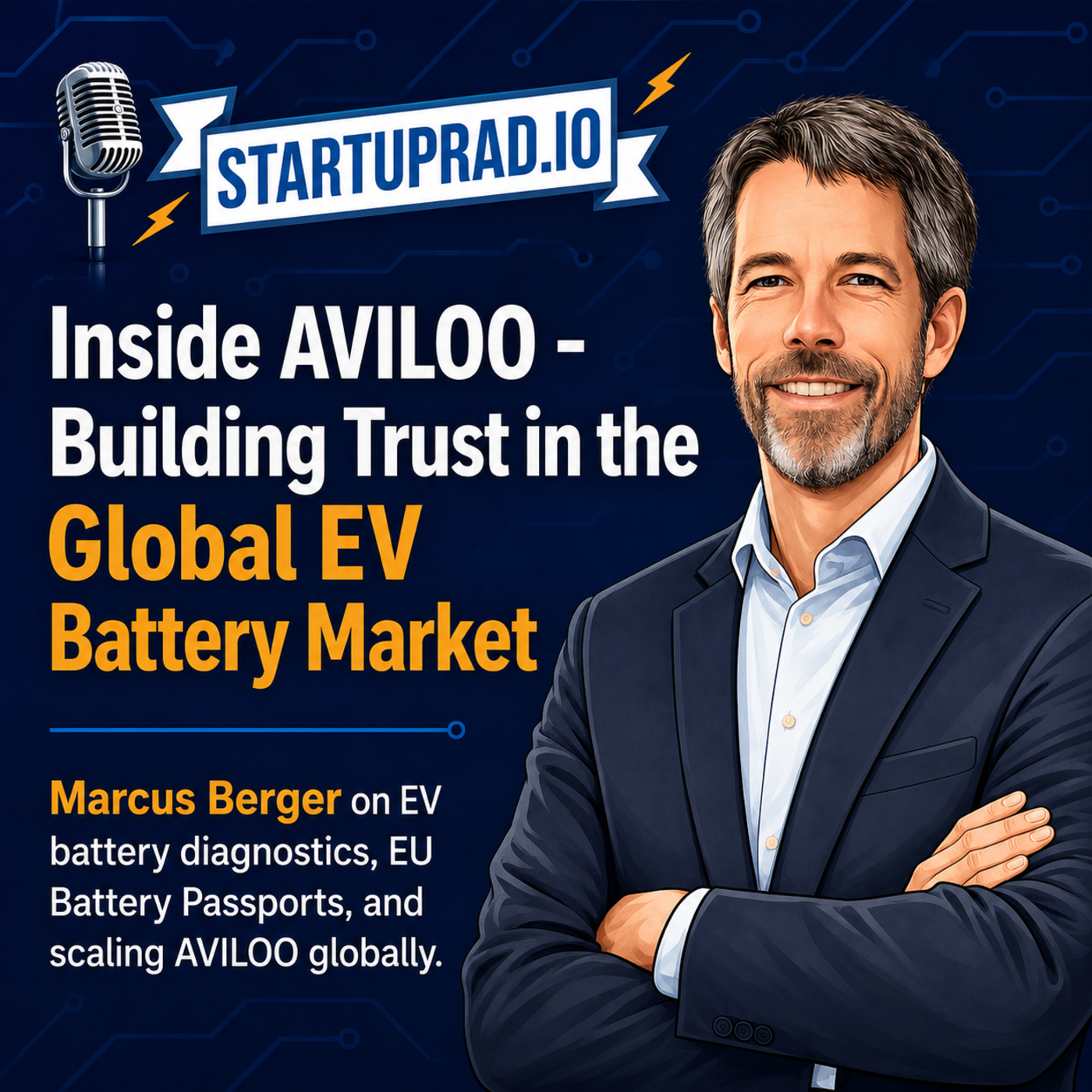
Used electric vehicles have a trust problem: battery state-of-health drives range, resale value, and buyer confidence, yet most buyers can't independently verify it. Marcus Berger, CEO and partner at Aviloo, builds independent EV battery testing infrastructure - the flash test, the EU battery passport, and used-EV certification. Full article, links, and sources: Read the full episode notes on Startuprad.io Why this matters for deep tech: Battery state-of-health is the physical constraint under the entire used-EV and second-life market. Independent diagnostics are the deep-tech infrastructure that makes battery value verifiable - a hardware-and-data play, not a SaaS wrapper. In this episode, we cover: Marcus Berger (CEO & partner, Aviloo), Austria's independent battery-diagnostics company Aviloo's flash test for battery state-of-health Why OEM battery data falls short for buyers The EU battery passport and what it changes US expansion and growth financing The future of used-EV certification Related deep-tech episodes: Voltfang: Second-Life EV Batteries · Climate-Tech SaaS vs Greenwashing .
Transcribed and scored by The B2B Podcast Index.
The battery is the most expensive single component in an electric vehicle. It costs more than the entire engine of a combustion car to replace. And until very recently, no one, not the dealer, not the insurer, not the buyer could tell you how healthy it actually was. Not from a trustworthy independent source.
The car's own computer gives you a number, but that number comes from a software written by the same company selling you the warranty. So here's the question. In a market where single data point determines whether a €40,000 asset is worth buying or walking away from, who do you trust? And why should that be anyone other than the manufacturer?
What does it actually take to build an industry standard when the most powerful players in the market the the car manufacturers hold all the data, control the diagnostic software, and even every financial incentive to keep it that way. Welcome to Startuprad IO, your podcast and YouTube blog covering the German startup scene with news, interviews and live events. Aviloo Guillen Behr was founded in 2018 in Wiedenoidorf, Austria by Wolfgang Berger and Nicolaus Meyerhofer with a single thesis that the EV battery market had no independent manufacturer agnostic method of measuring battery health.
Since then the company has run over half a million tests, built coverage across 96% of the EV and plug in hybrid models on the market, expanded into 50 countries and established partnerships relationships with organizations including mannheim Express Europe, TUF, Adiac, Hyundai, Aaval and Emil Frei. In December 2025, they announced a US market entry via partnership with Electrium, operating from a Denver subsidiary in February 2026. Just very recently, the close to 30 million euros strategic investment led by Amira Growth with Investagi participating to fund global scaling.
Their estimated enterprise value sits between 130 and 200 billion US dollars. The battery passport, which will mandate exactly the kind of data transparency Aviloo provides, becomes compulsory in February 2027. My guest today is Marcus Bager, CEO and partner at Aviloo since 2020. Hello and welcome everybody to Startup Radio, the podcast for the startup ecosystem and beyond.
Today we're speaking with the CEO of Avilooo Battery Diagnostics, a company that has positioned itself at the center of the most consequential trust problem in electric vehicle transition. Servus Markus hello. You came into Aviloo not as a founder but but as an operator brought in to build a structure around an idea that was already running. Let's start here, okay, with pleasure.
You spent nearly 20 years running operations for some of the largest real estate businesses in Central and Eastern Europe. CBRE EHL Acron with a fund with 500 million euros in assets, then you stop completely. Then you joined your brother's EV startup. What actually made you go back to work?
Yeah, that's true. I actually made my career in real estate, as you correctly pointed out. Yeah. And after more than 20 years, I came to a point where I kind of felt exhausted.
In parallel, I built together with my wife, a large family. So we got five kids and I was traveling a lot. And yeah, age of 45, I just came, as I mentioned, to the point where I felt like it's enough. I felt exhausted and I needed a break.
And I took that break. And that was exactly the timing when my brother and Nico had this idea of establishing Aviloo. And I still remember it's Christmas 2019. My brother approached me and just asked me if you want to join them.
And as I had the opportunity to do something totally new, I just took the risk and did it. And now I'm here. I see he caught you over drinks in a Christmasy mood. Aviloo has already two years.
Was already two years old when you joined as the COO back in 2019. What was the specific operational gap that needed to be filled and what was already broken when you arrived? Yeah, so the company was actually not three years old. It was more like one and a half years.
And it was nothing broken. It was just like my brother told me, Look, Marcus, you know, Nico and I, we book those technicians. We understand a lot about technology, but, you know, we have financial matters to be taken care. We have bills to be paid, we need financing.
You are a. A commercial guy. So my background is business administration. Do you want to join us and let's do it together.
And that was actually their motivation to bring me on board. The founding claim of your company is that no manufacturer independent battery test existed anywhere when you started in 2019. That was a claim actually true, or is it partly a positioning call? No, it was absolutely true.
And to be honest, it's still true. We are still the only company globally that provides an independent battery analysis is state of health calculation. But actually our diagnosis goes beyond pure state of health calculation. We are still the only company that does this independent from the OEM value.
Also interesting, you joined externally, but you took a meaningful financial stake in the company. When you joined. You were betting on your own capital on a hardware startup in a market that didn't exist at scale. Who was your logic that made that a reasonable bet and what would have had to be true to make it an unreasonable bet?
That's actually a good question. I mean, you're absolutely right. I made a bet. I was 40 years, 45 years old back then.
I had five kids and a wife to feed, so there were seven miles to be fed. And obviously we didn't have any income in those days, at the very early days of Avilooo, so we had to live off our savings. And it was a risky decision. Absolutely.
What made me do it? I don't know. It wasn't a logic decision. It was, I would say, in the end still the gut feeling decision.
It was like now or never. It's probably my last chance to do something like this and I just dared to do it. And yeah, and here we are. I think statistically speaking, the most successful entrepreneurs found the company with 45 and I have two kids.
Completely ignoring what you have to achieve. What do you have to do to be an entrepreneur with five kids? Your flash test takes three minutes. Your premium test your company offers takes significantly longer.
You choose to lead commercially with a three minute version. What was the resource allocation behind prioritizing speed over death? Well, it was a logic decision. You know, we started off with the premium test.
That was our first product. And as you correctly mentioned, it's a very sophisticated battery diagnostics. You know, you discharge the car from 100% down to below 10% state of charge. That takes quite some time.
Yeah. And you have to drive the car and we collect a lot of data while doing so. And the product still exists and we still sell it and we still love it because it provides us an enormous amount of insight through data. But obviously it doesn't fit into the processes of a car dealer, of a leasing company, of an auction house.
It just cannot drive a car for 300 or 400 kilometers. So we very quickly, back in those days then came to the conclusion on the basis of the premium test data, we need to provide the market with a quick test in standstill mode. No driving, no charging, no discharging required, and just plug in the box, wait three minutes, get a proper state of health calculation. And that's actually the product that we are selling today, that's the flash test.
According to your data, you cover 95, 96% of all EV and plug in hybrid models on the market. What does it actually cost in terms of times and resources to add a new vehicle to your system? And what's the constraint that stops you from reaching 100%? Well, there is substantial time and resources that goes into, you know, working on the communication through the obd, through the OBD interface, communicating with the internal canvas of each vehicle.
Because, you know, the canvas protocols are not standardized. And a Volkswagen or a BMW or a Tesla or BYD has, uses totally different protocols. And our job is, and we have a team of five people who do nothing else than ensuring that that communication is working properly. And their job is to ensure that we get the data that we need out of each and every car.
And sometimes that means that we need the car really physically here. Specifically when it's new brands, such as new Chinese brands that come to Europe, we want them, we need that car physically here to learn the communication, to train our models, to write respective software, and to be able to offer that car into our clients. When there are new models coming from existing OEMs like Volkswagen, and you know, they follow the campus protocols of the existing cars, like, for example, the ID7 follows the protocols of the ID4 and the ID3, but then it's comparably easier for us to do and we don't need the car actually physically here in our offices, can do it remotely.
I see. And what is, what is preventing us from reaching 100%? This is the, actually the scarce, scarce models that just arrive from China, which don't have a volume yet, where we didn't prioritize yet to learn to communicate with those cars, we will at a certain point of time when you mark market requires it. But that's actually the gap between 95 and 100%.
Now, we'll get a little bit into the technical details because you have stated publicly that a battery at 75% state of health can still be perfectly good car. Meaning it's as we said before, it's the most expensive part of the car. The industry convention treats 80% as a meaningful threshold. WHO benefits from the 80% rule staying in place and who gets hurt by it?
Well, it's a good question. I mean, I don't want to, I don't want to make a statement that I think someone would intentionally play with that figures to his own benefit. I don't believe that's actually true. I personally think that it's, it fully depends on, you know, on the individual driving behavior.
And when I say a car with 75, and I would even go further and say even with 70%, maybe even with 65 or 60% state of health is still a usable car for specific people. You know, if you just say, okay, I just need a card, you know, go to the supermarket maybe, okay, drive to my parents who live 80 kilometers away, and that's it. So then you're probably well off with a car. That has 70 or 60% state of has provided that there is no security, no safety risk, which might be the case.
But if that's not the case, then you can buy a car. It should just be priced adequately. You should get such a car much cheaper than a similar car with 85 or 90% state of health. And that's our job.
Keep EVs in the market for as long as possible and ensure that you can make an educated decision. When buying a used ev, you decide what you need and you go out and find a car that exactly meets what you need and that might differ from one person to another. You increased Mannheim Express Europe, so it's a used car online platform there used EV sales conversion rate by more than a third after introducing your certificate. Before your certificate, what were they doing instead and why was it failing?
Well, yeah, those are figures that Manheim publicly announces. So we are obviously quite proud and, and also quite happy that it proves what we always said is what consumers who walk into a dealer's office and spend, I don't know, 30 or 40k of their hard earned money for a used. What they want to know is they just want to be safe, they just want to be secure. They want to know that their hard earned money spent well.
And an EV is practically a battery and a computer on wheels. So the batteries, the decisive part is the black box. And we bring transparency into that black box. We would just make it publicly known this vehicle has a state of health of X and this has a state of health of Y percent.
We have make your decision, price it adequately and obviously those cars get sold much faster. Because, you know, our clients like Manha Express, can provide what their clients need, which is independent diagnostics, which is safety, which is security. And that's what clients want. And one of the reasons you're here, you raised 30 million in February 2026.
Congratulations, by the way. Primarily to expand the United States and Asia. But the EV battery passport becomes mandatory in almost a year February 2027. Right now your strongest regulatory tailwind is here in Europe, European Union.
Which market is the actual growth bet? The ones with legal mandate or the ones without it? Well, I think we are growing everywhere. So we have an extremely large business in Europe, obviously, for obvious reason.
We're an Austrian company. We started off in Austria and in Ger, Germany, and then expand it into Scandinavia, Benelux, France, South Europe, East Europe. So we have clients in every country in Europe and many clients also outside of Europe. But the European business provides us with a very strong financial foundation to allow us to now expand into the US to expand into China.
We already have partners in Australia, in Korea, in Japan, in Taiwan, in Brazil. So everywhere where EVs are driving around, our product is available. With this investment, you've taken capital from Amira Growth, a firm with 5 billion euros in assets under management. At what point does a strategic investor of that scale start influencing operational decision?
And what is your answer when this starts to happen? So Amira, I mean we didn't just go for the first one, you know, offering us a deal. And there were many thanks God. Why we chosen Amira in the end was because of their very hands on approach.
A nice and sympathetic team, you know, understanding what we're doing, not believing that they know everything better, but on the other hand providing a lot of expertise, providing a team that can advise us, providing people that, that have been doing what we are now doing for the first time in our lives. Meaning scaling up a business from zero to triple digit million revenues. So Amira, already the first couple of months has been very helpful in helping us with our go to market strategies, with working on our organizational chart with key hires and so on and so forth.
So they provide a lot of input. Except for money. So not except for, I apologize additional. In addition to money.
In addition to money, that's also something I tell everybody who's raising funds. You can't Simply buy money. KPIs. You can ring the term sheets.
There has to be personal fit. There has to be competence in there as well. I agree, I agree. Before the break, if you have bought or sold a used electric vehicle or if you're considering it, drop your question for Marcus in the comments.
We will address the best one in a future potential episode. Right after the break, we'll get into structured question. This entire market is standing around. If the car manufacturers are forced to publish their own battery health data by EU regulations next year, what is left for the independent diagnostic company to actually sell?
The EU battery passport arrives in February 2027. It will require OEM manufacturers to report state of health data for every battery. If that data is publicly available and legally standardized. What does exactly avalu sell that the buyer cannot get directly from the car's own communication?
Recurrent, your US competitor runs entirely without hardware. They aggregate real world traffic data through software integrations with no physical device involved. Explain precisely why software alone cannot do what your flash test does and what measurement specifically requires your hardware contact with the vehicle. So I actually, I wouldn't support the statement that recurrent is our U.
S. competitor. I think Recurrent is a marketing support company. They are by far not doing battery tests.
They are, I guess they tried, but they probably find out that it just doesn't work without the hardware. They are connecting through individual apps, getting some data out of it, but it definitely doesn't give you any information about the battery. So it just requires a hardware and it will require hardware for quite some time to go. Why?
Because the cloud solutions that OEMs have are still comparably small. There would be so much data that that the car producers that would have to go into cloud solutions that there is hardly any company who is able to do that at the moment. So we need the hardware, we need the Avila box to connect with the OBT interface. Exactly.
To get out all the data that we need in order to perform a proper battery test, to perform a premium test or to perform a flash test. And this data is not available in any OEM cloud that we know at least. And I think it won't force many years to come. But once that's the case, we would be more than glad to connect to that cloud solutions and just do the same.
Getting the data not directly out of the car, but indirectly through an OEM cloud solution would be perfect for us as well. Let me put a little bit my skeptic hat on looking at your business. The business world would say most first generation E business EVs used EVs are still covered by their OEM 80 warranty. So battery health testing is a solution in search of a problem.
What would be your answer to that skeptic? I believe that the question maybe results also in a misunderstanding what we're doing. So we are not here to discover OEM warranty cases. I we do that permanently do that, but that's not the primary goal.
The primary goal is to bring transparency into battery performance and also battery safety which are typically not covered by OEM guarantees. So if you want to buy used the we and it just makes a difference if you have one with 95% state of health or with 82% state of health, same age, same mileage, completely different state of health. And state of health directly translates into mileage, so your mileage just reduced substantially. Both EVs wouldn't be a warranty case.
But you might say okay, I take the one with 95% because that's what I need. I just need to go 400 kilometers once every week and the 82% car wouldn't deliver that. So for me it's not usable. There are no warranty cases involved here.
And still you want to know. Because every percentage difference in SOH reduces your mileage. Might have additional impacts on fast charging, by the way. And why would you pay the same amount of Money for an 82% state of health Tesla?
Like for a 95% state of health Tesla, you wouldn't. So you would still want to know regardless of OEM warranty topics. An interesting thing we figured out is you, your brother Wolfgang and co founder Nicholas are the three listed managing directors in the Austin firm Bull. How is your decision authority actually divided between you three and what is the process if you disagree on a significant operation operating decision?
Because there's a lot of entrepreneurs right now listening and maybe they also have the same problem or maybe you have a good solution for them. I don't know if I have a good solution. I mean, yes, there are the three of us. We form the management board, or let's say we form the formal management board.
What we also introduce is a senior management board that consists of additional people in the company which would actually take the majority of the decisions. So we just don't rely on the opinion of the three of us. We include more senior people with more experience or additional experience into any decision making board. But it has just recently been established over the first four or five years.
You are right, we just took the decisions, the three of us together. The good thing is, you know, we've been knowing each other. We know each other for more than 30 years, my brother and myself obviously. And also Nico is a very good friend to both of us for 30 years.
So we trust each other and we have very different areas of expertise. Where my brother is more a product sales guy, Nico is a technician, I'm a hardcore finance strategy guy. So we trust each other. If we have a technical question to be answered, we would just trust Nico's assessment because I don't know he knows.
And while the others trust me when it comes to maybe business decisions, strategic decisions, then they would say, okay Marcus, you know best, we trust you. So we could limit conflicts to an absolute minimum. Also on your internal workings, I would be interested in what's the single internal metric that tells you whether Avilooo is on track in any given quarter and at what threshold does a deviation in that metrics forces you to structurally respond. So thanks God we didn't have that incident or the case that, you know, we had to structurally respond to any kind of deviation because we didn't have that.
If we deviate, we just deviate to the upside, which typically doesn't force us for any response except for just letting it run. We have metrics, of course. I mean, we have our revenues coming in on a daily basis. So we track the amount of battery tests, the amount of revenues that we generate.
It practically live. Yeah, we have a live dashboard that would tell us in the hour, how many battery tests have we sold today, for example, until now it's I don't know, 11am we could tell you and we could react instantly if we feel that something would go wrong, which actually never happened. So that's more or less, I think you need to have actual data, ideally life data, specifically on revenues, and then you can manage and run your company quite efficiently. Your LinkedIn data, I mean, of the company abilo, show that you grew headcount by 58% in the last year.
At what hiring pace does a company start losing the operating properties that made it effective at a smaller scale? And how do you actually detect that before it becomes a problem? Yeah, very good question. Yeah, I mean, we grow at a substantial scale.
And of course, you know, finding those people, hiring those people is a challenge. Onboarding those people is a challenge. And you might easily make wrong decisions and go for speed instead of quality. We don't do that.
We take hiring decision when we are really convinced that that is the right person. And what I'm doing, for example, I'm calling practically everyone who sends us an interesting CV myself still at that size of the company. And we have now, by the way, over 600 open applications in our system. It doesn't mean that I call all the 600, but I would probably call 70 or 80 the most interesting.
And I would explain them how Avil works, what's in our DNA, what this person would have to expect if he or she would join us. And that makes it quite transparent. And some say that's exactly what I want. You know, this speed, the dynamics, the performance orientation, the nice atmosphere, the positive atmosphere.
And some would say, you know, probably not the right thing for me. You know, I don't want to go into such a challenging environment. And it's also fine and it's better to find out before you sign an employment agreement. So, yeah, we are doing very well on the hiring front and we are happy.
But also to say we are now hiring for the first time ahead of HR. We are now almost 100 people and I think it's now time to put that into professional hands. You're expanding into the US market. We're simultaneously running operations in 15 European markets.
What is one organizational decision you have already made for the expansion in the US that most European scale up playbooks would say is wrong. And why did you make it anyway? To be honest, Jorn, I don't know what European scale up playbooks would suggest for the us I can only tell what we did. We, we established our business in the US actually more than a year ago and my brother was taken care and then we hired a very experienced salesperson.
And I think the learning that we took is that it's not that easy, unfortunately. And we had hoped to get some spillover effects with some large European clients such as Cox Automotive or Mercedes. We can get an easy entrance into the us we can start to work with them and then everything happens more or less automatically. Didn't exactly turn out that way.
And so we revised our strategy early this year and we hired a CEO, a US based CEO, whom we now hand over the responsibility to build our business locally in the US because we also realized it's actually very difficult to build a business in the US out of Europe. That's at least our experience. Can you name one specific operating decision from your first two years at Avilooo that you would reverse today? Not like a general idea, the specific decision, the assumption behind it, the evidence that proved it wrong, and the rule he now operated buy instead.
To be honest, I mean, I thought about that when you provided this question to me and I didn't come, I mean, unable to come up with any decision, any substantial operating decision that I would, you know, do differently today. I mean, obviously there's a lot of smaller decisions or even bigger decisions that with the knowledge from today we would do differently if we had the opportunity. But at the time that we took a decision, it was right. I mean, I'll give you an example.
We started off with a third party hardware with the data logger. We said we are not a hardware company, we don't want to build our own hardware. There are so many OBD dongles, there's so many OBD hardware out there. It just takes one that exists.
And I think we tried for two years and it was always a struggle. And after two years we said that we stop it and now we build our own hardware, which we did. We designed our boards and we are now writing the whole firmware and we completely control the hardware now it's ours. And it was a perfect decision.
But it was also the right decision 6 years ago not to do that because it wouldn't have had the resources at those times. So it was right to say, let's try with the third party hardware first and I probably would do it again. But yeah, it was probably two years that we lost in hardware development. For everyone listening, if your founder who has had to kill a product bet or reverse a major strategic assumptions tell us what it was in the comments.
We want to build a real library of these reversals. Now we're getting very close to the end and I want you to make a falsifiable prediction about the used car electric market in 2028. Something specific enough that we can return to this episode in two years and judge whether you were right or wrong. Difficult question.
I would say in 2028 you are not going to sell a used TV without an independent. I bet there is a certificate attached to would just be impossible. No used to we will be sold. If you cannot prove the state of health of that specific car via an independent third party provider, you just not get buyers.
That's my prediction. We shall see if I'm right. Also something discussed over and over again. The dominant narrative in the category is that the EV adoption is unstoppable and your market growth with it.
What is the scenario in which this assumption is wrong and what does Aviloo look like? If EV adoption stalls in the next three to five years, how would the EV adoption come to a standstill? It's hard for me to imagine anything that happens in order to come to that result. I mean, I just don't see it.
Electro mobility or EVs is the dominant technology. I mean if you have ever driven ev, it's very difficult to go back into a diesel car. You feel like you're going back a century in technology. I agree.
I mean at the beginning EV adoption was a political there was a master plan behind and politics wanted that to happen and put a lot of money in in order to make that happen. And I wasn't entirely convinced that that is the right thing to do because I think people have to take their own decisions themselves without political pressure. And some people even don't want to be pressured. I think too much political pressure would even put people away and say okay then I don't do it because I don't want to get myself pressured into something.
I'm by the way such a person. The more pressure you put on me, the more is the likelihood that I just won't do it by principle. But I think that has stopped now and many market participants very afraid that you don't know okay, the it will crash, new EV sales will crash and they crashed for let's say Six months or so and then they fully recovered. And I think we are now in a far more stable environment.
Now. People are buying EVs not because they got so much public funding for it. They are buying used EVs because they really want to drive an EV. And that's what I think is stable market conditions.
So I don't see anything happening that that would reverse the trend. Yes. Given the current gas prices here, I can also see the allure of an ev. Let us close with our two mandatory questions.
Your capital posture. You just raised money, but you're currently open to talk to new investors. Well, we are not really in need on any new investors now. We're happy with the situation that we are in, but we always talk, we always listen.
We always want to remain in touch with the investment market and also with Amira, by the way, we started our discussions two years before we actually closed the deal. And two years from now. Yeah, it's a long period of time. Many things can happen.
So we are always happy to talk with the potential investors that want to talk with us. And I think we've already talked a little bit about it. You, you're still looking for talented people, right? Absolutely.
Absolutely. Yeah. Absolutely. Wonderful.
Thank you, Markus, it was a pleasure talking to you. Best of luck with your battery testing and the expansion in Asia and the us thank you very much. Thank you very much, Yan, for having me on your show. It was my pleasure.
The pleasure was all mine. Have a good day. Bye. Bye.
Same to you. Bye. Bye. That's all, folks.
Find more news, streams, events and interviews@www.startuprad.IO. remember, sharing is caring.
Other episodes covering the same guests and topics, from across The B2B Podcast Index.
 Europe's Defence-Tech Supercycle: STARK, KNDS & Fusion74 / 100
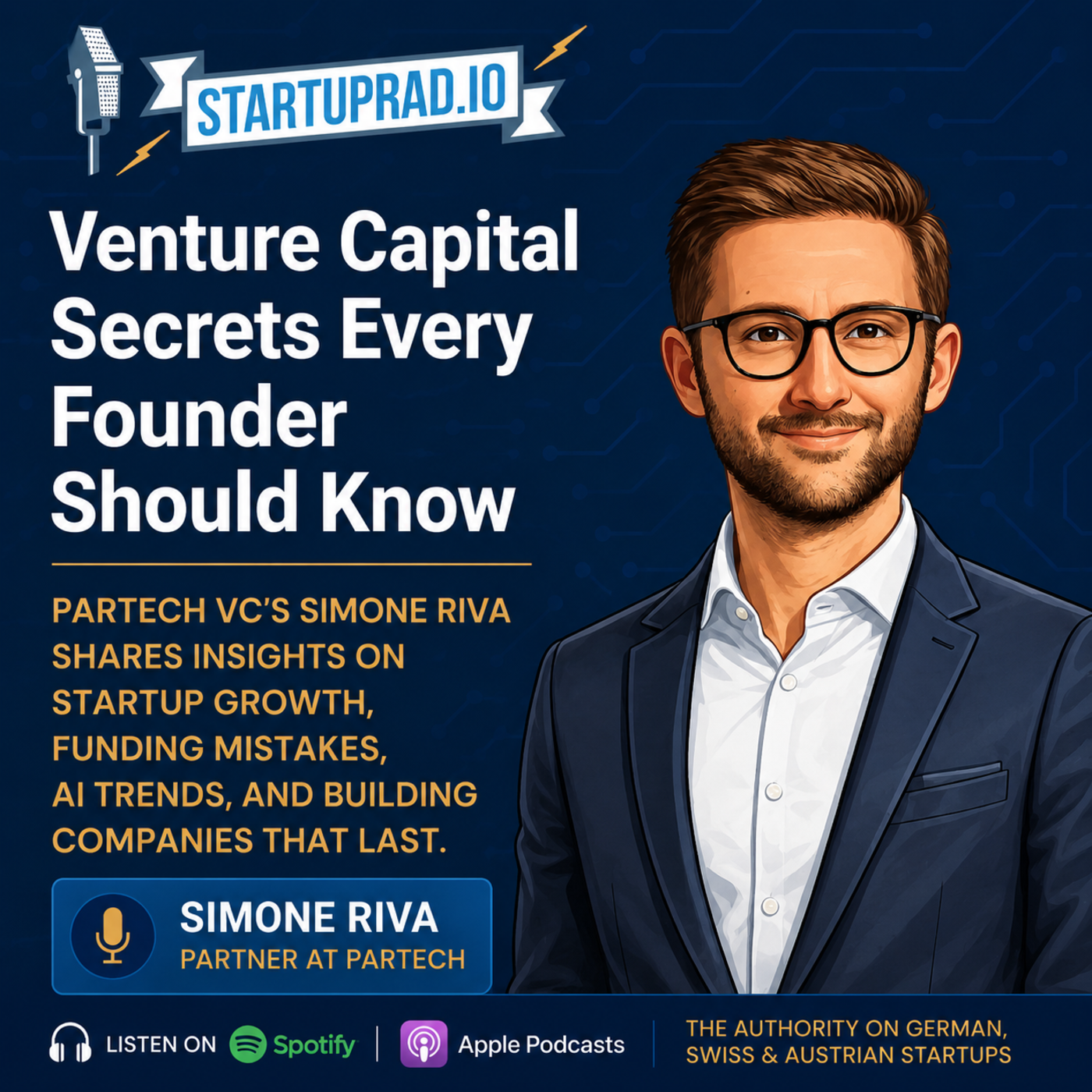 Capital Efficiency & AI Defensibility - Partech's Simone Riva68 / 100When Capital-Intensive Startups Should Raise VC - S. Riva74 / 100
.png) May 2026: Helsing $18B, Prior Labs AI Lab & Isar's Orbit Shot59 / 100April 2026: VC Rotates to Defence, Space & Industrial AI80 / 100
May 2026: Helsing $18B, Prior Labs AI Lab & Isar's Orbit Shot59 / 100April 2026: VC Rotates to Defence, Space & Industrial AI80 / 100