Boss Your Bridal Brand Podcast · 2024-07-29 · 36 min
Key moments - from our scoring
Substance score
26 / 100
Five dimensions, 20 points each
Cabare, founder of Designer Events Incorporated, explains how saying no has become a cornerstone of her boutique wedding planning business. Starting over a decade ago in India, she carved out a niche in intimate, personalized weddings when the market was dominated by large-scale events - a positioning that required constant discipline in client selection. Rather than pursuing volume, she and business partner Akshay maintain deep involvement in every project, from initial consultations to final execution, limiting themselves to a handful of meticulously crafted weddings annually. The core insight: turning down misaligned clients isn't a loss, it's a strategic gain that protects both brand integrity and team capacity. She emphasizes that the art of saying no extends beyond rejection - it includes offering referrals and alternatives to maintain relationships even when declining work. On social media and marketing, Cabare advocates radical transparency about what she does and doesn't do, using Instagram and other platforms to visually communicate her design philosophy and client expectations, ensuring only aligned couples reach out. This episode challenges the growth-at-all-costs mentality prevalent in the wedding industry, positioning selectivity as a competitive advantage.
Saying no prevents burnout, maintains brand clarity, and preserves capacity for high-resonance projects; clients you're not aligned with consume disproportionate time because you're not on the same page, whereas aligned clients trust your vision and move faster.
Provide an alternative or referral that fits their actual needs; this maintains the relationship, demonstrates your values through helpfulness, and positions you as professional rather than simply rejecting them.
Never portray setups, styles, or services you don't actually offer or believe in; instead, consistently showcase only the work that reflects your true philosophy and values, so your ideal clients self-select and others don't inquire.
A clear niche makes you known for a specific expertise, allows you to command premium pricing, attracts clients who value your specialty, and reduces time spent on misaligned projects - all of which improve profitability and sustainability.
Cabare and her partner personally attend every meeting and wedding, handle their own social media, and maintain creative control over all projects - this deep involvement signals to clients that they're working directly with the founders and ensures quality consistency.
Our reviewer’s read on each dimension, with quotes from the episode.
The episode circles back to the same two or three points - say no, pick a niche, be authentic - with heavy mutual agreement and repetition rather than adding new layers of reasoning. There are occasional practical observations (e.g. providing an alternative when saying no), but most of the runtime is filled with affirmation loops and platitudes rather than dense, actionable ideas.
The number of no's that we say to families in a year who want to get weddings done for from us are way more than the amount of times we say yes.
Even if two months you don't get work is better than doing something which is not meant for you.
The episode relies almost entirely on recycled business wisdom - 'jack of all trades, master of none,' a Steve Jobs quote, Apple/Nike logo examples, and 'like attracts like.' No contrarian arguments, no first-principles reasoning, and no counterintuitive claims are made; every point is something circulating widely in small-business coaching content.
Just like Steve Jobs says, love what you do otherwise and you wouldn't have to work a day in your life.
When they say jack of all trades, master of none, it's just absolutely the same till the time you do not identify your core strength.
Kaveri is a genuine practitioner with over a decade of real operating experience in boutique luxury wedding planning across India and the Middle East, and she has actual skin in the game. However, she is a small-scale boutique operator (a handful of weddings per year) and only tangentially relevant to the target audience of bridal fashion designers and retailers, limiting her direct applicability.
Until Date Me, my business partner Akshay, are personally present at every wedding. We are personally a part of every meeting that goes through.
When we started back 10 years ago, to be very honest, the word wedding planner did not exist in India.
The episode is almost entirely abstract - no client conversion rates, revenue figures, pricing data, booking volumes, or named case studies are offered. The closest thing to a concrete claim is a vague '15 to 20 seconds' attention-span figure, and references to Instagram handles at the close.
The attention span in today's world is not more than 15 to 20 seconds.
We work with families primarily from U.S. UK, Australia, uh, Indians who want to plan their weddings back in India, now that I stay in Dubai.
The host agrees with virtually every statement, frequently finishes the guest's sentences, and asks leading open-ended questions ('What tips would you give?', 'Can you tell me about…'). There is no pushback, no probing follow-up on vague claims, and no productive disagreement across the entire episode.
B: Absolutely. Yes. And I think that it's just so much easier to go from having an inquiry to having a paid client.
B: Exactly. I love that. I love that. I feel like I need that written on it on a post it note.
Computed from the transcript - who did the talking, and the words that came up most.
In this episode of Boss Your Bridal Brand Podcast I will be talking with Kaveri Vij a Luxury Wedding Planner and Designer about the power of saying No and creating your own space within the industry! We explore some of the most asked questions by wedding suppliers; * Should you niche down? * What are Kaveri’s best tips on taking that leap and doing what you really want to do? * Why is it so important to say no? * How do you show the online world who you really are and your business values? * What really is a luxury brand? It’s a rather juicy episode with lots of food for thought, especially if you are venturing into the luxury world of weddings and trying to find your niche. Listen now to discover why saying NO will improve your business. Thanks to Kaveri for joining me in such a fun conversation. I loved it. Enjoy, Joanna x PS- You can
Transcribed and scored by The B2B Podcast Index.
Speaker A: Hello and welcome to the Boss yous Bridal Brand podcast. I'm Joanna Southwell, a mentor for wedding fashion designers and, um, retailers.
Speaker B: If you are ready to get your
Speaker A: business visible in front of your dream clients and step into your true creative genius, then this podcast is for you. Forget slogging away and getting nowhere. During our time together, I will give you the roadmap you need and show you how to boss your bridal brand.
Speaker B: Hello and, uh, welcome to the Boss your Bridal Brand podcast.
Speaker C: Hi. Thank you for having me.
Speaker B: You're very welcome. Today we have such a wonderful, wonderful conversation that I am really, really excited to have same. So I thought I would just introduce you to the listeners, the people who, obviously coming from your side of things, they know you. But from some of my people, they might be completely brand new and I'd love to do a little intro into you and all the wonderful things that you do.
Speaker C: All right, then let's hear about that.
Speaker A: Okay,
Speaker B: so Cabare is a hospitality graduate with varied influences that float through everything that you do and everything you create as, uh, a luxury boutique wedding planner and designer. So you've been planning weddings for over a decade, which is incredible. And you started off in India and now, of course, you're across lots of the international territories and you're doing personalized and intimate weddings as your speciality.
Speaker C: Yes, absolutely correct.
Speaker B: Good, good. So you envisioned starting a boutique wedding planning and design company in a world that was full of big fat Indian.
Speaker C: That's what India is all about. It's all and it always will be about. Right. But it's also about creating your own space.
Speaker B: But your way of doing weddings is very different. Yes. Than that, isn't it?
Speaker C: Yes, absolutely. That's why, that's why we started the entire concept of intimate weddings back when we started. Whereas everyone got to this concept post Covid because it was a market dictated situation.
Speaker B: So could you tell me a little bit about. Because the weddings that I, when I look on your Instagram and we have obviously people who don't, um, aren't part of our conversation. They're very, very beautiful and they're very. They come across as being very design led and creative and beautiful. But can you just tell everybody the kind of weddings that you actually planned?
Speaker C: Okay, perfect. Firstly, uh, thank you for your kind words and that was a beautiful introduction. I might not have introduced myself like that. That well, I mean, so thank you so much. Um, so basically what we do as a company is we believe in creating stories. Um, not just stories, but actual love stories. Which are only about the couple and the family. Our ultimate aim is anyone who comes to that wedding needs to know that this couple is getting married. And it's not something which is of Pinterest, which is of Instagram. Trends are irrelevant to me because for me, the trend is what you want as a bride and what you want as a groom. And of course, we fine tune it with the art. Kind of creativity and detailing are my best friend. Like, you know, I love details. If there is no detailing in a wedding, I feel that what's even the point of planning one? Yeah. So, uh, so couples and families who firstly appreciate and understand what I bring to the table are the kind of people that we choose to work with. Uh, we work with families primarily from U.S. uK, Australia, uh, Indians who want to plan their weddings back in India, now that I stay in Dubai. So anyone who wants to have weddings in midd. But again, the point is to have a day of celebration rather than just a commercial world where. Which is what Indian weddings have become nowadays. Okay, so that's what. That's what we do.
Speaker B: And so can you tell me about what it was like to set up your business and, um, the fact that it was different and how Designer Events Incorporated and your business partner and the way that you work, how is that different than other wedding planners in your space?
Speaker C: Okay, so when we started back 10 years ago, to be very honest, the word wedding planner did not exist in India. It was more like events management. That's how it happened. Uh, and I would read articles about these famous wedding planners from UK Australia, and I'm like, wow, you know, this word needs to be a part of our life. So that's how we, uh, I mean, how we started is a completely different story. But when we started, we understood that eventually this market will get very chaotic, because in India, the barrier to entry to this industry is very, very low. Like, anyone can wake up one day and want to be a wedding planner, and no one will question your credentials. So that is why, when we envisioned this, we had to have a core usp, because of which we are starting the company. And that was to do intimate weddings where every person who's attending the wedding can be made feel special and not just the family who have hired us. So that was our ultimate vision. Until Date Me, my business partner Akshay, are, uh, personally present at every wedding. We are personally a part of every meeting that goes through. Because for us, it's not about the volume. It's about that one wedding we'll do in a Year. But it has to be perfect because every person is equally important in that wedding for us. So that's how it was. And how are we different is I feel the involvement that we have with our work. We are crazy. Like we don't even let other people handle our Instagram. Uh, we want to plan everything ourselves. I mean, of course we are like loaded with work because of this. But I think the very fact that because we take pride in our work and we are so personally involved in every detail, not only with a wedding, but even with the functioning of our company, I think that's what makes us different. And of course Kaali and Akshay make a difference because he brings the expertise to the table.
Speaker B: Of course. Yes. But I think that, uh, it is very different. And the fact that you have created this niche for yourself.
Speaker C: Yes, yes.
Speaker B: I think some people, and I know some of my listeners do worry about niching their business and really concentrating down on a particular style or a particular service. Because then you do have to.
Speaker C: You limit yourself sometimes.
Speaker B: Exactly.
Speaker C: That's the impression. But I truly feel that if you build your niche, you are known for your specialty. That is what your brand is known for. You know, when they say jack of all trades, master of none, it's just absolutely the same till the time you do not identify your core strength. It could be anyone.
Speaker B: You.
Speaker C: Can we ask a wedding person who designs stationery to plan a wedding? We probably can't. It's the same way. If you have your niche now, for example, tomorrow you tell me to plan a super big fat Indian wedding. Maybe I'll do it, but I won't be able to do justice to it because it's not my everyday. So hence I would suggest to the listeners and to everyone, always have your niche. Because it's not about today or tomorrow. It's about a brand that you create which will leave a legacy eventually.
Speaker B: I think that's a really important thing to talk about. Because if you are just doing whatever business you get, whatever somebody is willing to pay you for.
Speaker C: Exactly.
Speaker B: And not actually doing what you feel is your best work or you're more passionate about, you won't be able to
Speaker C: do justice to it. Right. You know, weddings are a day of love. It is something which will happen in people's life only once. And you know, this is my favorite thing to say to the world. You do not have the privilege of making mistakes over here. You do have to be the superman. You have to be the person who will avoid any mistakes just to make it come true. That can only happen if you put your entire heart and soul in making that dream come true for someone. And hence, you know, having that specialty always helps, because then you will do everything, and you will also know the technicals behind that particular niche, rather than being, you know, trying to excel at everything, everything around you completely.
Speaker B: And so, for the people who are listening, um, to this podcast, who might be bridal designers, yes, they might be making something. I always say to them, it's. It is, of course, a case of what you enjoy doing, but it is, like, you say what you're actually really good at doing.
Speaker C: Exactly. It needs to be a combination and a perfect balance of the two. It sometimes, you know, it cannot just be something you love doing, but when you actually do it in practicality, you might not be the best at it, but if you love something, you will make all efforts in this life to become the best at it. Because it's not work for you then, right? It's not something someone has put on your platter, but it's something that you would choose. Something over the world.
Speaker B: Absolutely. So what tips would you give to somebody who might be starting up, or maybe they're just doing a whole bunch of work that they think, I don't actually like any of this. This is all just boring, beige things that I'm just not interested. And I really want to have the courage to take that leap and do the thing that they really want to do. What tips would you give them, um, for having. Having taken the plunge and actually doing that?
Speaker C: Okay, so I would like to say, firstly, if you don't like what you're doing, stop. Stop today. Stop right now. You will. You might survive two years, you might survive five years, but after that, you will burn out because it is something you're doing out of habit and not out of love. That is. That is one. I know sometimes we are bogged down with responsibilities and other things where we have to, like, probably earn money. I still feel that if you do something that you love, you'll be able to do more justice. You'll be able to do a lot more, because you will put in a lot more. So first advice will be, stop right now. Second will be have the courage to take that step, because it's always about that first step step. The moment you take that first step, you will never look back. And, you know, it's. It's that. That you do it for yourself. You do not do it for the people around you, but you do it because you want to achieve something. It is something that you love doing eventually. So that's all I'll say. Please follow your heart. Stop doing if you're not happy what you're doing right now and take that leap of faith in yourself. Because if you don't put your faith in yourself, no one else will ever. In your life.
Speaker B: Absolutely. But I think it also makes really good business sense to do this. Absolutely. I mean, you have to have your heart in it. I completely agree with you, everything that you said. But also I want to kind of really compound, um, that with the. It's good for the. It's good for your business. It's. The money will be better. Yes. By doing that.
Speaker C: Because you're enjoying what you're doing. Just like Steve Jobs says, love what you do otherwise and you wouldn't have to work a day in your life. And, you know, same way. I also feel that, you know, how we were just talking about the expertise that you have or a specialty that you should do. Sometimes you as a human cannot be good at everything as well in your niche. But however, you always have the option of hiring your weaknesses. That's the power a business gives you. And when you have that power, I think there is no stopping anyone to do something that their heart truly loves.
Speaker B: Yeah. Yes, I completely agree. And I think that for me, it's an incredibly difficult thing to market a business or a brand that doesn't really stand for anything.
Speaker C: Exactly.
Speaker B: Because how do you know that's true? How do you know when you're looking through the world of weddings and. Which is a huge world, isn't it? There are so many different providers, designers, there's all these different press and platforms and all this. There's just so much, so much, so much around it. But if you're creating, if you're putting out something that is. Doesn't really stand for anything, and it kind of does a little bit of this and a bit of that. It's incredibly difficult for your ideal client, your dream bride, to actually know your values. Exactly. And how can they trust that you can provide them with what they can do if they can't see that in your work?
Speaker C: Exactly. And they will never be able to see through you if you do not love what you're doing. So I'm going to give you an example. I know you and I know that how conscious you are when you make your purchases. Right. Like you just mentioned that you are, you are very thoughtful of where your money is getting spent. Because you need to know what's the consciousness of that brand, the people who Work over there. Are they taken care of? You know, so many things. So you see through the brand, same way there are other people see through you if you're not passionate enough, uh, and if you're doing this only for a commercial basis, only of money, and especially in this world of weddings, because it is so, so people sensitive at the end. We are only dealing with humans out here. There is nothing. How much ever technology gets integrated into this industry, we will never be able to replace the fact that it is based on humans. So that ways if you do not have that love for what you do, that specialty, that expertise, that niche, people will not identify you for what you are and the values you bring to the table. So that's what, that's the end goal.
Speaker B: Absolutely, absolutely. And I think that we can lose sight on that sometimes because we look at the numbers on Instagram, we look at.
Speaker C: And our competitors probably. Yes, yes, and, and get so swayed away. Oh my God, they're doing hundred weddings. Do you even know the quality of weddings that they're doing? Do you know the price points they're charging? So you know, back when I was a kid and uh, I would study for my exams and I would be like, mom, they've completed their syllabus and my mom taught me one thing. Never compare yourself to anyone else because they cannot be you. And I remember that forever. So whoever is listening to this podcast needs to remember that no one can be you. And that is your superpower.
Speaker B: It 100% is. And I think that we have this phrase that for me is so important, which is that you, what you put out there is what other people are attracted to you. So like attracts like.
Speaker C: Absolutely. I, ah, truly believe in that.
Speaker B: So if you're putting out something that is not true to you. Yes. You're never going to be able to find those dream clients.
Speaker C: Yeah, you will find clients, but you'll always find that, oh, they always find faults. There's always something going wrong because you are not putting yourself, yourself in the right manner as well. You are probably not being honest with your own self that, okay, this is my core and this is what I want to do. So like you said, you're not putting yourself out there in the universe enough in the two way.
Speaker B: Absolutely. Yes. And I think some of that is about, you know, how we talk to people, uh, and how we present ourselves.
Speaker C: Yes.
Speaker B: And some of that presentation obviously is in person when you meet with clients, when people recommend you. But it's also in our social media, on our website.
Speaker C: How are we, How Are we portrayed exactly? Yes.
Speaker B: And so do you have any kind of things that you do in your business that are across maybe everything you do, your values, maybe the way that you present yourself, you and your business partner that you think works quite nicely to connect with your ideal clients? Yes.
Speaker C: Uh, so one thing that we definitely do is we, uh, believe in our intuition a lot.
Speaker B: Yes.
Speaker C: We believe in the power of connection a lot. Like, uh, I think the number of no's that we say, uh, to families in a year who want to get weddings done for from us are way more than the amount of times we say yes. And that's only because I feel that saying no is a power yes. It's a choice that you make for yourself. It doesn't come easy. It comes with its own risks. But the very fact, because we followed this advice for the both of us since day one, which was given by each other to each other, it has made us what we are today. That we are known for a specific brand, for a specific niche. And when people come to us with a separate requirement, we politely say no, that we are very sorry we don't do this, or we are not available to do what you expect us to do. So the very fact, uh, that I would say that one thing that we are very transparent about is till the time we can't fall in love with you, I don't think we can do your wedding. We have to spend eight months with you. There needs to be a synergy from both sides, and it's vice versa. Uh, you need to love us equally as well. If you need to call me at 3:00 in the night, that Kaveeri, um, I'm panicking being a bride. And if you hesitate in making that phone call, I'm sorry, I failed at my job. So that that connection is very important. And how you make that connection is by choosing the right kind of families, which only comes with the power you have to say no to choose the right kind of. I wouldn't say business, but the right kind of weddings that fit your platter that you want to do.
Speaker B: Definitely yes. And I think you know that the reason you can say no means that you can. It opens up the world to all the yeses.
Speaker C: Exactly. Exactly. Sometimes, you know, in life you need to know what you don't want ra other than what you want. Because if you know that, then your entire filter of what you want becomes so small that you're easily able to make your choices.
Speaker B: And I think it is actually of a really big positive influence to Your business, if we're going back down to literally how much money it makes, I think it does really, really help to say no and say this isn't for me. Because as you say, when sometimes you just get that vibe that this is going to be a difficult client.
Speaker C: Yes.
Speaker B: Because you can't do what they need.
Speaker C: Exactly.
Speaker B: And like you say, you don't have that synergy.
Speaker C: Yes. So you say no.
Speaker B: You say no. And those people are the most time consuming people. Because you're not on the same page.
Speaker C: Absolutely. But at the same time, you know, uh, when, when we as humans or we as, uh, people running this business have the power to say no, I also feel that there is an art of saying no.
Speaker B: Oh.
Speaker C: Um, yes. Which is very, very important. Now if you practice that, let's say, like, you know, I have met a family and I'm like, oh, sorry, I don't want to do this. That, that is not right. But maybe if I, if I probably provide them with an alternative or something which, which would fit their, their needs. Works perfectly. I am in a win win situation. I don't get to do that wedding. I still maintain my relationship with that family because I've already provided, provided a solution to what. Yes to what they wanted. So it is also about how you save your nose or how you choose your yeses. It's also that process. And I think that comes with experience. But the very fact, the underlining thing still remains, that you need to have the power to say no and not give in to the entire, uh, thing of being pressurized by, by something that we have to choose just because we have to. To choose it. No, I don't think so. Even if two months you don't get work is better than doing something which is not meant for you.
Speaker B: Definitely. But I feel like if you filled up your calendar with things that you would prefer not to be doing. Yes. That means you can't do all the things.
Speaker A: Exactly.
Speaker B: Exactly.
Speaker C: Because you're filled up, you've already done your days. Then how would you take something which your heart really wants to do? So sometimes this power of no needs to be used to the best of your benefit as well.
Speaker B: I completely agree. And I think that it's very, very difficult if you've never done that before to make the first, uh.
Speaker C: No. Yes.
Speaker B: Especially if your business might be quite new or maybe it isn't as busy.
Speaker C: You're scared as a business owner, maybe not as a wedding planner and a designer, but as a business owner. You're always afraid.
Speaker B: Of course.
Speaker C: What if I don't meet my expenses. What if I'm unable to play, pay my team? You know, there are so many things that can go. But I would still say that it's all about that first step. It's all about that first time when we have to do the difficult thing. Because again, everything in life is not easy. Right? Saying no is absolutely not easy. But the day everyone starts doing that for their own self, this world is going to be a better place for them.
Speaker B: Definitely. And I think. But it is a real, um, mindset that we have to say to ourselves in our businesses that we are going to take, we're going to have that courage. We're going to do it because not only is it better for us as people and our creativity and our soul, it's also going to be beneficial for
Speaker C: your business, like you said, because it frees up days where you can say yes. It helps you establish your brand. It helps you establish your niche by doing the kind of work you truly want to do or what your brand deserves of what you want to create or out of it. Not tomorrow again. 5 years, 10 years, 50 years. That years down the line. What do you want your brand to be known as? That is the kind of work you want to accept today because all of your todays make all of your tomorrows.
Speaker B: Exactly. I love that. I love that. I feel like I need that written on it on a post it note. So we've talked about how you say no and the, uh, the practical side of things and still looking after people and helping people in a way that shows your values as a business. But how would you suggest people do that on the online world? So when they're on Instagram and they're um, on Pinterest, when they're on podcasts, when they're talking at wedding fairs, maybe. Yes. How do you, what, what sort of things do you do to sort of show people your business values so that they can get to know you a little bit and that you can get them to tell them a little bit more and make sure that you're a good fit.
Speaker C: Okay, perfect. So, um, I mean, very, very valid question, especially in today's world where social media, I think, rules our life. Uh, that is where it's a bigger business card than your actual business card and your website address. Yeah. So I feel that you need to be first, be very honest to your brand value. So I'll explain. Explain this through the situation, not situation, through the values of our, uh, company. Let's say that we do only intimate weddings There'll never be a time that you will see a setup, uh, which is larger than life, because. Because I don't do that. So how do I show it? Secondly, I believe in details a lot. So there'll be a lot of pictures which promote that, which show that this is the kind of things that we work. Let's say that, you know, we, uh, we have personalized a tablescape with, with couples pictures. It'll be shown so that picture will do its talking for its own self. The next part would be there'll never be a portrayal of something that we do not do. So that is where, you know, you come into handy. And of course, on, um, podcast anywhere, at a networking event, at other places, you are your biggest cheerleader. You are the one who creates your own brand. So shout out loud, guys, like, tell the world what you are. Even if the world says, oh, my God, this girl is repeating what she says, that's fine. As long as they remember what I do and they need to remember me at the right time, my battle is done. But that will only happen if I voice it out loud. So your Instagram needs to be a very honest representation of what your brand offers, and you need to be the voice to that brand.
Speaker B: I love that. And I think that's completely. I completely agree because I always say, and it's like the thing that I think I feel like I say too much is that you can tell people what you do or you can show people what you do. And photography really helps show people.
Speaker C: Photographers need to be your best friend, Guys, as wedding planner and designers.
Speaker A: Yeah.
Speaker C: Yes, yes, they really do.
Speaker B: But I think that if you don't have those pictures in your portfolio, maybe you're new, maybe you want to make a shift and you're going to start saying no to these thing. Yes. I always think it's really, really important to then say, okay, well, maybe I don't have that yet, but I'll join a shoot or create something and have a photograph and create that content and put it out to the world.
Speaker C: Absolutely. I think people lack creation because what, uh, we get so busy in our daily life of operations as a planner and designers that we forget that sometimes we need to create, create what the world needs to see rather than, rather than everything just happening as an event. You can't always capture everything. But let's say I want to show that how a wedding card that we design for a couple needs to be portrayed in the right manner. That will have to get clicked. You will have to create that entire thing. And you know, that's why people need to hire you to teach them that.
Speaker B: Yes, but it is, it is a really great way. Yes. It is portrayed portraying your business you're about. Yes. By having those. And I think it's okay to take a little bit of, of a time to build that up and put that out into the world.
Speaker C: Never in a hurry. Once the brand is out, once your brand image is out, it takes very, it takes a very long time to change it in the minds of people. So even if you did want to take that one month extra, take that six months extra, take that time, but m. Do it right the first time. The attention span in today's world is not more than 15 to 20 seconds. Especially when you can just swipe your screen up apart from reels or whatever you want to move on to. In that if you lose the attention of someone, it's gone. That's a lost, that's a lost cause for you. So the very fact that you want the attention at the right product, at the right service that your brand offers, it needs to be portrayed the right way.
Speaker B: Absolutely. And I think that it's just so much easier to go from having an inquiry to having a paid client.
Speaker C: Yes.
Speaker B: You can show your portfolio if you can show what you've done. Yes. And your previous weddings, your previous dresses. And then it's very, very difficult to say to people, oh, I can create this. I can, I can do this for you. Without that proof and your, your photography, your website, your Instagram needs to talk,
Speaker C: that language needs to.
Speaker B: Exactly. So like you say, you need to. If you're about the details, you have the details. Yes. And if you're creating dresses that you don't like, please don't put them on Instagram.
Speaker C: Yeah. Please don't.
Speaker A: Please don't.
Speaker C: Exactly. Please don't. Till the time you cannot vouch for your own self, your own designs or your own m creation or go like, go sell it to the world because you're so proud of it. I don't think it deserves to be anywhere.
Speaker B: I don't. And I think it's better to not put something out than put on something out that is actually not going to benefit you. Get the right customers.
Speaker C: Absolutely. I think, Joanna, the pressure of posting on social media has become so much that people post blindly without even any thought process. I mean, I know we have endless social media management companies, we plan your feed for you, etc, etc, uh, but you know, what truly matters is even if there is one post in a month, I mean, I know That's a very bad thing for a business. But that post needs to do justice to what you want to communicate as a brand. I think we've got so messed up in this whole, uh, world where, you know, posting keeps on happening, reels keep on happening. But what about what we need to convey? Yeah, yes, that's got lost.
Speaker B: But I, you know, there's, there's things that I did five, six, eight years that still get me business now.
Speaker C: Yes, yes.
Speaker B: And it's because they connected with people. Correct. And actually, of course, styles change and fashions change. Of course they do. But if you put out something that is very authentic to you. Yes, yes, it really does, uh, talk about your values. And that can mean, I don't mean literally talking, but it shows what you
Speaker C: do and what you believe in and what you'll be able to create for
Speaker B: someone that is still going to connect with people. Not just today, next month, um, years to come, it will keep on coming back.
Speaker C: And that's what I meant. When you, when you want to build a brand that you'd never think about today, you think about the generations to come, that how they are going to think and perceive your brand, which can only happen through what you communicate to the world, whether it's through you, yourself, what you talk, how you. The words you use. Very, very important.
Speaker B: Yes.
Speaker C: Luxury, Intimate. You know, sometimes people think intimate weddings are, uh, like, very cheap.
Speaker B: Oh.
Speaker C: Oh, she'll be, she, she'll be affordable. I'm sorry, I'm not affordable. I'm a luxury wedding planner, and I come at a price because I put my entirety of my life in your wedding.
Speaker B: Yeah, of course.
Speaker C: Course I will come at a price. And that's the very fact that I decided to introduce the word luxury before my entire wedding planning. And like, wedding planner and designer. So those are things that you do to communicate what the world needs to expect out of you. Now, people know that, okay? She, she is what she is because she does a very handful of weddings. There are very selective weddings that she does in a year, but she gives her entire time to a wedding, and that's why she's a resource, and that's why it becomes expensive.
Speaker B: But that in itself is a luxury. And, you know, I don't think you can say, uh, you know, we are a luxury product, but we create 10 million of them.
Speaker C: You can't do that.
Speaker B: That's not luxury.
Speaker C: That's the whole thing. Like a volume and a luxury are not hand in hand.
Speaker B: Exactly.
Speaker C: Yeah. You create exquisite things when you are luxury.
Speaker B: Absolutely. And I think I always think about, like, an Hermes, uh, handbag. You can go to every store. They don't always have the handbag.
Speaker C: Exactly. And I think sometimes being unavailable is a boon.
Speaker B: I completely agree.
Speaker C: Because it creates a need.
Speaker B: Exactly.
Speaker C: Yes. Yes.
Speaker B: Um, and you are creating that atmosphere to your business. Yes. And you were saying. Yeah, I'm not going to be for everybody. I don't.
Speaker C: And I don't want to be for everyone. Yes, yes, but that is again, Joanna, that is again me or probably you. But people, I mean, all our listeners, maybe that's not what they desire to be. Maybe they want to be everyone's cup of tea. But still, even if they are everyone's cup of tea, they need to be that cup of tea in their own niche and not something that they offer as a service to, like, every service that. Okay, we'll do this. Wedding also, Etc, Wedding also. This. No, that's not. It is fine. You do volumes. No issues at all. Maybe that's what, you know, makes your business more fruitful, more successful. No issues. But the niche, the word niche cannot go away, unfortunately. I also think that people think niche means small, uh, scaling things, bringing it to limited.
Speaker B: Yes.
Speaker C: Bringing it inside or confined in a box. That's not it. It is actually establishing what you stand for and what, as a product or a service, you actually offer to everyone.
Speaker B: But don't you think that gives you freedom? Because you know the parameters of what you do and what you don't do.
Speaker C: It's so easy to say no. Yeah.
Speaker B: Yes. And then you say, well, you know, if you're looking at investing your money within your business, if it's whether to, say, take on a client or not. Yes. Whether it's when you're doing your website, rebranding, whatever it is.
Speaker A: Yes.
Speaker B: You're like, okay, well, here's my little parameters. This is my niche.
Speaker C: And I choose. I choose within them.
Speaker B: Yeah. Does it fit in with it or if it doesn't.
Speaker C: Simple. Uh. And, you know, so where people are struggling to make that entire choice of saying yeah or no, this is where it's so easy. You just define it in such an easy way that there is a parameter and that's what fits your platter. If it doesn't, then you don't do it.
Speaker B: Exactly. And I love the idea of having, like, a few words to describe your brand 110%.
Speaker C: And then it. It defines you.
Speaker B: It defines you. But even if you. I mean, you should share them with the world, but even if it's just for you Making decisions within your own business. I like that. So if I'm saying, okay, well, I'm luxury, you know, is this, is this part of this, Is this going to make my brand more established within that luxury market?
Speaker C: Correct.
Speaker B: Yes or no?
Speaker C: Yes, yes, absolutely. And also, let's say if I define myself, that, okay, I do understated luxury designs. So that means that my designs will stand out and will be a statement in themselves when you see them. It's not that when you enter a venue, you'll get lost because there's so much that is happening. So that one word has defined that you enter and you will know the value of everything that has been designed and placed over there. So all these things help a lot. They help a lot. And for yourself, to yourself as well, right? Absolutely, yes.
Speaker B: But I think the, uh, uh, you need. It's, it's, for example, things like when we're talking about branding and logos and stuff like that, you know, we have companies and brands around that don't even need their name. Like the Apple. We all know that. That's the tick. We all know what that is.
Speaker C: Yes, exactly.
Speaker B: We don't even need to have the name or the strap line.
Speaker C: Yeah.
Speaker B: We don't have to have it attached to a shoe to know what it is.
Speaker C: Exactly.
Speaker B: And, um, they didn't do that by just doing the tick and then doing something else with it.
Speaker C: It was through the communication that has happened with the world. Like, you know, it's simple.
Speaker B: You.
Speaker C: Till, like now, no one would even say, let's courier it. They'll say, let's FedEx it. You know, that's the power of a brand that you create. And I think that is what our listeners need to understand that from our beginning conversation to now, if you start saying no, if you start defining your niche, if you start building your brand, that is what eventually you'll have. People will only come to you for what you offer rather than. And that's what you want. You don't want your time to be wasted over calls where that is not something that you offer to the market. But that can only happen when you start with your own self.
Speaker B: I think that is perfect. And I think that is a really, really, really good place to finish.
Speaker C: Exactly.
Speaker B: I thank you so much for your honesty and thank you helping us, uh, and um, the listeners to really understand that, you know, in, in a business that is doing really, really wonderful things. So thank you for putting that into context for people.
Speaker C: You're most welcome. No, thank you for having me. And I think we should end the podcast on the note that, uh, saying no is a power and I think everyone should exercise it because that's why you build your brands.
Speaker B: Definitely. Thank you. So for people who want to follow you and connect with you, what's the best?
Speaker C: Instagram. Instagram, definitely. Uh, so Designer Events Inc. Is our, uh, India page. Designerevents Inc. Me is our are, uh, is the page that we target Middle east weddings. And of course, Kaveri Witch, which is K A V E R I V I J. You can find me on Instagram and I'm always happy to answer anything that anyone struggles with.
Speaker A: So very, very big thanks to Kaveri for joining me on that episode. I really, really enjoyed it and I think that what she had to say was really, really valuable. So I thank you, uh, her very much for that and for you for listening. So thank you very much. And if you enjoyed the episode, please do subscribe to the Boss your Bridal Brand podcast. See you next time.
 Bridal Wholesaling: What NOT to do
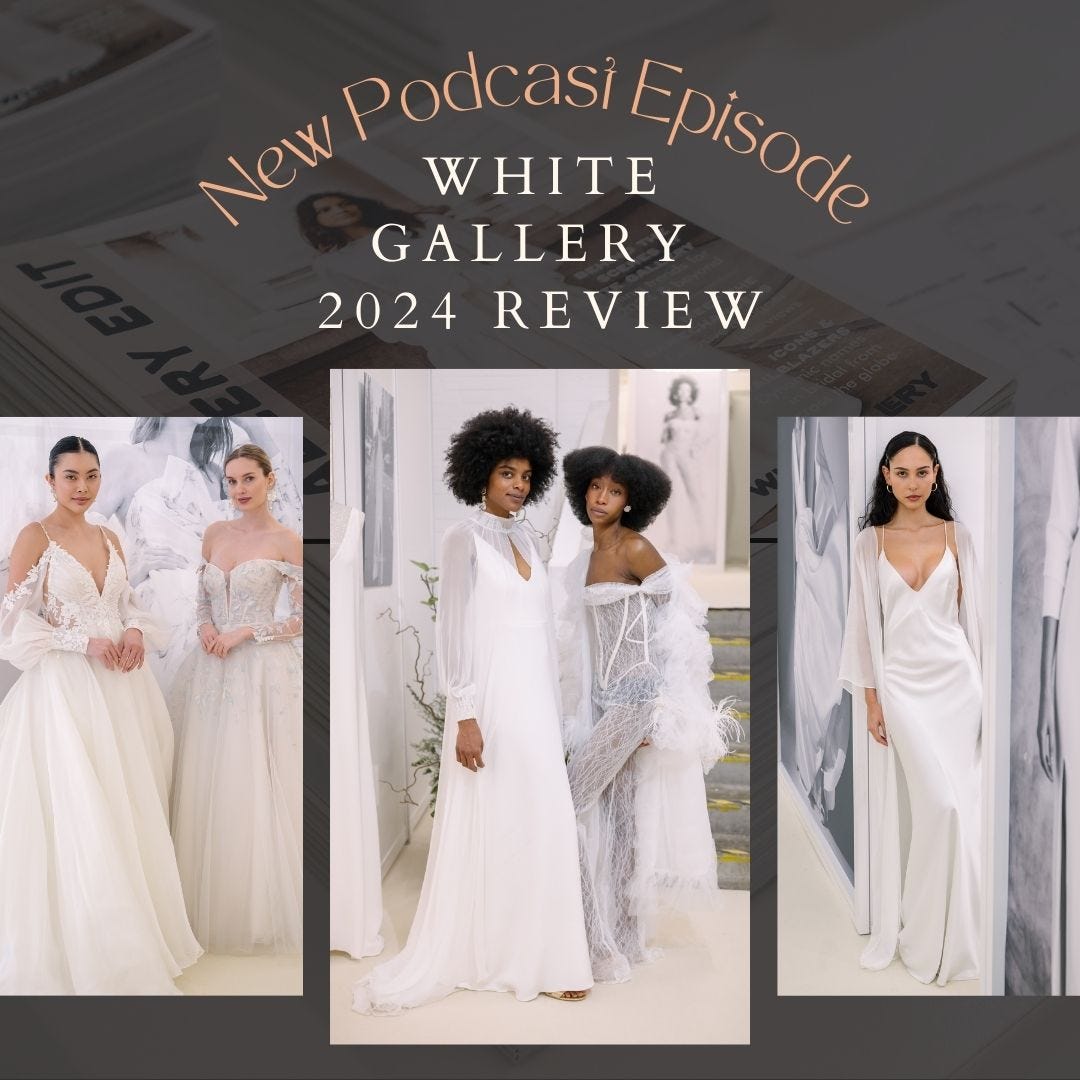 New Podcast: White Gallery 2024 Review
 The six benefits of photoshoots for your bridal business.
 Episode 5: What is a business niche?
 Episode 4: What actually is brand photography?