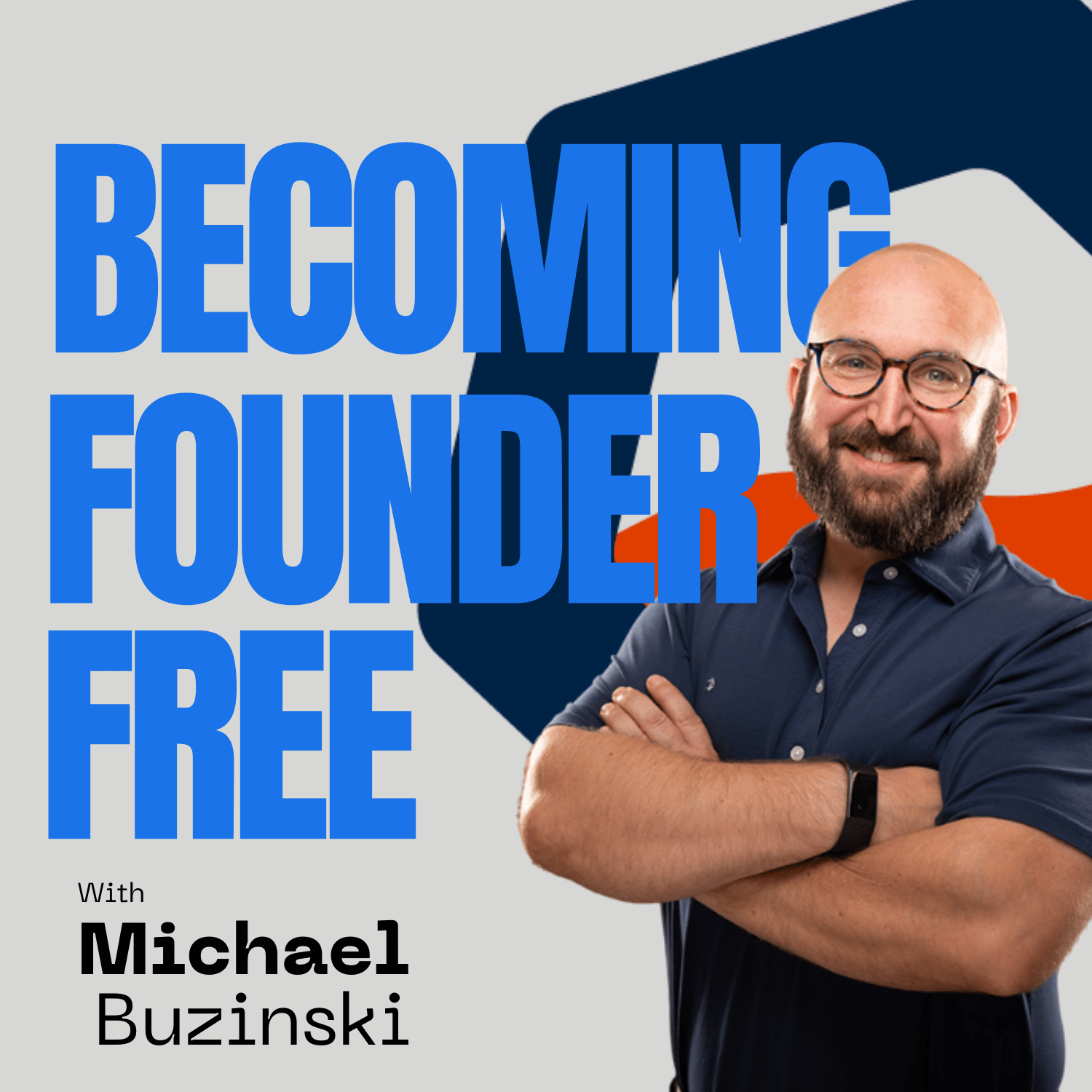
Hosted by Michael Buzinski
★5.0on Apple Podcasts · 7 recent reviews
Michael "Buzz" Buzinski, a 36 year award-winning marketing veteran, named a visionary marketer by the American Marketing Association, dives into one of the biggest challenges faced by Business-to-Business (B2B) companies: founder-led dependency.
124 episodes · publishes weekly · latest 2026-06-30 · ~16 min/episode
Rank
#3659
Substance
58.5
/ 100
Breakdown
Scored 2026-07
Updated monthly
Across the index
#3659 of 6181
Substance
Top 59%
outscores 41% of the index
Becoming Founder Free ranks #3659 on The B2B Podcast Index with a substance score of 58.5 out of 100, scored across 4 recent episodes. It scores highest on insight density and originality. The episode identifies a genuine post-close problem (momentum loss between sale and delivery) with specific mechanisms (context loss, emotional erosion, unmet implicit expectations) that most founders haven't systematized. However, the proposed solution is largely architectural/design rather than operationally novel - the core insight boils down to 'document and transfer what the founder knows.' There's limited fresh tactical depth on *how* to capture implicit expectations or measure emotional momentum beyond describing the problem.
Averaged across 4 recently scored episodes, with cited evidence.
The episode identifies a genuine post-close problem (momentum loss between sale and delivery) with specific mechanisms (context loss, emotional erosion, unmet implicit expectations) that most founders haven't systematized. However, the proposed solution is largely architectural/design rather than operationally novel - the core insight boils down to 'document and transfer what the founder knows.' There's limited fresh tactical depth on *how* to capture implicit expectations or measure emotional momentum beyond describing the problem.
“The handoff between sell and serve is where lifetime value either gets set or gets quietly undermined.”
“You can't systematize what was never captured. And if the context only ever lives in your head, the handoff is always going to be a data loss event.”
The framing of post-close momentum loss as a 'baton pass' and the distinction between 'founder-shaped handoffs' versus systematic handoffs is moderately fresh for a B2B services audience. However, the core idea - that knowledge transfer and client onboarding matter - is well-established. The three categories (relationship context, emotional momentum, implicit expectations) are logical but not counterintuitive or contrarian; they largely repackage conventional onboarding wisdom with slightly different language.
“But from a revenue engine standpoint, the close is actually a baton pass. And a baton pass only works if the person receiving the baton is ready, knows what they're holding, and doesn't slow down to read the label.”
“The handoff is where all three of those things need to transfer. The relationship context, the emotional momentum, the implicit expectations.”
This is a solo host episode with no guest. The host (Buzz) appears to be offering consulting/framework advice but provides no credentials, track record, or evidence of operating at scale. Without a guest operator or practitioner sharing tested experience, this dimension is not applicable.
“Welcome back to Becoming Founder-Free. I'm Buzz, and today we're talking about the part of your revenue engine that nobody's watching.”
The episode uses hypothetical scenarios ('if the post-close experience feels like hitting a wall') and generic patterns rather than named companies, metrics, or real data. There are no specific dollar figures, timelines with evidence, case studies, or measurable outcomes. The advice is grounded in observed patterns but lacks the concrete examples and data that would help a founder benchmark or quantify the problem.
“When a client loses momentum right after they sign on with you, the downstream effects are measurable with slower time-to-value, lower expansion rates, weaker referral behavior, and shorter retention.”
“This is where time-to-value really matters. Not as a metric on a spreadsheet, but as a felt experience.”
As a solo episode, there is no back-and-forth or host-guest dynamic to evaluate. The host uses rhetorical questions and direct address to the listener ('let me line out the five most common scenarios') which creates engagement, but without a guest to challenge or probe further, conversational craft is limited to monologue structure. The host does attempt to guide listener reflection ('Pull up whatever you know about that client') but there's no evidence of real intellectual sparring or willingness to be pushed.
“If any of this sounds familiar, you know exactly what I am talking about.”
“So here's a question for you: What does your client actually experience in the 72 hours after they sign?”
2026-05-26
2026-05-20
First period on the Index - history builds from here.
4 scored on substance · 60 tracked in total.
Outstanding podcast. Well formulated and conversational so the time flew by and we hit amazing high quality points. Buzz is a pro host and I'd come back again in a heartbeat!
- Sharpen the spear
Great energy and great guests. This is a podcast everyone should try out. You will be hooked.
- Rbroadhead
Add this badge to your site - it links back here and updates automatically as you rank.

<a href="https://index.fame.so/show/becoming-founder-free" target="_blank" rel="noopener">
  <img src="https://index.fame.so/badge/becoming-founder-free/badge.svg" alt="Ranked #68 on The B2B Podcast Index" width="360" height="136" />
</a>Track Becoming Founder Free's rank
Get an email whenever this show moves up or down the Index. Monthly at most, no spam.
The themes that come up most across this show's episodes.
Podcasts that dig into the same topics.

B2B Marketing with Fexingo
Fexingo

Revenue Insights Podcast
Fullcast & Silicon Slopes

Withum Sounding Board
Withum

Lean By Design
Oscar Gonzalez & Lawrence Wong

Money Skills For Therapists
Linzy Bonham

Scrum Master Toolbox Podcast: Agile storytelling from the trenches
Vasco Duarte, Agile Coach, Certified Scrum Master, Certified Product Owner