
Accounting Voices · 2026-07-27 · 12 min
Key moments - from our scoring
Substance score
20 / 100
Five dimensions, 20 points each
Field Guide, a vertical AI company focused exclusively on the CPA industry, is helping firms move beyond hiring challenges toward growth strategy through AI-powered productivity gains. Jin Chan, speaking from Silicon Valley where the company is based, argues that firms investing heavily in AI are fundamentally rethinking their engagement models and operating procedures - competing not just on service delivery but on talent attraction. He observes that leading firms treat AI as a first-class strategic initiative led by CEOs, not as departmental experiments or bolt-on features. The conversation surfaces a critical divide within firms: optimists who see AI's promise alongside necessary controls versus skeptics who emphasize risks. Chan positions this as a familiar historical pattern - those who architect the next operating model win the next era. Field Guide works with 54 of the top 100 U.S. CPA firms and has developed an AI maturity framework to guide firms at different stages of adoption. By 2027-2028, Chan predicts that leading firms will have fully integrated, end-to-end AI platforms embedded in engagement lifecycles, with some already reporting doubled revenue per headcount.
Field Guide is a vertical AI company built exclusively for CPA firms, focusing on audit and advisory practices. It works with 54 of the top 100 U.S. CPA firms and is expanding globally, positioning itself as a platform that helps the profession address talent shortages through AI innovation.
Leading firms are moving beyond hiring challenges to use AI as a growth lever, unlocking capacity to grow existing practices, expand into new service lines, and hit record margins. They're rethinking engagement teams to combine human expertise with AI agents, fundamentally reimagining their operating models.
Too many firms are struggling to keep up with rapid AI advances and treating AI as an experiment rather than a strategic initiative. There's also market confusion because many vendors claim AI capabilities without substance, and some firms buy technology indiscriminately just because it includes AI integration.
Firms are divided between optimists who see AI's promise alongside manageable risks, and skeptics who emphasize risks over progress. This mirrors historical industrial revolutions - those who figure out the next operating model become winners, while those resisting change may become less relevant.
Winners will have fully integrated, end-to-end AI platforms embedded in engagement lifecycles with reimagined engagement teams combining human experts and AI agents. Some leading firms are already doubling revenue per headcount, and that performance gap will widen among firms with strategic AI adoption versus those treating it as a bolt-on.
Our reviewer’s read on each dimension, with quotes from the episode.
The episode runs 12 minutes and is almost entirely filled with high-level platitudes about AI transformation with virtually no actionable or non-obvious claims. The handful of concrete-sounding statements are asserted without evidence or mechanism, and the 'insights' are things any podcast listener in this space heard two years ago.
The pace of AI is just at a blistering pace
AI productivity is becoming a growth lever. It's unlocking more capacity for firms to start to think about how to grow their firms
Every argument is a recycled AI-era truism: believers vs. skeptics, industrial revolution analogies, 'top talent wants to join AI companies.' There is no contrarian, first-principles, or counterintuitive claim in the entire episode.
Frankly, we as humans have seen these kinds of revolutions before. And one truism across every one of those industrial revolutions is the people who figure out the Next Era operating model... they are the winners of the Next era
top talent want to join AI Powered or AI Forward CPA firms
Jin Chan is the actual CEO of a real vertical-AI company serving accounting firms and has an auditor background, which gives some credibility, but this is a sponsored interview series and the guest functions almost entirely in a promotional capacity rather than sharing hard-won operational learnings.
we are pleased to be working with 54 of the top 100 CPA firms in the US
I was an auditor myself. I wasn't a partner. I was a junior senior manager auditor
The only concrete data point is the '54 of top 100 CPA firms' figure. The one performance claim - firms 'doubling or near doubling revenue per headcount' - is unattributed, hedged, and unexplained. No firm names, no timelines, no dollar figures, and the AI maturity framework is mentioned but never described.
we're seeing some firms reporting that they're doubling their or near doubling their revenue per headcount
Field Guide did release our AI maturity framework, and we wanted to offer that to the industry as a practical roadmap
This is an unchallenged PR conversation between a host and a paying sponsor. Every question is a soft setup, vague claims go entirely unprobed, and the host closes with explicit flattery. There is no follow-up, no pushback, and no productive tension anywhere in the transcript.
you're definitely helping firms chart the journey with AI
you're a remarkable individual. You're really changing the game
Computed from the transcript - who did the talking, and the words that came up most.
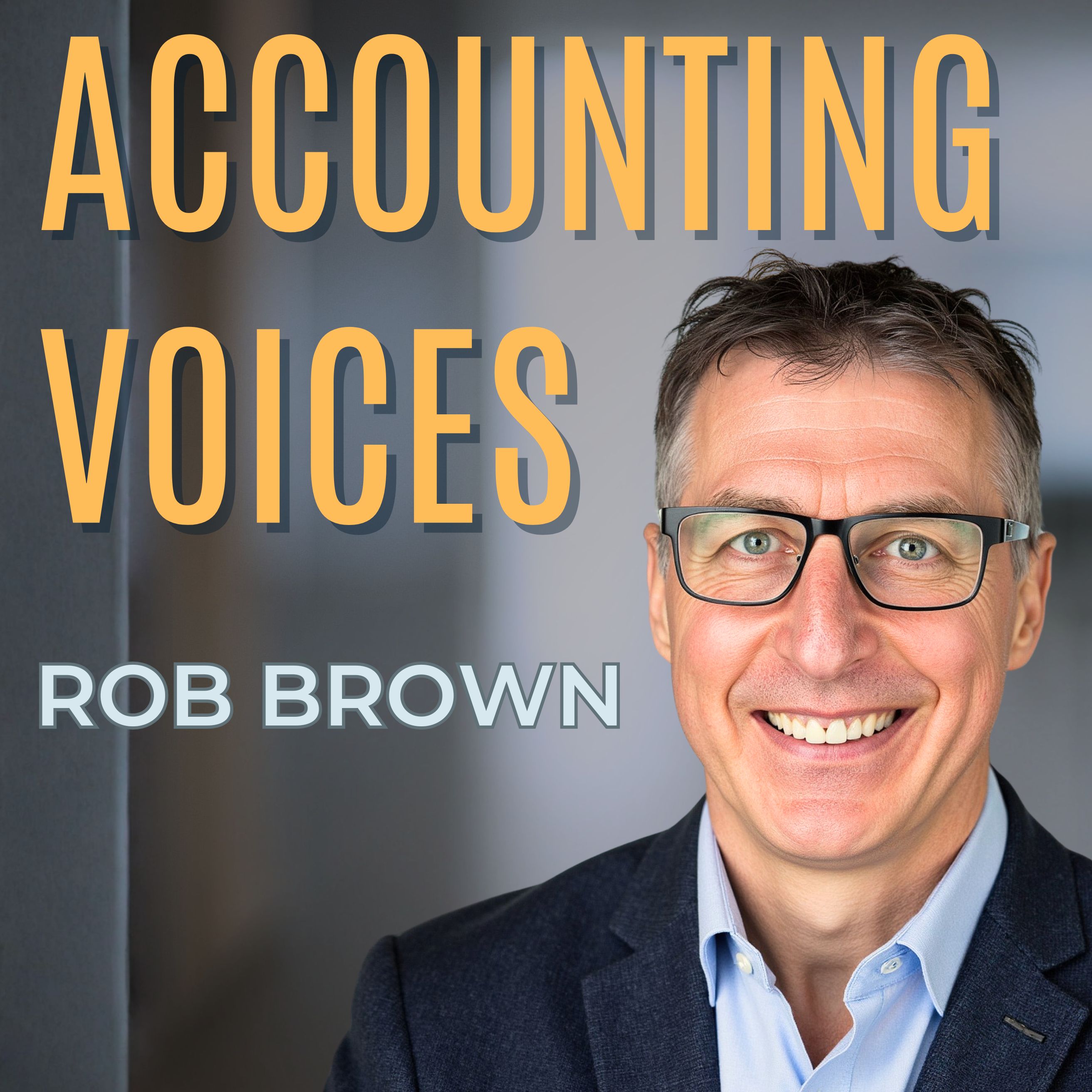
Accounting Voices is a senior leadership platform hosted by Rob Brown that interprets the forces reshaping accounting firms across North America and beyond. This "AI Reality Inside Firms" series brings together influential accounting leaders to answer the same five structured questions about how AI is actually landing inside firms. No hype. No vendor narratives. Just honest leadership perspective from someone navigating AI from the inside. Today's special guest is Jin Chang, CEO and Co-Founder at Fieldguide. The five questions: Where is AI genuinely reshaping strategic direction for firms? What are firms still getting wrong about AI? Which AI-related leadership decisions will matter most over the next two years? Where is AI creating the greatest internal tension in firms? By 2027, what will separate leading firms from the rest? Five questions. One honest conversation. Part of a season that is building a definitive picture of AI reality inside accounting firms in 2026. Watch this episode on YouTube: Thank you to our Season Partners for making this series possible.
Transcribed and scored by The B2B Podcast Index.
Speaker A: The pace of AI is just at a blistering pace. And I think with Field Guide, we are at the forefront of a lot of those developments. We have a great privilege and responsibility to bring these innovations to the CPA industry.
Speaker B: Where is AI reshaping strategic direction for
Speaker A: accounting firms with the pace of AI? It's an incredibly dynamic market right now. The firms who are investing heavily in AI, these are the firms are no longer talking about difficulties in hiring. Too many firms are still struggling to keep up with the rapid advances in AI as mentioned. So I don't believe blame these CPA firms at all. Again, I see it as our responsibility to help CPA firms. There's a group of people who are believers and optimists of AI. That doesn't mean we don't see the risks or the things that we need to control.
Speaker B: This is AI reality. Inside Firms, a series on accounting voices where a select group of senior firm leaders and tech CEOs answer the same five related AI questions based on what they're seeing, deciding and being held accountable for inside their firms and their clients. Jin Chan is our special guest today from Field Guide. Jin, welcome to the show.
Speaker A: Thanks Rob, for having me on Field
Speaker B: Guide Jin, we'll get a quick intro from you in a moment. But first I want to five technology companies, including yours, supporting us on this series and genuinely shaping how AI has been applied inside accounting firms. So Field Guide, obviously the AI native platform for audit and advisory firms. We'll hear more about that from Jin and the great things that they're doing. Instead of one of our partners, the first AI tax agent for end to end research, planning, filing and Defense Carbon are involved with us. The global leader in AI powered practice Practice management software digits the AI powered financial intelligence platform for accounting firms and finally filed the Intelligent Tax Workspace for prep and review automation. Great companies, great tech, great partners for accounting firms. Jing Chat, you've been on the show before. We love having you on. You're definitely helping firms chart the journey with AI. Tell us a bit about what you do and then we'll hit the five questions.
Speaker A: Absolutely. So Fuel Guide is uh, what Silicon Valley likes to call a vertical AI company. And that's uh, really enterprise AI company that's fully focused on the CPA Vertical. Vertical. And we're going to talk about horizontal versus vertical. There's value to each feel. Guide is a company that's fully dedicated to helping the CPA profession grow through the talent shortage. And we're pleased to be working with 54 of the top 100 CPA firms in the US and we're just now starting to expand globally as well.
Speaker B: And Jim, before we hit question one, what kind of shape do you feel the accounting profession is in right now? Because there's a lot going on, isn't there?
Speaker A: Absolutely. I mean, and I would argue that across every single sector, not just ours, the pace of AI is just at a blistering pace. And I think with Field Guide, because our team is based out of San Francisco Silicon Valley, we are at the forefront of a lot of those developments. And the good news is, uh, we have a great privilege and responsibility to bring these innovations to the CPA industry. And the other good news is many CPA firms that we work with are showing very encouraging signs of progress. I don't think our industry has seen this kind of leapfrog in productivity and quality gains. Uh, with the help of generative and now agentic AI. Yeah, we're just, uh, excited to be working hand in hand with many firms to do that.
Speaker B: Well, there's no doubt the Field Guide are helping firms get there faster because you mentor them, you guide them, you know this stuff inside out. Let's take question 1. Where is AI reshaping strategic direction for accounting firms?
Speaker A: What I'm noticing, and one of the reasons why I enjoy doing this with you, Rob, is because with the pace of AI, it's an incredibly dynamic market right now. And what I'm finding is that the firms who are investing heavily in AI, and of course bringing a healthy dose of professional skepticism along the way. But these are. The firms are no longer talking about difficulties in hiring, sharing. They're shifting the dialogue towards growth strategy. So one obvious reason for that is because AI productivity is becoming a growth lever. It's uh, unlocking more capacity for firms to start to think about how to grow their firms, whether it's growing their existing practices or expanding into new service lines, all while hitting record margins. These are results that we're, we're definitely seeing with the firms that are investing heavily in AI. It's really the firms who view agents as future engagement management team members. They're rethinking the operating model of the future. What's the formula to win the next decade or two? And it's in large part due to this human and AI collaboration, which is frankly the future that Fuel Guide wants to build towards too. Perhaps most importantly, in a talent constrained market like we are operating in, in the CPA industry, we're seeing that the AI powered CPA firms are better at attracting the industry's best talent. Put simply, top talent want to join AI Powered or AI Forward CPA firms. We see this in Silicon Valley too. The best talent, the engineers, marketers, salespeople, they all want to join AI companies right now to kind of rebuild their skillset for the next decade.
Speaker B: You're very vocal on helping firms chart that AI maturity. Uh, firms are at different stages. And the question 2 Jin asks, what are firms getting wrong about AI?
Speaker A: To be honest, while there's so much promise and great data points that we're seeing, too many firms are still struggling to keep up with the rapid advances in AI. As mentioned, even when we're in Silicon Valley, it's hard to keep up, frankly. So I don't blame DCPA firms at all. Again, I see it as our responsibility to help CPA firms firstly meet them where they are and then help guide these firms through the next transformation era. I think there's a lot of confusion in the market also because every vendor is basically saying the same thing now. Surprising to me how all of a sudden every vendor has AI agents, to be honest with you. But I am actually grateful for some of this too, because what the industry is talking about is forward advances, forward transformation. And whether every vendor supports that vision with their actual that's up for debate. But the good news is there's a shared vision for that future. As you kind of hinted. Field Guide did release our AI maturity framework, and we wanted to offer that to the industry as a practical roadmap to AI transformation to the wider industry, not just for using Fuel Guide. And what we're hearing is incredible feedback about that too, because like you hinted, some firms are just starting their AI journeys, some are already several years ahead. And we try to do our best to tailor our offerings, uh, to meet firms where they are.
Speaker B: Jim, you speak to a lot of firm leaders, CEOs, managing partners, which leadership decisions? This is question three. Which leadership decisions on AI are going to matter most over the next few years?
Speaker A: I encourage CPA firm leaders to treat AI as a first class strategic initiative. And at this point, almost every firm is experimenting with AI in some capacity. What I found is the firms who treat it like an experiment versus, for example, a CEO initiative, they're seeing greatly different results. So really, the best firms who are making the fastest progress, the consistent thread I see across all of them, frankly, is their CEOs are stepping up to lead their AI transformation journeys. They're of course empowering their C suite, their practice leadership, to create a safe but also controlled, secure space for AI use And some really exciting examples that I've picked up along the way is a CPA firm CEO who shared with me that she was vibe coding all weekend and she was creating operational efficiencies at her firm. That's so exciting for us, frankly, because it kind of whets a firm's appetite on what the potential of AI is. And Fuel Guide is a very complementary platform to that kind of general purpose, uh, operational efficiency too.
Speaker B: What you're saying is echoing through many of these interviews that I'm doing with senior firm leaders, they're making it strategic, they're having board level decisions about this and not bolt in AI as an add on to what the firm is doing or buying tech indiscriminately because it's got AI integration. So, uh, that speaks very well with growth. As you've mentioned a lot, Jin comes tension. Question four, ask where is AI? Creating the greatest internal tensions within firms? Because you're inside them as well. You know what's going on in there.
Speaker A: Yeah, and there are a lot of learnings that I'm seeing in Silicon Valley too. Not just Fuel Guide, our company, but also my friends who are operating other companies too. And what we're seeing consistent in Silicon Valley and with CPA firms is there's a group of people who are believers and optimists of AI. That doesn't mean we don't see the risks or the things that we need to control, but they see the promise, uh, the good in the, uh, potential there. And there's another group that likes to point out every risk sacrificing progress. And we're seeing that divide between those two groups of people. Frankly, we as humans have seen these kinds of revolutions before. And one truism across every one of those industrial revolutions is the people who figure out the Next Era operating model, the next gen way of doing things. They are the winners of the Next era. The people who are a bit more stubborn in their own older ways and not really trying to imagine what the future looks like with this revolutionary technology. They may not be as visible in the next era. So we're still in that early inning of humans figuring this out. That's somewhat the reason why we're so excited. Because while we're still early in the journey, we're seeing amazing progress. And there's still so much Runway ahead too.
Speaker B: We've got one more question coming up. A big thank you to instead carbon filed digits and our very own field guide. We got Jin Chan here, the CEO, uh, for their partnership in this series Each of these tech companies plays a, uh, very important role in how firms are bridging the gap between AI ambition and operational reality. So Jin, we are really grateful to you all, uh, being part of this important conversation. Question five asks us to look at the future now. In Silicon Valley, you have one foot in the future and one foot in now. By 2027, maybe 2028, what do you feel will separate the leading firms from the rest?
Speaker A: Yeah, so as I kind of hinted, the winning firms of the next decade will be the ones who figure out this next gen operating model. I think the growing best practice that I'm seeing is reimagining the engagement team of the future to amplify, empower their best human experts in collaboration with AI agents. So the leading firms will have fully integrated AI platforms that are end to end, encompassing the entire engagement lifecycle. They won't be treating AI as an experiment or a quick bolt on or just an Excel plugin. They're thinking about, you know, how to reimagine these engagements of the future, rethinking that operating model, that capacity model, and buying and partnering with the right platform AI platform providers. We're going to see those firms pulling ahead. We're already seeing some firms reporting that they're doubling their or near doubling their revenue per headcount, supporting more clients than ever, hiring the best talent, their firm's histories, and we're going to see that gap widen over the next several years.
Speaker B: Wow, crazy times. This is AI, uh, reality inside firms. Five questions. One influential leader. 12 minutes, no spin. You can find the full series on accounting voices across YouTube, LinkedIn. We're syndicated on CPA trend lines and all major podcast platforms. Jen, I've got one more question for you. Which is what excites you most about the future for accounting firms, particularly with Feel Guide in mind?
Speaker A: So when we started this company, Feel Guide started and continues to be a mission focused company. You and many folks know that Feel Guide is all about helping the CPA practitioner. I was an auditor myself. I wasn't a partner. I was a junior senior manager auditor. And we're building a platform. And I think historically our industry as well as many others have seen enterprise software sales being a top down kind of purchasing decision. Everything about Feel Guide is about building for the people. And when I see genuine smiles from uh, our, from our users, nothing makes me happier than that. I'm just excited to be continuing to invest in building for the people and seeing more of these smiles. And we're uh, here to partner closely with the industry.
Speaker B: Well, definitely the future is a little less foggy and muddy with you holding our hands, leading us into it. Jin Chang from Feel Guide. You're a remarkable individual. You're really changing the game. Thank you so much for joining us today and sharing your insights.
Speaker A: Thanks for having me, Rob. Um.
Other episodes covering the same guests and topics, from across The B2B Podcast Index.
 Why AI Pilots Fail: How to Escape AI Pilot Purgatory and Scale Enterprise AI with Ronnie Kwesi ColemanUsing AI at Work · on AI agents92 / 100
 More Agents Than Employees: How Zapier Disrupted Itself Before AI CouldTalking AI · on AI agents90 / 100
 PMs Are Fintech: How Column is Rethinking Property Management BankingThe Profitable Property Management Podcast · on AI agents89 / 100
 Inside an AI-powered personal dashboard | Matthew TiemannPossible · on AI agents83 / 100
 90% of AI prototypes never reach production (w/ Temporal's Samar Abbas) | AI BasicsThis Week in Startups · on AI agents81 / 100
 From Billable Hours to Business Outcomes: How AI Is Rewriting the Rules of IT ConsultingEvolving the Enterprise · on AI agents78 / 100
 The Accounting Reviewer Bottleneck Nobody Is Fixing54 / 100The Real Cost of Adopting AI in Accounting Firms Now65 / 100What AI Actually Changes for Accounting Firms Today62 / 100What This CIO Learned Building an AI Strategy for Firms52 / 100How One CPA Firm Is Leading Firm-Wide AI Adoption Now63 / 100